As thoroughly examined as the Civil War and the assassination of Abraham Lincoln by John Wilkes Booth have been, virtually no attention has been paid to the life of the Union cavalryman who killed Booth, an odd character named Boston Corbett. The killing of Booth made Corbett an instant celebrity whose peculiarities made him the object of fascination and derision. Corbett was an English immigrant, a hatter by trade, who was likely poisoned by the mercury then used in the manufacturing process. A devout Christian, he castrated himself so that his sexual urges would not distract him from serving God. He was one of the first volunteers to join the US Army in the first days of the Civil War, a path that would in time land him in the notorious Andersonville prison camp, and eventually in the squadron that cornered Booth in a Virginia barn. The Madman and the Assassin is the first full-length biography of Boston Corbett, a man who was something of a prototypical modern American, thrust into the spotlight during a national news event—an unwelcome transformation from anonymity to celebrity.
eBook - ePub
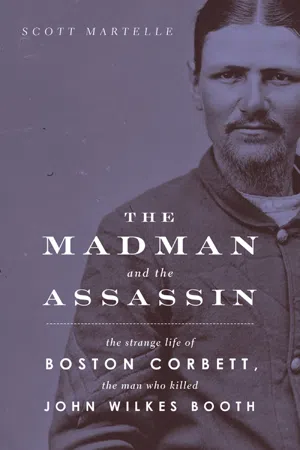
The Madman and the Assassin
The Strange Life of Boston Corbett, the Man Who Killed John Wilkes Booth
- 240 pages
- English
- ePUB (mobile friendly)
- Available on iOS & Android
eBook - ePub
The Madman and the Assassin
The Strange Life of Boston Corbett, the Man Who Killed John Wilkes Booth
About this book
Information
Topic
Histoire1

LOSS AND REDEMPTION
The 630-ton Zenobia, sailing from New York under the command of Captain Nathaniel Putnam, arrived in Liverpool in late July 1840 laden with passengers and cargo, including five hundred barrels of turpentine, more than seven hundred bales of cotton, some peach brandy, and other goods bound for British importers. By August 14, the empty ship was tied up at the Galt, Barff and Company dock to be loaded for the return trip. The records don’t reveal exactly what day the ship moved out of the harbor and into the Irish Sea to start the westward journey, but the Zenobia arrived back in New York around October 2, which suggests the ship left England by early September.1
Europeans had first inhabited New York some two hundred years earlier, so it was a mature shipping port the Zenobia reached on that early autumn day. Most of the transatlantic ships glided up the East River to dock, and the seascape presented an impressive sight with “the many sails, which were tending toward it, the expanding river and opening harbor, and at last the broad way, with its tall ships setting in from the sea,” one traveler wrote several years later. “And the Great Metropolis itself stretching into the distance, with its domes and spires, its towers, its cupolas and ‘steepled chimneys’ rising through a canopy of smoke in the gray dawn of a cloudless September morning.”2
In addition to its unspecified trading cargo and crew, the Zenobia carried 8 presumably well-to-do cabin passengers and 206 steerage passengers—men, women, and children in search of a different future from what they faced in the places whence they came. England and Ireland, mostly, but the passengers also included a few American-born travelers returning home. There were laborers and mechanics, butchers and farmers, whole families, broken families, and single adults destined for New York and points beyond: Pennsylvania and Connecticut and farther inland to Illinois. Some of the passengers would be taking seats on the burgeoning network of railroads connecting cities across the Northeast. A few were heading in a different direction, on to the Deep South—Charleston and New Orleans, primarily, where the economies were built on the backs of slaves but where the white immigrants hoped they might find paid work as mechanics, butchers, or laborers. A handful of the passengers planned to go even farther, using New York as a way stop en route to Canada or the West Indies.3
Some were looking to reunite families. Sarah Levi and her four children, ages five to thirteen, were joining her husband in New York. For some, the voyage would bring tragedy. James McFarland, a mechanic, and his wife, Betty, were traveling from Scotland to Pennsylvania with their two children. The youngest, Mary Jane, just one year old, died at sea on September 20. The next day, six-month-old British-born John Rowe, Ohiobound with his twenty-three-year-old mother, Anne, and his two-year-old sister, Elizabeth, also died.
Bartholomew Corbett was among the passengers who planned to go no farther than New York, where he hoped to earn his living as a taxidermist and naturalist. At age fifty-nine, Corbett was among the oldest of the Zenobia passengers, and it must have been a challenging trip for him and his children, thirteen-year-old Emma, ten-year-old John, and eight-year-old Thomas, the future “Boston” Corbett. Bartholomew’s wife and the children’s mother, Elizabeth, was not with them. Had she died? The records are unclear. The records also don’t reveal passengers’ motives, but her death could have been the catalyst that sent Bartholomew, his children, and their nine pieces of luggage off to the United States for a fresh start.
The Corbetts settled at 276 Mott Street, a few blocks north of the infamous Five Points slum. New York was already the nation’s largest city, covering the lower third of Manhattan Island. Since the 1825 opening of the Erie Canal, it was also becoming the nation’s dominant port and a doorway to the world. Of course, a door offers passage both ways, and the Corbetts were part of a flood of immigrants that would only increase over the next two decades, adding to the wealth and chaos of the city. That influx remade Manhattan, forcing construction of new homes northward on the island even as the poorest of the poor, both American-born and the freshly arrived, overflowed Five Points’ dilapidated buildings and mud streets. The congestion, poverty, and relentless vice fed cycles of disease and pestilence that swept far beyond the neighborhood’s ill-defined borders.4
Still, Manhattan was the place to be, despite its drawbacks. A financial panic in 1837 brought down several large banks on Wall Street, then as now the nexus of American financial power and influence, and the city’s economy had yet to fully recover. Even with the fiscal uncertainty, municipal leaders were beginning to lay the foundations for the modern city, establishing in 1842 a $12 million aqueduct from the Croton Reservoir at Forty-Second Street and Fifth Avenue. The lower tip of the island, the footprint of the original city, was quickly shifting from residential to commercial as the city expanded northward, driven by the rapidly growing population and the amassing of wealth.
For the next two decades, as the debate over slavery tore the nation North from South, New York would be an anomaly as a source of a surprising level of support for the secessionists—particularly among those who recognized that the city’s fortunes were built in part as the major exporting hub between slave-harvested cotton from the South and markets in England and the rest of Europe.5
Despite New York’s status as the nation’s most vibrant city, and the boom-and-bust cycles of the business and financing classes, poverty was endemic. Ships disgorged Europe’s poor by the hundreds. Manhattan’s population increased by 60 percent during the 1840s, fueled in part by the potato famine–driven exodus from Ireland. The slow recovery from the 1837 financial panic and the rapid addition of immigrant laborers meant high unemployment and low wages. Horace Greeley, the journalist and social chronicler, noted that two out of three New Yorkers took in less than one dollar a week in wages. He estimated there were fifty thousand city residents who were one week away from being out of money for food and rent. In the Fourteenth Ward (bordered north and south by Houston and Canal, and east and west by Broadway and Bowery), only 125 of the 3,700 residents in 1850 owned their homes. And the Fourteenth Ward was not the city’s poorest district.6
Bartholomew Corbett was among the renters. He also joined Manhattan’s internal northern migration; by 1849 he had moved his family to 395 Fourth Avenue. It’s unclear how Bartholomew made his living as a naturalist, an emerging occupation at a time when amateur science was on the cusp of an intellectual division. “Empiricism was being replaced by theory, amateurs by professionals,” according to historian Thomas Bender. “The ideology of professionalism in science was beginning to insist upon the purity and moral aura of scientific inquiry in an effort to separate science from the common life and commercial values” of New York City.7 The role of the naturalist was among those undergoing a metamorphosis. In England, the Royal Geographic Society had been founded in 1830, supporting a wide range of explorations around the globe. The next year, Charles Darwin embarked on his five-year world voyage aboard the HMS Beagle, gathering the samples and observations that would eventually form the core evidence for his theories on natural selection. In 1836, Louis Agassiz theorized that large swaths of the earth had once been covered in ice. In Washington, DC, a $500,000 bequest by British scientist James Smithson led, in 1846, to the Smithsonian Institution.
It’s unclear what if any formal background Bartholomew Corbett had in studying the natural world. His name shows up in none of the growing literature of the era, which suggests that his role was limited as the professionalism of the science progressed. Most likely, he prepared dead animals for displays—hunters’ game and other collectibles—while satiating his curiosity by reading deeply in the natural sciences. By his final years of life he had amassed a significant personal library that he kept in what, to an outside eye, were piles of junk—he was a nineteenth-century hoarder. It doesn’t seem as though Bartholomew found much success in his trade or satisfaction in America; sometime in the 1850s, when he was in his seventies, Bartholomew returned to England.8 By then, Thomas, the baby of the family, was out in the world on his own.
Few records remain of Thomas Corbett’s childhood and entry into adulthood. As a teenager, he gravitated to the hatmaker’s trade, a vibrant business centered around Nassau Street, just north of Wall Street. Corbett trained as a finisher of silk hats, a skilled trade undergoing seismic changes just as he was entering the workforce—changes that affected other industries as well.
The hat-making trade began with small craftsmen, often farmers filling in hours during the winter who would make only one or two hats a day as they slowly pressed animal hair into felt, then shaped it into a stiff block to create the frame for each hat. Some then sold the blocks to hat finishers; others finished off the hats themselves with a coating of beaver pelt or other material. For most craftsmen, markets were limited by proximity: places they could reach by horseback or, occasionally, stagecoach or boat. The hats, or hat frames for those supplying craft shops in town, were bulky, further limiting the amount of product the makers could carry to market.
Revolutions in production techniques and machines as well as transportation changed not only hat making but American industry at large. Canals, railroads, and turnpikes shortened the time it took to get products to markets and increased the amount of goods a manufacturer could ship. With better access to markets, small producers could sell more products, which led to expansion of the more successful businesses and the clustering of production in areas with the easiest access to labor, supplies, and cash markets (as opposed to more localized bartering economies).
For the hat-making trade, that meant the emergence of craft centers, which divided loosely along style lines. In 1835 silk hats became fashionable, and production centered in New York City and Philadelphia. Hatmakers specializing in the more traditional beaver and other fur hats, and in wool and felt hats, gravitated to different cities. “Soft” hat manufacturers clustered in Orange and Newark, New Jersey; for wool hats, Boston and Danbury, Connecticut, were the key centers. (Danbury, in fact, had been a hat-making city since the Revolutionary War era.) Richmond, Virginia, Troy in upstate New York, and Cleveland had smaller localized hat industries as well, but the geography of the industry was primarily in New England, New York City and nearby New Jersey, and Philadelphia. And thus that would be the geography of Corbett’s young adult life.9
The labor itself was fragmenting, too. In the early 1800s inventors and tinkerers concocted new machines that could make the basic hat block in minutes, compared with the hours it took by hand. So hatmakers began specializing. Some became machine operators; others focused on the distinguishing latter stages of production. Local unions, or guilds, controlled who was accepted as an apprentice and who was allowed to work in shops. They also struggled to set floor wages, with some success—it was one of the earliest American trades to unionize. Some of the factories were large, with scores of workers, but most of the shops were tight spaces with only a handful of crafters, all men except for the women who affixed ribbons, belts, and other decorative touches before the hats were shipped off. It was a hard-drinking workforce as well: guild initiations inevitably involved a night of drunkenness, an offshoot of the work conditions. It was generally believed that drinking on the job helped “increase … vigor and activity.” After the workday, the hatmakers simply moved the party to a nearby alehouse.10
It was into that close-knit, hard-drinking world of skilled tradesmen that Corbett entered as an apprentice silk hat finisher. And while it was a skilled trade, it was also a dangerous one, primarily because of the mercury-based compounds used to form the felt. The mercury stiffened fur while it was still on the hide, making it easier to remove and, with the application of liquids and heat, press into the basic felt forms around which the hats—including silk hats—were made. The rest of the processes involved more heat and water, which gave off a mercury-infused mist.
Hatmakers of the time who inhaled and ingested the mercury often became irritable, with slurred speech and unsteady balance. Those more heavily exposed were prone to fits of paranoia. The link between these symptoms and exposure to mercury would not be established for another three decades, but by the 1930s a phrase had arisen in England to describe such behavior: “mad as a hatter.”11
Exactly how much exposure the young Corbett had to mercury as a silk hat finisher is unknowable. Later in life he would exhibit some of the traits associated with mercury poisoning, including bouts of paranoia. But for now it was a chance for a young man to make his way in the world.

Sometime in the early 1850s, Thomas Corbett met a woman named Susan Rebecca (her last name does not appear in the records), who was thirteen years his senior. They married and moved into rooms on East Ninth Street just east of Tompkins Square Park. The particulars of their relationship are elusive, although census records, city directories, and later reports by friends offer some clues. It’s also unclear how much of a role religion played in their life together. Decades later, a friend wrote that Corbett had told him about “what a good Christian wife and what a pleasant home he had,” but there are no other references to Corbett being a particularly God-fearing man at the time.12
Corbett continued to work as a silk hat finisher, and the couple migrated from one hat-making city to another, including a stint beginning around October 1854 in Troy, New York. Corbett, who had been in the United States since he was eight years old, decided to make his transition from British citizen to American, and on June 9, 1855, Thomas H. Corbett took the oath in a Troy courthouse.13 At the time, he and Susan were living in the home of a couple named George and Sarah Robinson, along with the Robinsons’ two young children and Sarah’s mother. The Corbetts didn’t stay in Troy very long, though, eventually making their way south to Richmond, Virginia.
By some accounts, Corbett had a hard time finding and keeping work there, in large part because of his vociferous opposition to slavery in a time and place where divisions on that issue were stark and unforgiving. Richmond would have an even darker legacy for Corbett: his wife took ill, and as they were returning to New York City by ship, Susan died at sea on August 18, 1856. The body continued on to New York, where the death was recorded and Susan was buried.
Susan’s death devastated Corbett, and in the common telling of the story passed along initially by friends, Corbett began drinking heavily and constantly. At the depths of a binge he encountered some evangelical temperance Christians and, as one version of the story goes, was detained by them until he sobered up, undergoing a religious epiphany in the process.14
Corbett’s conversion was singular, but not his alone. It occurred as the nation was seized by the third in a series of religious paroxysms marked by surges of interest and new membership in evangelical ...
Table of contents
- Cover
- Title Page
- Copyright
- Dedication
- Contents
- Prologue
- 1 Loss and Redemption
- 2 Boston Corbett Goes to War
- 3 Andersonville: A Journey to Hell
- 4 The Assassin
- 5 A President is Murdered
- 6 The Hunt for Booth and Herold
- 7 Celebrity, and Infamy
- 8 Citizen Corbett, Preacher
- 9 Corbett Goes West
- 10 Corbett Cracks
- 11 The Return of Boston Corbett
- Acknowledgments
- Notes
- Sources
Trusted by 375,005 students
Access to over 1.5 million titles for a fair monthly price.
Study more efficiently using our study tools.
Frequently asked questions
Yes, you can cancel anytime from the Subscription tab in your account settings on the Perlego website. Your subscription will stay active until the end of your current billing period. Learn how to cancel your subscription
No, books cannot be downloaded as external files, such as PDFs, for use outside of Perlego. However, you can download books within the Perlego app for offline reading on mobile or tablet. Learn how to download books offline
Perlego offers two plans: Essential and Complete
- Essential is ideal for learners and professionals who enjoy exploring a wide range of subjects. Access the Essential Library with 800,000+ trusted titles and best-sellers across business, personal growth, and the humanities. Includes unlimited reading time and Standard Read Aloud voice.
- Complete: Perfect for advanced learners and researchers needing full, unrestricted access. Unlock 1.5M+ books across hundreds of subjects, including academic and specialized titles. The Complete Plan also includes advanced features like Premium Read Aloud and Research Assistant.
We are an online textbook subscription service, where you can get access to an entire online library for less than the price of a single book per month. With over 1.5 million books across 990+ topics, we’ve got you covered! Learn about our mission
Look out for the read-aloud symbol on your next book to see if you can listen to it. The read-aloud tool reads text aloud for you, highlighting the text as it is being read. You can pause it, speed it up and slow it down. Learn more about Read Aloud
Yes! You can use the Perlego app on both iOS and Android devices to read anytime, anywhere — even offline. Perfect for commutes or when you’re on the go.
Please note we cannot support devices running on iOS 13 and Android 7 or earlier. Learn more about using the app
Please note we cannot support devices running on iOS 13 and Android 7 or earlier. Learn more about using the app
Yes, you can access The Madman and the Assassin by Scott Martelle,Scott Martelle in PDF and/or ePUB format, as well as other popular books in Histoire & Histoire de la guerre de Sécession. We have over 1.5 million books available in our catalogue for you to explore.