eBook - ePub
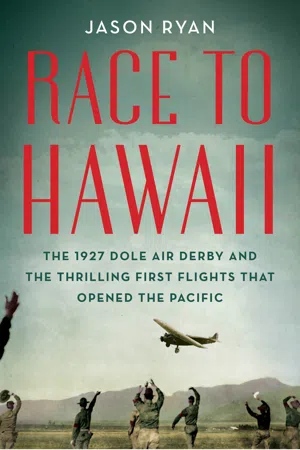
Race to Hawaii
The 1927 Dole Air Derby and the Thrilling First Flights That Opened the Pacific
- 320 pages
- English
- ePUB (mobile friendly)
- Available on iOS & Android
eBook - ePub
Race to Hawaii
The 1927 Dole Air Derby and the Thrilling First Flights That Opened the Pacific
About this book
A thrilling account,
Race to Hawaii chronicles the first flights to Hawaii in the 1920s, during the Golden Age of Aviation. These journeys were fraught with danger. To reach the tiny islands, fearless pilots flew unreliable and fragile aircraft outfitted with primitive air navigation equipment. The Dole Derby was an unprecedented 1927 air race in which eight planes set off at once across the Pacific, all eager to reach the islands first and claim a cash prize offered by "Pineapple King" James Dole. Military men, barnstormers, a schoolteacher, a Wall Street bond salesman, a Hollywood stunt flyer and veteran World War aces all encountered every type of hazard during their perilous flights. With so many pilots taking aim at the far-flung islands in so many different types of planes, everyone wondered who would reach Hawaii first, or at all.
Information
PART I
THE NAVY’S
PN-9 NO. 1
SAN FRANCISCO SEEMED A ghost town. The city’s office buildings were empty, its shops devoid of customers and clerks. Almost anyone attending to business the Monday morning of August 31, 1925, was doing so hurriedly, eager to join neighbors along the waterfront or on rooftops across the city. Few people were willing to miss the spectacle of a lifetime: the takeoff of two navy flying boats en route to the faraway paradise of Hawaii.
Thrilled by the prospect of air travel across the massive Pacific, residents waited eagerly for the aircraft to begin their daring journey. Straining their eyes across the bay, the crowd watched to see at any moment the seaplanes slowly lift from the water and turn west toward new horizons. Every vantage point had been claimed. Spectators and automobiles blackened the slopes of Telegraph Hill along the eastern, bay side of the San Francisco peninsula. At the western end of the city, atop Sutro Heights overlooking the Pacific Ocean and Golden Gate, it was much of the same. In between, through the Presidio, along every wharf and cove, atop a long seawall and throughout the Marina District, people crowded together to catch a glimpse of the flying boats.
Across the Golden Gate the crowds proved just as thick. The entire population of Marin County was said to have gathered on the hills above Lime Point, as well as quite a few people who drove in from nearby Sonoma Valley. Closest to the action was the audience on the bay itself, those lucky enough to squeeze onto assorted watercraft that stalked and circled the floating planes. The navy and coast guard patrolled the bay furiously to keep the curious a safe distance from the transpacific fliers, with Eagle boats, sub chasers, and cutters shooing away anyone who ventured too close.
The excitement felt across San Francisco and its outskirts penetrated the pair of aircraft bobbing in the bay. The flying boats were more or less airplanes devoid of landing gear and whose fuselages could float. When the first of these machines was towed into San Francisco Bay in preparation for takeoff, chief machinist’s mate Skiles Pope compared it to “leading a racehorse out on the track.” His fellow crewman aboard the flying boat, aviation machinist’s mate William M. Bowlin, was similarly moved by the hoopla concerning the historic journey and the potential consequences, both good and bad, of such a bold flight. That morning, after years of military service, the twenty-six-year-old finally mailed home to Indiana his government-provided life insurance policy.
Less impressed by the hubbub was Commander John Rodgers. On the eve of the biggest flight of his career, the forty-four-year-old career navy officer was conspicuously silent and determined. While other officers joked and smiled all morning, Rodgers was taciturn, especially with the many journalists hounding the two navy flying crews. Any talking, the old salt knew, should come later, after he and his fellow officers and sailors accomplished their mission and reached the Hawaiian capital, Honolulu, on the island of Oahu. Then he’d be more than happy to boast about becoming the first men to fly an airplane to Hawaii. Until then, there remained much work to do. The pride of the navy was at stake, and the world was watching.
The airplane had been invented just twenty-one years earlier, when brothers Wilbur and Orville Wright launched an aircraft of their own design and manufacture from the sand dunes of Kitty Hawk, North Carolina, on December 17, 1903. The brothers’ longest flight that day lasted just 59 seconds and traversed 852 feet, but it signaled a new dawn of aviation and inspired countless adventurers. In the next two decades bold pilots blazed air routes across the globe, flying clear across the English Channel, the continental United States, the Mediterranean Sea, and the Atlantic Ocean. By 1925, however, no one had tried to cross the Pacific. That would change this afternoon.
Rodgers spent the morning preparing his aircraft for takeoff, adjusting the flying boat based on observations made during a final test flight the day before. He took stock of the weather, leaning out from a hatch atop the plane and gazing toward downtown San Francisco, just a few miles away. The conditions were ideal for takeoff, with light wind, calm water, and, mercifully, no fog.
Navy ships cruising the Pacific radioed reports of good weather, too. These reports, however, did not particularly encourage Rodgers. Should the weather be too calm, he knew, his plane would not fully benefit from the typical trade winds that blew across the ocean. The navy was counting on a favorable tailwind to help carry their aircraft across the water. Weather experts assured the fliers they’d encounter the trade winds soon after leaving the California coast.
As morning stretched into early afternoon, the navy fliers ate an early dinner on board their aircraft—the last decent meal they’d receive before reaching Honolulu. They read a telegram from Washington, DC, learning secretary of the navy Curtis Wilbur wished them “every success.” The fliers then received a distinguished guest, Rear Admiral William A. Moffett, chief of the navy’s Bureau of Aeronautics. Arriving by motorboat, the rear admiral wished the men luck and handed Rodgers two commemorative letters for overseas delivery to Hawaii.
Nicknamed the “Air Admiral” for his strong support of military aviation, Moffett had just arrived to San Francisco via steamship from Hawaii. While on the islands, Moffett had inspected the navy’s air station at Pearl Harbor and taken a tour of Oahu by air. Before leaving, Moffett promised residents in Honolulu that regular airmail and air passenger service would soon be established between Hawaii and coastal California. This revolution in the skies, he said, would begin with the navy’s pioneering flights across the Pacific. “The proposed airplane flight from San Francisco to Honolulu this month is the most important event in naval aviation since the World War,” proclaimed Moffett. “The flight means much to Honolulu, as well as the mainland, in peacetime as well as in war. We know it can be done—and if the planes fail in this effort—another attempt will be made very soon.” Not only planes but also airships. Moffett informed the Honolulu crowd that the navy planned to have one of its dirigibles float over the Pacific to Honolulu within two months.
Part of Moffett’s confidence stemmed from the fact that a navy flying boat had been the first aircraft to cross the Atlantic Ocean six years earlier. During that mission, Lieutenant Commander Albert Read and a crew of five piloted the NC-4 across the ocean in hopscotch fashion. Leaving New York City on May 8, 1919, the flying boat took nineteen days to cross the Atlantic, making essential stops for repairs and fuel in Massachusetts, Nova Scotia, Newfoundland, and the Azores before finally reaching Lisbon, Portugal, then continuing on to England. Navy ships were stationed at intervals along the overseas route to provide rescue and repair services in the event of an emergency ocean landing or crash.
Despite the protracted nature of the trip, the flight was a milestone for aviation. But in a sign of how quickly this new industry was evolving, the navy’s accomplishment was eclipsed weeks later. On June 14, 1919, British aviators John Alcock and Arthur Whitten Brown crossed the Atlantic Ocean by traveling nonstop in a small Vickers Vimy biplane from Newfoundland to Ireland. Though their flight was not perfect—Alcock and Brown crash-landed in an Irish bog soon after crossing over terra firma—the men did fly from North America to Europe without any stops or detours. The world rejoiced at Alcock and Brown’s triumph, and King George V knighted the men, who both survived their crash landing.
Five years later, in 1924, it was the US Army’s turn to crow, as two of its pontoon-fitted biplanes made the first successful flights around the world. Starting in Seattle, four Douglas World Cruisers operated by the Army Air Service headed west to Alaska, then Asia, then the Middle East and Europe before crossing the Atlantic and traversing the United States. The trip took a total of 175 days and covered more than twenty-seven thousand miles across twenty-one countries. It also featured about fifty-seven stops for repairs, refueling, and rest. But no matter the many stops, or the fact that two of the army planes did not finish the mission, the flights were a major coup for the United States, who bested the rest of the world and earned the distinction of being the first country to have a plane circle the globe.
Now the US Navy was plotting to steal back the glory, eager to one-up the army and cross the Pacific, or, to be precise, half the Pacific. Unlike the aforementioned aviators, who skirted open water in favor of routes that hugged coasts and minimized the distance spent flying across channels, the navy did not plan for its flying boats to touch down again until reaching Oahu. In other words, while the army’s round-the-world flights were broken into dozens of legs, or hops, that averaged 483 miles, the navy was attempting to make a single nonstop leap over open ocean. And though the navy and newspapermen were fond of calling this flight the “Hawaiian Hop,” their alliterative phrasing understated the rigors of the air voyage.
The navy had been planning its West Coast–Hawaii Flight for at least three years, though it was still uncertain whether to have its flying boats depart from bays outside San Diego or San Francisco. While San Francisco was closer to Hawaii by two hundred miles, some navy experts argued that winds were generally more favorable if traveling from San Diego, which could result in a shorter flight despite the longer distance. To make the best decision, Commander Rodgers decided to scout both locations in the final weeks before his flight. First he surveyed San Diego, where he and other navy fliers had arrived in late summer to outfit their planes and train for the transpacific flight. Then Rodgers flew north to San Francisco, where he and his crew were given a warm reception and invitations to many parties. Local officials lobbied him incessantly, eager to secure San Francisco as the hop-off point. Rodgers didn’t mind the attention. “Upon our arrival, much to our surprise, we were met by the mayor of the city and the public-spirited citizens of San Francisco . . . a brigade of newspaper men and photographers,” he wrote. “This turnout showed me for the first time the amount of interest that was being taken in the flight by the people of the United States.”
Polite as Rodgers was listening to these boosters, their flattery did not sway the commander as he assessed the merits of each city and considered the needs of his aircraft. Flying boats required long stretches of water to take off, especially if loaded heavily with fuel and emergency equipment, as they certainly would be on this long-distance flight. It helps if this stretch of water is shallow, as this would “form a firmer roadbed so to speak” and more quickly enable lift, explained Rodgers. It also helps to take off while running with the tide but into the wind. Rodgers discovered that all these conditions could be met on San Pablo Bay, the northern part of San Francisco Bay. Dismissing fears of fog near the Golden Gate as overblown and “bugaboo,” Rodgers recommended to his navy superiors that the flights should leave from San Francisco. The navy concurred.
Three navy flying boats were originally slated to attempt the Hawaiian Hop, each of them twin-engine biplanes. One, PB-1, was made in Seattle by the ten-year-old aircraft manufacturer Boeing (P standing for Patrol, B for Boeing). The other two planes were nearly identical flying boats named PN-9 No. 1 and PN-9 No. 3, each produced at the Naval Aircraft Factory in Philadelphia (P for Patrol, N for Navy). Pilots and crews from the navy’s aircraft squadron scouting fleet were chosen to make the flight. This included Rodgers, who was named flight unit commander, in charge of all three airplanes from his position in the flagship, PN-9 No. 1.
The PN-9 was the navy’s most modern version of the flying boat, valued for its reliable performance. In May 1925, three months before the navy planned to take off for Hawaii, navy pilots set an endurance record for this type of flying boat by flying PN-9 No. 1 for more than twenty-eight hours above Philadelphia before landing as the aircraft’s fuel supply neared exhaustion. The flight was certainly a testament to the plane’s capabilities, though the distance traveled while circling Philadelphia for twenty-eight hours was just barely enough to reach Hawaii from California, so long as pilots encountered no headwind.
The PN-9 was big, heavy, and relatively slow, capable of cruising at an average speed of seventy miles per hour. Its metal fuselage stretched forty-nine feet from nose to tail and was melded to a wide, all-metal boat hull that made the craft buoyant. This was the first navy flying boat to replace a wooden hull with metal. Specifically, the PN-9 hull was made of duralumin, an aluminum-copper alloy that was stronger and lighter than wood. The use of such aluminum sheathing would soon become commonplace in aircraft manufacturing.
Atop the PN-9 were affixed two sets of seemingly oversized wings that measured close to seventy feet long and nine feet wide. Each was made of wooden ribs covered in fabric and painted with aircraft dope. Under each end of the bottom wing was a pontoon to help stabilize the flying boat in the water.
Weighing twenty thousand pounds fully loaded, the sturdy, supersized flying boat was deemed a “leviathan of air and sea” by one newsreel. To lift the seaplane into the air, the navy installed two 500-horsepower Packard engines between the upper and lower wings, each with a wooden propeller measuring thirteen feet in diameter. While much of the flying boat’s exterior was aluminum and gray in appearance, the tops of both PN-9s’ wings were painted yellow to help searchers find the aircraft in case of an ocean landing. The flagship of the West Coast–Hawaii Flight, PN-9 No. 1 also had a bright yellow bow. All in all, said Rodgers, the PN-9 was “the best flying boat ever gotten out.”
The three navy flying boats were originally expected in San Francisco on August 22, 1925, one week before the historic flight was to commence. None arrived as scheduled. The PN-9s remained in San Diego suffering mechanical issues, including radiators that vibrated excessively. Rodgers, his crew, and a slew of navy mechanics had been laboring furiously for weeks to prepare the planes. Administrative tasks and training needs so overwhelmed Rodgers and his crew that the commander persuaded his superior, Captain Stanford E. Moses, to come and help provide relief.
“The whole outfit was working like trojans both day and night,” wrote Rodgers. “Sheaves of radios were sent and received. Mail was sky high, filled with matters of importance and tons of letters from curio collectors desiring that they be carried to Hawaii in the seaplanes.”
After a short delay, the mechanical problems were fixed and the PN-9s departed north from San Diego. An oil leak in PN-9 No. 1, however, soon forced that plane down in Los Angeles for additional repairs. PN-9 No. 3 flew successfully to the army’s Crissy Field in San Francisco, which featured seaplane facilities along the bay, right at the foot of the cliffs of the Presidio. Meanwhile, the PB-1 made by Boeing experienced troubles of its own traveling to San Francisco and was forced to make an emergency landing soon after taking off from Seattle. On account of ongoing mechanical problems, the new airplane was in danger of being scratched from the mission.
These mechanical mishaps inspir...
Table of contents
- Cover Page
- Title Page
- Copyright Page
- Dedication Page
- Contents
- Author’s Note
- Part I: The Navy’s PN-9 No. 1
- Part II: The Army’s Bird of Paradise
- Part III: The Dole Derby
- Acknowledgments
- Notes
- Bibliography
- Index
Trusted by 375,005 students
Access to over 1.5 million titles for a fair monthly price.
Study more efficiently using our study tools.
Frequently asked questions
Yes, you can cancel anytime from the Subscription tab in your account settings on the Perlego website. Your subscription will stay active until the end of your current billing period. Learn how to cancel your subscription
No, books cannot be downloaded as external files, such as PDFs, for use outside of Perlego. However, you can download books within the Perlego app for offline reading on mobile or tablet. Learn how to download books offline
Perlego offers two plans: Essential and Complete
- Essential is ideal for learners and professionals who enjoy exploring a wide range of subjects. Access the Essential Library with 800,000+ trusted titles and best-sellers across business, personal growth, and the humanities. Includes unlimited reading time and Standard Read Aloud voice.
- Complete: Perfect for advanced learners and researchers needing full, unrestricted access. Unlock 1.5M+ books across hundreds of subjects, including academic and specialized titles. The Complete Plan also includes advanced features like Premium Read Aloud and Research Assistant.
We are an online textbook subscription service, where you can get access to an entire online library for less than the price of a single book per month. With over 1.5 million books across 990+ topics, we’ve got you covered! Learn about our mission
Look out for the read-aloud symbol on your next book to see if you can listen to it. The read-aloud tool reads text aloud for you, highlighting the text as it is being read. You can pause it, speed it up and slow it down. Learn more about Read Aloud
Yes! You can use the Perlego app on both iOS and Android devices to read anytime, anywhere — even offline. Perfect for commutes or when you’re on the go.
Please note we cannot support devices running on iOS 13 and Android 7 or earlier. Learn more about using the app
Please note we cannot support devices running on iOS 13 and Android 7 or earlier. Learn more about using the app
Yes, you can access Race to Hawaii by Jason Ryan in PDF and/or ePUB format, as well as other popular books in History & Military & Maritime History. We have over 1.5 million books available in our catalogue for you to explore.