- 288 pages
- English
- ePUB (mobile friendly)
- Available on iOS & Android
eBook - ePub
About this book
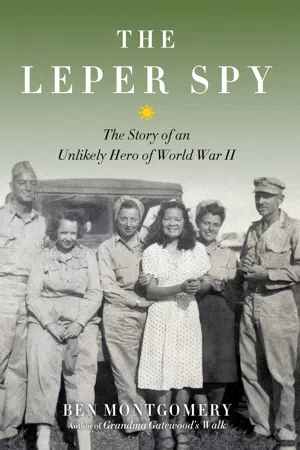
The GIs called her Joey. Hundreds owed their lives to the tiny Filipina who stashed explosives in spare tires, tracked Japanese troop movements, and smuggled maps of fortifications across enemy lines. As the Battle of Manila raged, Josefina Guerrero walked through gunfire to bandage wounds and close the eyes of the dead. Her valor earned her the Medal of Freedom, but what made her a good spy was also destroying her: leprosy, which so horrified the Japanese they refused to search her. After the war, army chaplains found her in a nightmarish leper colony and fought for the US government to do something it had never done: welcome a foreigner with leprosy. This brought her celebrity, which she used to publicly speak for other sufferers. However, the notoriety haunted her and she sought a way to disappear. Ben Montgomery now brings Guerrero's heroic accomplishments to light.
Information
1
EVERYTHING IS IN READINESS
If you looked down on the cluster of 7,107 Philippine Islands from a Mitsubishi G4M bomber in the 1940s, you might see the profile of a stoop-shouldered old woman with her arms bent and her hands drawn up in prayer. Her face, the largest island, would be Luzon, and at the back of her throat sat Manila, the Pearl of the Orient, a bustling Asian city with a unique and diverse cultural tapestry shaped by the indigenous Tagalog Filipino, more than three hundred years of Spanish rule and, more recently, forty years of American occupation. The capital city was headquarters for American interests in the Orient, and the four decades of occupation had transformed Manila from a sleepy Spanish city into a thriving metropolis. Add to the mix a bunch of Chinese and Japanese migrants and Scottish and German traders who made Manila their home, and the city’s cultural web connected it to three different continents and an international heritage. The only facet of culture that wasn’t diverse was religion. The Spanish Catholic missions and educational system had converted generations upon generations, leaving few who didn’t long for the body and blood of Jesus Christ.
Between the deep blue of Manila Bay and the thick jungle there grew high-rise buildings, apartment complexes, shopping centers, and hotels and beyond those, fish farms and rice paddies and the brown thatched roofs of bamboo houses. The mist that settled low upon the mountains ringing the city gave it an exotic feel. To the southwest, in the mouth of the ship-spackled bay, rose the rock island of Corregidor and a bit to the north stood the knuckled knobs of the Bataan Peninsula, behind which the sun disappeared each day.

On hot nights the teenagers would drag their portable phonographs down to the seawall on the Vito Cruz corner, opposite the Casa Manana, and stomp to the music until sweat soaked their shirts. The street vendors sold sweet halo-halo from their carts, click-clacking down the paved roads, while river gypsies poled their cascos though the choking boat traffic on the Pasig. The bazaars were always packed with customers searching through straw hats and practical clay pottery, and the Escolta, the busiest boulevard, was a constant flurry of activity, the men darting through automobile and carriage traffic in white suits and the women sauntering in the heat. Inside the clubs, bodies pulsed every expression, displaying the blending of cultures: the tango, the flamenco, the waltz, the jive. It was a beautiful life, and though relatively short, the overlay of friendly American influence had left an impression. Most Filipinos felt, in some small way, like they were Americans.
The young commonwealth was on the cusp of independence after four hundred years of foreign rule, and the city was filled with a palpable anxiety. The United States was helping lift the Philippines to its feet, and at the head of that effort was a man who was pacing back and forth on the long sixth-floor balcony of the Manila Hotel, high above Dewey Boulevard.
Douglas MacArthur was born on a military base in Little Rock, Arkansas, the son of a Civil War hero. He learned how to ride and shoot before he learned how to read and write. He had been valedictorian at West Texas Military Academy, where he played quarterback and shortstop, and first in his class at West Point, and first captain, too. He had been the youngest major general in the US Army, the first American army officer ever to become a field marshal, and the first American to be a four-star general twice.
He smoked a corncob pipe, dressed loud, and wore swagger like cologne. His spine was straight as a flagpole. He had served as chief of staff in the War Department under Franklin Delano Roosevelt, but by 1934, near the sunset of his four-year term, developments in the Far East had grown interesting. The Japanese had conquered Manchuria, and Congress passed an act granting commonwealth status to the Philippines, now on its way to full independence, which would come in 1946. The exuberant leader of the Nacionalista Party, Manuel Quezon, was favored to be the new president of the independent Philippines, and he was working to establish a military to protect the islands. He leaned on MacArthur for help.
The general had served in the Philippines before, the first stint starting in 1903, the second in 1922, and the third later that decade. He knew the islands. He loved them. He also knew that politics in Washington were tumultuous. When FDR was adamant about cutting the War Department budget by 51 percent to pull the federal government out of the red, MacArthur stared down the president. “When we lose the next war, and an American boy with an enemy bayonet through his belly and an enemy foot on his dying throat spits out his last curse, I want the name not to be MacArthur, but Roosevelt,” he said, voice trembling. He told the president he was resigning as chief of staff. As he turned to leave, FDR stopped him. “Don’t be foolish, Douglas,” the president said. “You and the budget must get together on this.” Outside, MacArthur vomited on the steps of the White House.
Now he was in Manila. His family occupied the six-room penthouse atop the air-conditioned hotel, where he walked miles on the balcony overlooking the bay, Bataan, and Corregidor, wearing his West Point dressing gown and swinging a cane. He had been appointed field marshal in 1936, during a ceremony at Malacañang Palace, where the commonwealth’s first lady, Aurora Quezon, presented him with a golden baton. He had become the highest-paid professional soldier in the world and often referred to himself in the third person. Nonetheless, he inspired awe on the streets of Manila. Filipinos loved MacArthur. He spoke to them with respect and came across as a sort of father figure, a protectorate. They saw him at the theaters, watching The Great Ziegfeld or A Tale of Two Cities, and at social affairs and cocktail parties. It also appealed to the heavily Catholic population that he seemed morally centered and rarely finished a gimlet.
MacArthur, meanwhile, was worried about defending the islands. The first measure Quezon put before his new legislature in 1935 had been a defense bill, but it took two years before the first twenty thousand draftees showed up at training camps, and then it was learned that they spoke eight languages in eighty-seven dialects. And a fifth of them were illiterate.
Nonetheless, MacArthur maintained that the strategically important islands—“the key that unlocks the door to the Pacific,” as he called them—were defensible, even if they had more total coastline than the United States and were just one thousand miles from Nagasaki while they were seven thousand miles from San Francisco. He called for the formation of a Filipino navy that would man torpedo boats, for 250 aircraft, and for an army force of four hundred thousand Filipinos. “We’re going to make it so very expensive for any nation to attack these islands that no nation will try it,” he said. What’s more, he regarded Japanese soldiers and pilots as inferior to red-blooded Americans. He knew the Japanese had been whipped by the Soviets during border clashes in 1938 and ’39 and that they weren’t able to defeat the peasant militias of China after three years of fighting.
But his war plan needed funding, and every indication was that Washington was iffy with support, at best. The War Department failed to allot money so MacArthur could pay his draftees a pittance. The Filipino trainees were issued pith helmets and shoes that fell apart during exercises, and they were armed with ancient Enfield rifles. As the war churned toward fury elsewhere, the War Department began reassessing plans in the Pacific. The Orange Plan, under which the US armed forces had been operating, suddenly felt outdated because it assumed a war between just two world powers. An updated plan drafted in June 1941 proposed abandoning the Philippines to Japan or defending it without additional military support, so the US effort could focus on defeating Italy and Germany.
July had brought a rapid turn of events. American scout planes were reporting large Japanese troop transports moving south. The Japanese had seized nearly every port in China. They also were filling bases in French Indochina. Roosevelt watched Tokyo closely. He was well aware of the rising nationalism in Japan, laid bare in the Japanese army newspaper Sin Shun Pao, which demanded that the Japanese deliver the United States “a smashing blow.” “We hate the United States, which forgets humane justice,” the paper wrote. “The time will come when either we will swallow up the United States or the United States will swallow us.”
“Awaken Asiatic people!” it continued. “We must speed up military and diplomatic measures by which we can crush Anglo-American efforts to obstruct the new order.”
The new order the piece referred to was also known as the Greater East Asia Co-prosperity Sphere, which wasn’t all that different from the concept of the Third Reich in Europe. It was a military exploitation of a nonmilitary idea. Original theorists coined the term to suggest Asia should be free from colonial powers through peaceful means. But nationalists had other ideas, as did the military, which hijacked the slogan and used its propaganda machine to bend the term to mean an Asia free from colonial powers, peace be damned. The push was on to fight and reclaim Anglo-occupied territories for Asian people.
On July 26, 1941, Roosevelt pushed back with an order that froze Japan’s assets, clamping a sweeping control over all economic intercourse between the countries, including ships and silk and cash. He merged American and Filipino troops into one army, and MacArthur was the man who would lead them.
“By God, it was destiny that brought me here,” the general said of his return to active duty.
In August, the United States stopped selling oil to Japan.
In September, after the American warship Greer was fired upon by a German submarine, FDR, his wife by his side on the first floor of the White House, gave the navy orders to shoot on sight any suspected Axis raiders in open water that America deemed vital to its defense. “We have sought no shooting war with Hitler, and don’t seek it now,” he told the American public. “But neither do we want peace so much that we are willing to pay for it by permitting him to attack our naval and merchant ships while they are on legitimate business.” Some in Congress shot back, calling the order an unofficial declaration of war. An investigation into the USS Greer incident was launched by an isolationist US senator, but by then the footfalls toward a fight seemed imminent.
In October, as Russia pounded back against Germany in the west, surging and retreating, Japan began claiming that the US and British forces were trying to “encircle” the country, and the newspapers were filled with stories that war was likely at any time. American intelligence reports suggested the military group in Japan was on the ascendancy. Texas senator Tom Connally, chairman of the Senate Foreign Relations Committee, was worried that Japan was poised to strike the United States. He read the tea leaves. “It is within the bounds of possibility that we will have trouble with Japan,” he told reporters. “In the present situation, anything could happen. If Japan decides that Germany is on top of Russia, she might try to interfere with our shipments of equipment to Russia. Her policy toward us certainly will be hooked up with the German military effort in Russia.” Japan, he said, “would like to get something out of this war.”
Just days later, the Nazis took Bryansk in their advance on Moscow, despite heavy losses in the snowy fields of Russia. The Reds advanced fresh troops constantly in order to stop the surge.
A week after the fall of Bryansk, on October 17, a strongly pro-Axis and heavily militarized faction took over in Japan, unseating moderate premier Prince Fumimaro Konoe, primarily because he hadn’t reached an agreement during peace talks with the United States. The takeover came as such a shock that FDR canceled a cabinet meeting and called together his top military advisors: the secretary of state, the secretary of war, the secretary of the navy, the army chief of staff, and the chief of naval operations. Their meeting was so private that none of them spoke a word to reporters afterward.
Two days later, FDR announced he had adopted a wait-and-see policy to give the United States time to determine what the newly empowered Japanese military leaders were going to do. Meanwhile, Japanese leaders were making belligerent statements in the foreign press. The spokesman for the Japanese navy said they were “itching for action.” George Norris, a Progressive Republican turned Independent from Nebraska, didn’t like the way things were shaping up. “Like Hitler,” he said, “the Japs believe that they are a superior race destined to rule the world. They have no friendship for the United States and will turn on us when they think it is to their interest.”
In Manila, MacArthur was trying to make the best of what he had. He didn’t expect an attack until April 1942, at the earliest, so he began ramping up defense installations. An $8 million airfield construction project gave the islands about forty finished airfields and an impressive concentration of warplanes. When a shipment of American B-17s flew over Manila on the way to Clark Field, the city cheered. The residents of working-class Tondo packed the streets to watch a parade of M3A1 tanks roll through, bound for Fort Stotsenburg.
By the end of October 1941, the rhetoric was fevered. The new Japanese premier, Gen. Hideki Tojo, said that Japan “must go on and develop in ever expanding progress—there is no retreat!”
“If Japan’s hundred millions merge and go forward, nothing can stop us,” he said. “Wars can be fought with ease.”
On October 31, Halloween, a German U-boat torpedoed the USS Reuben James, which was on neutrality patrol near Iceland, the first sinking of an American destroyer by the Nazis. The ambush killed more than one hundred men. German chancellor Adolf Hitler’s spin the following day, that the United States had attacked the submarine, was viewed as an attempt to pull Japan into the war. And it was followed by increasingly hostile rhetoric in the Japanese press.
On December 5, just as a group of educated Japanese civilians began an effort to convince the government to appoint a commission to try to solve the Pacific deadlock, President Roosevelt learned of the massing of Japanese troops in French Indochina. He called for an explanation. Two of Tokyo’s envoys, Ambassadors Kichisaburo Nomura and Saburo Kurusu, showed up at the diplomatic entrance to the Department of State.
News cameras flashed as the two walked in, smiling blandly. They were ushered into the office of Cordell Hull, the Tennessean who had been secretary of state since 1933. The two met with Hull for twenty-five minutes. The United States was demanding that Japan sign a nonaggression pact and evacuate China and Indochina or its assets would remain frozen. Japan wanted America to halt its naval expansion in the western Pacific. Talks quickly broke down, and the envoys left Hull with a terse 150-word response from Tokyo, saying Japan was only reacting to aggressive Chinese troop movement: “As a natural sequence of this step, certain movements have been made among the troops stationed in the southern part of the said territory. It seems that an exaggerated report has been made of these movements. It should be added that no measure has been taken on the part of the Japanese government that may transgress the stipulations of the protocol of joint defense between Japan and France.”
The War Department cabled MacArthur, saying, “Hostile action possible at any moment” and that “the United States desires that Japan commit the first overt act.”
“Everything is in readiness,” MacArthur replied.
It was not.
Lookouts sighted aircraft north of Manila, near Clark Field.
The next day, a Japanese reconnaissance plane was spotted in the sky.
The next day, at dawn, planes appeared once again, dark spots in the clouds above a peaceful island.
Later, MacArthur would write, “I prepared my meager forces, to counter as best I might, the attack that I knew would come from the north, swiftly, fiercely, and without warning.”
On the night of December 7, all of Manila seemed to be partying. The Feast of the Immaculate Concept...
Table of contents
- Cover
- Title Page
- Copyright
- Dedication
- Contents
- Introduction: The End
- 1 Everything Is in Readiness
- 2 Fools
- 3 Family
- 4 Sirens
- 5 Safeguards
- 6 Bombs
- 7 Envelope
- 8 Boys
- 9 Hobnailed Boots
- 10 Bastards
- 11 Volunteer
- 12 Leaflets
- 13 Gone
- 14 Espionage
- 15 Speedo
- 16 Spies
- 17 Promise
- 18 Beleaguered
- 19 Taken
- 20 Pledge
- 21 I’m a Leper
- 22 Vengeance
- 23 Landings
- 24 Advance
- 25 Map
- 26 Los Baños
- 27 Dispatched
- 28 Leper Camp
- 29 Loose Ends
- 30 Visits
- 31 In Sickness
- 32 Independence
- 33 Spotlight
- 34 Discovery
- 35 Return to the Rock
- 36 All That Is Changed
- 37 Medals
- 38 Friends of Friends
- 39 Carville
- 40 Old Fears
- 41 Crusader
- 42 Fallen
- 43 Controversy
- 44 Fences
- 45 Walk Alone
- 46 Praise
- 47 Bureaucracy
- 48 Sisters
- 49 Deportation
- 50 California
- 51 Sunset
- 52 Disappear
- 53 I Am Still Alive
- 54 Anonymous
- Acknowledgments
- Bibliography
Trusted by 375,005 students
Access to over 1.5 million titles for a fair monthly price.
Study more efficiently using our study tools.
Frequently asked questions
Yes, you can cancel anytime from the Subscription tab in your account settings on the Perlego website. Your subscription will stay active until the end of your current billing period. Learn how to cancel your subscription
No, books cannot be downloaded as external files, such as PDFs, for use outside of Perlego. However, you can download books within the Perlego app for offline reading on mobile or tablet. Learn how to download books offline
Perlego offers two plans: Essential and Complete
- Essential is ideal for learners and professionals who enjoy exploring a wide range of subjects. Access the Essential Library with 800,000+ trusted titles and best-sellers across business, personal growth, and the humanities. Includes unlimited reading time and Standard Read Aloud voice.
- Complete: Perfect for advanced learners and researchers needing full, unrestricted access. Unlock 1.5M+ books across hundreds of subjects, including academic and specialized titles. The Complete Plan also includes advanced features like Premium Read Aloud and Research Assistant.
We are an online textbook subscription service, where you can get access to an entire online library for less than the price of a single book per month. With over 1.5 million books across 990+ topics, we’ve got you covered! Learn about our mission
Look out for the read-aloud symbol on your next book to see if you can listen to it. The read-aloud tool reads text aloud for you, highlighting the text as it is being read. You can pause it, speed it up and slow it down. Learn more about Read Aloud
Yes! You can use the Perlego app on both iOS and Android devices to read anytime, anywhere — even offline. Perfect for commutes or when you’re on the go.
Please note we cannot support devices running on iOS 13 and Android 7 or earlier. Learn more about using the app
Please note we cannot support devices running on iOS 13 and Android 7 or earlier. Learn more about using the app
Yes, you can access The Leper Spy by Ben Montgomery in PDF and/or ePUB format, as well as other popular books in Sozialwissenschaften & Sozialwissenschaftliche Biographien. We have over 1.5 million books available in our catalogue for you to explore.