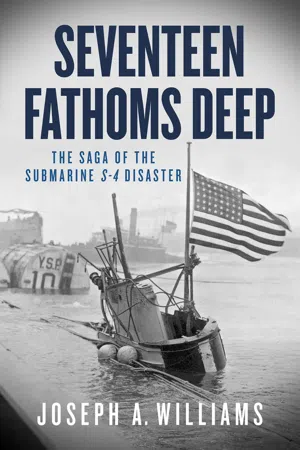
The rescue divers could hear the crew tapping out a message in Morse code: Is there any hope? After being accidentally rammed by the Coast Guard destroyer USS Paulding on December 17, 1927, the USS S-4 submarine sank to the ocean floor off Cape Cod with all forty crew aboard. Only six sailors in the forward torpedo room survived the initial accident, trapped in the compartment with the oxygen running out. Author and naval historian Joseph A. Williams has delved into never-revealed archival sources to tell the compelling narrative of the S-4 disaster, the first attempt to rescue survivors stranded aboard a modern submarine. As navy deep sea divers struggled to save the imprisoned men, a winter storm raged at the surface, creating some of the worst diving conditions in American history. Circumstances were so terrible that one diver, Fred Michels, became trapped in the wreckage while trying to attach an air hose to the sunken sub—the rescuer now needed to be rescued. It was only through the bravery of a second diver, Thomas Eadie, that Michels was saved. As detailed in Seventeen Fathoms Deep, lessons learned during this great tragedy moved the US Navy to improve submarine rescue technology, which resulted in later successful rescues of other downed submariners.
- 304 pages
- English
- ePUB (mobile friendly)
- Available on iOS & Android
eBook - ePub
About this book
Information
1
The Rum-Chaser
ON A BRISK MID-DECEMBER DAY in 1927, the Coast Guard cutter Paulding patrolled off Provincetown, Cape Cod. To the east on the coast loomed a tower, the 252-foot-tall Pilgrim Monument. Commanding officer John S. Baylis’s eyes were drawn to the blood-scarlet pennant over a red-and-blue flag that flew before the tower.
Lieutenant Commander Baylis’s stony-handsome face held a penetrating stare accentuated by a stiff, impeccably clean uniform that gave the impression of formality. Yet from time to time this veneer would crack with the smile and bright blue eyes of a dignified patrician. Being forty-three, he was on average two decades older than his subordinates. He looked at himself as a teacher to his officers and crew.
Baylis directed the men on watch to rifle through their manuals and tell him what the pennants meant. At length, they deciphered the signs to indicate a storm—a nor’easter. But Baylis corrected his crew: The wind was from the northwest. The flags were in error. The captain was a stickler for detail.
Northwest or northeast, a storm was coming, but Baylis was unalarmed. The Paulding was close to the protection of Provincetown Harbor. There was time enough for him to carry on his mission and catch a prize. But Baylis’s quarry was not a pirate ship stuffed with holds of shimmering bullion and hard jewels. Rather, he hunted illegal booze.

Lieutenant Commander John S. Baylis (USCG), commanding officer of the Paulding.
Courtesy of the Stephen B. Luce Library Archives, SUNY Maritime College
In 1924, the Coast Guard had vowed to suppress the smuggling that sprouted in the face of the national prohibition on alcohol. Smugglers found a thriving and profitable trade in New England, where it was easy for mother ships in international waters to load small boats, which hustled the contraband to one of the region’s many hidden coves and lonely shores. The illegal trafficking had grown so rampant that the US Navy had lent the Coast Guard twenty World War I–era destroyers to hunt the rumrunners. The Paulding, which had been used by the navy during the war for escort duty, was one of these so-called rum-chasers. At over 293 feet in length and 742 tons, the Paulding dwarfed any smuggler. The ship was capable of 30 knots, and in its mission it was sometimes forced to go at that speed.
While on the open ocean, the cutter could run down the smaller rumrunners; it was not as maneuverable in the shallows. Smugglers could find safety close to shore if they could get past the Paulding. If that happened, Baylis would be forced to call on the ship’s four guns to force a boat to heave to.
The previous December, the Paulding encountered the Marge. It was a small but fast rumrunner with three engines capable of 1,350 horsepower. It roared across Cape Cod Bay in broad daylight to evade the Paulding. Baylis zealously gave chase, running after the zigzagging boat at a 30-knot clip, firing warning shots to cajole the vessel to stop. But the boat ran inshore and managed to dump all its illegal cargo before the Coast Guard could catch it. The Marge’s crew had vanished via a train to Boston.
Baylis was fervent in his pursuit of rumrunners, not because of a strong opinion on Prohibition but because of his fundamental dedication to service on the sea. He graduated as a cadet in 1903 from the New York Nautical Schoolship St. Mary’s, an ancient sloop of war that trained mariners. Sometimes when he was ashore with his wife and son in Brookline, Massachusetts, he looked at old photographs of a beaming teenager grasping the oversized wheel of the square-rigged school ship. Upon graduating, he signed aboard a British square-rigger and made a voyage around Cape Horn. After his return, he joined the Revenue Cutter Service* in 1907 and remained with it ever since. He was considered one of the best commanding officers in the service. Aside from chasing rumrunners, he was involved in rescue work. In the latest incident, his vessel rescued a foundered boat on the Peaked Hill Bar during a February storm. Baylis received a commendation for the heroics. In total, Lieutenant Commander John Baylis had been on the water for twenty-six years and had even returned to his alma mater as its superintendent before reassignment to the Paulding in 1924.
On this outing, on December 17, 1927, Baylis possessed a secret list of nearly three hundred vessels with which his division commanding officer, Commander Leroy Reinburg, had furnished him. These vessels, if encountered, needed to be stopped, searched, and potentially seized. The Paulding and its eighty-two men had been out since nine in the morning and found no smugglers, only a couple of schooners carrying fish and other legitimate cargo.
By three o’clock, the sun was descending behind a choppy sea. Since visibility was decent, and it was frigid on the bridge’s outdoor wings, Baylis allowed his men to stay inside the glass-encased bridge. From here, they could clearly see the roughening seas batter the coast of Wood End.
Wood End was a narrow spit of land that curled into Cape Cod Bay, ending with a stretch of shore named Long Point. It was a lonely but beautiful place, lined with wind-driven sands, salt marshes, and grasses. The only sounds were the crash of waves and the call of seabirds. The clearest marks of civilization were two lighthouses that stood sentinel along the shore, the distant Pilgrim Monument, and the masts of ships anchored in Provincetown Harbor, which appeared on the far side of the point. The only thing that seemed strange was that the Nantucket Lightship was off its station. A note of it was made in the log.
The Paulding rolled by Wood End at 18 knots. Then, at three thirty, they sighted a small fishing boat that they could not immediately identify. There must have been a piratical buzz on the bridge as Baylis gave the order to pursue. The excitable helmsman, James Milazzo, spun the Paulding’s wheel.
All binoculars bore on the small craft as it came into view. At one hundred feet away, the quartermaster, a former navy man named Charles Reed, had stepped outside to observe the vessel. He sung out, “It’s the William Landry.” Baylis, and all hands, could now clearly see the name on the vessel’s side. It was a known fishing boat, and not on Baylis’s secret list.
Baylis ordered a course toward Provincetown. Milazzo turned the wheel, and the vessel changed its heading again. The Paulding drew closer to the shore, where there were a series of white can buoys. The navy had laid these out in 1909 for use in testing vessels along Wood End and Long Point. The length of the courses had been plotted, and they were referred to as “measured mile” courses. There were two such courses, an inner one that was closer to Provincetown Harbor, and an outer one. Baylis was nearing one end of the inner course—the buoys were useful navigation aids for vessels coming into Provincetown Harbor.
It was obvious to the crew that the day’s hunt was up and that the Paulding was heading in for the night. But Baylis had another idea.
He turned to the officer of the deck, a fresh-faced ensign straight out of the Coast Guard Academy named George Phannemiller. Baylis ordered him to take command and follow the white buoys toward Provincetown. The young officer hurriedly stepped up with a probable air of nervous authority contained only by a starchy uniform.
Baylis left the bridge and stepped into the adjoining chart room. It was a cramped space with a smooth table that had a chart of Cape Cod Bay set on it. He laid his fingers on the chart and began to estimate distances and time. He was close enough to the bridge that he could hear if there was any trouble. But there was none expected. Phannemiller was navigating the ship along the course of the white buoys. The ensign had just given the order to alter the course 5 degrees to port.
Baylis had roughly an hour of daylight left, maybe a little less, but it was enough time to bring the Paulding into Cape Cod Bay in order to scrutinize the western Plymouth shore. He decided that would be the Paulding’s last action of the day and maybe they would find something among the small boat traffic into Plymouth. He just needed to plot the best way to bring the ship to the optimal spot.
But Baylis was interrupted by a shout from the bridge.
“Right full!”
Baylis’s head jerked up. It was Phannemiller. Thoughts of Plymouth and smugglers evaporated as he rushed out of the chart room and onto the bridge.
Baylis saw through the glass windows what appeared to be two brown iron sticks just ahead under the ship’s port bow. The weather-beaten spars looked like markers for nets that fishermen used at times to flag traps so that they could leave them and pick them up later. They were less than seventy yards away and quickly closing. Hitting a fishing marker might foul the Paulding’s propellers.
White feathery foam trailed behind the sticks, making them hard to discern in the choppy water. Strangely, the foam showed signs of motion, as if it were a wake. But real fishing markers should not move. Instantly, revelation crashed onto Baylis; it was confirmed by the quartermaster, who rushed inside the bridge.
“It’s a submarine!” Charles Reed shouted.
The supposed fishing sticks were, in fact, the twin periscopes of a submarine. They were just peeping above the sea’s surface and rising. They were heading at the Paulding’s prow at a right angle.
“Full astern!” cried Baylis. He grasped the lever to telegraph the order to the engine room and found that Reed had already gripped the lever. They pulled it together, giving the order to reverse the engines.
The siren of the general alarm peeled through the decks. Baylis felt the engines groan as the engineers below set them in reverse. Loud thumping noises boomed throughout the Paulding and the vessel shook. But a sizable ship going 18 knots does not just stop on command.
The Paulding slowed and started to veer right, but the periscopes kept rising and closing. As the Paulding turned, the periscopes changed from a 90-degree to a 45-degree angle in relation to the ship. The submarine was still going to strike the Paulding. The vessel’s staying cables emerged. These were long wires that were attached forward on the submarine from the conning tower to the bow—they were used as an extended antenna for the submarine’s radio systems. Then the conning tower started to appear. The Paulding was laden with oil and stores and drew deeply in the water. There was nothing Baylis could do. The impact was to be immense.
Baylis’s gut must have churned as he gave an order that any veteran sea officer would pray never to have to give.
“All hands, prepare to abandon ship!”

*The Revenue Cutter Service merged with the US Life-Saving Service in 1915 to form the US Coast Guard.
2
The Pigboat
SUBMARINE STANDARDIZATION TRIALS WERE A safe assignment; no hunting destroyers, no unexpected crash dives, and no enemy depth charges along the well-known measured mile course. For the S-4, there was just the quiet serenity of Cape Cod—though the view of it was limited inside a submarine.
The trials meant that the boat* would spend more than a week pacing up and down the same mile of cold sea. With the expected monotony, there were outsiders present from the navy’s Board of Inspection and Survey, which disturbed the submarine’s isolated and intimate universe.
The S-4’s captain, Lieutenant Commander Roy Kehlor Jones, had endured the tedious trials before. The thirty-four-year-old son of a dry goods merchant was a boyish-looking but conscientious commanding officer who had left his native Oklahoma for the US Naval Academy, from which he graduated in 1916. He had seen a fair share of action aboard the battleship Michigan during World War I, escorting convoys and training personnel. U-boats were a hidden menace during the war, and Jones probably admired how much submarine technology had matured in the three decades of his life. In 1920, he enrolled in the navy’s submarine school and five years later earned the command of the S-4. It was not unusual for a young navy officer to gain his first command aboard a submarine. It was considered a fast track to promotion. So, the depths of the sea were now home to Jones, though it was no Oklahoma.
The S-4 had a complement of forty men, a small command, but that did not matter to Jones. It was his “pigboat,” a nickname for the old diesel-powered submarines that reflected the crowded, somet...
Table of contents
- Cover
- Title Page
- Copyright
- Dedication
- Contents
- Preface
- 1 The Rum-chaser
- 2 The Pigboat
- 3 The Fate of the Paulding
- 4 Trapped
- 5 The Boatswain
- 6 “Who Wants to Know?”
- 7 The Falcon
- 8 The Ace of Divers
- 9 Hide and Seek
- 10 Where’s Ellsberg?
- 11 “An Olympian Zeus”
- 12 One Man down
- 13 Six Taps
- 14 Blowing the Ballast Tanks
- 15 “How Long Will You Be?”
- 16 “Tonight or Never”
- 17 Two Men down
- 18 Inside the Iron Doctor
- 19 The Six
- 20 “It’s Terrible, It’s Terrible”
- 21 “Is There Any Hope?”
- 22 “Y-E-S”
- 23 Carr’s Cross
- 24 Christmas Eve
- 25 Bringing up the Bodies
- 26 “The Knee of the Gods”
- 27 “My Body to Pelnar”
- 28 Of Lungs and Bells
- 29 Twelve Years Later
- Epilogue
- Acknowledgments
- Notes
- Bibliography
Trusted by 375,005 students
Access to over 1.5 million titles for a fair monthly price.
Study more efficiently using our study tools.
Frequently asked questions
Yes, you can cancel anytime from the Subscription tab in your account settings on the Perlego website. Your subscription will stay active until the end of your current billing period. Learn how to cancel your subscription
No, books cannot be downloaded as external files, such as PDFs, for use outside of Perlego. However, you can download books within the Perlego app for offline reading on mobile or tablet. Learn how to download books offline
Perlego offers two plans: Essential and Complete
- Essential is ideal for learners and professionals who enjoy exploring a wide range of subjects. Access the Essential Library with 800,000+ trusted titles and best-sellers across business, personal growth, and the humanities. Includes unlimited reading time and Standard Read Aloud voice.
- Complete: Perfect for advanced learners and researchers needing full, unrestricted access. Unlock 1.5M+ books across hundreds of subjects, including academic and specialized titles. The Complete Plan also includes advanced features like Premium Read Aloud and Research Assistant.
We are an online textbook subscription service, where you can get access to an entire online library for less than the price of a single book per month. With over 1.5 million books across 990+ topics, we’ve got you covered! Learn about our mission
Look out for the read-aloud symbol on your next book to see if you can listen to it. The read-aloud tool reads text aloud for you, highlighting the text as it is being read. You can pause it, speed it up and slow it down. Learn more about Read Aloud
Yes! You can use the Perlego app on both iOS and Android devices to read anytime, anywhere — even offline. Perfect for commutes or when you’re on the go.
Please note we cannot support devices running on iOS 13 and Android 7 or earlier. Learn more about using the app
Please note we cannot support devices running on iOS 13 and Android 7 or earlier. Learn more about using the app
Yes, you can access Seventeen Fathoms Deep by Joseph A. Williams in PDF and/or ePUB format, as well as other popular books in History & Military & Maritime History. We have over 1.5 million books available in our catalogue for you to explore.