From the
New York Times–bestselling author of
Intellectuals: "All the highlights of Irish history . . . useful and informative." —
Irish Echo
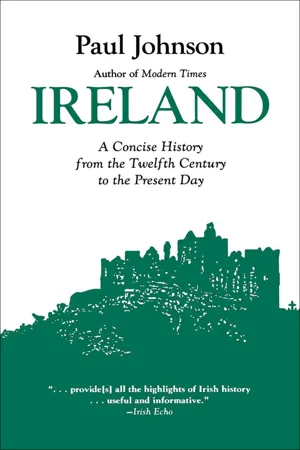
Drawing from a wealth of historical and scholarly sources, Paul Johnson, acclaimed for such works as
A History of the Jews and
A History of Christianity, traces the important social, religious, and political development of Ireland's struggle to become a unified, settled country. Johnson describes with accurate detail Ireland's barbarous beginnings, Oliver Cromwell's religious "crusade," the tragic Irish potato famine, the Ulster resistance, and the outstanding fact of the constant British-Irish connection and the fearful toll of life it exacted. Among the anonymous multitude who are part of the story are also such famous names as "Silken Thom" Kildare, Thomas Wentworth, Archbishop Plunkett, and Lord Frederick Cavendish—and great men who marshaled their energies and wits to settle Ireland: Sir Henry Sidney, Sir Walter Raleigh, Edmund Spenser, Churchill, and others.
"[Paul Johnson] is wonderfully adroit at condensing history in an interesting way." —
Kliatt
"A lively, intelligent, sometimes provocative but always stimulating account." —
Sunday Telegraph
- 272 pages
- English
- ePUB (mobile friendly)
- Available on iOS & Android
eBook - ePub
About this book
Information
Sources
Chapter One: Gaelic Ireland and the English Pale
1. Francis John Byrne, Irish Kings and High Kings (London 1973), 7ff.
2. Richard Howlett (ed.), Chronicles of the Reigns of Stephen, Henry II and John (Rolls Series, London 1884–5), I, 167.
3. Byrne, op. cit., 270–3.
4. W. L. Warren, Henry II (London 1973), 189.
5. D. A. Binchy, ‘The linguistic and historical value of the Irish law tracts’, Proceedings of the British Academy, xxix (1943).
6. A. O. Gwynne, History of Irish Catholicism, vol. II: ‘The Twelfth-Century Reform’ (Dublin 1968); J. A. Watt, The Church and the Two Nations in Medieval Ireland(Cambridge 1970).
7. Byrne, op. cit., 270ff.
8. A. Saltman, Theobald Archbishop of Canterbury (London 1956), 95.
9. Text of Laudabiliter in Edmund Curtis and R. B. McDowell (eds), Irish Historical Documents, 1172–1922 (London 1943), 17–18.
10. E. H. Scott and P. X. Martin (eds and trns), Expugnatio Hibernica (Dublin 1978), 145–7.
11. Cf. J. F. O’Doherty, ‘Rome and the Anglo-Norman invasion of Ireland’, Irish Ecclesiastical Record, 42 (1933), 31–45; and M. P. Sheehy, ‘The Bull Laudabiliter: A Problem in Medieval diplomatique and history’, Journal of the Galway Archaeological and Historical Society, 29 (1961), 45–70.
12. C. C. J. Webb (ed.), Metalogicon (Oxford 1929), 217–18.
13. Robert de Torigny in Chronicles of the Reign of Stephen, Henry II and Richard I, IV, 81–315. See Warren, op. cit., 195.
14. Warren, op. cit., 192.
15. For the Norman invasion see G. H. Orpen, Ireland under the Normans (Oxford 1911–20), I, 141ff.
16. Warren, op. cit., 199.
17. The pipe rolls of 17 Henry II and 18 Henry II give details of the expedition’s equipment.
18. Expugnatio Hibernica, 98–9.
19. Ibid. 101.
20. Text of Alexander’s letters in Irish Historical Documents, 19ff.
21. Text of treaty in Irish Historical Documents, 22ff.
22. Warren, op. cit., 205.
23. Sidney Painter, William Marshall (Baltimore 1933).
24. Edmund Curtis, History of Medieval Ireland from 1086–1513 (2nd edn, London 1938).
25. J. F. Lydon, The Lordship of Ireland in the Middle Ages (Dublin 1972).
26. Harold G. Leask, Irish Castles and Castellated Houses (Dundalk 1941).
27. Orpen, op. cit., IV, 274.
28. A. J. Otway-Ruthven, A History of Medieval Ireland (London 1968), and in Irish Historical Studies, VI, 261–70 and VII, 1–16.
29. A. McKerrall, ‘West Highland mercenaries in Scotland’, Scottish Historical Review, xxx (1951).
30. Text in Irish Historical Documents, 38ff.
31. Annals of Ulster (Rolls Series), II, 433.
32. Robin Frame, ‘Power and Society in the Lordship of Ireland, 1272–1377’, Past and Present, 76 (August 1977).
33. Annals of the Four Masters, 111,761.
34. For examples, between James Butler Earl of Ormonde and the O’Kennedys in 1336 and 1356, see Irish Historical Documents, 48ff.
35. Text in Irish Historical Documents, 52ff.
36. Ibid, 59f.
37. A Discovery of the True Causes why Ireland was never Entirely Subdued and brought under Obedience of the Crown of England, in Historical Tracts by Sir John Davies (Dublin 1787).
38. Edmund Curtis, A History of Ireland (Dublin 1964), Chapter 9.
39. Leask, op. cit.
40. Text in Irish Historical Documents, 72ff.; see H. G. Richardson and G. O. Sayles, The Irish Parliament in the Middle Ages (Philadelphia 1952).
41. Richardson and Sayles, op. cit., 274; Documents 83ff.
42. S. B. Chrimes, Henry VII (London 1972), 257ff.
43. Text in Documents, 78f.
Chapter Two: Conquest and Plantation
1. Quoted in Nicholas P. Canny, The Elizabethan Conquest of Ireland (London 1976).
2. Wotton to Throgmorton, 25 December 1561, British Museum Addit. Mss 35, 380, f.230.
3. Canny, op. cit., 30.
4. Curtis, History of Ireland, 185.
5. Quoted in...
Table of contents
- Cover
- About the Author
- Also by Paul Johnson
- Title Page
- Copyright
- Contents
- Illustrations
- Acknowledgements
- Dedication
- Gaelic Ireland and the English Pale
- Conquest and Plantation
- From Cromwell to the Boyne
- Rebellion and Union
- Famine and Diaspora
- Ascendancy Culture
- Home Rule and the Land
- Ulster Resists, Dublin Rises
- Freedom and Partition
- From Revolt to Stalemate
- Epilogue
- Sources
Trusted by 375,005 students
Access to over 1.5 million titles for a fair monthly price.
Study more efficiently using our study tools.
Frequently asked questions
Yes, you can cancel anytime from the Subscription tab in your account settings on the Perlego website. Your subscription will stay active until the end of your current billing period. Learn how to cancel your subscription
No, books cannot be downloaded as external files, such as PDFs, for use outside of Perlego. However, you can download books within the Perlego app for offline reading on mobile or tablet. Learn how to download books offline
Perlego offers two plans: Essential and Complete
- Essential is ideal for learners and professionals who enjoy exploring a wide range of subjects. Access the Essential Library with 800,000+ trusted titles and best-sellers across business, personal growth, and the humanities. Includes unlimited reading time and Standard Read Aloud voice.
- Complete: Perfect for advanced learners and researchers needing full, unrestricted access. Unlock 1.5M+ books across hundreds of subjects, including academic and specialized titles. The Complete Plan also includes advanced features like Premium Read Aloud and Research Assistant.
We are an online textbook subscription service, where you can get access to an entire online library for less than the price of a single book per month. With over 1.5 million books across 990+ topics, we’ve got you covered! Learn about our mission
Look out for the read-aloud symbol on your next book to see if you can listen to it. The read-aloud tool reads text aloud for you, highlighting the text as it is being read. You can pause it, speed it up and slow it down. Learn more about Read Aloud
Yes! You can use the Perlego app on both iOS and Android devices to read anytime, anywhere — even offline. Perfect for commutes or when you’re on the go.
Please note we cannot support devices running on iOS 13 and Android 7 or earlier. Learn more about using the app
Please note we cannot support devices running on iOS 13 and Android 7 or earlier. Learn more about using the app
Yes, you can access Ireland by Paul Johnson in PDF and/or ePUB format, as well as other popular books in History & Irish History. We have over 1.5 million books available in our catalogue for you to explore.