American politics changed forever in January 1973.
In the span of thirty-one days, the Watergate burglars went on trial, the Nixon administration negotiated an end to the Vietnam War, the Supreme Court issued its decision in
Roe v. Wade, Lyndon Johnson died in Texas (and Harry Truman passed away just a month earlier), and Richard Nixon was sworn in for his second term. The events had unlikely links and each worked along with the others to create a time of immense transformation.
Roe in particular pushed political opponents to the outer reaches of each party, making compromise something that has become more and more difficult in our system of checks and balances.
Using newly released Nixon tapes, author and historian James Robenalt provides readers a fly-on-the-Oval-Office-wall look at events both fascinating and terrifying that transpired in the White House during this monumental month. He also delves into the judge's chambers and courtroom drama during the Watergate break-in trial, and the inner sanctum of the US Supreme Court as it hashed out its decision in
Roe v. Wade. Though the events took place more than forty years ago, they're key to understanding today's political paralysis.
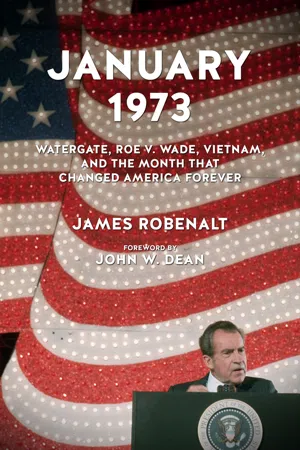
eBook - ePub
January 1973
Watergate, Roe v. Wade, Vietnam, and the Month That Changed America Forever
- 416 pages
- English
- ePUB (mobile friendly)
- Available on iOS & Android
eBook - ePub
January 1973
Watergate, Roe v. Wade, Vietnam, and the Month That Changed America Forever
About this book
Information
1
The Oval Office, January 1, 1973
Richard Nixon welcomed the New Year in quiet solitude. He arose early and made his way to the Oval Office, arriving shortly after 7:30 AM, surprising the security guards who had to scramble to find keys to open the office for the president. First Lady Pat Nixon was in Pasadena, California, the guest of honor in the eighty-fourth Tournament of Roses Parade, which was scheduled to begin later that morning. Nixon was by himself in the White House. He scribbled notes about his second term on one of his ubiquitous lawyers’ yellow pads and dictated some personal letters for his secretary, Rose Mary Woods, to transcribe whenever she finally made it to her office on that holiday morning.
Nixon had rare time to reflect. As he looked out over the next four years, his immediate focus was to put an end to America’s involvement in the war in Vietnam, something he promised to do in the 1968 campaign. Time was running out on his first term and his ability to keep that pledge. He desperately wanted a peace agreement before his inauguration on January 20.
He knew that he was at the end of the rope with Congress—he had tested its limits in December with his bombing campaign in North Vietnam, and he was alert to the fact that the new Congress set to convene later in the week was likely to vote to cut off further funding for the war.
The ex-presidents club, such as it was, had decreased to one with the passing of Harry S. Truman, the nation’s thirty-third president, the day after Christmas in Independence, Missouri.1 The only living ex-president, Lyndon Baines Johnson, was seen popping nitroglycerin capsules to relieve acute angina at a civil rights symposium he had hosted in Austin in the middle of December, but Johnson had survived several previous heart scares, and he was only sixty-four years old.
Despite the fact that Nixon was trying to dismantle many of the reforms of the Great Society, he needed Johnson’s support in his handling of the war, and he intended to respect LBJ’s legacy with an end to the war that was something more than an abrupt pullout. “Peace with honor,” Nixon called his plan. Johnson and Nixon had developed a peculiar relationship, at times bordering on friendship.
As 1973 dawned, the domestic calm that prevailed was a thin veneer. The stock market was reaching new highs, but within a year, after another devastating Middle East war and an oil embargo, the economy would be in real trouble. The cutoff of oil would touch off both a severe recession and trigger high inflation—“stagflation”—a vexing condition that would persist well into the 1980s. For this and other reasons, the stock market would start a long downward spiral after reaching its high in January 1973.2
Under the surface ominous forces were churning. The trial of the Watergate burglars was scheduled to begin in the second week of January, casting a menacing shadow that Nixon could not ignore. He was bedeviled by this scandal—this “third-rate burglary”—that simply would not go away, even in the face of his landslide victory in November.
By January 1974, only one year later, Judge John J. Sirica would be on the cover of Time as the “Man of the Year,” and Richard Nixon would be scrambling to explain an eighteen-and-a-half-minute gap in a White House tape recorded several days after the break-in.3 By then, Nixon’s presidency would be in a death spiral.
All of that seemed unfathomable as January 1, 1973, began. Most of the president’s advisors were out of town, still on holiday vacations, enjoying the fruits of their hard work in the 1972 reelection campaign. Everyone assumed that the worst was behind them and that the second term would be less tempestuous than the first.

Steve Bull, the president’s thirty-one-year-old aide, was in the West Wing when he heard the buzzer in Rose Mary Woods’s office going off, indicating a call from the president. Bull responded, telling the president that Woods had not yet arrived; he asked if there was anything he could do, as nobody else seemed to be around.
Nixon replied that only Woods could help with his personal letters. But he told Bull to be on the lookout for Washington Redskins quarterback Billy Kilmer and Coach George Allen and his family, whom Nixon had invited to come to the White House later that morning.
The day before, the Redskins had surprised Tom Landry’s Dallas Cowboys, winning 26–3 in a sensational NFC Championship Game, propelling the Redskins to a berth in Super Bowl VII.4 They would face the AFC champion Miami Dolphins, who were undefeated.5
Bull told the president that he had attended the Redskins game and the two then compared notes on the gutsy performance of their home team, which had shut down the defending Super Bowl champion Cowboys, led by quarterback Roger Staubach. Nixon was a huge football fan and had spent big chunks of his weekends in December by himself watching the NFL playoff games at Camp David, Maryland (in part because the NFL at the time blacked out all home games, whether or not they were sellouts).6
Soft-spoken and deferential, Steve Bull coordinated the president’s schedule and appointments. Bull had lost his father when he was thirteen years old, and he came to see Nixon as something of a father figure. Though Bull was from a well-off New York family, he enlisted and served in Vietnam as a second lieutenant in the marines and later found work as an executive with the Canada Dry Corporation. He signed up to be an advance man for the Nixon campaign in 1968. Impressed with Bull’s skills, Nixon’s chief of staff, Bob Haldeman, asked Bull to stay on after the campaign. Bull rose in responsibilities as others left the administration. A Marlboro chain-smoker with a stylish razor haircut and fashionably long sideburns, Bull had regular access to Nixon, coming and going ten to twenty times a day for brief scheduling discussions.7
On that morning, Bull politely reminded Nixon that he had to make a decision about whether he would attend Harry Truman’s memorial service at the National Cathedral, planned for the end of the week on Friday, January 5.8
Nixon groaned. “Can we get out of it?” he asked.
“It appears it would be rather difficult,” Bull quietly responded.
Nixon and Truman had never been on good terms. Truman thought Nixon was a congenital liar, and Nixon resented Truman’s attacks on him during the Alger Hiss investigation when Nixon was a congressman.9 But Nixon’s uneasiness about the Truman memorial was driven less by his poor relationship with Truman than by his total disdain for the man who was scheduled to deliver Truman’s eulogy: Francis B. Sayre, the dean of the National Cathedral.
“He’s such an ass; he’s been an ass for years,” Nixon seethed about Sayre to Bull.
Bull responded that Sayre had been seen “wandering around with his marchers [there] on Saturday.”10 Francis Sayre was one of the foremost opponents of the war in Vietnam. On Saturday, December 30, Sayre had led a peaceful walk to the White House in protest against the Christmas bombing of North Vietnam.11
Sayre was no stranger to the White House, and not just because he would occasionally show up to protest. Francis Sayre had been born in the White House fifty-eight years earlier, in January 1915. He was Woodrow Wilson’s first grandchild, the son of Jessie Woodrow Wilson, the president’s second daughter.
“President Wilson made no effort to conceal his joy when informed that the child was a boy and that Mrs. Sayre was well,” the papers reported on the occasion of Sayre’s birth. “His face was wreathed in smiles for hours afterward,” the press wrote of the proud grandfather. Wilson had three daughters, and reports were that the child might be named for his grandfather, but Wilson vetoed the idea and the baby was named for his father, Francis.12
Sayre’s antiwar sentiment was inextricably linked with the civil rights movement of the 1960s. He had marched with Martin Luther King Jr. in Selma in 1965, and it was Sayre who invited King to preach a sermon at the Washington National Cathedral on Sunday, March 31, 1968.13
King’s appearance with Sayre in March 1968 was in response to concerns that his Poor People’s Campaign, scheduled to descend upon the capital later that spring, might turn violent. Just a week before in Memphis, at a massive rally that King helped to organize in support of striking sanitation workers, chaos had erupted and one young man had been shot and killed by police. King promised those who came to hear him at the National Cathedral that his marchers would not “tear up” Washington.14
By this time, though, King was as concerned with the Vietnam War as he was with civil rights. In this, his last Sunday sermon, entitled “Remaining Awake Through a Great Revolution,” he denounced the war. “I want to say,” King said with Sayre sitting nearby, “one other challenge that we face is simply that we must find an alternative to war and bloodshed.” To ignore this reality was to be untrue to the movement. “Anyone who feels, and there are still a lot of people who feel that way, that war can solve the social problems facing mankind is sleeping through a great revolution.”
King had become convinced, he said, that the Vietnam War was “one of the most unjust wars that has ever been fought in the history of the world.” The war, he said, wreaked havoc with the country’s domestic agenda, sucking up precious national resources, and it “put us in the position of appearing to the world as an arrogant nation.”
“The judgment of God is upon us today,” he thundered at the climax of his talk. “It is either nonviolence or nonexistence.”15
Four days later he was dead.
King’s stance on the war put him at odds with President Johnson, who had done so much for the movement with the passage of the Civil Rights Act of 1964, the Voting Rights Act of 1965, and the Fair Housing Act of 1968. But the war was destroying Johnson’s Great Society reforms and his war on poverty. “This day,” King said on March 31, “we are spending five hundred thousand dollars to kill every Vietcong soldier. Every time we kill one we spend about five hundred thousand dollars while we spend only fifty-three dollars a year for every person characterized as poverty-stricken in the so-called poverty program, which is not even a good skirmish against poverty.” There simply was not enough money to pay for the war and the Great Society programs. And minorities, King knew, were dying in disproportionate numbers in Vietnam.
Johnson felt the sting. On the very evening that King spoke at the National Cathedral, he appeared on national television to speak to the country about his hopes for peace in Vietnam, but then, citing “division in the American house,” announced that he would not run for reelection in 1968. “I shall not seek,” Johnson said, “and I will not accept the nomination of my party as your president.”16
Johnson’s abrupt exit from the race opened the door to the White House for Richard Nixon. In 1968 Alabama governor George Wallace split the South and the Democratic Party, taking votes that in another year would have gone to the Democratic candidate. (Wallace received 13 percent of the vote.) As it was, Nixon barely won in a three-way race between himself, Wallace, and Johnson’s vice president, Hubert Humphrey.

President Johnson and Dr. Martin Luther King Jr. in Cabinet Room, White House, March 18, 1966.
LBJ Library photo by Yoichi Okamoto
In 1972 things were very different. Nixon ran away with the election. But the election result was mixed, explaining in part Nixon’s sour attitude about Dean Francis Sayre and his other perceived enemies on the morning of January 1, 1973.
Executive Office Building, November 7, 1972
Nixon’s contrary...
Table of contents
- Cover
- Title Page
- Copyright
- Dedication
- Contents
- Foreword
- Introduction: A Stand of Aspen
- Prelude: “The Very Thought of Losing Is Hateful to Americans”
- 1. “We’ve Got to Still Shoot Some Sparks”
- 2. “You Have Shown You Are Not Someone to Be Trifled With”
- 3. “Human Adversaries Are Arraigned Against Me”
- 4. “The Abortion Cases”
- 5. “I Just Feel the Torture You Are Going Through on Vietnam”
- 6. “Every Tree in the Forest Will Fall”
- 7. “The Pregnant Woman Cannot Be Isolated in Her Privacy”
- 8. “Harry’s Lovely Farewell”
- 9. “I Wanted the Young Prosecutor to Know Just How Whitewashers Are Engineered”
- 10. “We Celebrated the President’s Birthday Today by Making a Major Breakthrough in the Negotiations”
- 11. “He Can Renew It After the Opening Statement Is Made”
- 12. “Only Kings, Monarchs, Dictators, and United States Federal Judges”
- 13. “We May Be Doomed to Come to an Agreement Today”
- 14. “LBJ Got Very Hot”
- 15. “And We Shall Overcome”
- 16. “I Want to Do This Job That Lincoln Started”
- 17. “We Should Wait for His Formal Reply Before Popping Corks”
- 18. “I’m Going to Be with the Rich Cats Tonight”
- 19. “In Our Own Lives, Let Each of Us Ask—Not Just What Government Will Do for Me, But What I Can Do for Myself”
- 20. January 22, 1973
- 21. “The Sun Is Shining in Paris This Afternoon”
- 22. “Now Your Client Is Smiling”
- 23. “It Is a Rule of Life”
- Epilogue: The Blessings of Simultaneity
- Acknowledgments
- Notes
Trusted by 375,005 students
Access to over 1.5 million titles for a fair monthly price.
Study more efficiently using our study tools.
Frequently asked questions
Yes, you can cancel anytime from the Subscription tab in your account settings on the Perlego website. Your subscription will stay active until the end of your current billing period. Learn how to cancel your subscription
No, books cannot be downloaded as external files, such as PDFs, for use outside of Perlego. However, you can download books within the Perlego app for offline reading on mobile or tablet. Learn how to download books offline
Perlego offers two plans: Essential and Complete
- Essential is ideal for learners and professionals who enjoy exploring a wide range of subjects. Access the Essential Library with 800,000+ trusted titles and best-sellers across business, personal growth, and the humanities. Includes unlimited reading time and Standard Read Aloud voice.
- Complete: Perfect for advanced learners and researchers needing full, unrestricted access. Unlock 1.5M+ books across hundreds of subjects, including academic and specialized titles. The Complete Plan also includes advanced features like Premium Read Aloud and Research Assistant.
We are an online textbook subscription service, where you can get access to an entire online library for less than the price of a single book per month. With over 1.5 million books across 990+ topics, we’ve got you covered! Learn about our mission
Look out for the read-aloud symbol on your next book to see if you can listen to it. The read-aloud tool reads text aloud for you, highlighting the text as it is being read. You can pause it, speed it up and slow it down. Learn more about Read Aloud
Yes! You can use the Perlego app on both iOS and Android devices to read anytime, anywhere — even offline. Perfect for commutes or when you’re on the go.
Please note we cannot support devices running on iOS 13 and Android 7 or earlier. Learn more about using the app
Please note we cannot support devices running on iOS 13 and Android 7 or earlier. Learn more about using the app
Yes, you can access January 1973 by James Robenalt,John W. Dean in PDF and/or ePUB format, as well as other popular books in History & North American History. We have over 1.5 million books available in our catalogue for you to explore.