One woman's "affecting and well-written" memoir of growing up with twelve siblings in rural Kentucky, and returning as an adult (
Kirkus Reviews).
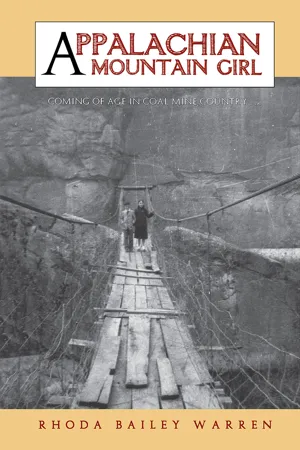
Appalachian Mountain Girl is a sensitive and beautifully written autobiographical account of a childhood in the coalmine district of Depression-era Kentucky. With humor and warmth—but without sentimentality—Rhoda Warren recounts the lives of these mining people whose religion and family values buttressed and sustained them. As a young girl, Rhoda began to catch glimpses of the world outside her narrow mountain community through the stories in
True Confessions magazine and the pictures in the Montgomery Ward catalog—which to her seemed like visions of a fairy world. Much later, after poverty drove her family to Wyoming and then Rhoda married and moved to a small town in New York State, it seemed that her dreams of a better life had finally been realized.
Yet scenes of Letcher always hovered in the back roads of her memory. When she revisited her homeland, this time as a New Yorker, Rhoda found that Letcher was no longer the place she recalled—and in this vivid memoir, she contemplates the relationship between our past and our present and the ways that our childhood stays with us forever.
- 175 pages
- English
- ePUB (mobile friendly)
- Available on iOS & Android
eBook - ePub
About this book
Information
LEAVING HOME

In Letcher County, Carbon Glow, Dixie Diamond and Blackey Coal Companies had hollowed the coal out of the mountains, and Franklin D. Roosevelt’s NRA (National Recovery Act) could do nothing to replace it. People were laid off work, coal camps closed and no trains ran in Letcher. People who had no place to go lived in the empty camp houses.
One morning after breakfast Father remained at the table while he and Mother talked about hard times as she cleared the big kitchen table and wiped the oil cloth clean. She then brought him a penny pencil and rough tablet and he set to writing a letter to his sister Betty Deaton who lived on a farm near Wyoming, New York, between Buffalo and Rochester. Father told Aunt Betty how bad things were and that we had to get away from there or starve to death.
She wrote right back for us to come to New York State, that she had found an empty farmhouse we could rent very cheap near her, and that when we got there she would help Father find a job of some kind with the many farmers in the area. “Don’t worry about how to get here, I’ll send the boys with the truck to get you all. Just let me know when you can come.”
As soon as Father sold our house, he wrote Aunt Betty that we were ready to come.
My oldest brother, James Willard, would not be coming with us. He had enlisted in the Army when he wasn’t quite sixteen years old by getting an older man to verify that he was seventeen. He put in twenty years of military service mostly in the 82nd Airborne Division, starting just before World War II. He earned the Purple Heart and the Medal of Honor, and sent home an Army check regularly for years.
At ten o’clock one night about a week later, a big truck pulled up to our gate and Dick and George got out. Mother hugged and kissed them, Father shook hands and we children stood and stared at them. Next morning they put all the furniture, clothes and bedding that would fit in the truck, leaving room at the end for the children, Mother sat in front with the baby. A tarpaulin had been tied on so that it could make a roof if it rained or got cold at night. It was a long journey in a slow truck with no super highways and right down the middle of every city and village with a thousand red lights to stop for and a thirty-mile speed limit.
Three or four nights later, about eight o’clock, we drove into Aunt Betty’s driveway. She hugged and kissed everyone and went to the kitchen where she cooked an enormous supper of pork chops, hot biscuits with cream gravy, mashed potatoes and applesauce. I couldn’t sit up long enough to eat. I lay down on the sofa and fell asleep. For days I couldn’t comb my hair, standing in the back of the truck in the wind had tangled it so.
Father found a job that he liked very much with a nearby farmer in an apple orchard. When winter came he worked with Dick and George in the woods, cutting down trees, sawing them into cord wood for delivery to a market in Buffalo. He loved working outdoors.
Here, in Wyoming, we revelled in the area’s beauty, with Carleton Hill rising 1,612 feet above the broad, flat Oatka Valley. Studying it, Mother would say, “A few more feet and hit could have been a mountain.” We were surrounded by friendly, generous farmers who went out of their way to welcome my parents and their children and to share with us their plenty. There were apple and peach orchards, meadows of beef and dairy cattle, fields heavy with corn, and acres of potatoes which were offered to us simply for the gleaning.
Yet there were wide cultural differences. The natives talked loudly. Mother said, “Hit’s because of so much wind here, and they all work out in it.” The houses were unfenced, giving the impression of pictures without frames, and with no admitting gates it seemed bold to walk right up to the door. Their front porches were narrow, nobody ever sat on them, and without hordes of children in the yards, the houses looked unpeopled.
As for the language, it was precisely spoken with g’s and d’s on word endings, and with a vocabulary peculiar to the region. The differences were so great that a storekeeper, having difficulty with Mother’s Southern dialect, asked her what country she was from.
Mildly offended, she replied, “I’m an American.”
It was the first blizzard, however, that determined the family’s immediate future.
We had celebrated our first Christmas in the north, made joyful by a beautiful tree decorated with paper chains the children had made from the pages of an old catalog, and gifts for each child provided by the local church women. My gift, wrapped in real Christmas paper, was a small box of Coty face powder, the white and orange Art Deco box with the gold powder puff. The sight of it at a cosmetic counter, even now, brings brings back memories for me of that Christmas.
A few days later, gray clouds in the oval shapes of doves came pushing smoothly and silently over the summit of Carleton Hill. By noon they were dark charcoal, covering the sky from horizon to horizon and so heavy and low they seemed to barely skim the rooftops. They hung there in an eerie breathless silence. About four o’clock, a gust of wind came roaring across the top of the hill, pushing a solid wall of snow before it. Except it wasn’t a gust; it was a steady blast that slammed into the side of the house with the roar and speed of a freight train. Carleton Hill, the Oatka Valley, the barn across the road, the whole world was obliterated in a deafening disorienting roar.
Father hadn’t arrived home from delivering wood to Buffalo, and Mother was going from one whitewalled window to the other, wringing her hands as she stared at the reflection of her anguished face. Suddenly, the front door blew wide open with such force it scattered clothes and papers in every direction. The door between the living room and the kitchen slammed shut with an earsplitting crash. As the storm blew right into the house, Mother stood dead in her tracks, looking bewildered. The children began crying. Then we saw Father trying with all his might to shut the door behind him. We rushed to help till he got it locked. Half frozen in his skimpy clothes, he hugged the stove as close as he dared, to get warm.
Mother said she was “too tore up to cook,” so we had a frugal meal of boiled potatoes with salt as the storm intensified. Raising her voice over the howling wind, Mother showed her exasperation. “Why on earth did you rent a house on top of a hill? They told you they had snowstorms here.”
“Hit’s just as bad down there,” Father asserted, pointing toward the valley. Neither one of them used the word “blizzard” because they had never heard it.
When I took the children upstairs to bed, they saw the two or three inches of snow that had blown across the beds through cracks in the windows and refused to get into them. I took a load of quilts and pillows and made pallets along the wall downstairs, where they slept restlessly, turning and mumbling in their sleep.
The house bent and creaked with tearing sounds, and the room became as cold as if the stove weren’t there. The electricity had gone off, leaving an old kerosene barn lantern with a black-streaked chimney as our only source of light. Father added wood to the stove, and we all stayed in the gloomy room that night with its murky shadows moving to the fluttery lantern wick and dimmed by puffs of smoke that occasionally seeped from every seam of the stove as the wind breathed down the pipes. The room and its people looked like an Old Master’s drawing done in bitumen.
Sometime during that long night, Mother vowed, “If God lets me live through this, I’m takin’ the children and goin’ home.” Father’s silence indicated agreement. In spite of the magical world which appeared after the storm, in spite of the world of plenty, a contrast with the hard exacting life in the coal fields, the mountains seemed to offer safety and security.
The day after the blizzard dawned calm and sunny, the shadow of the barn across the road lay on the snow in vivid pink. The sun sprinkled fiery diamonds on the snow that covered the world. Father had gone down the hill to Aunt Betty’s, and the school bus had picked up the children. I decided to make gingerbread and, finding there was no sugar, I thought I’d walk to get it at the village store about two miles away. The sunshine was warming the day when I set out in a fairy world.
The store was a large brick building with huge plate-glass windows. A tall, thin, white-haired man, Mr. Withey, worked there with two women clerks. Mr. Withey, who had courtly manners, noticed my hesitant entrance at the front door and came over to me when I leaned on the radiator to warm up.
We talked about the weather; Mr. Withey asked me if I lived in town. When I told him where I had come from, he seemed amazed that I had walked all that way. After I felt warmer, I asked him for five pounds of sugar. Mr. Withey went behind the counter and got it off the shelves. But instead of giving it to me, he carried the sugar with him to where a small office fitted into a corner in the back of the store.
When he returned, he was accompanied by a tall handsome man who seemd to be in his early forties. Mr. Withey introduced him as Howard Warren, the store’s owner. “I’ve told him to drive you home,” he said authoritatively. Mr. Withey, who was seventy-five years old, had worked for Howard’s father for over thirty years.
I protested that I could walk home.
“Get your coat and boots on, Howard,” Mr. Withey said. He took care of giving me the sugar, and walked me to the front door to wait for Mr. Warren’s black Ford coupe.
On the way home, we drove through the narrow corridor of ice and snow and talked about the weather. The car suddenly skidded and slid sideways in the road, scaring me half to death. He laughed and patted my hand. Then he asked if I was married.
Our driveway hadn’t been shoveled because we didn’t have a shovel, but the children’s feet had trampled down a path going to the bus. Howard Warren walked with me to the house and I introduced him to Mother. She offered him a chair near the big wood stove and thanked him for bringing me home. “I got worried when she got outta sight in all this ice.” He didn’t stay but a few minutes. He said later that the house had been too warm.
I answered a knock on the front door next morning about 11:30 and there stood Howard. He stepped in and stood on the doormat with his wet boots. “I came to ask if you’d go to lunch with me,” he said, smiling.
“Well … er …” As I hesitated, he looked disappointed. I explained, “I have to ask Mother if I can go, she’s in the kitchen.” Mother returned with me and he asked her himself and she said yes. So we went to lunch.
The next day at 11:30 I answered the door and there he was again, asking me to go to lunch. Mother was sitting by the stove and with my back toward him I made a face at her to say yes and she did. After lunch we went to a bowling alley where he tried to teach me to bowl and then we went back for a late dessert at the restaurant. When I got home it was beginning to look like dark was coming, and Mother thought I’d been gone too long.
Howard had worked on Wall Street as a CPA for years, but was in California when his father died very suddenly, about two years before we met. His mother had died a few years before that of a kidney infection. His father willed him the store that had been designed and built by one of New York State’s most prominent architects, Claude Bragdon of Rochester. When Howard returned from California, he moved into one of the two five-room apartments above the store.
In his little office in the back of the store, he kept track of his businesses: a house and a car repair shop at a railroad siding at the edge of the village, where he had also a large warehouse left to him by his grandfather, Simeon Howard; farmers rented the space to store apples and potatoes. It sat on a railroad siding at the edge of the village, where he also owned a house and car repair shop. In his little office at the store he kept track of these businesses.
Aunt Betty sent word to me one day that an elderly woman in the village was looking for live-in help. She had a housekeeper, but wanted someone who could read to her, write letters and do other personal things. “It don’t pay much,” my cousin said, “but it’s a job.” He drove me to Mrs. Hubbard’s house in his truck to apply. She hired me and I started work the next day.
Mrs. Hubbard was the widow of a doctor who had willed everything they had to a Dr. Crawford to take care of her for the rest of her life. On a little shelf across from her bed stood a jasper jar with her husband’s ashes in it. The middle-aged housekeeper, Amelia, was a Czech who spoke little English. She kept the house very clean. I sat by the bed and read paperback novels to Mrs. Hubbard or wrote as she dictated long rambling letters to her friends in Lilydale who were mediums.
In early April my family went back to Kentucky. But without me. I lacked a month being eighteen when in May, Howard and I were married in the Victorian parlor of the Presbyterian manse, witnessed by two of his friends.
I moved into his five-room apartment that had a hallway that seemed a mile long. I found myself cast into a world I couldn’t believe. My closet was overflowing with clothes. The dressing table was covered with cosmetics: perfumes, powder, lipsticks in various shades of pink, and every other beauty aid a Yankee woman needed. Whenever my conscience was pricked by the faraway voice of Gideon telling me, “Lay not your treasures up on earth …,” I simply closed my ears and wrote another check.
I had sets of matching dishes, rugs underfoot, draperies at the windows, and knickknacks covering every surface. We simply went to Rochester and bought what we thought we needed. It was my husband who thought we needed two sets of dishes, one for everyday, and one for company.
Then he asked me to pick out a set of dessert dishes for “evening company.” After that, we had to buy a china cabinet to put all these dishes in. I knew nothing about buying anything, having had no experience of that in my previous life in Kentucky, so I had to rely on what the store clerks told me. My husband called this buying frenzy “setting up housekeeping.”
Driving home one day from Rochester, the back seat heaped with purchases, my husband suddenly remarked, “I don’t like mountains, and I don’t like three-room shacks, but wouldn’t you like to go to Kentucky for a visit? You could go on the train without me.”
“I never want to set foot in Kentucky again,” I declared with conviction. “The mud, the bare floors, the smoky old cookstoves. Why on earth would I ever want to go there again?”
He reached over and patted my knee. “Well, when you do …”
I assured him that I’d never go back there.
During the months following our wedding, my husband’s friends invited us to one dinner party after another. I loved getting dressed up and going to these affairs. It was the first time in my life that I spent time in front of a looking glass, perhaps because it was the first time in my life that I had a choice about what to wear. No matter what I wore, however,...
Table of contents
- Cover
- Title Page
- Copyright
- Dedication
- Contents
- Introduction
- Corbin Glow
- Arriving in Letcher
- Going to School
- Ithal
- Miss Rainey
- The Telegram
- Lie Shingles
- The Parlor Organ
- Gideon
- Kin
- This Sun’s Too Hot
- That Man
- Dragon’s Teeth
- Cindy
- Leaving Home
- Epilogue
Trusted by 375,005 students
Access to over 1.5 million titles for a fair monthly price.
Study more efficiently using our study tools.
Frequently asked questions
Yes, you can cancel anytime from the Subscription tab in your account settings on the Perlego website. Your subscription will stay active until the end of your current billing period. Learn how to cancel your subscription
No, books cannot be downloaded as external files, such as PDFs, for use outside of Perlego. However, you can download books within the Perlego app for offline reading on mobile or tablet. Learn how to download books offline
Perlego offers two plans: Essential and Complete
- Essential is ideal for learners and professionals who enjoy exploring a wide range of subjects. Access the Essential Library with 800,000+ trusted titles and best-sellers across business, personal growth, and the humanities. Includes unlimited reading time and Standard Read Aloud voice.
- Complete: Perfect for advanced learners and researchers needing full, unrestricted access. Unlock 1.5M+ books across hundreds of subjects, including academic and specialized titles. The Complete Plan also includes advanced features like Premium Read Aloud and Research Assistant.
We are an online textbook subscription service, where you can get access to an entire online library for less than the price of a single book per month. With over 1.5 million books across 990+ topics, we’ve got you covered! Learn about our mission
Look out for the read-aloud symbol on your next book to see if you can listen to it. The read-aloud tool reads text aloud for you, highlighting the text as it is being read. You can pause it, speed it up and slow it down. Learn more about Read Aloud
Yes! You can use the Perlego app on both iOS and Android devices to read anytime, anywhere — even offline. Perfect for commutes or when you’re on the go.
Please note we cannot support devices running on iOS 13 and Android 7 or earlier. Learn more about using the app
Please note we cannot support devices running on iOS 13 and Android 7 or earlier. Learn more about using the app
Yes, you can access Appalachian Mountain Girl by Rhoda Bailey Warren in PDF and/or ePUB format, as well as other popular books in Social Sciences & Social Science Biographies. We have over 1.5 million books available in our catalogue for you to explore.