- 304 pages
- English
- ePUB (mobile friendly)
- Available on iOS & Android
eBook - ePub
About this book
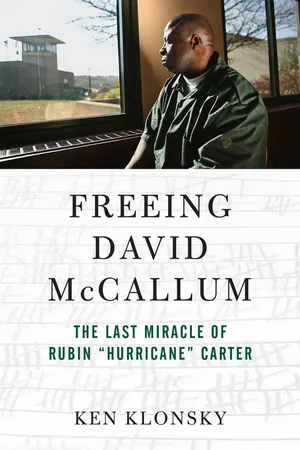
In April 2014, Rubin "Hurricane" Carter died after a long battle with cancer. David McCallum was exonerated and freed two months later, after serving 29 years in prison. This is the story of how Carter and his friend and coauthor Ken Klonsky worked for ten years to help free the wrongfully convicted McCallum. It details their struggles—from founding an innocence project, to finding lawyers willing to work pro bono, to hiring a private detective to sift through old evidence and locate original witnesses, and the most difficult part, convincing members of a deeply flawed criminal justice system to reopen a case that would expose their own mistakes. It eventually took a new district attorney, a documentary film, and a
New York Daily News op-ed written by Carter on his death bed to secure justice.
Freeing David McCallum tells a tale of frustration, agony, and undying hope, and the miracle that resulted in David's release.
Information
1
RUBIN CARTER
The Hurricane
It was a warm, muggy Toronto morning in the summer of 2002. My son, Ray, was at home sleeping off a party that ended after dawn broke. I lay awake the whole night, anticipating how the day would unfold. This summer vacation had a feeling of finality for us both: he was going into his last year of high school, and I was to begin my final year of teaching. I had driven to 155 Delaware Avenue, then the home of Rubin “Hurricane” Carter, to interview him for the Sun magazine. I was ridiculously early. Fear and anxiety had me getting caught behind some dump truck or getting a flat tire or losing my way in the city I had lived in for thirty-five years. I got out of the hot car and walked slowly around the block. The interview had been arranged at my home by an intermediary, a dissolute-looking fellow who was to die of alcohol-related illness a few years later. You are going to interview Rubin Carter, I kept telling myself, the famous boxer you hated in your teens; the same Rubin Carter who had been thrown into prison for a triple murder in Paterson, New Jersey, that you were sure he had committed; the same Rubin Carter who was now a legend. I had seen Norman Jewison’s searing film The Hurricane, about Carter’s wrongful conviction, in which the boxer is brilliantly portrayed by Denzel Washington.
I had actually met Rubin Carter previously when he visited the high school English class I taught. I had taken the class on a field trip to see the The Hurricane, and they were as overwhelmed as I was by Washington’s remarkable portrayal. Knowing that Carter lived in Toronto, I suggested to my students that we write to him and invite him to speak to us. It seemed a good life lesson for them to take the risk of rejection while getting a chance to accomplish something of value. Finding his home was easy because the son of my good friends lived across the street from him. The letters from the class moved Carter to call my home. In an act of inexplicable generosity—his speaking engagements in those years earned him minimally ten thousand dollars—he agreed to speak to us for no fee.
What happened that day at school was magical. Carter and I met with the principal in her office, where I first witnessed a part of his repertoire that became familiar to me over the years: glowing charm. He was the most charismatic individual I’ve ever known. He entered my classroom and spent an hour and a half “running off at the mouth,” as he later described it, talking about Og Mandino, spiritual awakenings, and life lessons that neither the students nor I could comprehend. But what he said was secondary to his presence. The fact that he was there made the moment memorable and life changing for those students. He was validating them; they were special that day; they were envied by other students. Many of them went on to become better students and more involved in the school and went on to graduate.
I understood intuitively that his presence was also a gift to me. I wanted to learn where his ideas originated from, what these ideas might mean to others, and what their ultimate meaning might be in my own life. The Sun expressed immediate interest in my interview proposal.
Carter’s house was red brick and large, one of thousands of sturdy winter-resistant homes in older Toronto neighborhoods. I climbed up the steps of the covered porch and rang the doorbell. My heart migrated to my throat. I rang again. Nothing. I sat on the railing, thinking he must be doing something that temporarily prevented his coming down. Five minutes later, beset by a different sort of anxiety, I rang again. Still nothing. Maybe the dissolute man had neglected to tell Carter about the appointment or had gotten the day wrong? Excitement slowly ebbed and turned into despair and then to humiliation. Briefcase in hand, I walked back to my car. Had I overreached?
Driving north past his house, I stopped and looked at the front door; seeing no one, I continued on. At that moment, a voice inside me said, You don’t spend months setting up an interview and then just go home. So I parked and walked back to a corner where I had spotted a pay telephone. (Yes, they still had those things at the time.) Still resisting the culture of the cell phone, I hadn’t bothered to take Carter’s number with me. My hand shaking, I called home and, when my groggy son answered, directed him to where he could find the number. He gave it to me, but I immediately forgot it after hanging up. So I had to call back. This time, in a very deliberate and condescending fashion, Ray read out the numbers . . . three times.
I couldn’t find another quarter, so I went into the corner store for change. Back inside the phone booth, the number eluded me yet again. To stop hyperventilating and to still my mind, I summoned up years of fruitless yoga and meditation. Calling Ray again might make him think that his father was on the verge of dementia. Concentrating fiercely, I heard his patronizing voice: 4 . . . 1 . . . 6 . . . 6 . . . 0 . . . I dropped in the quarter and punched in the number, and the phone rang at the other end.
A deep and authoritative voice answered: “Rubin Carter speaking. How may I help you?”
A deep breath. “Rubin?”
“Ken?”
“I’m calling from Bloor Street. You didn’t answer the door.”
He let loose the genuine laugh I was to hear hundreds of times during the course of our friendship. “That was you? I never answer the door. You have to call first.”
“But M—— never told me that.”
“M—— don’t know to say shit. Now come on up, my man.”
When I went back to Carter’s house, the door was open, but no one was there to greet me, aside from a giant fluffy gray cat that brushed past. I rang the bell again, then ventured inside. Carter came down the stairs smoking a cigarette, dressed in casual dark slacks and a dashiki with a gorgeous African print, his skin a darker shade of black. The house reeked of cigarette smoke and an additional annoyance: a very strong cologne. Whenever I returned home from seeing him, I would open a vial of eucalyptus in my car and throw my clothes in the washing machine.
It didn’t occur to me until later why he would splash on such a powerful fragrance, why, as I discovered, he would even bathe in it. For ten years in total, he had been in solitary confinement down in a dark hole at ancient Trenton State Prison. Given that he was only allowed to shower every fourteen days, the smell of his own body was repugnant to him. His preparations for being in public, in addition to the cologne baths, included the insertion of a custom-made glass eye—he had lost one eye after a botched retinal operation in the ill-equipped prison hospital—and a set of glistening false teeth. When male pattern baldness set in, he bought an Akubra, a wide-brimmed Australian hat, to wear at public events and speaking engagements and on television. But it wasn’t just vanity that motivated him. Since the justice system had stolen his youth and middle years, he was determined to take them back: he told his friends that his date of birth was now November 8, 1985, the year, month, and day he emerged from prison. An odd but compelling mixture of a man, he died at age twenty-nine—or seventy-seven, if you insist on being conventional.
“Phoenix, get on in here.” The cat obeyed. It had a beautiful face and less separation from its master than most of its breed. “Come on up, my man.” Carter waved at me to follow him.
On the stairway walls hung many photos, all of Carter with well-known people—Nelson Mandela, Denzel Washington, Norman Jewison, Ellen Burstyn, and Sugar Ray Robinson—and one iconic photo of Bob Dylan in a flop hat staring in at Rubin through a prison door.
Inside his office, he sat down in front of a well-ordered desk and motioned for me to sit a short distance across from him. He blew out a cloud of smoke, the kind of billow wherein the smoker actually disappears for a second. I began to cough. This did not bode well for my image, or for my allergies.
“Well, well, well, well, well.” He butted out. Fiercely, frighteningly, he asked, “What is this about?”
Just then I knew that he hadn’t bothered to read the numerous Sun magazine copies I had sent him.
When a person is falling, his brain subdivides time in much the same way the seconds tick down at the end of a basketball game. While seconds are the only measurement for twenty-three minutes, the final minute of each half is measured in tenths of a second. Those tenths suddenly take on significance. In just the same way, my mind subdivided tenths of a second into thousandths. I knew I needed to say something perfect to avoid getting thrown out the door.
“Posterity.” Yes, that bought me time for a full sentence. “Posterity, Rubin. People are going to know what you think, not just that you were a boxer and a wrongly convicted man.” He didn’t stop me, so I kept going. “The Sun gives the longest interviews of any magazine; they let you have your say.”
From the look on his face, whether by chance, luck, or intuition, I knew I had appealed to something inside him, his innermost need for serious recognition (having not yet received his two treasured honorary doctorates). He smiled and lit another cigarette. I took out my tape recorder and my writing pad. Suck it up, I thought. Wait until next time to ask him to stop smoking.
Carter then stood up, broad and powerful despite his smallish stature, and, with a mischievous look, walked out the door, closing it behind him. Ten seconds passed, the door opened, and he peered inside.
“Turn that thing on.” He pointed to the recorder. From the hallway, he boomed, “There are four kinds of knowing, Ken. The first kind of knowing is not knowing, or ignorance. You listening, my brother?”—Rubin Carter had just called me “brother”!—“Anybody can guess there’s a desk and a chair and the normal stuff you find inside an office. But what’s that person gonna know about the other contents in the office? Nothing! He can only guess, and he’s gonna be wrong most of the time. That’s ignorance. Spouting off when you don’t know a damn thing.”
Then he stuck his head inside the door. “The second kind of knowing is what I see from the door. I can’t know everything that’s in the office, but at least I have some facts in front of me. The desk is there; the window’s at the back. My guess about everything else is going to be educated but superficial; that’s superficial knowing.”
Then he stepped fully inside. “This is the third kind of knowing, Ken. I’m in the room. I see everything that’s in here and can name everything I see. It’s all in front of me. I’m not guessing anymore. I now know that the other Rubin Carters, the ignorant one behind the door and the superficial one, did not know the full contents of the room. But I do. I know it all . . . don’t I, Ken?”
I nodded, quietly assented, “I guess so,” while realizing that I was awaiting the kicker.
He laughed. “You guess, but you’re wrong. The third Rubin Carter, the one who just walked into the room and thinks he knows everything, is worse off than the other two. He’s asleep, but he’s convinced he knows what he really can’t know. He’s the dangerous one, like all people who judge things from what they see on the surface. Like people in a court of law. They can’t know the whole truth . . . and you can’t know it either. Can you? Damn right you can’t.” He laughed mockingly, sat down, and lit another cigarette, his body embracing the smoke like a doomed lover. Then he laid the lit cigarette in the ashtray. He liked doing that, keeping a lit cigarette in the ashtray.
“And that brings us to the fourth kind of knowing. I’m in the room, above the room, below the room, inside the drawers and the closets all at once. I don’t mean that. No—no—no.” He began to stammer. Pointing to the tape recorder, he said, “Turn that thing off! Turn it off!” Rubin had stammered as a child, a speech impediment so terrible that he could not speak a single full sentence before he was thirteen years old. His life was encompassed by ridicule, humiliation, and the meting out of violence to those who laughed. He sat there in front of me but not seeing me, struggling with words. He picked up the cigarette and dragged deeply.
“Turn it on again. These ideas . . . these ideas . . . mmmmmm”—a deep rumble—“It’s almost impossible to talk about. What I’m saying, Ken, is that this room doesn’t exist for the fourth Rubin Carter. Not at all. On a higher level of life, this room does not exist. That’s the level of consciousness. Consciousness. Consciousness.” He punctuated the word with his trademark smile, all-embracing and forbidding at the same time, and his laugh, which hinted a bit at self-mockery, but only a very little bit.
He went on. “Those first three Rubin Carters were all sleeping unconscious beings. Not the fourth. The fourth man . . . the fourth man . . . is not even Rubin Carter. This man is awake. This man woke up to this world of infinite possibility. From inside a prison cell, he woke up.” He stared into my eyes and held my gaze. Once again, he let out that sonorous laugh, that deep cackle.
“You hearing this, my brother? There are laws that govern this level of life: what goes around, comes around; every action has an equal reaction. These laws don’t exist on a higher level, but you don’t need to climb up a mountain to reach that higher level. You can even find it in a prison. The day-to-day life in a prison is the lowest level a man can be on this earth and still be alive. Nothing but savagery. Nothing but unconscious human insanity. People acting like machines—robbing, raping, killing one another. But the highest level is right inside you. It’s always been there; it will always be there until you die. You can find it anytime and anyplace you want, but you have to do ‘the work.’” I could not escape the feeling that he was speaking as much to me as to the readers of the magazine.
“What kind of work?” I asked.
“The work. On your inner self. That work is too difficult for most people. Even outside a prison. I never would have found myself if I hadn’t been in prison. That’s the miracle. A miracle is nothing but higher laws manifested on a lower level.” Dragging on the cigarette, he leaned back. This big house that he shared with Phoenix, this office, was his domain.
I began to think of a riddle: What’s the hardest thing in the world to find yet is sitting right next to you? I listen now to this first tape of many and remember my initial cynicism. Was he just blowing more smoke?
“You know what I’m talking about, Ken? Let me try and explain it a different way. I work with the law; I’m the founder and CEO of the Association in Defense of the Wrongly Convicted. Wrongly convicted people need a miracle to get them out of prison. The whole system is stacked against them. When one of them goes free, higher laws are acting on a lower level. The fact that you can see me sitting here in front of you is a miracle. This man here, who is Rubin Carter and who is not Rubin Carter, just narrowly escaped the electric chair.
“I don’t blame the law for wrongful convictions. I don’t blame police. I don’t blame prosecutors. I don’t blame judges. The law is just what it has to be on this lower level of existence. But don’t be mistaking it for the truth, my brother. You have t...
Table of contents
- Cover Page
- Title Page
- Copyright Page
- Contents
- Introduction
- 1 Rubin Carter: The Hurricane
- 2 David McCallum: The Prisoner
- 3 Oscar Michelen: The Lawyer
- 4 - STEVE DRIZIN - The False Confessions Expert
- 5 Ray Klonsky: The Brother and the Son
- 6 Chrissie Owens: The Witness
- 7 Laura Cohen: The Parole Resource
- 8 I, Poltergeist
- 9 Mr. DNA: The Suspect
- 10 Marvin Schechter: The Gadfly
- 11 Van Padgett: The PI
- 12 Ken Thompson: The District Attorney
- Epilogue
- Acknowledgments
- Appendix: Contrasting False Confessions
- Key Figures
- Index
Trusted by 375,005 students
Access to over 1.5 million titles for a fair monthly price.
Study more efficiently using our study tools.
Frequently asked questions
Yes, you can cancel anytime from the Subscription tab in your account settings on the Perlego website. Your subscription will stay active until the end of your current billing period. Learn how to cancel your subscription
No, books cannot be downloaded as external files, such as PDFs, for use outside of Perlego. However, you can download books within the Perlego app for offline reading on mobile or tablet. Learn how to download books offline
Perlego offers two plans: Essential and Complete
- Essential is ideal for learners and professionals who enjoy exploring a wide range of subjects. Access the Essential Library with 800,000+ trusted titles and best-sellers across business, personal growth, and the humanities. Includes unlimited reading time and Standard Read Aloud voice.
- Complete: Perfect for advanced learners and researchers needing full, unrestricted access. Unlock 1.5M+ books across hundreds of subjects, including academic and specialized titles. The Complete Plan also includes advanced features like Premium Read Aloud and Research Assistant.
We are an online textbook subscription service, where you can get access to an entire online library for less than the price of a single book per month. With over 1.5 million books across 990+ topics, we’ve got you covered! Learn about our mission
Look out for the read-aloud symbol on your next book to see if you can listen to it. The read-aloud tool reads text aloud for you, highlighting the text as it is being read. You can pause it, speed it up and slow it down. Learn more about Read Aloud
Yes! You can use the Perlego app on both iOS and Android devices to read anytime, anywhere — even offline. Perfect for commutes or when you’re on the go.
Please note we cannot support devices running on iOS 13 and Android 7 or earlier. Learn more about using the app
Please note we cannot support devices running on iOS 13 and Android 7 or earlier. Learn more about using the app
Yes, you can access Freeing David McCallum by Ken Klonsky in PDF and/or ePUB format, as well as other popular books in Social Sciences & Criminology. We have over 1.5 million books available in our catalogue for you to explore.