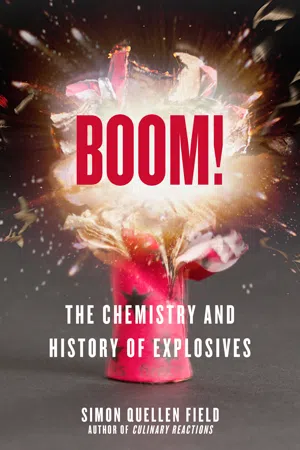
Black powder, the world's first chemical explosive, was originally developed during the Tang dynasty in China.It was a crude mixture at first, but over time chemists discovered the optimum proportion of sulfur, charcoal, and nitrates, as well as the best way to mix them for a complete and powerful reaction. Author and chemistry buff Simon Quellen Field takes readers on a decades-long journey through the history of things that go boom, from the early days of black powder to today's modern plastic explosives. Not just the who, when, and why, but also the how. How did Chinese alchemists come to create black powder? What accidents led to the discovery of high explosives? How do explosives actually work on a molecular scale?
Boom! The Chemistry and History of Explosives reviews the original papers and patents written by the chemists who invented them, to shed light on their development, to explore the consequences of their use for good and ill, and to give the reader a basic understanding of the chemistry that makes them possible.
- 288 pages
- English
- ePUB (mobile friendly)
- Available on iOS & Android
eBook - ePub
About this book
Information
1
BLACK POWDER
Black powder, a mixture of nitrates with sulfur and charcoal, was originally developed during the Tang dynasty in China, in the seventh century. This was the golden age in China, known for its poetry and painting, along with gunpowder and other inventions, such as wood block printing. With a population of fifty million people and vastly expanded borders, there were many resources available for the expansion of knowledge and technology.
In searching for medicines, Chinese practitioners experimented with many extracts and mixtures. They were already familiar with sulfur and charcoal, both of which have medicinal uses. They were also familiar with saltpeter, which in its impure form is a mixture of several nitrates, including sodium and potassium nitrates. Purified potassium nitrate, where enough of the sodium had been removed that the resulting crystals imparted a purple color to a flame, had been available for at least three centuries prior to its use in gunpowder.
Heating and burning mixtures was a common practice in making medicines, and heating charcoal or sulfur with nitrates generates a notable reaction. The Chinese named this mixture huo yao, or “fire chemical.” The first known recipes for black powder, written down as early as 1044, used less nitrate than is commonly used today. The nitrate is the oxidizer, and if the mixture was to be burned in the open air, it may not have been as necessary to have a lot of oxidizer. Later uses, in which the powder was confined in rockets or guns, would lead to mixtures with about 75% nitrate.
Of the three ingredients, charcoal was likely the easiest to procure. Charcoal was used in metal smelting and other industries because it burns very hot, and the temperature can be controlled easily by controlling the flow of air. Commercial production of charcoal was an involved affair. A stack of wooden logs was carefully made and covered in sod, clay, or earth to prevent outside air from getting in, with a chimney for controlled airflow. The wood was set on fire, and once it was well started, the openings for air were closed off with more sod, clay, or earth. The whole apparatus was carefully tended for as long as five days or more, and any leaks that developed were covered to prevent the product from going up in smoke.
As a source of combustible carbon, charcoal has some special properties that make it work better in black powder than other sources of carbon, such as coal or graphite. It is porous, and as the mixture of materials is finely ground together, the other ingredients are packed into the pores of the charcoal and remain finely mixed. It has other volatile compounds in it besides carbon, which reduce the ignition temperature and speed the burning. The high carbon content leads to high temperatures when burning, which is essential in making the gases expand quickly.
Sulfur is widely available in nearly pure form near volcanic regions and hot springs. As volcanic gases escape from openings in the ground, the brim of the opening becomes covered in sulfur as the gases cool (hence the name brimstone). It was used for medicines, fumigation, and bleaching. In addition to sulfur mining, the Chinese had extracted sulfur from iron pyrite as early as the third century.
Sulfur ignites at a very low temperature, 190°C, and when finely powdered, can have a flash point as low at 166°C. Above about 444°C it becomes a gas. Along with the trace volatiles in the charcoal, sulfur speeds the burning of the final powder. The gases produced by the burning powder are carbon dioxide, carbon monoxide, and nitrogen, and at room temperature and normal atmospheric pressure, these gases would take up 380 times as much space as the original powder. But at the temperatures reached in the reaction, the gases expand to something closer to 3,000 times the original volume of powder. As this happens in twenty-five microseconds, a bang is heard.
Nitrates were likely the most difficult black powder ingredient to procure. While they exist in small quantities in animal dung, extraction would have been uneconomical. However, nitrates are a by-product of nitrifying bacteria (such as nitrobacter and nitrosomonas), which convert other nitrogen-containing molecules in compost heaps into nitrates. Over time (after about two years), a dung heap becomes richer in nitrates as the bacteria grow. The result is a much better fertilizer than animal dung alone, and farmers learned to tend the manure heaps by turning them to allow the bacteria to get oxygen, to add urine to the heaps as feedstock for the bacteria, and to build the piles on beds of clay and protect them from rain and sun. With all of these careful management processes, the result was rich enough in nitrates that crystals would form on surfaces.
Potassium nitrate decomposes when heated above about 550°C, releasing potassium nitrite and oxygen. In black powder at this temperature, the sulfur is already a gas and is well above its ignition temperature (190°C). The ignition temperature of charcoal (349°C) has also been exceeded at this point. Above about 790°C, the potassium nitrite then decomposes, releasing nitrogen and more oxygen to combine with the remaining sulfur and charcoal.
Early gunpowder may have been made from those unpurified crystals of potassium nitrate, sodium nitrate, ammonium nitrate, and strontium nitrate. But potassium nitrate can be purified from those dung-heap scrapings by making use of rudimentary chemical knowledge.
First, the nitrates are leached out of the nitrified manure by pouring water into it and collecting the nitrate-laden water the next day, which is then run through more nitrified manure, to get a higher concentration of nitrates. This extra concentration saves energy, as the water will later be boiled away.
The nitrate-laden water contains calcium nitrate, magnesium nitrate, sodium chloride, and potassium chloride, as well as the desired potassium nitrate. To convert the other nitrates to potassium nitrate, potassium hydroxide is added. This is done by adding wood ashes, which are rich in potassium hydroxide. The calcium and magnesium salts precipitate out of the solution and are filtered out.

Potassium nitrate
The refining process continues by boiling the filtered liquid. Potassium nitrate is more soluble in boiling water than common salt (sodium chloride) is. The salt gradually precipitates out, where it can be removed, and organic matter floats to the top, where it can be skimmed off.
When the liquid cools, the potassium nitrate crystallizes out and falls to the bottom, where it can be collected. The result contains 75% to 95% potassium nitrate. Further refining involves adding water to the crystals, adding protein (glue or blood) to coagulate any organic matter that can then be filtered out, and recrystallizing the potassium nitrate, stirring constantly as the mixture cools so that masses of crystals do not form (which would trap impurities between them).
Finally, the collected fine crystals are washed with a saturated solution of pure potassium nitrate (from prior refining). This cannot dissolve any more potassium nitrate, so the crystals do not dissolve, but it will wash away any remaining impurities and dissolve any salt.
As mentioned earlier, the first Chinese black powders were likely made with impure ingredients and without the optimum amount of nitrate oxidizer. As more experience with the manufacturing process evolved, recipes improved. One key discovery was that the burning happens faster if the mixture is very finely powdered. This is useful for making bombs and for use in small arms, but fast-burning fuel is not good for large cannons or rockets. To slow down the burning, the fine powder is mixed with small amounts of water and a binding agent (such as dextrin, a modified starch) and then forced through a sieve to make larger particles with less surface area. The ingredients thus remain finely mixed, as they were in the fine powder, which guarantees proper combustion, but the lower surface area reduces the combustion speed. At the same time, the spaces between the larger grains allowed the flame to set all the grains burning at once, so the pressure buildup started sooner and was more constant.
Burning black powder in air produces lots of nice smoke and flames, and it burns much faster than other materials do. This alone would have made it remarkable to early Chinese experimenters. But it is when black powder is confined that it produces the loud bang of the firecracker. It could be packed into bamboo tubes and thrown into a fire, creating an explosion.
The first paper firecrackers appeared around the tenth century, attributed to the Chinese inventor Li Tian. He is still celebrated in China every April 18, and parts of his workshop have been preserved by worshippers, giving evidence for the time line. Around the same time, the invention of the fuse allowed the user to light the firecracker and get away before it went off. Early fuses, made of straws or feather quills filled with black powder, were not very reliable. It was only much later (in the 1800s), when large amounts of black powder were used in mining, that more reliable fuses were developed.
During the Song dynasty in China (AD 960 to 1279), black powder was used in warfare as an incendiary. Since the recipes used then were low in nitrates, they burned rather than exploded. Black powder, wrapped in paper and attached to the shafts of arrows and equipped with a fuse, burned hotter than the burning pitch used earlier and was harder to put out, since it had its own oxygen source. Hollow metal balls with holes in them were filled with black powder and lofted at enemies from catapults. Again, the very hot flames shooting out the holes ignited whatever flammable material they encountered. Sometime around 1100 the emperor Jen stopped all export of sulfur and saltpeter, and made a state monopoly out of the manufacture of black powder to prevent its use by enemy armies.
The Song dynasty (at least the northern part) fell to the Jin invaders from Korea when the capital Kaifeng was attacked. During that battle, in the year 1126, the first exploding bombs were used against the invaders. Because the low nitrate content of the powder could not burn fast enough to burst strong container walls, they were not much more than big firecrackers made of bamboo or paper and produced mostly noise and smoke, although the bombs contained as much as four pounds of powder and were probably effective incendiaries as well. But despite this new technology, the battle was lost in 1127.
By 1150 the invaders (now the Jin dynasty) were manufacturing saltpeter in manure heaps designed for that purpose and manufacturing black powder for weapons. They perfected the recipes, adding more nitrate until the powder could burst iron bomb casings. By holding up against more pressure, the bombs could deliver much more power than the earlier paper bombs could. When, in 1231, the invading Mongols attacked Kaifeng, these bombs were used to defend the city. The explosions charred areas scores of yards square and could be heard over 30 miles away. The shrapnel could pierce the Mongol iron armor, and bombs lowered on chains from the city walls blew the attackers to pieces.
Eventually, however, the Mongols under Genghis Khan prevailed and the Jin dynasty fell. The Mongols, with their highly effective cavalry tactics, brought the new weapons to later conflicts. By 1274, under Kublai Khan, the grandson of Genghis, they attacked the remaining Southern Song dynasty, adding the remainder of China to their expanding empire.
For the duration of the Mongol Empire, bomb-making technology continued to improve. Larger bombs, bombs with added shrapnel, and bombs with shrapnel mixed with noxious chemicals and waste designed to maim, blind, and infect the enemy were created and deployed. But this was also the era of the rocket.
The first rockets were likely the arrows discussed earlier, equipped with black powder in paper tubes attached to the shaft. A relatively small change to that design resulted in a tube that generated extra thrust for the arrow as the powder burned, exiting through the hole made for the fuse.
Fire lances, which were handheld tubes filled with black powder and ignited, had been used for some time already as frontline weapons, spewing fire for several feet in front of the operator. Think of these as an early flamethrower. The flames would persist on the order of five minutes or so. An operator of such a weapon might feel a force pushing back, but it would not be much unless there was some constriction (a nozzle) where the flames left the tube. This would allow pressure to build up in the tube, propelling the gases forward at a higher speed. Fire lances were used by the Jin defending Kaifeng from the Mongols in 1232 and may have been in use as early as 1000.
As early as 1256, when the Mongols attacked the Assassins, the use of rocket-assisted arbalest arrows allowed ranges of up to two miles. A type of large crossbow, the arbalest likely provided much of the propulsive power, but to reach that distance, the rocket would have certainly helped. With a delayed fuse, a rocket could take over the propulsion before the arrow pointed down, adding to the range and possibly to the penetrating power on impact. It would not have had to be powerful enough to launch itself.
When a rocket is self-launched, its initial velocity is low, and this greatly reduces the accuracy. Starting with an arrow launched from a powerful arbalest, the rocket would ignite when the aerodynamics of the speeding arrow had already stabilized it, making it an effective weapon. And there would obviously be less powder needed in the rocket. Without the rocket assist, arbalests of the time had a range of about a quarter of a mile.
Unassisted by the speed and aerodynamics of an arrow, a tube filled with powder and closed at one end would propel itself along the ground in a random fashion, unable to aim. Such devices, known as “ground rats,” were in use sometime after 1224 and provided amusement in the court of the emperor.
One record of rockets being used as signaling devices dates to 1272, during the Mongol siege of Xiangyang. Defenders had quietly left the city in boats in the night to try to bring in supplies. Seeing masts in the dark, they signaled what they thought were Song ships come to help. The ships were instead manned by Mongols, who saw the flares and captured the boats and crews, leaving the city cut off from supplies. These signal rockets may have been the first rockets that did not need the assistance of a launching bow, as accuracy would not be as important for this use.
Rockets continued to improve in subsequent years. Technicians learned to increase the surface area of the burning front by making the powder charge hollow. The powder thus formed its own tube inside the containing tube. Nozzles were made to increase the pressure, so the gases would escape at higher speed. This greatly increased the propulsive force. As with the arrows before them, rockets could carry explosive charges. Adding a second stage, so that one rocket lifted another one, gave them still greater range.
Not much has survived regarding the methods by which the early makers of black powder practiced their craft. But there are more recent documents, such as one from the American Civil War, where the practice of making saltpeter (potassium nitrate) for the Confederate war effort was laid out in a pamphlet encouraging farmers to produce it.
The Northern blockade was quite effective in c...
Table of contents
- Cover
- Title Page
- Copyright
- Dedication
- Contents
- Introduction
- 1 Black Powder
- 2 Black Powder Guns
- 3 Fulminating Compounds
- 4 Guncotton and Smokeless Powders
- 5 Nitroglycerin
- 6 Picric Acid
- 7 Trinitrotoluene
- 8 Tetryl
- 9 Pentaerythritol Tetranitrate (PETN)
- 10 Cyclotrimethylenetrinitramine (RDX)
- 11 Cyclotetramethylene Tetranitramine (HMX)
- 12 Hexanitrohexaazaisowurzitane (HNIW or CL-20)
- 13 Triaminotrinitrobenzene (TATB)
- 14 Polymer-Bonded Explosives (PBX)
- 15 Testing Explosives
- 16 Insensitive Explosives
- 17 Shaped Charges
- 18 Types of Explosives
- 19 Thermobaric Explosives
- 20 Eco-friendly Explosives
- 21 High-Energy Rocket Fuels
- 22 A Brief History of Explosives in the Home
Trusted by 375,005 students
Access to over 1.5 million titles for a fair monthly price.
Study more efficiently using our study tools.
Frequently asked questions
Yes, you can cancel anytime from the Subscription tab in your account settings on the Perlego website. Your subscription will stay active until the end of your current billing period. Learn how to cancel your subscription
No, books cannot be downloaded as external files, such as PDFs, for use outside of Perlego. However, you can download books within the Perlego app for offline reading on mobile or tablet. Learn how to download books offline
Perlego offers two plans: Essential and Complete
- Essential is ideal for learners and professionals who enjoy exploring a wide range of subjects. Access the Essential Library with 800,000+ trusted titles and best-sellers across business, personal growth, and the humanities. Includes unlimited reading time and Standard Read Aloud voice.
- Complete: Perfect for advanced learners and researchers needing full, unrestricted access. Unlock 1.5M+ books across hundreds of subjects, including academic and specialized titles. The Complete Plan also includes advanced features like Premium Read Aloud and Research Assistant.
We are an online textbook subscription service, where you can get access to an entire online library for less than the price of a single book per month. With over 1.5 million books across 990+ topics, we’ve got you covered! Learn about our mission
Look out for the read-aloud symbol on your next book to see if you can listen to it. The read-aloud tool reads text aloud for you, highlighting the text as it is being read. You can pause it, speed it up and slow it down. Learn more about Read Aloud
Yes! You can use the Perlego app on both iOS and Android devices to read anytime, anywhere — even offline. Perfect for commutes or when you’re on the go.
Please note we cannot support devices running on iOS 13 and Android 7 or earlier. Learn more about using the app
Please note we cannot support devices running on iOS 13 and Android 7 or earlier. Learn more about using the app
Yes, you can access Boom! by Simon Quellen Field,Simon Quellen Field in PDF and/or ePUB format, as well as other popular books in Biological Sciences & Science History. We have over 1.5 million books available in our catalogue for you to explore.