- 240 pages
- English
- ePUB (mobile friendly)
- Available on iOS & Android
eBook - ePub
About this book
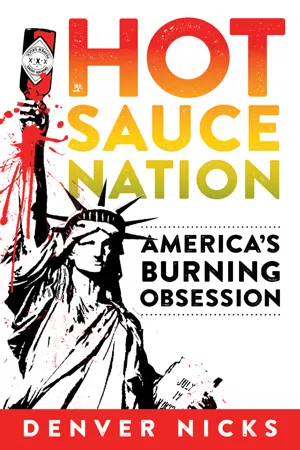
Hot Sauce Nation is a red-hot ride through the story of hot sauce in America. Why should the world's most painful food have inspired such adoration in the USA? While chili pepper-based sauces have transformed cuisines worldwide, successive waves of immigrants landing in the New World have turned up the heat on the American palette with their native pungent sauces. Today, the fast-growing hot sauce industry has made it into everything from salsa to barbecue, buffalo wings, chocolates, and cocktails, inspiring passionate romances and changing people's lives along the way. With fascinating detours into science, history, and current events, as well as stories of the people who make, use, sell, and love hot sauce, this flavorful volume explores the unique hold the condiment has on the American heart.
Information
Topic
ArtSubtopic
Popular Culture1
A BRIEF HISTORY
OF HEAT
In 1491, the world was in many of its aspects and characteristics a minimum of two worlds—the New World, of the Americas, and the Old World, consisting of Eurasia and Africa. Columbus brought them together, and almost immediately and continually ever since, we have had an exchange of native plants, animals and diseases moving back and forth across the oceans between the two worlds. A great deal of the economic, social, political history of the world is involved in the exchange of living organisms between the two worlds.
—ALFRED W. CROSBY, JR.,
AUTHOR OF THE COLUMBIAN EXCHANGE
AUTHOR OF THE COLUMBIAN EXCHANGE
In the beginning, God created a man and named him Narama and a woman whom he named Uxuu. Narama and Uxuu lived in a land of plenty where they wanted for neither food nor sustenance. In time, God cast them from this Eden.
Having been evicted from his homeland, Narama began to sweat so profusely that he came to be covered in salt. The Creator was, at the time, busy giving jobs to the creatures of the earth—he’s the keeper of this, she’s the keeper of that, and so on. Uxuu, the first woman, was put in charge of the seeds and fruits of summer, and of rain. Narama, the first man, was given the enviable job of overseeing salt, mescal, and chili.
With roles assigned, the Creator invited everyone to a big potluck fiesta around a table situated on the center of the earth, to which all the creatures of creation brought their special foods. The last to arrive, Narama, showed up naked and covered in salt—patron saint of mescal, remember. With everyone seated around the table, Narama scraped salt from his face and sprinkled it on the food. He then grabbed his testicles, which turned into chili pods, plucked them, and began sprinkling his fiery new spice onto the fare.
This went over with the other guests about as well as one might expect. Around the table creatures shouted in protest and scolded Narama for defiling dinner. He asked that they give him a chance. If everyone else got to contribute their thing, shouldn’t he be able to add his own specialty to the buffet? Just try it and you’ll see, he pleaded, that there’s nothing better for a good meal than salt and chili.
Brave souls that they were, the others gave Narama’s chili testes a shot. They ate, it burned, and they loved it. And thus, from the scrotum of the patron saint of mescal, who showed up late to a party naked and covered in salt, the first creatures on earth were converted into the world’s original chiliheads.
The above comes from the creation mythology of the Cora, a people indigenous to central-western Mexico who still speak a language related to the Nahuatl tongue spoken by the Aztec. It’s not incidental that Narama was the patron saint of both chili and salt, the only spice that is not a plant but a mineral essential for human survival (or, for that matter, the patron saint of mescal, but that’s another story). In preindustrial societies salt was a rock on which empires were built and crushed, and the quest for it a matter of life and death. Let the fact that the saint who spoke for salt also spoke for chili speak for itself.
The Cora creation story is a particularly colorful one, but it is far from unique. Indigenous cultures throughout the Americas celebrate and revere the chili as a food, a medicine, and a sacrament central to their place in the cosmos. The Inca believed the chili was one of the four original gods and the brother of the first Inca king. The Maya prescribed chilies to treat a cough and a sore throat. The Aztec used an early form of pepper spray as kind of primitive chemical warfare by burning huge amounts of chili upwind from their enemies. Like many cultures after them, the Aztec punished errant children by making them eat a spicy chili pepper. They also dropped a little chili juice on a tooth to soothe its aching. The Aztec, and other civilizations, held the plant so sacred that abstinence from chili and sex was an important form of religious fasting.
Scientists believe the chili plant most likely emerged out of the evolutionary soup in a small area in Bolivia north of Sucre that straddles the Río Grande, a river that flows easterly into the Mamoré and ultimately the Amazon. Bolivians today enthusiastically eat the ulupica chili, a mostly wild variety that closely resembles members of that original pioneer community. These, or the similar but domesticated locoto pepper, are the spicy ingredient in a simple sauce made of chilies, tomatoes, and sometimes a little salt known as llajwa. Because of the geographic and genetic proximity of the ingredients and people who make llajwa to the ingredients and people who lived in the area in prehistory, it may well be that llajwa was—ready for it?—the world’s first hot sauce.
On the other hand, the earliest evidence we have of humans bold enough to chow down on chili peppers comes from excavations of a group of cave dwellings in southern Mexico led by archaeologist Richard Stockton MacNeish in the 1960s. Those digs turned up evidence dating to as early as about 6000 BCE of elaborate burials, including one of a child with its skull smashed in—in his report MacNeish suspects there may have been “some sort of dirty work afoot . . . perhaps evidence of human sacrifice?”—as well as evidence of squash and chilies in the remains of discarded vegetable matter and, in case you needed proof that these people were actually chewing and swallowing the chilies, in caprolites, the polite term for the fossilized poop.
The earliest known word for a chili pepper is in the Proto-Oto-Manguean language spoken in roughly the same region of southern Mexico as far back as 6,500 or more years ago. The word, rendered as *ʔki3 in the International Phonetic Alphabet, is a hypothetical reconstruction of a word that no longer exists in a language that has gone extinct, so it’s impossible to say for sure how exactly the oldest known word for the chili sounded coming out of the mouths of prehistoric Proto-Oto-Manguean speakers. But linguistic anthropologist Dr. Cecil Brown, who led a study on the subject, points us in the right direction. “I guess that the closest English word to the Proto-Oto-Manguean word for chili peppers,” Brown told me, “is key.”
The word chili comes to English by way of Mexican Spanish from the Aztec language Nahuatl, and it’s not alone. In addition to chili, English also inherited from Nahuatl the words chocolate, mesquite, avocado, sapodilla, tomato, peyote, and, for what it’s worth, shack.
As with many crops, exactly when and where wild chili pepper plants were domesticated is difficult to determine, largely because domestication is more a gradual process than a revolution. Small hunter-gatherer bands might cull and nurture a group of wild plants, or transplant a few closer to camp, well before larger villages start plowing and harvesting fields. But it’s certainly plausible—indeed, it seems only logical—that humans were eating wild chilies before they started farming them.
“We know from the paleobiolinguistic evidence that people were interested in chili peppers in some parts of the Americas at least one thousand years before (in the case of Oto-Manguean at least three thousand years earlier than) the development of village farming,” says Dr. Brown. “Whether this interest involved domesticated or wild peppers is difficult to determine.”
What we are reasonably sure of is that people started cultivating different varieties of chilies independently of one another in different parts of Latin America.
It’s a truism that taxonomic classification is an inexact science at best—in its unrelenting indifference nature recognizes no species or genus, only the spectrum of life in its myriad forms—but that fact has never been more evident than in the case of chili peppers.
All chilies belong to the genus Capsicum, a word that comes to us from Joseph Pitton de Tournefort, the seventeenth-century French botanist at the royal garden of Louis XIV and a forebear of modern taxonomy, whose posthumously published Institutiones rei herbaria contains the first description of the genus. Why Tournefort assigned chilies the moniker remains a matter of speculation, but it’s generally believed that he named it for either the Latin capsa, meaning “box”—a reference to the generally hollow interior of a chili pepper—or the Greek kapto, meaning “to bite,” in reference to the obvious. Debate over the precise boundaries of and within the genus Capsicum has been simmering ever since.
Of the twenty-five or so known species of chili, just five (or four, or three, depending on how you slice it) have been domesticated, and within each are numerous cultivars, varieties of the species further refined through cultivation.
Capsicum pubescens, so named because of its hairy leaves, is found almost exclusively in midelevation areas running along the Andes mountains from Colombia to northern Chile. This is the locoto pepper used today in the ancient Bolivian llajwa hot sauce and a close relative of the wild ulupica peppers that most resemble the ancestral crew.
Capsicum baccatum is a variety found primarily in a wide band across South America, with a great many cultivars ranging from hot to mild, like the South American aji and the bishop’s hat, so named because of its bizarre flattened-cone shape.
The following three are closely related, and there is ongoing debate within the taxonomic community as to where, precisely, lie the lines between species. We won’t wade into that debate.
Capsicum chinense is not a Chinese pepper but a Brazilian one, originating in the Amazon and endemic in pre-Columbian times to a wide swath of northern South America, Central America, and the Caribbean. Cultivars include some of the hottest peppers on earth, such as the habanero, Scotch bonnet, Carolina reaper, and Bhut Jolokia, also known as the ghost pepper.
Capsicum frutescens is both widely used and not. Few of its cultivars are grown in any significant quantities except the Peri Peri pepper in Africa and the big one, tabasco, used in the eponymous sauce.
Capsicum annuum—yet another naming foible, since in the absence of frost this species is not an annual but a perennial—is by far the most widely grown species. Its cultivars include the bell pepper, ancho, jalapeño, serrano, cayenne, and many others.
Now for a word on pepper.
On a day in late April 1493, down the crowded, crooked streets of medieval Barcelona, in the vaulted banquet hall of the Grand Royal Palace, Christopher Columbus bowed before Queen Isabella of Castile and King Ferdinand of Aragon, and—we must assume—took a deep and uneasy breath to steady his quivering heart.
The Genoese navigator had just returned from a voyage around the world to the east end of Asia and back. The expensive trip had been largely funded by the monarchs before him, and he’d brought back an odd and somewhat disappointing assortment of souvenirs: six unquestionably terrified Indians, two parrots (green and yellow), a regrettably small amount of gold, and some cinnamon, which did not, all agreed, taste right. Missing from Columbus’s assortment of proofs that he’d made the journey was an item the Italian merchant Marco Polo had brought back to much acclaim from his own trip to Asia via the overland eastern route two centuries earlier: black pepper. Indeed, Columbus had been partly inspired by Polo to make his journey and had taken with him a heavily annotated copy of the account of Polo’s travels. Finding a better and cheaper way to get to pepper was sort of the whole point of getting to the Far East by sailing west in the first place.
Though always exotic, for the European upper classes spices were more or less readily available in the world of antiquity, when traders along the rim of the Indian Ocean from East Asia to Arabia maintained a robust mercantile network that connected the Far East to the Mediterranean and beyond. Records survive of Roman sentries using pepper to season their meals while keeping tense watch against Caledonian barbarians at Hadrian’s Wall in the far north of modern-day England. Notwithstanding the occasional hiccup, throughout the Middle Ages, trade between Europe and the East continued such that a taste for spices among Europeans steadily grew. In time, even people outside the upper gentry could occasionally afford to enliven their food with exotic Oriental spices. Pepper was the most prized spice of all.
It’s difficult for moderns to comprehend the place pepper held in the European minds of the distant past. Spices came from farther away than nearly any European had ever traveled, and they were, on the whole, outrageously expensive, marked up by middlemen on the long trade routes from their distant places of origin. The name given by Europeans to the Spice Islands was, in its time, a literal description of a place shrouded in myth and mystery whence came some of the most prized commodities known to humankind. Every clove consumed on earth came from a string of five tiny volcanic islands in eastern Indonesia. All nutmeg came from a similarly minuscule archipelago not far to the south. The world’s pepper came from the jungles of southern India and out through the Malabar Coast on the southwestern tip of the subcontinent.
In a world with virtually no long-distance communication or reliable maps, when rumor, fantasy, and terror slathered together in the mind to paint a fearsome mirage of the world beyond the small confines of one’s own immediate experience, spices were precious and tangible artifacts from alien lands—specifically the Orient, with its fabled harems, infidels, and exotic seductions. Many believed spices possessed powerful medicinal, psychoactive, and sometimes dangerous properties, especially as aphrodisiacs. Pepper in particular was looked on as a treacherous narcotic capable of awakening overpowering lust—or sexual prowess, depending on one’s point of view.
Take, for example, a tale from the extraordinary life of Duke William IX of Aquitaine, a lyric poet and early troubadour who, as author Jack Turner puts it in his essential Spice: The History of a Temptation, “on account of his riotous living” managed to both lead a minor Crusade and be excommunicated by the Vatican. Twice.
In a poem that professes to recount a not altogether unflattering misadventure—today we might call his tale a “humblebrag”—William tells of a summer’s day when, riding through Auvergne, in modern-day France, he was abducted by two noble ladies who imprisoned him in their castle and put him to use for a week of steamy ménage à trois. William confesses that before regaining his freedom he went 188 rounds, aided by a meal of two fat chickens, bread, wine, “and the pepper laid on thick.”
“I nearly broke my tool and burst my harness,” William laments. “I can’t express the remorse that overtook me.”
I’m sure.
To the medieval European, educated by folk wisdom and interpretations of the Bible handed down by church authorities, spices were of such encha...
Table of contents
- Cover Page
- Title Page
- Copyright Page
- Contents
- Acknowledgments
- Introduction
- 1 - A Brief History of Heat
- 2 - Some Like It Hot
- 3 - Becoming a Hot Sauce Nation
- 4 - Voodoo Chile
- 5 - Harissa Explains It All
- 6 - Cooking with chilies in H-Town
- 7 - Cashing in on Capsaicin
- 8 - Chicken Wings and Southern Things
- 9 - Ça Pique
- 10 - The Last Dash
- Selected Bibliography
- Index
- Photo insert
Trusted by 375,005 students
Access to over 1.5 million titles for a fair monthly price.
Study more efficiently using our study tools.
Frequently asked questions
Yes, you can cancel anytime from the Subscription tab in your account settings on the Perlego website. Your subscription will stay active until the end of your current billing period. Learn how to cancel your subscription
No, books cannot be downloaded as external files, such as PDFs, for use outside of Perlego. However, you can download books within the Perlego app for offline reading on mobile or tablet. Learn how to download books offline
Perlego offers two plans: Essential and Complete
- Essential is ideal for learners and professionals who enjoy exploring a wide range of subjects. Access the Essential Library with 800,000+ trusted titles and best-sellers across business, personal growth, and the humanities. Includes unlimited reading time and Standard Read Aloud voice.
- Complete: Perfect for advanced learners and researchers needing full, unrestricted access. Unlock 1.5M+ books across hundreds of subjects, including academic and specialized titles. The Complete Plan also includes advanced features like Premium Read Aloud and Research Assistant.
We are an online textbook subscription service, where you can get access to an entire online library for less than the price of a single book per month. With over 1.5 million books across 990+ topics, we’ve got you covered! Learn about our mission
Look out for the read-aloud symbol on your next book to see if you can listen to it. The read-aloud tool reads text aloud for you, highlighting the text as it is being read. You can pause it, speed it up and slow it down. Learn more about Read Aloud
Yes! You can use the Perlego app on both iOS and Android devices to read anytime, anywhere — even offline. Perfect for commutes or when you’re on the go.
Please note we cannot support devices running on iOS 13 and Android 7 or earlier. Learn more about using the app
Please note we cannot support devices running on iOS 13 and Android 7 or earlier. Learn more about using the app
Yes, you can access Hot Sauce Nation by Denver Nicks,Denver Nicks in PDF and/or ePUB format, as well as other popular books in Art & Popular Culture. We have over 1.5 million books available in our catalogue for you to explore.