George Ehrlich Award Recipient
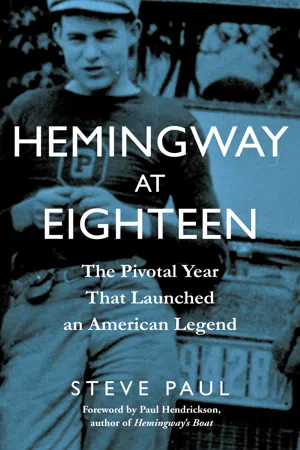
In the summer of 1917, Ernest Hemingway was an eighteen-year-old high school graduate unsure of his future. The American entry into the Great War stirred thoughts of joining the army. While many of his friends in Oak Park, Illinois, were heading to college, Hemingway couldn't make up his mind and eventually chose to begin a career in writing and journalism at the
Kansas City
Star
, one of the great newspapers of its day.
In six and a half months at the
Star, Hemingway experienced a compressed, streetwise alternative to a college education that opened his eyes to urban violence, the power of literature, the hard work of writing, and a constantly swirling stage of human comedy and drama. The Kansas City experience led Hemingway into the Red Cross ambulance service in Italy, where, two weeks before his nineteenth birthday, he was dangerously wounded at the front.
Award-winning writer Steve Paul takes a measure of this pivotal year when Hemingway's self-invention and transformation began—from a "modest, rather shy and diffident boy" to a confident writer who aimed to find and record the truth throughout his life.
Hemingway at Eighteen provides a fresh perspective on Hemingway's writing, sheds new light on this young man bound for greatness, and introduces anew a legendary American writer at the very beginning of his journey.
eBook - ePub
Hemingway at Eighteen
The Pivotal Year That Launched an American Legend
- 256 pages
- English
- ePUB (mobile friendly)
- Available on iOS & Android
eBook - ePub
About this book
Information
1
Summer of Indecision
You know you are much better fitted to be a newspaper man than anything else.
—LUCILLE DICK TO ERNEST HEMINGWAY
The potato beds at Longfield Farm were parched. From the other side of the lake, Ernest Hemingway could stand in the perforated tree-shade near the family cottage and peer over toward the brown dirt he’d been working so hard that summer. His hands were toughened by hay cutting and shed building, and that part of it was done now. It was surprisingly cool for early August but dry enough to worry that the potatoes and the beans were in trouble. The fish were running good, though. A few nights earlier, after a long day in the field, he’d pulled some big rainbows and a two-pound brook trout out of the water near Horton Bay. And as he did often that summer while fishing the cool Michigan water and toiling in the summer fields, he churned the options in his mind. This, he knew, would be his last boyhood summer. Yet it was still unclear how his adult life would unfold.
His graduation from Oak Park and River Forest High School in June, five weeks before his eighteenth birthday, led straight to uncertainty. Many of Hemingway’s friends in Oak Park would be off to the University of Illinois. His yearbook picture caption announced the same regarding his intentions, though Cornell and Princeton had also become tempting. His sister Marcelline was bound for Oberlin. And Hemingway, too, might have gone to that liberal Ohio school, because it was a family tradition. But college disappeared from his plans that year. Perhaps family finances were stretched too far to accommodate both Marcelline and Ernest in college. Or so went the rumors, according to one classmate: “We all thought it was unfair, as we kids felt that he should have had prior right.” Still, Dr. Clarence Hemingway’s small-town medical practice went only so far, especially with six children and an ambitious wife in the house. One thing Grace Hemingway wanted was her own cabin at the lake, a quiet place away from the family’s Windemere cottage, a place where she could sing and perhaps paint, and that would come in due time.
Marcelline was a year older than her brother; she had been held back in grade school to concentrate on music, and thus she and her brother left high school at the same time. So if only one of them could go to college first, she had an advantage. But most likely, Marcelline was more determined than Ernest to advance to Oberlin. For her brother, college did not seem all that necessary. He liked to find things out for himself. Hemingway, perceived as the class “prophet,” could exude a certain self-confidence, bolstered by his strapping good looks. The United States had just entered the war in Europe, and the idea of serving in the military also set in. But he placed that aside for a while, mostly discouraged by his father, who insisted he was too young. Nevertheless Hemingway already had built his own arsenal of interests. He had already absorbed the wisdom of his elders in the books and in the writing he’d explored in high school. He’d read Shakespeare. He’d kept detailed diaries. He’d written short stories. He’d chronicled excursions in the woods and on the Des Plaines River near his home. Sure, he might eventually get to the state university, possibly the following year, but first he wanted to get some work and life away from home under his belt.
As usual, the family had headed up from Oak Park for another summer season in the north country near Michigan’s Little Traverse Bay. This year, for the first time, Clarence had a horseless carriage, a Model T Ford. The girls had gone with an aunt up Lake Michigan on the Manitou steamer, but Clarence drove Ernest, his wife, and the youngest, Leicester, on a five-day journey from their home. It was a road trip not without incident—a blown tire and other mechanical setbacks slowed them down. But they’d had a jolly gathering with relatives on the way and arrived at the cottage on Walloon Lake no worse for the wear.
Hemingway, now almost six feet tall, asserted his independence by pitching a tent outside, across the lake on the family’s Longfield Farm acreage. Though his summer was not spent in total isolation from his family, it might as well have been. He was stubborn, combative, and intent on doing things his way. Oak Park, Illinois, where the Hemingways lived in a comfortable Victorian home, was a place where “citizens took pride in the past and distrusted the future, especially the new liberties and wild music favored by the younger generation.” Hemingway was certainly interested in the liberties. He was clever, funny, somewhat unkempt—all uncharacteristic of the straitlaced Oak Parkers. And he kept his parents at arm’s length and beyond. Dr. Hemingway was “a very arbitrary, very gruff man,” said one of Hemingway’s old friends. “He and Ernest did not get along then or at any time and I think home was none too attractive to Ernest.”
In one way it seems ironic that Ernest and his mother didn’t get along either. Grace Hall Hemingway, a woman devoted to life’s creative pursuits, demanded that people have spunk and stand up. Most people thought of her as domineering. “My mother had little tolerance for people who had no gumption,” Hemingway’s younger sister Carol Hemingway Gardner recalled late in her life, adding that gumption was one of her mother’s favorite words. “She herself was full of ideas and the will to carry them out. She was not interested in pale people who lamented their fate or who had no plans for the future.” Hemingway may have dithered about his future in that summer of 1917, but he was hardly of the pale variety. Yet he mostly disappointed his mother with his youthful rambunctiousness and disregard for decorum. His feelings seemed to seethe under the surface one August day when he wrote to her, “Please don’t burn any papers in my room or throw away anything that you don’t like the looks of.” Oh, the anxieties of youth.
Hemingway soon left his tent and boarded in town, in Horton Bay, about six miles west of Windemere, on Lake Charlevoix. The village, once home to a lumber mill, gave the sometimes awkward boy a chance to expand his social horizons. Liz and Jim Dilworth ran the Pinehurst Inn at Horton Bay and had become summer friends of the family. Hemingway referred to Liz as Aunt Beth and favored her cooking. Jim Dilworth ran a blacksmith shop. One night in June, Hemingway visited his friends Bill and Kate Smith at their aunt’s place on Pincherry Road, a short stroll from the center of the village. Also visiting that night was a friend of the Smiths, J. Charles Edgar. Known as Carl and casually as Odgar, he had a thing for Kate. (“Odgar always wanted to marry Kate,” Hemingway would later write.) Edgar was twenty-eight, but he and Hemingway hit it off in the few weeks they spent together. They fished often, until Edgar returned to Kansas City, where he was living and working.
If Hemingway had not yet begun considering a newspaper job there, Carl Edgar at least gave the young man an appealing reason to relocate and explore life elsewhere. Maybe he could go to Kansas City to “seek his fortune.” Hemingway told Edgar he’d show up and look for a job. Edgar undoubtedly served as an adult role model, a substitute father figure, a man of strong fiber who was anchored with a good job in the oil business. Odgar, Hemingway would write in one of his Nick Adams stories, “had been nicer to Nick than anybody ever had.” He could be a good influence in Kansas City, a guide as the teenaged Hemingway left the nest and began to find his own way in the world. Still, at the beginning of the summer of 1917 Hemingway was hardly thinking about a career of any kind. Hemingway then was as “ingenuous a youth as I have ever met,” Edgar later wrote, “large and handsome with no thought but fishing and the outdoors in general.”
Hemingway’s letters over the summer revealed his struggle to make a decision about his future. At one time he thought he’d become a doctor. Now he wasn’t so sure. To one relative he said he’d either go live with an uncle in California or try to get a job at the Chicago Tribune. If he went to his uncle Leicester’s, he’d save up money for school in a year. This would be the University of Illinois option—to California first, then back on the college track. Another uncle promoted the idea of newspaper work. Tyler Hemingway had told Ernest he could get him a summer job at the Kansas City Star, a towering newspaper based in the heart of the country and distributed in seven states. Then it turned out the Star could not take the boy on until fall. So if that appealed to him, Hemingway could wait it out up in Michigan, explore the lake and the woods, and consider other options in his budding exercise at self-creation.
For a while, he might have led his parents and uncle on by saying he’d take that Kansas City job. Later in the summer, his high school English teacher, Fannie Biggs, tried to line up interviews for Hemingway at two of the Chicago papers. But eventually he figured the summer work on the farm was his main laboring effort for the time. Later he suggested he might work in Jim Dilworth’s blacksmith shop, at least through October. And fishing certainly filled out many of his summer days.
In previous summers Ernest had imagined a life as an explorer or following his interest in the natural sciences. His father had taught him about the outdoors, natural history, and the precise observations of science. Hemingway filled notebooks with inventories of his property and other aspects of life (“1 worn out suit of clothes, l pair of hiking shoes . . . 1 Lot of knowledge about Woodcraft. Hunting. Fishing etc. 1 Lot of knowledge about farming, Lumbering”). But later, literature and writing, some of it very much informed by that scientific curiosity, took hold.
Over the summer, Hemingway got a piece of useful advice from Trumbull White, a family friend and retired magazine editor. White managed the Bay View Chautauqua near Petoskey, where Marcelline spent a month playing music. At a party, White told Hemingway that one learned to write by writing. And a newspaper job was just what the boy needed to learn about writing through experience.
In the end, newspapering made sense. He had taken to writing in high school. He crafted Ring Lardner knockoffs for the high school newspaper and, inexplicably inspired by a pawnbroker’s sign, if not Lardner’s penchant for wordplay, christened himself Hemingstein. He’d worked as a delivery boy for the local weekly paper, Oak Leaves. The family’s house was filled with books and magazines, and Hemingway read them all. Marcelline said she and her brother both submitted essays to the Atlantic Monthly contributors club but were unsuccessful. Hemingway had a solid image of what writing professionally would mean to him. He had read Richard Harding Davis’s book Stories for Boys, which contained an entertaining fantasy portrait of a newspaperman. In “The Reporter Who Made Himself King,” Davis, a war correspondent who had died in 1916 while Hemingway was still in high school, spelled out the glamorous attraction of newspaper work. If Hemingway were looking for a way to grow up fast, he might have found a solution here:
After three years—it is sometimes longer, sometimes not so long—he finds out that he has given his nerves and his youth and his enthusiasm in exchange for a general fund of miscellaneous knowledge, the opportunity of personal encounter with all the greatest and most remarkable men and events that have risen in those three years, and a great fund of resource and patience. He will find that he has crowded the experiences of the lifetime of the ordinary young business man, doctor, or lawyer, or man about town, into three short years; that he has learned to think and to act quickly, to be patient and unmoved when everyone else has lost his head, actually or figuratively speaking; to write as fast as another man can talk, and to be able to talk with authority on matters of which other men do not venture even to think until they have read what he has written.
The personal encounter with remarkable men, the fast writing—these were not empty words, as Hemingway would soon discover. But all that lay ahead. That summer he battled trout and dug potatoes at Longfield Farm; there was a brawl he took part in. Ernest didn’t seem to be thinking much farther ahead than the moments of work and play that engaged him.
By August, Clarence Hemingway was disgusted. Grace was back in Oak Park, and he had his hands full with his son. “Ernest . . . is just as headstrong and abusive and threatening as ever,” he wrote to his wife. We can suspect the teenager was testing his freedom and spending far more time with his friends than with his father. Clarence had been urging Ernest to write to Uncle Leicester and to make up his mind about Kansas City. Tyler had been up for a visit just the week before, so clearly the subject was fresh. “Brother Tyler told him he could get Ernest a job on the Kansas City Star and Ernest could live at his house until he was well started.”
For the next two months, Ernest worked the fields. He supplied Mrs. Dilworth’s Pinehurst resort with potatoes but was worried over the poor quality of much of the crop. He vowed that he’d return to Oak Park the first week of October, in time for the World Series. And the woods, the fish, the lake became fixed in his mind. The red and yellow leaves of fall began to paint the background. Hemingway suffered a bout of tonsillitis and a headache after working in a carrot patch in the rain. He saw a doctor in Petoskey, who advised a little rest. His letters that September detail a heavy workload on the farm, but he recovered and soon reported to his father, “I am in great shape now and feeling lots of the old Jazz.” He loaded a batch of apples and potatoes onto a lake boat to send to Oak Park, and his friendlier dispatches perhaps helped to smooth over the tensions. One day he landed a rainbow trout that measured seven pounds, nine ounces, big enough to put on display at Bump and McCabe’s hardware store in Petoskey and win him a best-of-the-season prize. This summer—the beginning of his eighteenth year—added indelible details to the storehouse of material that he would eventually draw from and reimagine, off in another place when his life would have changed, when the wounds were real and when writing had become the fiber of his being.
Late in September, in response to Fannie Biggs’s letters of recommendation, the managing editors of the Chicago Examiner and the Chicago Daily Tribune said they weren’t hiring. One suggested sending Hemingway over anyway. By then, though, Hemingway saw his best life choice for now would be Kansas City. He left the lake on October 5, getting home in time to revel in Happy Felsch’s fourth-inning home run for the victorious Chicago White Sox in the first game of the World Series against the New York Giants. Ten days later, on the morning of October 15, 1917, a Monday, Hemingway’s father saw him off at the LaSalle Street Station in Chicago. We can turn to Hemingway’s later fiction to find a pertinent reflection on that moment of departure:
Robert Jordan had not felt this young since he had taken the train at Red Lodge to go down to Billings to get the train there to go away to school for the first time. He had been afraid to go and he did not want any one to know it and, at the station, just before the conductor picked up the box he would step up on to reach the steps of the day coach, his father had kissed him good-by and said, “May the Lord watch between thee and me while we are absent the one from the other.” His father had been a very religious man and he had said it simply and sincerely. But his moustache had been moist and his eyes were damp with emotion and Robert Jordan had been so embarrassed by all of it, the damp religious sound of the prayer, and by his father kissing him good-by, that he had suddenly felt so much older than his father and sorry for him that he could hardly bear it.
It’s possible to think that, like Robert Jordan going off to school, Hemingway might have been a little bit scared about leaving home and taking on his first job at a major American newspaper. Yet one must always read Hemingway’s fiction as something other than biographical facts wrapped in invented names and situations. The best writing, he’d later say, was the stuff he made up. But as Hemingway wrote that passage in For Whom the Bell Tolls, he might very well have looked back at that transformative moment and thought of himself as “so much older than his father,” a man who, a decade later, would deeply disappoint his son by taking his own life.
Similarly, if we can believe that a short, unfinished sketch about a young man on a train has some grounding in fact, then Ernest Hemingway thought about baseball as the train to Kansas City sat at a siding on the east side of the Mississippi River. On this day, while traveling toward his new life away from home, the White Sox played in New York. In the sketch “Crossing the Mississippi,” Nick Adams, Hemingway’s frequent alter ego, learns from a roving magazine vendor on the train—“Got any dope on the Series?” he’d asked—that the White Sox had won the last game. That puts a “comfortable glow,” a “fine feeling” on the last leg of the trip, and he sits back to read his Saturday Evening Post as the train rumbles westward across Missouri.
Crossing the river might very well have been a strong metaphor for Hemingway, a meaningful passage from one stage of life to another, from rambunctiousness, perhaps, to a kind of maturity he’d find as a newsman. And crossing the Mississippi on his way to Kansas City triggered Hemingway’s thoughts of history...
Table of contents
- Cover Page
- Title Page
- Copyright Page
- Contents
- Foreword
- Introduction
- Prologue
- 1 Summer of Indecision
- 2 Creative Cauldron
- 3 “The Morally Strenuous Life”
- 4 “The Insignificance of Self”
- 5 A Lack of Vices
- 6 The “Great Litterateur”
- 7 A Suicide, a Flea, a Vile Place
- 8 The Ambulance Run
- 9 Crime and Punishment
- 10 The War Beckons
- 11 “Snap and Wallop”
- 12 “You See Things”
- 13 At the Piave
- 14 Lies and Disillusionment
- Coda
- Acknowledgments
- Appendix
- Notes
- Bibliography
- Credits
- Index
- Photo Insert
Trusted by 375,005 students
Access to over 1.5 million titles for a fair monthly price.
Study more efficiently using our study tools.
Frequently asked questions
Yes, you can cancel anytime from the Subscription tab in your account settings on the Perlego website. Your subscription will stay active until the end of your current billing period. Learn how to cancel your subscription
No, books cannot be downloaded as external files, such as PDFs, for use outside of Perlego. However, you can download books within the Perlego app for offline reading on mobile or tablet. Learn how to download books offline
Perlego offers two plans: Essential and Complete
- Essential is ideal for learners and professionals who enjoy exploring a wide range of subjects. Access the Essential Library with 800,000+ trusted titles and best-sellers across business, personal growth, and the humanities. Includes unlimited reading time and Standard Read Aloud voice.
- Complete: Perfect for advanced learners and researchers needing full, unrestricted access. Unlock 1.5M+ books across hundreds of subjects, including academic and specialized titles. The Complete Plan also includes advanced features like Premium Read Aloud and Research Assistant.
We are an online textbook subscription service, where you can get access to an entire online library for less than the price of a single book per month. With over 1.5 million books across 990+ topics, we’ve got you covered! Learn about our mission
Look out for the read-aloud symbol on your next book to see if you can listen to it. The read-aloud tool reads text aloud for you, highlighting the text as it is being read. You can pause it, speed it up and slow it down. Learn more about Read Aloud
Yes! You can use the Perlego app on both iOS and Android devices to read anytime, anywhere — even offline. Perfect for commutes or when you’re on the go.
Please note we cannot support devices running on iOS 13 and Android 7 or earlier. Learn more about using the app
Please note we cannot support devices running on iOS 13 and Android 7 or earlier. Learn more about using the app
Yes, you can access Hemingway at Eighteen by Steve Paul,Paul Hendrickson in PDF and/or ePUB format, as well as other popular books in Literature & Literary Biographies. We have over 1.5 million books available in our catalogue for you to explore.