eBook - ePub
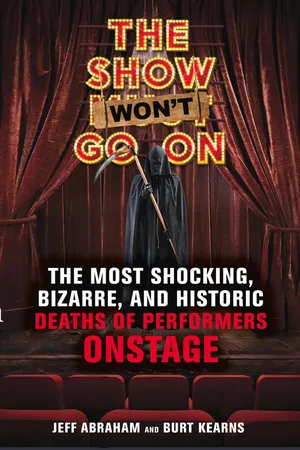
The Show Won't Go On
The Most Shocking, Bizarre, and Historic Deaths of Performers Onstage
- 240 pages
- English
- ePUB (mobile friendly)
- Available on iOS & Android
eBook - ePub
The Show Won't Go On
The Most Shocking, Bizarre, and Historic Deaths of Performers Onstage
About this book
There has never been a show business book quite like
The Show Won't Go On, the first comprehensive study of a bizarre phenomenon: performers who died onstage. From the comedy magician who dropped dead on live television to the amateur thespian who expired during a play called
The Art of Murder, the book is a celebration of lives both famous and obscure, as well as a dramatic and accurate recounting of events leading to the moments they died "doing what they loved."
The Show Won't Go On covers almost every genre of entertainment and is full of unearthed anecdotes, exclusive interviews, colorful characters, and ironic twists. With dozens of heart-stopping stories, it's the perfect book to dip into on any page.
Information
Subtopic
World History1
The Guinness
World Record
Jane Little
Jane Little stood four feet, eleven inches tall and weighed less than a hundred pounds. Yet she played the double bass, the largest instrument in the Atlanta Symphony Orchestra, and one that stood a good foot taller than she did.
She was Jane Findley and sixteen years old when she joined the Atlanta Youth Symphony Orchestra in 1945. She made her debut that February 4 wearing a pastel evening gown, and she remained with the group when it began to admit adults and grew into the Atlanta Symphony.
Jane married the symphony’s principal flutist in 1953. Warren Little was six foot two and would carry his little flute and her big bass. Even after he retired, he’d drive her to and from Atlanta Symphony Hall in their big baby-blue Chevrolet Caprice Classic station wagon. During her career, Jane played for conductors such as Igor Stravinsky, Leopold Stokowski, Aaron Copland, and James Levine. In 1996 she performed at the opening and closing ceremonies of the Atlanta Summer Olympics with conductor John Williams.
The highlight of her symphonic career came on February 4, 2016, two days after she celebrated her eighty-seventh birthday. Jane wasn’t in the best of health that day. She’d been undergoing chemotherapy treatment for multiple myeloma and had suffered a cracked vertebra the previous August, but after months of rehabilitation she was ready to play the double bass once more. The Washington Post reported on the occasion: “On Monday, Jane Little got her weekly chemo shot. Thursday, she gulped down five green steroid pills and reported to Symphony Hall to fight her way back to the stage. And that she did, all 98 pounds of her, stroking a D chord at 8:04 p.m. to make her comeback official.”
With that stroke of the bow, Jane Little became holder of the Guinness World Record as the musician with the longest tenure with an orchestra. With seventy-one years, she passed the record set by Frances Darger, the violinist who’d retired in 2012 after seventy years with the Utah Symphony. Indeed, the prospect of taking the title was one reason Jane decided to return to the symphony for one last season, despite serious illness and injuries.
“I’d thumb through the Guinness book and say, ‘Wouldn’t it be neat?’” she told the Post. “A lot of people do crazy things like sitting on a flagpole for three days. I just kept on. It was just me and the lady in Utah. So finally, I said, ‘I’m going to do this.’”
To Michael Kurth, who joined the bass section in 1994, Jane’s accomplishment was less inspirational than mythical. Kurth tells us, “You’d have to be really ambitious to be inspired, because it was such an unattainable record. To spend that many years on the job, it’s almost inconceivable. She was certainly a great musician. Nobody can stand in that job for long unless they have real intuitive and innate musicality. And her technique was amazing. Her hands were so flexible. I would sit behind her, and her thumb would bend in angles that I didn’t think human thumbs could bend.”
Jane and her double bass were onstage on the afternoon of Sunday, May 15, 2016, for an Atlanta Symphony pops concert. Broadway’s Golden Age was a great, rousing show. For an encore, the program called for a tune from Irving Berlin’s classic musical Annie Get Your Gun.
The players were about thirty seconds from the final measures of the encore number when Jane stopped playing. Michael Kurth was playing bass right beside her, sharing her music stand. “There were maybe ten measures left in the last piece of the last program of the year,” he says. “And I suddenly saw, out of the corner of my eye, her falling. Her bass teetered over and crashed into my bass—there’s still a gouge in my bass from it. And she just collapsed over, unresponsive.”
Kurth and tuba player Michael Moore (a mere forty-nine-year veteran of the orchestra) carried the tiny double bassist off the stage while the rest of the orchestra went on with the show and completed the number. A physician who was a member of the chorus and a nurse from the audience worked to revive her, but Jane Little never regained consciousness.
After the paramedics took Jane away, Michael Kurth joined most of the orchestra backstage behind the bass section. There were tears and hugs. “We weren’t calculating and assessing the momentousness of the occasion. We were just reacting and trying to—I mean, it’s our Jane. We all loved Jane,” he says.
That night, Kurth told the Washington Post, “She seemed to be made of bass resin and barbed wire. She was unstoppable. I honestly thought I was going to retire before she did.”
The Atlanta Symphony Orchestra announced on Facebook that it would dedicate the following weekend’s performances to the late Jane Little. One commenter on the site said she was “still shakened” after witnessing her collapse but added, “RIP dear lady; you are an inspiration!” Another called that final concert at Atlanta Symphony Hall “harrowing” but added that Jane Little died “doing what she loved.” “What an amazing way to go,” orchestra fan Amanda Turner wrote.
Senior orchestra manager Russell Williamson marveled at the timing. “For her to go out at the end of a concert, the golden age of Broadway, and it was during the encore!” he told the Post.
Michael Kurth points out that “when she played her last note, she was doing what she loved, surrounded by people she loved, in a place that was like home to her.
“It was a pretty spectacular exit, frankly,” he says, “for a really spectacular lady. I mean, you really couldn’t write a better Hollywood ending.”
Had the actual ending been scripted by a Hollywood screenwriter, reviewers would say it was too obvious. The song that Jane Little was performing when she collapsed to the stage was “There’s No Business Like Show Business.”
2
Theater
Corpsing IS BRITISH THEATRICAL SLANG for unintentionally breaking character by laughing. The origin of the term has never been nailed down, but it most likely arose from a laughing fit by an actor portraying a corpse. Another, far more literal interpretation of corpsing would be to actually become a corpse onstage, by dying. This has happened many times in many venues over the years. If there’s a stage on which to act, there’s a public platform on which to drop dead.
Some onstage deaths are more obvious than others. The seventeenth-century French actor and playwright Jean-Baptiste Poquelin, known to the world as Molière, was fifty-one and suffering from tuberculosis on February 17, 1673, when he performed in the title role in his play Le malade imaginaire (“The Hypochondriac”) for King Louis XIV at the Théâtre du Palais-Royal in Paris. Already so ill that he was forced to perform while sitting in a red velvet chair, he was seized by a violent coughing fit and began hemorrhaging from the mouth. “Don’t be alarmed! I am not dead!” Molière announced, insisting on going on with the show before he collapsed after an even more copious hemorrhage. They carried him offstage in his red velvet chair. No hypochondriac, he was indeed dead within a few hours.
Then there was Emil Hasda, the comedic actor who in 1904 starred in a Berlin touring company production of Ludwig Fulda’s play The Twin Sister. When the show opened at the Municipal Theatre in Nimptsh, Poland, on March 24, he had the crowd roaring with laughter through the first act and received half a dozen curtain calls. On the sixth, he drew a revolver from his hip pocket, placed it to his temple, and, in front of the entire audience, pulled the trigger and blew out his brains. One wire service reported that “when the blood was seen to flow, women fainted and men fought their way to the stage to get a glimpse at the suicide.” Apparently one of the actresses had rejected his proposal of marriage. (If Hasda’s suicide seems an overreaction, consider Ludwig Heinle. On October 26, 1926, the actor ran onstage and stabbed himself to death with a dagger during a performance of Peer Gynt at the Municipal Theatre in Strasbourg, France. He was upset that the stage manager gave him a hard time for showing up late!)
Despite such histrionics, the most memorable deaths onstage are ones in which an actor recites a line and then takes his or her leave from the stage and mortal coil, as if on cue. The “exit line” often serves as all-too-perfect set-up for the ultimate punchline. Most of the time, the audience thinks it’s part of the show.
Joe Greenwald
After three weeks of rehearsals in Los Angeles, Homer Curran’s road production of Golden Boy rolled north in March 1938 for two tryout performances at the Lobero Theatre in Santa Barbara. The show, starring Francis Lederer, would be a hot ticket. Clifford Odets’s acclaimed play about violinist-turned-prizefighter Joe Bonaparte was a smash hit on Broadway and still running at the Belasco Theatre on West Forty-Fourth Street, where it had opened the previous November with Luther Adler in the title role and Frances Farmer as his love interest.
The only omen of any potential problems was that the first road performance was scheduled for April Fools’ Day. Twenty-one-year-old future movie star Glenn Ford had the job as stage manager (and two lines in the third act: “Knockout!” and “Lombardo’s stiff ”). “Actors are a very superstitious breed,” he told his son Peter, as noted in the latter’s biography, Glenn Ford: A Life, “so there was already some feeling of uneasiness among some in the cast. The curtain went up and everything went smoothly, until we got to the second scene.”
In the second scene of the first act, Joe’s father, Mr. Bonaparte, shows off the expensive violin he plans to give his son the next day for his twenty-first birthday. “The actor playing the boxer’s immigrant father in the play, Joe Greenwald, said his line—‘A good life ah, is, ah, possible . . .’—and suddenly collapsed dead of a heart attack,” Ford remembered. “I rushed onto the stage immediately. He was lying in the arms of one of the other actors.” The trade journal Variety reported a different line in the Golden Boy script as the sixty-year-old actor’s final words: “He had just concluded his line, ‘This is the moment for which I have waited,’ when he collapsed.” The New York Times offered its own version: “Mr. Greenwald had just uttered the opening lines of a speech, ‘All my life . . .’ when he crumpled to the floor.” So there’s some confusion:
A good life ah, is, ah, possible . . .
This is the moment for which I have waited . . .
All my life . . .
Any of those reported last words would suffice, as Joseph Greenwald’s body lay motionless and Sam White, the only other actor on the stage at the time, called frantically for the curtain. The curtain was dropped, the capacity audience was eventually dismissed, and everyone got refunds. The Santa Barbara Fire Department’s pulmotor squad tried to revive Greenwald, to no avail. “He was already dead,” Glenn Ford said. “God, what an experience.”
There was no understudy for Joe Greenwald, so the show was shut down for a week until a replacement was found. The producers brought in Lee J. Cobb, from the original Broadway production.
Edith Webster
Edith Webster died onstage every night. For eight years, she’d played the role of the grandmother in community theater productions of The Drunkard at the Moose Lodge in Towson, Maryland. In each performance, the role called for her character to sing a song, then collapse to the floor, dead.
That’s what she did on Saturday night, November 22, 1986. “There was tremendous applause. Hearing that, she died,” the director, Richard Byrd, told United Press International. The applause was the last thing Edith Webster would ever hear.
When the other actors called for a doctor and phoned paramedics, most of the two hundred people in the audience thought Edith’s exit was part of the show. When the performance was stopped and they realized Edith had died of a heart attack, most of the audience sat quietly for almost an hour. Some of them prayed.
Edith Webster was sixty. Her daughter, Merri-Todd Webster, told the UPI reporter that the way she went was “not a bad thing . . . a lot of people have been saying it.”
“Night after night, she died and she died,” director Byrd observed, “and last night she died and she really did.”
By the way, what was the name of Edith’s show-stopping song? “Please Don’t Talk About Me When I’m Gone.”
Kent Stork
Kent Stork was a community theater actor whose death was notable not only for his dedication as an amateur thespian but also for the name of the last...
Table of contents
- Cover Page
- Title Page
- Dedication Page
- Copyright Page
- Contents
- Prologue
- 1 The Guinness World Record
- 2 Theater
- Interlude: Bad Night for Green Day
- 3 Comedy
- 4 The Tommy Cooper Effect
- 5 Magicians & Escape Artists
- Interlude: The Bullet Catch
- 6 Dance
- 7 Classical Musicians & Opera Stars
- Interlude: The Deadliest Occupation in Show Business
- 8 Rock 'n' Roll 'n' Hip-Hop
- 9 Country & Gospel Music
- Interlude: The Long Goodbyes
- 10 Jazz
- 11 International Pop Music
- Interlude: Open Mic Night
- 12 Television
- 13 Radio
- 14 Social Media
- Interlude: Tragic Kingdoms
- 15 Vaudeville
- 16 The Circus
- Interlude: The Great Wallendas
- Epilogue: Audience Participation
- Acknowledgments
- Appendix: Fifty More Who Died Onstage—a Chronological Selection
- Index
- Photos Insert
Trusted by 375,005 students
Access to over 1.5 million titles for a fair monthly price.
Study more efficiently using our study tools.
Frequently asked questions
Yes, you can cancel anytime from the Subscription tab in your account settings on the Perlego website. Your subscription will stay active until the end of your current billing period. Learn how to cancel your subscription
No, books cannot be downloaded as external files, such as PDFs, for use outside of Perlego. However, you can download books within the Perlego app for offline reading on mobile or tablet. Learn how to download books offline
Perlego offers two plans: Essential and Complete
- Essential is ideal for learners and professionals who enjoy exploring a wide range of subjects. Access the Essential Library with 800,000+ trusted titles and best-sellers across business, personal growth, and the humanities. Includes unlimited reading time and Standard Read Aloud voice.
- Complete: Perfect for advanced learners and researchers needing full, unrestricted access. Unlock 1.5M+ books across hundreds of subjects, including academic and specialized titles. The Complete Plan also includes advanced features like Premium Read Aloud and Research Assistant.
We are an online textbook subscription service, where you can get access to an entire online library for less than the price of a single book per month. With over 1.5 million books across 990+ topics, we’ve got you covered! Learn about our mission
Look out for the read-aloud symbol on your next book to see if you can listen to it. The read-aloud tool reads text aloud for you, highlighting the text as it is being read. You can pause it, speed it up and slow it down. Learn more about Read Aloud
Yes! You can use the Perlego app on both iOS and Android devices to read anytime, anywhere — even offline. Perfect for commutes or when you’re on the go.
Please note we cannot support devices running on iOS 13 and Android 7 or earlier. Learn more about using the app
Please note we cannot support devices running on iOS 13 and Android 7 or earlier. Learn more about using the app
Yes, you can access The Show Won't Go On by Jeff Abraham,Burt Kearns in PDF and/or ePUB format, as well as other popular books in Media & Performing Arts & World History. We have over 1.5 million books available in our catalogue for you to explore.