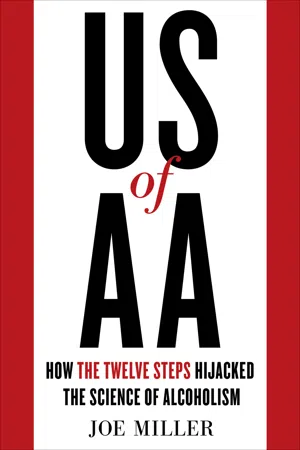
In the aftermath of Prohibition, America's top scientists joined forces with AA members and put their clout behind a campaign to convince the nation that alcoholism is a disease. They had no proof, but they hoped to find it once research money came pouring in. The campaign spanned decades, and from it grew a multimillion-dollar treatment industry and a new government agency devoted to alcoholism.
But scientists' research showed that problem drinking is not a singular disease but a complex phenomenon requiring an array of strategies. There's less scientific evidence for the effectiveness of AA than there is for most other treatments, including self-enforced moderation, therapy and counseling, and targeted medications; AA's own surveys show that it doesn't work for the overwhelming majority of problem drinkers.
Five years in the making, Joe Miller's brilliant, in-depth investigative reporting into the history, politics, and science of alcoholism shows exactly how AA became our nation's de facto treatment policy, even as evidence accumulated for more effective remedies—and how, as a result, those who suffer the most often go untreated.
US of AA is a character-driven, beautifully written exposé, full of secrecy, irony, liquor industry money, the shrillest of scare tactics, and, at its center, a grand deception. In the tradition of
Crazy by Pete Earley and David Goldhill's
Catastrophic Care,
US of AA shines a much-needed spotlight on the addiction treatment industry. It will forever change the way we think about the entire enterprise.
- 208 pages
- English
- ePUB (mobile friendly)
- Available on iOS & Android
eBook - ePub
About this book
Information
1
1934–1944: BIRTH OF A DISEASE
The Little Doctor Who Loved Drunks
The earliest American notion of heavy drinking as an illness appeared in 1805, when Benjamin Rush, a preeminent American doctor of the Revolutionary War era and one of the signers of the Declaration of Independence, took quill to parchment and authored a pamphlet, “Inquiry into the Effects of Ardent Spirits upon the Human Body and Mind,” in which he argued that “habitual drunkenness should be regarded not as a bad habit but as a disease,” that it’s “a palsy of the will,” an “odious disease (for by that name it should be called).” He enumerated more than a dozen symptoms, from “unusual garrulity” to “unusual silence” to “certain extravagant acts which indicate a temporary fit of madness” such as “singing, balling, roaring, imitating the noises of brute animals, jumping, tearing off clothes, dancing naked, breaking glasses and china, and dashing other articles of household furniture upon the ground, or floor.”
Rush believed “drunkenness” to be a progressive disease, much the way proponents of AA do today. “Its paroxysms occur,” he wrote, “like the paroxysms of many diseases, at certain periods, and after longer or shorter intervals. They often begin with annual, and gradually increase in their frequency, until they appear in quarterly, monthly, weekly, and quotidian, or daily periods. Finally, they afford scarcely any marks of remission either during the day or the night.” He even speculated as to its hereditary nature: “I have once known it to descend from a father to four out of his five children.”
It wasn’t until nearly fifty years later that Rush’s malady got a proper name. In 1852, Swedish physician Magus Huss coined the term “alcoholism” in his book Alcoholismus Chronicus. And even then it didn’t take hold in the lexicon of medicine, much less popular society. Through the nineteenth century and into the twentieth, excessive drinking was seen primarily as an issue of character or as an inevitable result of the destructive force of a terrible drug. Throughout the 1800s there appeared in the United States a smattering of sanitariums to help heavy drinkers find their way to sobriety, but the bulk of the energy against drunkenness was channeled through the temperance movement toward outlawing alcohol. People looked down on drunkards as degenerates, weak-willed and depraved.
The conception of alcoholism that’s commonly held today, the one proliferated by AA, can be traced back to the early twentieth century and an otherwise undistinguished doctor named William Silkworth. Known affectionately in AA lore as “the little doctor who loved drunks,” he had a solid education, having graduated from Princeton in 1896 and receiving his medical degree from NYU in 1900. He did his intern work at Bellevue Hospital in New York, where he found himself gravitating toward the drunk wards. A slight man with a gaunt face, ghostly white skin and hair, and piercing blue eyes, his diminutive, ethereal appearance was said to have put alcoholics at ease. Silkworth saw in drunks redeeming qualities that others couldn’t see, a human frailness that evoked his sympathies and curiosity. He spent more and more time with them, talking, asking questions, getting to know them, puzzling over what made them drink so. When a burly man in the throes of withdrawal dropped to his knees, crying, and begged for a drink, a story began to emerge in Silkworth’s mind. “I said to myself then and there,” he would later recall, “this is not just a vice or habit. This is compulsion, this is pathological craving, this is disease.”
Alcoholism was not a common interest among doctors at the time. There were almost no opportunities for a doctor such as Silkworth with an interest in helping problem drinkers. Most hospitals wouldn’t accept alcoholics. By and large the only ones that would were state hospitals, what people at the time would’ve referred to as “the loony bin.” In New York, however, there was one: Charles B. Towns Hospital, a private facility at 293 Central Park West. It catered to wealthy patients looking to dry out from drunken binges. Founded in the early twentieth century by its namesake, a man with no background in medicine or psychology, the hospital attracted most of its patients through advertisements in New York’s many daily newspapers and through word of mouth (though legend has it that Towns was known to literally kidnap drunks and force his treatment on them). For the price of about $350 for a five-day stay, patients were given comfortable rooms, bathrobes and slippers, and access to an elegant spa as they suffered through the “Towns-Lambert Treatment”—a two-day regimen consisting of ample hourly doses of Atropa belladonna (a hallucinogen more popularly known as deadly nightshade) mixed with henbane (also a deliriant), and prickly ash, to alleviate the intestinal cramps caused by the psychedelics. On top of this toxic cocktail, patients would often also experience delirium tremens (DTs), an agonizing and hallucinatory condition caused by alcohol withdrawal. Towns claimed a cure rate at 75 to 90 percent, deduced from the number of patients who tried it once and never came back.
Shortly after World War I, Silkworth took a job at Towns Hospital. Over the course of his tenure, he developed a theory that alcoholics suffer from a “phenomenon of craving” that drives them to drink at dangerous levels. The cravings are physiologically based, he believed. “Alcoholism is an allergic state,” he would later write, “the result of gradually increasing sensitization by alcohol over a more or less extended period of time . . . some are allergic from birth, but the condition usually develops later in life. The development and course of these cases are quite comparable with the history of hay fever patients.”
Silkworth was not a distinguished or reputable researcher. He wrote only a few papers in his career, one of which was “Alcoholism as a Manifestation of Allergy,” quoted above and published in 1937. In it he added that his findings were based on “observation of numerous cases at Towns Hospital, New York City, over a period of years, clinical constants have been derived and data have been accumulated”—a vague set of parameters within which to place his claims. It offers virtually no hard data or clinical observations but instead lays out the outlines of a story. An alcoholic “cannot take his liquor or leave it,” he opined. “The phenomenon of craving is prominent; there are complete loss of appetite, insomnia, dry skin and hypermotor activity. He has a feeling of anxiety which amounts to a nameless terror.” This inevitably draws the alcoholic to another drink, which only makes the condition worse. What’s more, alcoholics can never rid themselves of their malady. “It is noteworthy that such patients may be deprived of liquor altogether for a long period, a year or longer for example, and become apparently normal,” Silkworth observed. “They are still allergic, however, and a single drink will develop the full symptomatology again.”
This article received no attention in the scientific community except for an article refuting it, written by a top physiologist at Yale. “The concept of an allergic reaction to alcohol has had little scientific support,” wrote Dr. Howard Haggard, and “is supported only by analogy, metaphor and connotation. It is an expression, and unfortunately an erroneous one, of the long and disappointing search for a cellular basis for craving for and habituation to alcohol.” He warned that “the acceptance of an erroneous explanation, whatever its originally intended purpose, may be more detrimental to progress than is ignorance. It tends to stop progress.”
Nonetheless, Silkworth operated under this theory for decades without receiving any attention or exerting any influence on the medical field. He wasn’t an active member of any professional association, nor was he affiliated with an academic institution, and the few articles he published in medical journals were largely ignored by their intended audience. It’s likely he would have died in obscurity if he hadn’t treated one fateful alcoholic who sought treatment at Towns several times in 1934 and 1935: Bill Wilson, who would go on to be cofounder of Alcoholics Anonymous.
A Flash of Light
Of all the stories in the annals of alcoholism, perhaps the most harrowing is that of William Wilson, better known as Bill W., cofounder of Alcoholics Anonymous. Throughout Prohibition, he drank “‘Bathtub’ gin, two bottles a day, and often three,” he wrote in a short memoir that serves as the first chapter of his book Alcoholics Anonymous. (It’s this text that’s now better known as the Big Book.) He’d quit from time to time, sometimes staying sober for weeks or a month or more, but he would eventually always swing back around to having a drink, and then another, and dozens more.
He was unemployed, living on his wife Lois’s meager draw as a department store clerk. In 1934, his brother-in-law footed the bill for him to take the treatment at Towns Hospital, where he came under the care of Dr. Silkworth, who told him that he suffered from a kind of allergy that caused him to react differently to alcohol than most people, that booze triggered a physiological impulse to drink and drink and drink. The story resonated with Wilson. He felt a kind of relief—he wasn’t weak-willed and immoral, he was sick, biologically incapable of controlling his drinking. He just had to stay away from that first drink. And for a few months, he did so—the knowledge of his condition kept him sober. But then one day he had a drink, and suddenly he was back to drinking around the clock. His wife Lois consulted with Silkworth, who told her that he was a “hopeless” drunk and that it was likely he’d never get well. He warned that she would likely have to commit him to an asylum in order to save his life.
If Wilson were to have any hope of quitting drinking, his story needed another plotline, a third-act twist. It came from an unexpected place. Out of the blue one day he received a visit from an old drinking buddy, a man named Ebby whose drinking had been even worse than his. It cheered him; at least for one day he wouldn’t have to drink alone. He offered his friend a tumbler of gin and lemonade. His friend shook his head.
Wilson, incredulous, asked his friend what had happened to him.
The friend smiled and said, “I’ve got religion.”
“I was aghast,” Wilson would later write, and he poured himself a tall drink, bracing for the sermon he was sure would follow.
But his friend didn’t preach. He just told his story, how a mutual friend of theirs named Rowland had traveled to Switzerland to be treated for his alcoholism by the great psychologist Dr. Carl Jung, who hadn’t offered a psychological cure but instead said the only hope for hopeless alcoholics such as he was to somehow have “a spiritual experience.” Rowland sought this through a religious movement of the time called the Oxford Group. It had emerged between the world wars, and it was modeled on first-century Christianity. All the problems on Earth, they believed, are caused by people’s own selfishness and fear. The world is insane and the only way to be sane in it is to surrender completely to “God-Control.” The group offered a multistep process through which to achieve sanity, one of which was to bring new followers to the group. They aimed for high-profile members, and among their recruits were Harry Truman, Mae West, Joe DiMaggio, and Henry Ford; but they also sought regular folks and people who were struggling spiritually, such as heavy drinkers. Rowland had evangelized to Ebby, and now Ebby was doing the same to Wilson.
Wilson, an avowed atheist, recoiled at the notion that God could save him. Ebby asked him, “Why don’t you choose your own conception of God?” The idea intrigued Wilson, stuck with him, and he started attending Oxford Group meetings in New York. It didn’t much work—he continued to drink night and day, and he would show up at meetings in a stupor. He wound up back at Towns Hospital, back in Silkworth’s care.
Once again under the influence of belladonna, he felt himself falling into a deep, deep depression. His life seemed worthless, with no purpose and no prospect other than the continued misery of drinking until its fast-approaching end in an insane asylum or with suicide or liver disease. He was at absolute rock bottom. Consumed with despair, he fell to his knees and cried out to God. Then, all at once, a flash of light consumed him and his body seemed to fill with a cleansing wind. Immediately his desire to drink disappeared, and it didn’t return the next day when he woke up. Indeed, he felt better than he had in years.
He asked Silkworth if he was going insane.
“No, Bill, you are not crazy,” the doctor said. “There has been some basic psychological or spiritual event here. Whatever you’ve got now, you better hold onto. It’s so much better than what you had only a couple hours ago.”
“He Hasn’t Suffered Enough”
And so began what would become America’s modern alcoholism treatment system, with a discredited scientific theory and a startling hallucination. It was a tenuous beginning. Wilson was sober, but he had no job, was living week to week off of Lois’s paltry department store paycheck, and he was depressed. “I was not too well at the time, and was plagued with waves of self-pity and resentment,” he would later write. “This sometimes nearly drove me back to drink, but I soon found that when all other measures failed, work with another alcoholic would save the day.”
He’d visit and revisit Towns Hospital looking for drunks who might be ready to quit, hoping he might help them the way his old friend Ebby had. He’d tell them about the spiritual experience he’d had at Towns Hospital, how it had delivered him from his desire to drink. It was the only thing that seemed to lift him from his depression. But while it helped him, it never worked for the people he was trying to help. He couldn’t get any of his prospects to quit drinking, much less attend an Oxford Group meeting with him.
“For God’s sake stop preaching,” Dr. Silkworth scolded him. “You’re scaring the poor drunks half crazy. They want to get sober, but you’re telling them they can only do it as you did, with some special hot flash.” The doctor said to instead “give them the hard medical facts. Tell about the hopeless condition, a matter of life and death.” There were, of course, no such hard medical facts, but Silkworth urged Wilson to sell them on the story of alcoholism, that they suffer from an allergy, a disease that they have no control over that compels them to drink themselves to death.
“You’ve got to deflate these people first. So give them the medical business, and give it to them hard,” he said. “Pour it right into them about the obsession that condemns them to drink and the physical sensitivity or allergy of the body that condemns them to go mad or die if they keep on drinking.”
Wilson landed a temporary job that took him away from New York for a while. A Wall Street firm was trying to take over a small machine tool company in Akron, Ohio, and it hired Wilson to go out and serve as its proxy. Five months sober, he took a train to the Midwest and checked in at the Mayflower Hotel. His task, he quickly learned, was nearly impossible; the company’s local leadership was dug in, and the deliberations were acrimonious. Wilson grew depressed and lonely, with too much time on his hands. One afternoon he was in the sleek art deco lobby of the Mayflower, listening to the sound of laughter coming from the bar. He ached for the camaraderie he’d find there, for the calming buzz of a stiff drink.
The thought terrified him. One drink, he knew, would lead to another and another and he’d be plastered again, back to his old misery. He needed to find another alcoholic to talk to, someone he could try to help, so as to help himself.
In a corner of the lobby was a public phone and a church directory. He sat down and dialed a number at random. A preacher answered, and Wilson told his story, that he was an alcoholic from New York who hadn’t had a drink in months, but he needed to help another alcoholic in order to stay sober. The preacher seemed to understand, and he offered a list of ten people. Wilson dialed down the list with no luck until he got to the last number. A woman answered, and after hearing Wilson’s spiel, she said she had just the right person for him—a doctor who had once enjoyed a sterling reputation in Akron but had fallen so deep into his drinking that...
Table of contents
- Cover Page
- Title Page
- Copyright Page
- Dedication Page
- Contents
- PROLOGUE
- 1 1934–1944: BIRTH OF A DISEASE
- 2 1944–1953: THE DISEASE GOES VIRAL
- 3 1953–1970: DRUNK WITH POWER
- 4 1970–1983: ZEITGEIST
- 5 1983–1999: SUPPRESSED ALTERNATIVE
- EPILOGUE - 2000–PRESENT: STUCK IN THE 1950S
- ACKNOWLEDGMENTS
- BIBLIOGRAPHY
- INDEX
Trusted by 375,005 students
Access to over 1.5 million titles for a fair monthly price.
Study more efficiently using our study tools.
Frequently asked questions
Yes, you can cancel anytime from the Subscription tab in your account settings on the Perlego website. Your subscription will stay active until the end of your current billing period. Learn how to cancel your subscription
No, books cannot be downloaded as external files, such as PDFs, for use outside of Perlego. However, you can download books within the Perlego app for offline reading on mobile or tablet. Learn how to download books offline
Perlego offers two plans: Essential and Complete
- Essential is ideal for learners and professionals who enjoy exploring a wide range of subjects. Access the Essential Library with 800,000+ trusted titles and best-sellers across business, personal growth, and the humanities. Includes unlimited reading time and Standard Read Aloud voice.
- Complete: Perfect for advanced learners and researchers needing full, unrestricted access. Unlock 1.5M+ books across hundreds of subjects, including academic and specialized titles. The Complete Plan also includes advanced features like Premium Read Aloud and Research Assistant.
We are an online textbook subscription service, where you can get access to an entire online library for less than the price of a single book per month. With over 1.5 million books across 990+ topics, we’ve got you covered! Learn about our mission
Look out for the read-aloud symbol on your next book to see if you can listen to it. The read-aloud tool reads text aloud for you, highlighting the text as it is being read. You can pause it, speed it up and slow it down. Learn more about Read Aloud
Yes! You can use the Perlego app on both iOS and Android devices to read anytime, anywhere — even offline. Perfect for commutes or when you’re on the go.
Please note we cannot support devices running on iOS 13 and Android 7 or earlier. Learn more about using the app
Please note we cannot support devices running on iOS 13 and Android 7 or earlier. Learn more about using the app
Yes, you can access US of AA by Joe Miller in PDF and/or ePUB format, as well as other popular books in Social Sciences & Global Development Studies. We have over 1.5 million books available in our catalogue for you to explore.