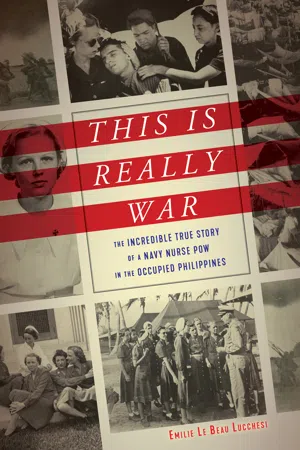
In January 1940, navy nurse Dorothy Still eagerly anticipated her new assignment at a military hospital in the Philippines. Her first year abroad was an adventure. She dated sailors, attended dances and watched the sparkling evening lights from her balcony. But as 1941 progressed, signs of war became imminent. Military wives and children were shipped home to the states, and the sailors increased their daily drills. When Pearl Harbor was attacked, Dorothy and the other nurses braced for a direct assault. When the all-clear sounded, they raced across the yard to the hospital and prepared for the wounded to arrive. In that frantic dash, Dorothy transformed from a navy nurse to a war nurse. Along with the other women on the nursing staff, she provided compassionate, tireless, critical care.
When the Philippines fell to Japan in early January 1942, Dorothy was held captive in a hospital and then transferred to a university along with thousands of civilian prisoners. Cramped conditions, disease and poor nutrition meant the navy nurses and their army counterparts were overwhelmed caring for the camp. They endured disease, starvation, severe overcrowding, and abuse from guards, but also experienced friendship, hope, and some, including Dorothy, even found love.
eBook - ePub
This Is Really War
The Incredible True Story of a Navy Nurse POW in the Occupied Philippines
- 336 pages
- English
- ePUB (mobile friendly)
- Available on iOS & Android
eBook - ePub
This Is Really War
The Incredible True Story of a Navy Nurse POW in the Occupied Philippines
About this book
Information
Part I
1941
1
I’d Die Before
I Wore Those
DOROTHY STILL SLEPT soundly in her bed in the nurses’ quarters. It was comfortably dark, and a breeze flowed through the veranda attached to her private room. She did not stir as the telephone rang downstairs, sending a shrill scream through the quiet house. Dietitian Bertha Evans picked up the handset and heard her fiancé’s voice on the other end of the extension. He was an officer assigned to the nearby naval yard in Cañacao, Philippines, and he was calling with urgent news.
“Bertha,” he said. “Pearl Harbor has been bombed. We’ve been up all night with the admiral.”
The US armed forces in the Philippines anticipated they would be next. At one point during the night, radar had detected a formation near Manila Bay. Warhawks took to the sky to intercept the threat, but no contact had been made.
Bertha knew she had to wake her superior, Chief Nurse Laura M. Cobb. She hurried up the stairs and knocked on Cobb’s door. “We’re at war with Japan,” she reported.
Doorways began to crack as the other women heard the commotion. Cobb instinctively knew a blackout order was in effect. “Do not turn on your lights,” she warned.
Nurse Mary Rose Harrington squinted in the darkness. Cobb ordered her to dress and accompany her to receive orders. Dorothy continued to sleep through the disturbances. She didn’t hear Cobb and Mary Rose return to the quarters. Nor did she wake when Mary Rose clanked around the kitchen, looking to start a pot of coffee. Dorothy finally opened her eyes when the auburn-haired woman stood over her bed.
“Dottie! Wake up!” Mary Rose urged.
Dorothy stumbled from bed and followed Mary Rose. The other nurses stood in the darkened hallway, stunned and confused. Cobb was brief. All they knew for certain was Japan had attacked Pearl Harbor around midnight Manila time. It would be only a matter of hours before Congress officially declared war. But what did that mean to the nurses? Should they expect an attack as well? Cobb didn’t know. She ordered her nurses into uniform.

Navy nurse Dorothy Still. Courtesy of Bureau of Medicine and Surgery
Dorothy felt her way back to her room. She went to her washbasin and turned on the water, thinking about newspaper reports describing the fighting in Europe. She had seen photos of decimated villages and images of destroyed battlefields. Would war in the South Pacific look the same? Dorothy thought not. If there was indeed a war with Japan, she assumed the United States would quickly win. It wasn’t the same as the hostilities between the Europeans.
Dorothy opened her dresser drawers and selected a pair of white knee-high tights. She stepped into the white dress, fixing the buttons that ran down to the high-waist belt. She combed back her blond hair and secured her striped cap to her head. Dorothy pulled her flashlight from the box and screwed off the bottom. She slipped in two batteries and then felt the spring press tighten as she rotated the end back into place. After masking the top with blue cellophane so it was safe to use in a blackout, she shone the light on her mirror and felt unnerved as she studied her reflection in the ghostly blue light.
Dorothy joined the other nurses in the living room. The women traded mixed expressions of doubt and reassurance. Several of the nurses didn’t think the Asiatic Fleet was prepared for battle. Others thought the same as Dorothy—Japan was a small nation and it was no match for the mighty United States. Susie Pitcher, a forty-year-old nurse anesthetist from Des Moines, lit a cigarette. Susie loved smoking and seemed determined to not let her emphysema interfere with her favorite pastime.
Susie inhaled and released a swirling cloud as she spoke. “You girls ready for war?” she asked.
The young nurses weren’t sure what to think. Earlier in 1941, the navy had begun censoring mail, and spouses and dependents of military personnel had been shipped back to the States. At the time, the nurses felt odd to be the only women on base, but then they adjusted to the new routine. Blackouts and air raid drills became standard, yet with all the warnings and preparation, nothing ever happened. Now it was difficult to determine whether they should truly be alarmed.
It was easy, however, to feel vulnerable. The naval base was located on a small peninsula just south of Manila. The peninsula had an odd shape, like a crab’s claw. The navy occupied the parts that resembled the pinchers, filling the area around the bay with an ammunition depot, hospital, living quarters, and a naval yard to service marine vessels. There were also two soaring radio towers, which the nurses detested for being an easy target. What would happen if they were bombed? The women shuddered to think, especially if the ammunitions depot took a direct hit. The concussion could obliterate the entire peninsula.
Several of the nurses didn’t want to face the possibility of war. But others, like Bertha, experienced ominous warnings and sensed the time had come. Bertha had transferred to the Philippines in February. On the boat ride to Hawaii, a reserve officer said he felt sorry for her.
“You’ll be eating fish heads and rice before you come home,” he warned.
“Do you really think so?” Bertha asked.
“I know so,” he cautioned.
The comment stuck with Bertha. At thirty-seven years old, she had been in the navy for a decade. She had wavy brown hair and beautiful dark eyes that turned downward at the corners. Most sailors typically boasted in an attempt to impress her. The reserve officer’s lack of bravado felt like a chilling omen.
The women came to attention as Cobb entered the room. She reported they did not have specific orders from the admiral. However, the fleet surgeon had told Cobb they needed to evacuate the hospital. The women were to report immediately for duty. Dorothy followed the other nurses into the humid air. Rain had fallen overnight and the ground was spotted with puddles. Cobb instructed the nurses to run to the hospital as if they were under attack.
Dorothy and the other women began to jog without much enthusiasm. In the distance, a pathologist stood outside the hospital and watched the pack of approaching blue lights. He wondered how long it would take the nurses to run the two-block distance. If the base was hit, how quickly could the nurses arrive? He pulled out a stopwatch and began to time them.
The nurses were hesitant in the dark. As they approached, the pathologist saw they were trying to avoid splashing in the puddles. The nurses did not want to get their shoes wet or their uniforms dirty. They took the long way around larger pools of water and carefully stepped over smaller puddles, sometimes stopping to hold on to each other for support. The pathologist looked at the second hand spinning around the dial. What were these nurses doing? Had they no sense of urgency?
The pathologist held up the stopwatch as Dorothy and the other nurses trotted up the circular drive. “Two minutes and twenty-three seconds,” he scolded.
War was not what Arissa Still had intended for her daughter when she brought Dorothy to the Los Angeles County General Hospital for an interview with the nursing school. It was 1932, and Arissa knew people who had lost their jobs and then their homes. She wanted her daughter to find a stable career, and Dorothy had failed to supply one practical idea of which her mother approved. Dorothy had dreamily proposed working as a costume designer in Hollywood. The girl could sew, yes, and she appreciated fashion, but Arissa thought Hollywood was unpredictable and competitive.
Nursing, Arissa had assumed, was a far safer choice. The Los Angeles County General Hospital offered a three-year program with free tuition, room, and board. The student nurses worked at the hospital and received a small monthly stipend. Being paid to go to school? At a time when unemployment was near 25 percent? Arissa promptly brought Dorothy in for an interview and hovered in the hallway while her daughter met with the admissions director. She knew her daughter was an excellent candidate. Dorothy had performed well at Burbank High School, and she was one of a few students with enough merit points to join an exclusive honorary. The nursing school officials were impressed, as Arissa expected.
Arissa’s plan for her daughter was on track—until Dorothy graduated and received her pin. Then Arissa realized nurses were not immune from the crippled economy. Low wages and job insecurity were standard, and nurses typically bounced from one short contract to the next. In the first two years after graduation, Dorothy cycled through three jobs. The last of these was at a small hospital in a desert town where a few senior nurses successfully campaigned to have Dorothy and another young nurse fired. Demoralized, Dorothy returned to her parents’ home and looked for a new position.
Dorothy flipped through the November 1937 issue of the American Journal of Nursing and stopped on an article about the Federal Nursing Services. Its military nurses enjoyed the “security of a regular salary,” the article promised. They also received medical care, four weeks’ leave, and the opportunity to train in a specialty. Dorothy was intrigued, but she still stung from her recent termination. She figured she was wasting a stamp when she wrote to request an application. Within a month, she received notification that the navy was indeed interested. Before the year was over, Dorothy was instructed to report to duty in San Diego as a member of the Navy Nurse Corps.
As Dorothy reported to San Diego, the world was becoming increasingly unstable. The United States maintained an isolationist stance, but American military commanders watched with unease as Japan conquered Nanking, the capital city of China, on December 13, 1937. Within mere weeks, more than 250,000 Chinese were massacred by the Japanese army. It seemed that every newspaper in the United States had a front-page story about the invasion, but few Americans understood the extent of the massacre. Chinese men, women, and children were rounded up, marched through the streets, and then sadistically executed. Every type of agony emerged in Nanking. Yet American attention instead focused on the sinking of a naval ship on a river near Nanking. President Franklin D. Roosevelt demanded an apology and payment, both of which Japan supplied. The US government then edited the news footage. When newsreels spun in cinemas across the county, Americans were treated to a sanitized account of the violence, as well as a false sense that Japan knew better than to mess with Uncle Sam.
The world was darkening, and the United States simply wasn’t ready to defend itself. In 1937, the annual report of the secretary of war to the president described the country’s forces as a “peace time army.” Just one year later, the authors of the report were looking long and hard at their own inadequacies. With only about 162,000 enlisted men, the US military was merely the eighteenth largest in the world. The report also admitted that after the recent World War, the United States failed to keep pace with the development of defensive weapons. Materials shortages during the Great Depression added more budgetary challenges, and the military was woefully short on antiaircraft defenses. As for aircraft, the report authors pitifully described themselves as making “progress.”
At the end of 1939, Dorothy learned that she was being transferred from San Diego to the Philippines. She was to report before February 1, 1940, to Cavite Naval Base. Dorothy promptly consulted a map and anxiously scanned the distance across the Pacific Ocean and into the Philippine Sea. She had never left the United States, and the Philippines seemed so far away. The other nurses helped to ease her anxiety. They recommended that Dorothy pack plenty of party dresses. Nurses at Cavite were only required to work half shifts due to the high temperatures, so Dorothy would have plenty of time to play tennis, golf, swim, and enjoy evenings out with officers. She was assured it was a very good assignment.
Dorothy eased her own anxiety by visiting the library in her Southern California hometown of Long Beach during her two-week leave. She read about the history of the Philippines and its quest for independence, which gave her an admiration for the Filipino people. The Spanish had colonized the archipelago in the sixteenth century. After the Spanish-American War in the late 1890s, the United States took over foreign rule and brutally suppressed Filipino resistance. In 1935, President Roosevelt proclaimed the Philippines a constitutional commonwealth and established an eleven-year timeline for the country to transition into full independence. The Filipino people, it seemed, were so close to achieving the independence they had long craved.
The farewells were still difficult. Dorothy stood at the train station in Los Angeles with her parents, sister, and infant nephew. Her brother-in-law was absent due to work, but he sent a message for “Dixie” to have a good time.
“Tell him I intend to!” Dorothy told her sister optimistically.
Around 6:00 AM, the loudspeaker in the hospital at Cavite crackled. A slight static popped, and everyone paused to hear the announcement. “Hear this,” a man’s voice thundered. “Pearl Harbor has been bombed.”
The patients had mixed reactions. Men eligible for discharge were eager to give the Japanese a good pounding. They anticipated the fight would be fast and easy. For the patients with broken limbs, there was a helpless feeling of vulnerability. They were marooned on their backs with cast-covered limbs suspended in the air. If the hospital was hit, they were tethered in place, unable to run or even roll under the bed for protection.
An attack on the hospital was a terrifying possibility. The Empire of Japan had signed but did not ratify the Third Geneva Convention, which meant they ...
Table of contents
- Cover Page
- Title Page
- Copyright Page
- Dedication Page
- Contents
- Author's Note
- Key Figures
- Chronology
- Part I: 1941
- Part II: 1942
- Part III: 1943
- Part IV: 1944
- Part V: 1945
- Epilogue: I Hear You
- Acknowledgments
- Notes
- Bibliography
- Index
Trusted by 375,005 students
Access to over 1.5 million titles for a fair monthly price.
Study more efficiently using our study tools.
Frequently asked questions
Yes, you can cancel anytime from the Subscription tab in your account settings on the Perlego website. Your subscription will stay active until the end of your current billing period. Learn how to cancel your subscription
No, books cannot be downloaded as external files, such as PDFs, for use outside of Perlego. However, you can download books within the Perlego app for offline reading on mobile or tablet. Learn how to download books offline
Perlego offers two plans: Essential and Complete
- Essential is ideal for learners and professionals who enjoy exploring a wide range of subjects. Access the Essential Library with 800,000+ trusted titles and best-sellers across business, personal growth, and the humanities. Includes unlimited reading time and Standard Read Aloud voice.
- Complete: Perfect for advanced learners and researchers needing full, unrestricted access. Unlock 1.5M+ books across hundreds of subjects, including academic and specialized titles. The Complete Plan also includes advanced features like Premium Read Aloud and Research Assistant.
We are an online textbook subscription service, where you can get access to an entire online library for less than the price of a single book per month. With over 1.5 million books across 990+ topics, we’ve got you covered! Learn about our mission
Look out for the read-aloud symbol on your next book to see if you can listen to it. The read-aloud tool reads text aloud for you, highlighting the text as it is being read. You can pause it, speed it up and slow it down. Learn more about Read Aloud
Yes! You can use the Perlego app on both iOS and Android devices to read anytime, anywhere — even offline. Perfect for commutes or when you’re on the go.
Please note we cannot support devices running on iOS 13 and Android 7 or earlier. Learn more about using the app
Please note we cannot support devices running on iOS 13 and Android 7 or earlier. Learn more about using the app
Yes, you can access This Is Really War by Emilie Le Beau Lucchesi in PDF and/or ePUB format, as well as other popular books in History & Military Biographies. We have over 1.5 million books available in our catalogue for you to explore.