Winner of the Mystery Writers of America's 2021 Edgar Allan Poe Award for Best Critical/Biographical
In 1933, Joan Harrison was a twenty-six-year-old former salesgirl with a dream of escaping both her stodgy London suburb and the dreadful prospect of settling down with one of the local boys. A few short years later, she was Alfred Hitchcock's confidante and one of the Oscar-nominated screenwriters of his first American film,
Rebecca. Harrison had quickly grown from being the worst secretary Hitchcock ever had to one of his closest collaborators, critically shaping his brand as the "Master of Suspense."
Harrison went on to produce numerous Hollywood features before becoming a television pioneer as the producer of
Alfred Hitchcock Presents. A respected powerhouse, she acquired a singular reputation for running amazingly smooth productions— and defying anyone who posed an obstacle. She built most of her films and series from the ground up. She waged rough-and-tumble battles against executives and censors, and even helped to break the Hollywood blacklist. She teamed up with many of the most respected, well-known directors, writers, and actors of the twentieth century. And she did it all on her own terms.
Author Christina Lane shows how this stylish, stunning woman became Hollywood's most powerful female writer-producer—one whom history has since overlooked.
eBook - ePub
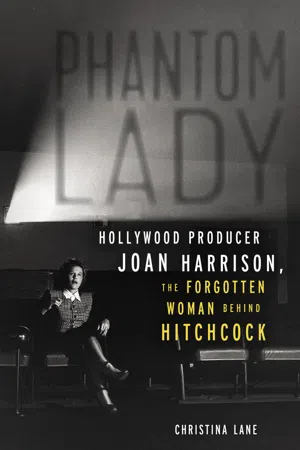
Phantom Lady
Hollywood Producer Joan Harrison, the Forgotten Woman Behind Hitchcock
- 400 pages
- English
- ePUB (mobile friendly)
- Available on iOS & Android
eBook - ePub
About this book
Information
Print ISBN
9781613733844
Subtopic
Social Science BiographiesAT HOME
ON JUNE 20, 1907, Joan Harrison’s life began in the quintessentially British borough of Guildford, Surrey. The village had hosted kings, castles, chapels, and Lewis Carroll, who (according to locals) wrote Through the Looking-Glass, the sequel to Alice’s Adventures in Wonderland, in his provisional second home, surrounded by ancient archways and rabbit burrows. Joan was born into an Edwardian time—a “golden afternoon” of prosperity—replete with green pastures, gas streetlamps, and the romance of yore.1 A dazzling mist would rise at dawn from its many rivers, and a special hillside stream was ascribed healing powers.
Named for the golden sands (“gold ford”) along its riverside, Guildford is sandwiched into a gap along the Harrow Way trail on the banks of the River Wey. Founded during the Saxon period, it is dotted with medieval architecture, anchored by the ruins of a twelfth-century stone Norman castle. Located about thirty miles southwest of London, Guildford began to boom when the railway arrived in the mid-nineteenth century, after which dormitories for London commuters sprang up, and eventually dairies, breweries, and an engineering industry. By the 1860s the town was starting to course with the energy of new artistic and literary interests and, if Carroll’s frequent presence was any indication, a great force of imagination. It attracted people with foresight, ingenuity, and pluck.
Among them was Joan’s maternal grandfather. Alexander Forsythe Asher had been born in 1839 in the commercial district of Keith in Banffshire. He was the sixth son of James Parker Asher, a writer and bookbinder who hailed from the small Scottish town of Huntly. The enterprising, industrious Alexander discovered his talents for newspaper reporting in his teenage years and began moving up the ranks of local papers. Feeling a bit unmoored at the age of twenty (his mother died when he was young), he sought career advice from a trusted minister. The local vicar counseled him, “My friend, do as Abraham did: go south.” And so he did. He trekked southeast to Wellington and then to Sevenoaks in Kent, earning accolades at each job along the way. Alexander could sniff out a story.2
The cold, wet climate of a South Wales post took a toll on his health. On doctor’s orders, he accepted an assignment with the Surrey Standard, and soon confronted an unusual proposition: the chance, at the age of twenty-eight, to become chief proprietor of a successful weekly newspaper. Along with fellow reporter Angus Fraser Walbrook, Alexander signed on as a financial partner to the Surrey Advertiser in November 1867.
The Surrey Advertiser was barely four years old, but it had grown rapidly in influence since launching as an eight-pager with a circulation of three thousand. An old-form “pennysaver”—the paper cost “one penny (where not sent free),” according to its cover—its purpose, as its name suggested, was to advertise local businesses. Still, the original owners had decided almost right away that it served them well to integrate legitimate news with ads. The paper was so successful that it transitioned from a monthly to a weekly periodical within its first quarter.
With the paper’s growing clout in Guildford and the surrounding county of Surrey, Alexander became quickly beholden to the paper’s conservative backers, the businessmen and community leaders who had ushered him into power. Despite Alexander’s espoused claims of impartiality and a “guiding mission” that stated the Advertiser would “on all occasions be gentlemanly in tone and temperate in language, advocating the right, denouncing the wrong,” his paper was hardly neutral. The Advertiser positioned itself in direct contrast to the Surrey Times, a competitor that appealed to the labor party and more liberal readers. Alexander was in fact proud to be cast as a pro-business conservative. It aligned with his values and was a formula that worked.3
The most widely circulated paper in West Surrey, the Advertiser projected a youthful, industrious image. The article announcing Asher and Walbrook’s ascendancy referenced the English essayist Lord Thomas Macaulay, who reputedly proposed, “Advertising is to business what steam is to machinery. The grand propelling power.” This was a vision of a forward-thinking team assuring rapid progress, fueled by ad sales. “Advertising keeps the steam up,” the article declared.4
The Advertiser was emerging at precisely the moment the British newspaper industry was adopting more commercial and sensationalistic practices. Though Asher and Walbrook stayed away from tabloid and entertainment journalism, and maintained a conservative tone (“by gentlemen, for gentlemen”)5, they were forging the paper in the context of an increasingly competitive marketplace. If in the early days the paper had made an effort to balance news and ballyhoo (and to camouflage the latter), it shifted briskly. Advertising—specifically, purely ad-driven content—became more and more crucial to the operation, “keeping the steam up.”
On June 11, 1867, in the same year that Alexander took control of the Surrey Advertiser, he married a determined Scottish woman named Eliza Mure. Her father, James Mure, had entertained ambitions as a writer before taking up law, presumably for financial stability. Known for her love of education and children, Eliza, like her father, fostered literary instincts. At the time of her meeting Alexander, Eliza had been working as a governess for families across southern England.6 The marriage represented a major step up for her.
The Ashers embarked upon starting a family, eventually bearing four children; daughter Amelia McWhir Mure (born August 1871) would be Joan’s mother. By now, the Ashers were living at the Grove, an orange brick Georgian Revival house that would be Joan’s family home. Located on Farnham Road, an ancient route that led up a steep hill out of the town’s center, the house was in the neighborhood of the Mount, which scaled west Guildford. The Mount offered an aerial view of both downtown and the surrounding countryside. The Grove property, which included an expanse of land and buildings that stretched well beyond the estate grounds, was perched strategically along the railway bridge, giving the Ashers a front row to the flow of industry and commerce.
The Ashers were part of the rising middle class, stitching their way into the social fabric of a place that was becoming increasingly appealing to affluent families. Villas and well-sized homes sprung up from farmlands and fields, as did working-class communities, drawn to new service and manufacturing jobs, and especially the giant Dennis Brothers automobile plant, which opened in 1895. Guildford’s pulse was also quickening with the arrival of electricity and water pipes, conveying modern comforts, even if horse-drawn buggies were still common on the village’s gray granite streets.
After some deliberation, Alexander chose to locate the Advertiser’s office in the middle of town on Market Street, anchored by its hotels, pubs, and markets, just a stone’s throw away from advertising row, where the walls and windows of local businesses featured poster-sized signs.7
Remain in the hub, attuned to the action, but stay out of the headlines—this was the careful positioning that spelled success for Alexander and his family. They grew accustomed to adhering faithfully to Guildford’s social rules and customs, taking center stage when it was called for, but mostly abiding quietly in the margins. To mention themselves in the Advertiser would have been objectionable, even garish; to see their lives reported on in the Surrey Times would mean that something had gone truly awry.
The year 1900 began with sorrow: Eliza died of heart failure at the Grove on January 9. She was sixty-one. She was laid to rest in the cemetery on the Mount.8 Several weeks later, devastating floods wiped out the old Town Bridge—the lifeline in and out of Guildford—spelling disaster for local businesses. With commerce at a standstill, the newspaper stumbled, but only temporarily.
Meanwhile, inside the Surrey Advertiser office, a romance had been blooming. Alexander’s daughter Millie (as Amelia was called), considered a spinster at twenty-eight, had developed a fondness for a young man who had joined the business department a few years prior. Walter Harrison, the Irish-born son of a clerk, had been raised in West Sussex and trained in banking. With angular features and a serious, businesslike demeanor, he appealed to Millie.9 Walter had led a peripatetic existence growing up (it’s likely that his father, Charles, had some affiliation with the British army, as Walter was born in Longford, an army town) and was drawn to the firm ground that the Ashers had established in Surrey. And he was keen on Millie, who was lovely looking with bright cobalt blue eyes.
On July 11, 1900, six months almost to the day after her mother’s death, Millie married Walter in Guildford’s Holy Trinity Church. This twisted pattern, in which tragedy and joy occurred close together, would become familiar for the Harrisons.
Living at the Grove, they had cemented into one family now, with Walter having fully integrated himself. A shared triumph came when Alexander was elected mayor of Guildford in November 1901. Millie, in her mother’s absence, served as unofficial mayoress, shining in a role of public leader and social hostess typically reserved for women with decades more life experience. As the still-grieving bride took on new official duties, she continued the familiar pattern of meeting life’s challenges in intense privacy. If it was the Asher way, so it would be with the Harrisons.
Mayor Asher’s greatest deed, one memorialized in stone, was the completion of the new Town Bridge in February 1902, just shy of the flood’s two-year anniversary. The opening of the new bridge signaled the village’s financial and psychological rebirth at the dawn of the new century.10
Millie and Walter welcomed their first child, Muriel Mary, on August 6, 1902.11 Jack Forsythe followed on October 18, 1904.12 With their brood expanding, the Harrisons moved to the Craigmore residence a short distance away at 3 Mareschal Road. The Victorian two-tone house (redbrick bottom, light stucco on top), with its spacious ten rooms, was rich in architectural detail and flanked by a stately brick wall and an arched entrance, but it did not come close to the grand scale of the Grove.13 It ran more along the lines of young Charlie’s Santa Clara home in Hitchcock’s Shadow of a Doubt.
It was in Craigmore that Joan was born on June 20, 190714. (Though some official documents list June 26, her original birth certificate reports that she was born on June 20, which is when she celebrated her birthday.) Her early life was marked by music, songs, and plays—pursuits nurtured by her father, who supervised the music programs at the family’s church. Thus, it became customary for young Joan or one of her siblings to appear at a prominent home to perform a short dramatic scene or at a local recital to play a pianoforte. By the time Joan was seven, with soft curls in her fair hair, dimples, and her mother’s blue eyes, she received accolades in the Surrey Advertiser for her part in a local musical concert. (The Advertiser’s editorial policies notwithstanding, the Ashers were not immune from occasional displays of pride, particularly when it came to their children.)
Walter’s devotion to youth education was manifest in an unflagging commitment to local school boards and church activities. He was commended for knowing “no parochial bounds to his churchmanship,” during his lengthy time as rector’s warden for St. Nicolas’ Church and for committing years of faithful service to the Guildford Diocesan Conference.15 Joan did not inherit her father’s reverence for religious institutions; many who knew her later in life commented on her strong disavowal of organized religion. And though she rarely disclosed recollections of her early years to anyone, when she did, she painted her childhood with a dry brush. It was unduly formal and often exacting.16
While other children spent their days romping among the Guildford castle ruins or rock climbing up a favored hill near St. Catherine’s Chapel, leisure time for Joan and her siblings tended to be more rigid. They might be found rehearsing for an upcoming Saturday afternoon matinee or cheering for their father’s cricket team (often playing against a rival newspaper). Some days must have glided by as little bits of fun in “fairyland” (Jack, in fact, played the part of a forest chestnut in a play titled “Fun in Fairyland”), while on others, the children may have felt like props trotted out for show.17
Joan might have been just old enough for one of Guildford’s most historic occasions to have made an impression: the royal festivities surrounding the coronation of King George V on June 22, 1911. Nearly every one of the town’s twenty thousand residents gathered in the heavily decorated downtown streets to witness a grand procession of over thirty-five floats.18 She would be a royalist all her life, never so far from her roots that kings and queens did not impress her.19
Still, it’s unlikely that, for Joan, the crowning of a new monarch came anywhere close in importance to the arrival of Faith Mary, her younger sister (and final sibling). Born May 26, 1912, Fa...
Table of contents
- Cover Page
- Title Page
- Praise for Phantom Lady
- Copyright Page
- Dedication Page
- Contents
- Prologue
- 1 At Home
- 2 Wartime
- 3 Beyond the Village
- 4 Birth of a Master
- 5 True Crime Pays
- 6 Bigger Steps
- 7 A Team of Three
- 8 Going Hollywood
- 9 Oscar Calls
- 10 Building Suspense
- 11 Hitting Hurdles
- 12 Phantom Lady
- 13 New Associations
- 14 Bedeviling Endings
- 15 Crimes and Misdemeanors
- 16 Let It Ride
- 17 Full Circle, by Degrees
- 18 A New Proposal
- 19 Back on Top
- 20 Into the Unknown
- Acknowledgments
- Filmography
- Notes
- Selected Bibliography
- Index
- Photos Insert
Trusted by 375,005 students
Access to over 1.5 million titles for a fair monthly price.
Study more efficiently using our study tools.
Frequently asked questions
Yes, you can cancel anytime from the Subscription tab in your account settings on the Perlego website. Your subscription will stay active until the end of your current billing period. Learn how to cancel your subscription
No, books cannot be downloaded as external files, such as PDFs, for use outside of Perlego. However, you can download books within the Perlego app for offline reading on mobile or tablet. Learn how to download books offline
Perlego offers two plans: Essential and Complete
- Essential is ideal for learners and professionals who enjoy exploring a wide range of subjects. Access the Essential Library with 800,000+ trusted titles and best-sellers across business, personal growth, and the humanities. Includes unlimited reading time and Standard Read Aloud voice.
- Complete: Perfect for advanced learners and researchers needing full, unrestricted access. Unlock 1.5M+ books across hundreds of subjects, including academic and specialized titles. The Complete Plan also includes advanced features like Premium Read Aloud and Research Assistant.
We are an online textbook subscription service, where you can get access to an entire online library for less than the price of a single book per month. With over 1.5 million books across 990+ topics, we’ve got you covered! Learn about our mission
Look out for the read-aloud symbol on your next book to see if you can listen to it. The read-aloud tool reads text aloud for you, highlighting the text as it is being read. You can pause it, speed it up and slow it down. Learn more about Read Aloud
Yes! You can use the Perlego app on both iOS and Android devices to read anytime, anywhere — even offline. Perfect for commutes or when you’re on the go.
Please note we cannot support devices running on iOS 13 and Android 7 or earlier. Learn more about using the app
Please note we cannot support devices running on iOS 13 and Android 7 or earlier. Learn more about using the app
Yes, you can access Phantom Lady by Christina Lane in PDF and/or ePUB format. We have over 1.5 million books available in our catalogue for you to explore.