eBook - ePub
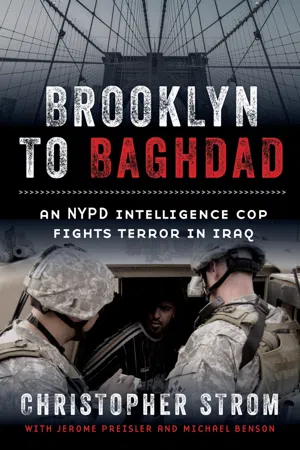
Brooklyn to Baghdad
An NYPD Intelligence Cop Fights Terror in Iraq
- 288 pages
- English
- ePUB (mobile friendly)
- Available on iOS & Android
eBook - ePub
Brooklyn to Baghdad
An NYPD Intelligence Cop Fights Terror in Iraq
About this book
Brooklyn to Baghdad is the true story of a retired NYPD intelligence sergeant applying his street-cop tactics and interrogation skills against a lethal insurgency that had infected Iraq. A group of retired Special Forces soldiers and law enforcement experts came together to form the counterinsurgency group codenamed "Phoenix Team." Exposing the corruption of both the Iraqi and US governments, the team faced serious setbacks and challenges. Brooklyn to Baghdad shows the effectiveness of Phoenix Team, their ability to process forensic evidence and human intelligence gleaned through interrogations at the point of capture to provide direct targeting for follow-on missions. This memoir also illustrates the politics of Washington, DC, and the US Army in the war-fighting effort, which continually hampered complete success while simultaneously preserving career aspirations. Throughout are many humorous and emotional anecdotes that reveal the men behind the missions and the toll the theater of war takes on real human lives
Information
1
Life as a Cop
I’M CHRIS. I AM THE INTERROGATOR, the Q in Q&A. One of the best. Not to brag, but merely to point out that I am a worthy narrator for this important story, a story both inspiring and frustrating. Before Iraq, I was one of the skilled interrogators of the New York City Police Department, a member of its elite Intelligence Division. I have more than twenty years of experience getting the truth out of hard-core liars.
My experience as an interrogator dates back to 1996, but even before then I knew that I had instinctive skills as a judge of character. One of the keys to interrogating someone is to be able to tell a couple things right away, and I mean in the first thirty seconds. One, is this basically a good person? And two, is he guilty of what he’s been accused of?
One of my favorite side effects to being a good judge of character is my friends tend to be folks of excellent character.
I cannot count the number of criminals I questioned as a cop in New York City. First as a street cop, then as a member of a narcotics detail in South Brooklyn, I was good at getting criminals to gab. In Iraq, I upped the ante, questioning terrorists: “Who are your friends? Where did you hide the bombs?”
And this is my book. With it, I hope to accomplish several things. I will take you with me as I crash through the front door of evil with the most effective counterinsurgency team ever assembled. I will share some tough secrets and expose the forces that eventually compromised our leadership and shut us down, putting soldiers’ lives at risk with the complicity of the CIA, FBI, and US Army. And I will tell you about a dedicated husband and father—me!—separated from my wife and kids by thousands of miles, torn between my love for them and a mission I knew was saving countless American (and Iraqi) lives.
While many books about the war in Iraq have been written from the point of view of journalists embedded in a military unit on a restricted and temporary basis, my story tells of a civilian contractor, not just embedded within a conventional army unit but entering right beside them as the structural target is assaulted, the gates and doors shotgunned off their hinges.
And it’s a story about the importance of human intelligence. Today’s intelligence-gathering techniques being what they are, people can easily be distracted by the high-tech toys: electronic gadgets, surveillance devices, satellite communications. Who doesn’t love that part in a James Bond movie when Q introduces 007 to all-new tech? Future-shock technology is fun, but it is still HUMINT—human intelligence—that drives the intel picture.
And the key to HUMINT is to take subjects alive. In wartime, it might feel efficient to kill bad guys whenever you get the opportunity, but in most cases a live captive beats a body. If the target of an investigation is killed, the intel picture also dies. If the target is captured, the role of interrogation in gathering human intelligence becomes critical.
But I’m getting ahead of myself. My story begins in peacetime, if you can ever call New York City peaceful. The five boroughs had their own war zones, and as a cop I prowled some of the most dangerous streets in America.
The events of my life before I joined the NYPD molded me as much as or more than anything that happened after. There were kids who had a lot tougher time than I did, but my youth was nonetheless tumultuous. My parents divorced when I was three. My dad was in and out of my life, mostly because my mother had remarried in disastrous fashion. My stepdad had seven kids from a previous marriage, most of whom had gone through their own trauma/drama in life. As a bonus, my mother and stepdad had twins.
When that marriage ended, my two sisters and I moved to Garden City, Long Island, to live with our grandfather. My mom worked nights at a bar in Glen Cove, and my poor grandfather was on the verge of a nervous breakdown because of all the turmoil. My sisters and I were basically left to fend for ourselves.
I struggled in school, not because I wasn’t capable—my grades were fine—but because I was listless, feeling angry and abandoned. One day when I was sixteen I passed by the US Marine Corps recruiting station at the Roosevelt Field shopping mall and asked about joining. They told me I had to wait until I was seventeen, and even then I’d need the permission of both parents. I couldn’t sit around anymore and watch the family deteriorate even further, so I got my mother and father to sign off. Five days after turning seventeen, I was in Marine Corps boot camp in Parris Island, South Carolina.
When I graduated fourteen weeks later, I was sent to aviation mechanics school in Tennessee, and after completion I was stationed at New River Air Station in Jacksonville, North Carolina. From there, I traveled all over the world courtesy of the US Navy: Scandinavia, elsewhere in Europe, Africa, and the Caribbean.
After four years I reentered civilian life, moved to Texas, and was a police officer in Plano for two years. Then I moved back to New York and was hired by the NYPD. It was the best career decision I ever made. In 1993 I met Deborah, my Debbie, and in December 1994 we were married, both of us for the second time.
In April 1996 I was reassigned to the Queens Robbery Task Force, a unit designed to combat violent felony crimes including robberies, car thefts, gun crimes, and serious assaults. I remained in the robbery unit for four years, until my promotion to sergeant in May 2000. At that point I was assigned to the Seventy-Sixth Precinct—the Seven-Six—in Carroll Gardens / Red Hook, Brooklyn. Not long after my arrival, the captain reviewed my career folder and put me in charge of the narcotics unit. Within six months of my taking over, the team had eclipsed the previous year’s activity, doubling the felony arrests and narcotics seizures.
September 11, 2001, happened to be my daughter Stephanie’s fourth birthday. I had intentionally changed my shift to a daytime tour of duty to be there for her on her special day. Before leaving home that morning, I kissed her and wished her a happy birthday and told her that when she came home from school, we would have a cake.
When I got to the Seven-Six, I grabbed my detective Ginger Velazquez and headed to the local diner for breakfast. Since we were both in plainclothes and not in the running for jobs from Central Communications, I had intentionally turned down my radio so as to not attract attention from patrons inside the diner. After finishing breakfast, we headed west on Atlantic Avenue toward the East River when I saw the first tower of the World Trade Center erupt into flames. My first thought was that it was an accident, a plane crash, tragic but not necessarily a national security issue. I turned up the volume on the police radio, but there was so much traffic it was hard to discern what was happening.
I called Debbie, who was working in the X-ray department at St. John’s Episcopal Hospital in Far Rockaway, Queens. Debbie was five foot four, 105 pounds, and 100 percent Italian. Debbie grew up on the South Shore of Long Island, in a town called North Woodmere. In a neighborhood known for large homes and great affluence, Debbie’s attitude was hard to miss. Not because she flaunted any wealth—hell, I was a civil servant, not a trader for Goldman Sachs. More because of the way she spoke and her choice of words, sharp and direct. Debbie could trade verbal jabs with the best, and choosing to spar with her could prove very embarrassing. She was tough on the inside and beautiful all at the same time.
I told her that I still intended to be home later for dinner and some birthday cake. I was still on the phone when I saw the sun glint off a jet in the sky and watched in horror as it slammed into the South Tower. The explosion was so violent that it shook my police vehicle, causing my partner Ginger to scream out loud. Gray ash sprinkled down over Lower Manhattan like a hellish snowstorm.
“What was that?” Debbie asked.
I knew we were under attack, but I didn’t say that. “I have to go,” I said, and hung up.
Easterly winds carried the airborne debris across the water until it was falling on the hood of my car. I saw small portions of photographs, presumably pictures of loved ones from someone’s workstation.
In the three days that followed, I was first stationed at the entrance to the Brooklyn-Battery Tunnel, then as security at Ground Zero, and later digging on the pile looking for survivors. One of the eeriest things I saw were the hundreds of pairs of ladies’ high-heeled shoes and empty baby strollers abandoned on the street, presumably so that their owners could run away faster from the falling debris.
On the third day, I finally got to go home to see my family. Driving along on the Belt Parkway, I was initially numb, exhausted from the past seventy-two hours of work, trying to process what had just happened. As I entered my house, I tried to compose myself for Debbie and my daughter, Stephanie, who would have to live with the fact that her birthday was forever associated with unthinkable carnage. My son Christian was still too young to understand any of this, but he was on my mind, too. Who knew at that point what his future would hold?
In the weeks that followed, Intelligence’s counterterrorism unit investigated each tip that came in and responded to everything from an explosion to a report of a suspicious package. They covered the whole city, a world unto itself, from the uppermost Bronx to Coney Island, from Staten Island to the far eastern reaches of Queens. That was where the action was, and where I wanted to be.
The events of 9/11 were acts of war, an attack on American ideals and freedom. That, and the fact that we didn’t know what would happen next, with perhaps more attacks to come, kept us all on the ball. We took our work very seriously, and it kept us busy.
The entire city was on edge, a level of communal anxiety I’d never encountered before. Because of the attack from the outside, folks who would normally have nothing to do with one another, folks from different neighborhoods, of different colors, different religions, were banding together. They had terror in common. For a time, the city was as one. It didn’t last, of course.
But the nervous edge persisted everywhere, including in my house, where you could accurately gauge the anxiety of the day by the number of cigarettes Debbie smoked. She was a moderate smoker on relatively calm days but chained them if there was a major incident in the city. The threat of anthrax made us crazy for a while.
As the weeks turned into months, I restarted the narcotics team as a way of bringing about some normalcy and routine. During the summer of 2002, my old captain David Barrere called me on my cell phone and asked me how my son was doing. In January 2001, Christian had been in intensive care for nine days with a deadly virus. Concerned about Christian’s recovery, Captain Barrere had gotten me reassigned to Employee Relations, allowing me to stay home for eight weeks with my son. An incredible gesture. I was pleased to say Christian was now doing great.
“Chris, I need a favor.”
“Anything, boss.”
“I need you to take the FIO [field intelligence officer] spot for Captain Harris.” Thomas Harris was the commanding officer of the Seventy-Sixth Precinct. “I need you to please take it. After six months, if it doesn’t work out, I’ll try to give you a soft landing at the 114th Precinct.”
“For you, boss, anything,” I said.
By October 2002, I was reassigned to the Intelligence Division, specializing in interrogations, debriefing of prisoners, and criminal investigations. Because I had developed a reputation among the criminal element, people would reach out to me directly to give me information on illegal activity or to help themselves get out from under a pending court case.
One time we received a walk-in at the Seven-Six, a guy who presented himself as a confidential informant. Joey the Junkie came through the door out of the blue, went right up to the desk officer, and told him he was interested in speaking directly with me. When the DO asked why, he clammed up. I don’t know how he got my name, but he insisted it was either me or nobody.
A few minutes later, Joey was at my desk telling me he had information about a cold-case double homicide—presumed to be a gangland crime—that was closing in on six years old. I hadn’t expected that, but I knew he wasn’t a crank, because he mentioned some accurate details about the investigation that we hadn’t released to the public. Joey confirmed our long-held suspicions that there was Mafia involvement in the killings, specifically by a wiseguy in the Gambino crime family—John Gotti’s old outfit—which controlled all the rackets in the Cobble Hill–Carroll Gardens neighborhood.
Joey was not only from the neighborhood but also a stone-cold heroin junkie and errand boy for Stephen Borriello, a tough wiseguy who’d also grown up nearby on Clinton Street in Red Hook. It occurred to me that we could use Joey to get close to the supposed shooter, and that was exactly what happened. Basically, we gave him cash to buy guns and drugs from Borriello’s partner, Pedro “Pete” Medina, who had inherited the drug trade from his papi and was now the exclusive dealer for Borriello. Medina dealt out of his apartment above a social club in Red Hook, as well as out of his girlfriend’s apartment in the Fort Greene section of Brooklyn and his locker at the hospital where he worked as an aide. And he was the suspect in the old double murder. Before long we were introducing NYPD undercover officers into the mix and buying guns and heroin from the target by the kilo.
We ran the case for five months, conducting video surveillance of the dealer and an NYPD undercover cop who’d been introduced to him courtesy of Joey the Junkie. When we finally took the case down, I interrogated the dealer. Medina saw himself as a hard case and refused to talk. “I’ll do the time,” he said adamantly.
“Oh really?” I said. “Well, let me show you a movie. You like movies, right?”
“Sure,” he said. “Who don’t like movies? Everybody likes fucking movies.”
“Good, because I’ve got an Academy Award–winning performance to show you, and guess who has the starring role?”
I played Medina the surveillance video. Again and again there he was, selling firearms and drugs to our undercover man and Joey the Junkie. When the recording was finished I gave him some mock applause. For good measure, I had the undercover cop walk into the office and give Medina a bright, toothy smile worthy of Hollywood.
Just like that, the dealer wasn’t acting so tough. He looked about ready to crumble....
Table of contents
- Cover Page
- Title Page
- Copyright Page
- Dedication Page
- Contents
- Foreword: You're in Good Hands
- Author's Note
- Abbreviation Key
- 1. Life as a Cop
- 2. Last Days
- 3. Moving
- 4. Recruited
- 5. CSI for IEDs
- 6. Roswell
- 7. Fort Hood
- 8. First Missions
- 9. Under Attack
- 10. A Job with Meaning
- 11. The Soldiering Part
- 12. A Nasty Potpourri
- 13. FNGs
- 14. Mr. Subhuman, Mr. Oscar, and Mr. Lover
- 15. Mr. Bad Guy
- 16. Crushing Demons
- 17. “Daddy, Why Are You Going Back?”
- 18. Madame Death
- 19. The Boy and the Police Station
- 20. Why I Missed Chow
- 21. The Bomb in the Market
- 22. Home and After
- Conclusion: Matt Pucino
- Epilogue: And Not a Damned Thing Has Changed
- Acknowledgments
- About the Authors
Trusted by 375,005 students
Access to over 1.5 million titles for a fair monthly price.
Study more efficiently using our study tools.
Frequently asked questions
Yes, you can cancel anytime from the Subscription tab in your account settings on the Perlego website. Your subscription will stay active until the end of your current billing period. Learn how to cancel your subscription
No, books cannot be downloaded as external files, such as PDFs, for use outside of Perlego. However, you can download books within the Perlego app for offline reading on mobile or tablet. Learn how to download books offline
Perlego offers two plans: Essential and Complete
- Essential is ideal for learners and professionals who enjoy exploring a wide range of subjects. Access the Essential Library with 800,000+ trusted titles and best-sellers across business, personal growth, and the humanities. Includes unlimited reading time and Standard Read Aloud voice.
- Complete: Perfect for advanced learners and researchers needing full, unrestricted access. Unlock 1.5M+ books across hundreds of subjects, including academic and specialized titles. The Complete Plan also includes advanced features like Premium Read Aloud and Research Assistant.
We are an online textbook subscription service, where you can get access to an entire online library for less than the price of a single book per month. With over 1.5 million books across 990+ topics, we’ve got you covered! Learn about our mission
Look out for the read-aloud symbol on your next book to see if you can listen to it. The read-aloud tool reads text aloud for you, highlighting the text as it is being read. You can pause it, speed it up and slow it down. Learn more about Read Aloud
Yes! You can use the Perlego app on both iOS and Android devices to read anytime, anywhere — even offline. Perfect for commutes or when you’re on the go.
Please note we cannot support devices running on iOS 13 and Android 7 or earlier. Learn more about using the app
Please note we cannot support devices running on iOS 13 and Android 7 or earlier. Learn more about using the app
Yes, you can access Brooklyn to Baghdad by Christopher Strom,Jerome Preisler,Michael Benson,Michael Benson in PDF and/or ePUB format, as well as other popular books in History & Military Biographies. We have over 1.5 million books available in our catalogue for you to explore.