eBook - ePub
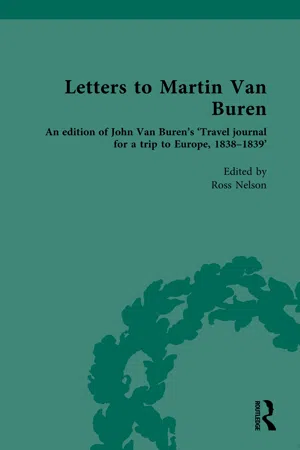
Letters to Martin Van Buren
An edition of John Van Buren’s ‘Travel journal for a trip to Europe, 1838-1839’
- 168 pages
- English
- ePUB (mobile friendly)
- Available on iOS & Android
eBook - ePub
Letters to Martin Van Buren
An edition of John Van Buren’s ‘Travel journal for a trip to Europe, 1838-1839’
About this book
John Van Buren's 'Travel journal for a trip to Europe, 1838-1839' is a record of the a year he spent in England, Scotland, Ireland, Belgium and Holland, primarily for his father, Martin Van Buren, the 8th President of the United States. A fly-on-the-wall view of the political and social situation in Europe was invaluable to the President at a highly sensitive moment in Anglo-American relations, and provides a rich and insightful view for historians of the period. Published in its entirety for the first time, Van Buren's objective and good-humoured observations present fresh insights into complex and compelling personalities and relationships on both sides of the Atlantic, providing an invaluable and highly readable resource for scholars and students of the period, as well as for the general reader.
Information
LETTERS TO MARTIN
VAN BUREN
An edition of John Van Buren’s ‘Travel
journal for a trip to Europe, 1838–1839’
1
At sea25 May – 10 June 1838
DOI: 10.4324/9781003228424-2
Friday, 25th May 1838
Well! here we are four days out at sea and running along delightfully: everything augurs a charming passage & my good luck attends me, now as ever. So my friends, & brothers did not see fit to accompany me to the Hook1 & I did not wish they should, on my account, incur the gêne2 of returning. Yet had the case been reversed with most of them, I think my stoical self would have acted differently. Poor Mrs Clarke & pretty Mrs Pell3 reluctantly compelled, for want of a cavalier, to content themselves with bidding Alfred4 adieu! at the wharf. But one of the passengers had any friends to attend him to the ship: that one is an active politician of the 5th Ward,5 & was cheered off by a squadron of his warmhearted, land handed associates. It is curious how very, very sad I felt the first 48 hours after leaving New York. It is curious, because my absence is to be of so short duration; my relations, I live apart from, & therefore shall not feel my absence from: the weather was delightful, which always exhilarates me, & it is a long time since I remember to have experienced a sensation of this sort, that I could not, by an effort, shake off. Can it bode evil? I trust not, & certainly fear no such result. A firm believer in pre-ordination, & conscious of my inability to vary my fate, I am sanguine, always, in hoping for the best; &, as I believe, quite prepared for the worst. The last time I remember to have felt such sadness as I speak of, was when I went to school at Jamaica:6 how well I recollect when I was first left there, that for months I cried as if my heart would break: & when my father favored us with an occasional visit, & marked the well rolled gravelled walks of old Mr King, with the track of his solitary coach wheel; how, after his absence, I used to watch from day to day, almost with affection its gradually disappearing trace, & well nigh quarrel with Mr King’s careful gardener for obliterating what may be associated, in my mind, with such fond recollections. But a time to such childish recollections. What stuff they would seem to the eye of any other but myself.
How strongly this ship, the ocean, the voyage & the attendant circumstances bring back to my mind my former trip,7 my father, Vail, d’Otrante8 & others, our landing in England, Robert Hunter’s hypochondriacal face & his pretty wife,9 London, my rapid tour on the Continent, our unexpected return, & the disgraceful causes that brought it about, the condign punishment that has been visited on the heads of those unworthy politicians who contrived my father’s downfall.10 His uninterrupted advancement, the difficulties that environ him now,11 the faith that I have in the ultimate victory, all these images pass daily through my brain like the figures in a panorama.
We have been running rapidly away from the Hook, some 200 miles a day, & are now within 300 miles of the Banks, off Newfoundland: there we are just in time for the islands of ice, which float along the outside of the Banks in great quantities in June. But I passed there in June, returning in ‘32, & fell in with no ice. A packet ship the ‘Liverpool’, ran on the ice some years since, & went down in 15 minutes. The passengers were saved after being out 70 hours in the long boat.12 On leaving New York I prophesied that we should be 22 days on the passage. Since then I have bet against 22: but for that, I believe we should run over in 18. We might easily do it at our past rate.13
Whilst in the passage, I have devoured (as people say) two novels, – ‘Alice’, by Bulwer, & ‘The Robber’, by James.14 ‘Devour’ is a good turn for it, by the way, for I guzzle up a couple of volumes a day. ‘Alice’ is a very queer improbable story, absurd, indeed, but written with great power, & intensely interesting. I did not think any fictitious love story could engross me, so entirely. It is full of wit & some philosophy. Bulwer, I have long thought, the first novel writer of the age. The chief defects in his work are created, or arise rather, from the taste of the society for which he writes. An ennuyé’d, fashionable world must have glare & tinsel, & excitement; & he gives them to them. The number of seductions, & illicit connexions in all his works, & particularly in this, is ludicrous. Even Lady Blessington,15 with her fruitful invention, can hardly exceed him in this line. The good society of England is bad enough, I dare say, but notwithstanding the picture of Lady B[lessington] & Bulwer, I half suspect virtue is not such a very rare plant as they would make us believe.
Saturday, 26th May 1838
A lovely night, last night & I lay on the taffrail,16 smoking cigars, & looking at the phosphorescent lights about the tail of this ship, & the stern, & up into the clear, bright starry heaven, ‘till the one o’clock bell admonished me to have an end of my smoking, & castle building & betake myself to sleep. We had a fine rain through the night, & this morning am now over the Banks. The Captain thinks we shall pass to the South of them. A fine large ship under full sail has been ahead of us these two hours, she is now just under our bow & we are now over-hauling her fast.
Had a game of chess this morning with an Englishman on board, who played quite well & seems to take a pride in his game. I was the conqueror this time, but apprehend more trouble before our voyage is finished. I have limited him to one game a day. Zounds! If I keep on beating people this way, I shall begin to set up for a chess player. By the way, this ship is not the only thing that brings to my mind an individual in Albany,17 of whom I think a great deal more than I ought to do, or that I know why. Our intercourse has been, almost, like that of the icicles, & yet hardly a moment passes that I do not detect myself recalling some look, or act, or word, of it. I wonder why it is! She no doubt has quite forgotten me, simply from having other things to attend to, & when thus treated, I never before recollect an instant where it gave me a moment’s concern. And what my feelings towards it are, I cant [sic] exactly analyze. Not a limitation altogether, because it has qualities, & ways, I don’t like. Not a desire to possess, because I never could seriously think of changing my condition where such a process was easy & natural. Much less here, I should think, where such a step would be difficult, if not impossible. Besides I sincerely believe I shall never ask one to share my fortunes, who would be a loser by granting the request. I bitterly hate anything that looks like dependence. It can’t be done, for its want of enthusiasm, excitement, susceptibility & buoyant spirits, & its coldness, keep that afar off. But it is beautiful; such a shaped head, complexion, eyes, hair. More than all – a nonsense[.] How I run on, & what stuff I am writing for my own silly penchant. But it has good sense & excellent breeding! & so now adieu, my troublesome, pertinacious, unbanishable, compagnon or compagnne of my age.18
Sunday, 27th May 1838
& good riddance to you my friend Mr M? Ilvaine.19 Here had I spread out the Captain’s desk all nicely to add a meagre page to my young journal, when down lounges my friend Mr I[lvaine] into the seat I had prepared & leaves me for a couple of hours to console myself with Lockhart’s life of Scott.20 As usual I have begun the last work with the seventh & concluding number & find it so intensely interesting that I shall read backwards a few numbers. What odd taste some people have! Last night was Saturday evening & according to usage, we gathered round a noggin of punch to tell & hear the wonders those see that go down to the sea in great ships! A return gentleman who is now making his forty third! passage gave us some fearful account of hair breadth escapes, which were well enough: but then he began to comfort us with assurances that we should fall in with ice, that it abounded in this longitude exactly at this season exactly, that the last time he was in the ice on the banks, they first knew of the presence or propinquity of ice, by seeing it slithering over the fore top & conquering the fore top & main mast with the help of the mizen [sic] sails they backed out from under it & were saved, that it was the easiest thing in the world to avoid the ice by steering south, but the Captain, from sheer obstinacy, never would; with much more consolatory & cheering information. We had a fog & cold weather last night, both of which portend that ice is near. After this veteran of 43 trips had made most of his associates as uncomfortable as possible, he turned into his birth & in 15 minutes, one could hear him snore all over the cabin. Pleasant fellow, sure enough! Tho’ I didn’t half like his stories, I could not help laughing at the hearty enjoyment his relations seemed to afford himself & the sort of ‘d___n you, take that’ way in which he dealt them out harder & stronger as he went on. When he was in the midst of his horror about running under the ice, I set the passengers laughing by asking very grandly ‘whether they had an ice house on board’ & as he said, no! I thought it was an ill wind, that blew nobody good. Once I ventured to suggest by way of comfort that it was a wonder when so many vessels passed the Banks daily that so few were lost: but he put this solace to flight by repeating the names of half a dozen that were lost & adding, ‘when a ship sails & is not heard of again, very little is said about it!’ Notwithstanding his forebodings we had a calm smooth night & that with no accident. Sat up ‘till near 2 o’clock & but for a heavy dew, should have enjoyed the night over much. The water was as smooth as glass & a light breeze aft sent the vessel booming on some seven knots an hour, without a particle of motion. About 9 this morning Mr Clarke21 awakened me to say that we had fair wind, a clear day, were going nine knots & had had warm rice-cakes for breakfast. There is a budget of good news for which I was exceedingly thankful; I am more so now, that I have been on deck, & find not a word of it is true. It is now 3 P.M. & a breeze is just springing up after we have been becalmed since 5 A. M. The fog & mist cleared away about noon & left us as lovely a spectacle as can be imagined, the sea as calm, & clear, & smooth as a mirror. A balmy, mild atmosphere & in truth one of nature’s as well as man’s Sabbath day. We have made no progress today, our ship which was too seriously disposed to start on Sunday, maintaining its character by refusing to continue its journey today. However ...
Table of contents
- Cover
- Half-Title
- Title
- Copyright
- Dedication
- Contents
- Illustrations and map
- Preface
- Acknowledgements
- Editorial policy
- Introduction
- The Journal
- Bibliography
- Index
Trusted by 375,005 students
Access to over 1.5 million titles for a fair monthly price.
Study more efficiently using our study tools.
Frequently asked questions
Yes, you can cancel anytime from the Subscription tab in your account settings on the Perlego website. Your subscription will stay active until the end of your current billing period. Learn how to cancel your subscription
No, books cannot be downloaded as external files, such as PDFs, for use outside of Perlego. However, you can download books within the Perlego app for offline reading on mobile or tablet. Learn how to download books offline
Perlego offers two plans: Essential and Complete
- Essential is ideal for learners and professionals who enjoy exploring a wide range of subjects. Access the Essential Library with 800,000+ trusted titles and best-sellers across business, personal growth, and the humanities. Includes unlimited reading time and Standard Read Aloud voice.
- Complete: Perfect for advanced learners and researchers needing full, unrestricted access. Unlock 1.5M+ books across hundreds of subjects, including academic and specialized titles. The Complete Plan also includes advanced features like Premium Read Aloud and Research Assistant.
We are an online textbook subscription service, where you can get access to an entire online library for less than the price of a single book per month. With over 1.5 million books across 990+ topics, we’ve got you covered! Learn about our mission
Look out for the read-aloud symbol on your next book to see if you can listen to it. The read-aloud tool reads text aloud for you, highlighting the text as it is being read. You can pause it, speed it up and slow it down. Learn more about Read Aloud
Yes! You can use the Perlego app on both iOS and Android devices to read anytime, anywhere — even offline. Perfect for commutes or when you’re on the go.
Please note we cannot support devices running on iOS 13 and Android 7 or earlier. Learn more about using the app
Please note we cannot support devices running on iOS 13 and Android 7 or earlier. Learn more about using the app
Yes, you can access Letters to Martin Van Buren by Ross Nelson in PDF and/or ePUB format, as well as other popular books in Literature & 19th Century History. We have over 1.5 million books available in our catalogue for you to explore.