This book offers international perspectives on the economic, social, geopolitical, and environmental implications of COVID-19 on tourism, an unprecedented situation for this sector.
It considers the challenge of making the tourism industry more resilient to such crises and the future sustainability of tourism. Contributions explore the changing dimensions of tourism marketing post-COVID-19; the rising challenges in tourism education and ways to handle the crisis; the impact of the pandemic on tourism governance; and the emerging ethical issues of stakeholders' responsibility.
The book will be useful for researchers, students, and practitioners in the fields of tourism, geography, and crisis management disciplines.
1 The Impact of COVID-19 on Tourism Demand and Supply
Adejumoke Abiose and Hosea Olayiwola Patrick
DOI: 10.4324/9781003207467-3
Introduction
An outbreak of severe respiratory illness was first detected in the city of Wuhan, Hubei province of China, in late December 2019 (Chen et al., 2020; Kaplan et al., 2020; Yang et al., 2020). The World Health Organization (WHO) and health care workers in China announced a rise in the number of patients with cases of pneumonia of unknown cause. It was subsequently identified that a novel virus named Coronavirus Disease 2019 (COVID-19), a highly communicable disease was responsible for the viral outbreak (WHO, 2021). This new strain of SARS also referred to as SARS-CoV-2 has since grown, spreading across many countries, and has been declared a global pandemic by the World Health Organization (WHO) (Gössling et al., 2020). This novel virus is assumed to have originated from bats and wild birds and then spread down to non-mammals and hence to mammals, possibly by contamination of meat from wild animals as sold in China meat markets (Chen et al., 2020; Cohen, 2020; Li et al., 2020). A highly communicable respiratory disease, COVID-19, is mainly spread through droplets produced when an infected individual sneezes, coughs, or exhales. The virus spans through contact with other infected individuals with symptoms such as fever, cough, loss of taste and smell, and, in more severe cases, difficulty in breathing (Bakar and Rosbi, 2020).
Owing to the drastic spread of the virus, several suggestions were recommended to suppress and contain the further spread of the virus. Most countries responded with various forms of non-pharmaceutical interventions such as frequent hand washing, adoption of nose masks, total lockdown, travel controls, isolation/quarantine, and social distancing, i.e., maintaining physical distance from others (Chu et al., 2020; Gössling et al., 2020; Moloney and Moloney, 2020; Patrick et al., 2021: Shah et al., 2020). Imposing travel restrictions immediately affected national economies as the majority of the world’s population became grounded. These travel restrictions led to airlines suspending flights, the closure of tourism sites and attractions, hotels, cafes, and restaurants closed, cancellation, or postponement of major events and festivals such as the Olympics, leaving the tourism industry virtually standstill (Mohanty et al., 2020).
Within over 14 months of first reporting a pneumonia outbreak in Wuhan, China, there are over 111 million COVID-19 cases and over 2.46 million deaths across 219 countries as of February 23, 2021. As of March 10, 2021, the World Health Organization (WHO, 2021) reported that about 117 million people globally have been confirmed to have the virus, with approximately 2.6 million deaths (WHO, 2021). For instance, South Africa reported its first COVID-19 case on the 5th of March 2020 (NICD, 2020). Subsequently, widespread community transmission began to occur, and the number of cases continued to grow each day. With the highest number of SARS-COV-2 infections in Africa, South Africa has recorded about 1.52 million confirmed cases with approximately 60,000 deaths (WHO, 2020). The country is currently experiencing a second wave of SARS-CoV-2 with an increase in new infections and deaths. Quite a substantial number of these new infections are fueled by a new highly local contagious variant of the SARS CoV-2 and a series of super spreader events. The 501Y.V2 variant, first identified in South Africa, has spread quickly beyond South Africa and its sub-region.
It is pertinent to assert that while the tourism industry has withstood pressures from a wide range of pandemics and attendant crises in the past, the swiftness and implication of the COVID-19 pandemic have been unprecedented. The industry was hard hit by the measures taken to subvert the spread of the virus (Uğur and Akbıyık, 2020). Analysis for the present immediate COVID-19 impact for the tourism industry indicates that the international tourism industry would continue to experience a decline in tourism supply and demand with a slight hope of recovery until the fourth quarter of 2021 (UNWTO, 2020a). This would put approximately 100 to 120 million direct jobs at threat. Some nations are expected to be severely hit compared to others due to their high dependence on the tourism industry (Paola, 2020; Statista, 2020). The implication for the local tourism industry, especially in economies highly dependent on tourism, is better imagined than felt. In South Africa, the impact of the pandemic has been unprecedented, especially for the rural poor dependent on tourism-centered livelihood options (Mabuza, 2020; Makhaye and Mkhize, 2020). Owing to this assumption, this chapter explores the impact of COVID-19 on the demand and supply of tourism.
Impacts of Pandemics on Travel and Tourism
Going down history lane, the outbreak of diseases and pandemics has long had a transmuting effect on societies and environments. The principal reason for this sprawl emerges from the processes of globalization and urbanization (Hall et al., 2020; Watts and Parks, 2018). In our current urbanized settings, unrestricted human movements towards urban environments have increased as half of the world population currently resides in urban centers. The prospect for infection and spread in these settings has also increased alongside the increasing population due to closer proximity and contact. Additionally, these urban centers are now more interconnected than ever before due to transport integration and development through plane, train, ship, and road. This goes without saying that while curtailing the spread of the disease by breaking its transmission chain is a necessity, the movement of people aided by easier and faster transportation networks serves to spread the disease faster than normal. In this sense, tourism becomes both an agent for proliferating the disease and also a casualty of the virus spread at the same time (Ishmael, 2020). In other words, a passenger plays a vital role in the transfer of diseases and epidemics from one urban center to another side of the world in a day (Connolly et al., 2021). To this effect, the tourism industry is particularly affected as it is often a target for breaking the chain of disease transmission.
It is imperative to establish that the global travel and tourism industry has withstood the pressures of a wide range of pandemics and crises in the past (Mensah, 2020). Notable examples are the Ebola virus (2014–2016), the H1N1 swine flu (2009–2010), Severe Acute Respiratory Syndrome (SARS) (2002–2004), Spanish flu (1918–1920), and the Black Death pandemic (1346–1353), among others. Having a similar pattern with the recent COVID-19 pandemic, the Spanish flu led to the restriction on travels for about 4 months and led to about 21 million deaths within a short timeframe (CDC, 2020a, b, c; Mensah, 2020). SARS and the H1N1 virus caused an economic loss of over 21 billion and 8 billion US dollars for the America’s Asian Pacific regions, respectively (Škare et al., 2020). In the same vein, the Mexican tourism industry had economic loss amounting to approximately 2.8 billion dollars courtesy of the H1N1 epidemic (Glaesser, 2011; Mensah, 2020).
The sprawl and emergence of the COVID-19 pandemic have echoed through all facets of the globe, having an unprecedented impact on societies around the world, causing the loss of livelihoods, the loss of lives, and a major collapse in general economic activity to many individuals and organizations (Ishmael, 2020; Jaipuria, 2020). While demand for specific segments of the economy such as grocery stores saw growth during the pandemic, other areas of the economy such as the transportation and tourism industries experienced drastic decline (and in some instance, total disappearance) in the demand for their services (Del Rio-Chanona et al., 2020). The travel and tourism industry are considered one of the hardest hits and worst affected of all major economic sectors by the COVID-19 outbreak. This is largely due to the heavily reliant nature of the industry on an intact environment (Jaipuria, 2020; UNWTO, 2020a, b). Despite the historical resilient nature of the tourism industry as depicted in its response to previous crisis, the COVID-19 pandemic present unprecedented challenge leading to immediate and immense shock to the sector.
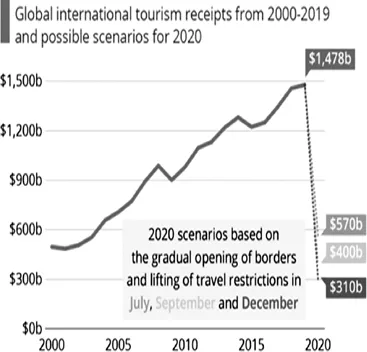
As a result of governments’ restrictions as a measure to curtail the spread of the virus, traveling from one country to another was restricted, resulting in a drop in international tourist arrivals and receipts in 2020 compared with 2019. The travel and tourism industry prior to the COVID-19 pandemic provided over 320 million jobs and account for approximately 10% of the global GDP (Behsudi, 2020). The sector experienced a 59% growth from 880 million to 1.5 billion US dollars between 2009 and 2019 and contributed about 8.9 trillion to global GDP in 2019 (Alaae Sbai, 2020). The World Travel & Tourism Council (WTTC, 2020a), however, projects a loss of roughly 75 million jobs and up to US$ 2.1 trillion dollars in relation to tourism due to the effect of COVID-19 pandemic on the industry. Richter (2020) argued that about 120 million jobs considered to be at risk, with approximately 1 trillion dollars in economic loss. It is speculated that depending on the length of the crisis and when travel bans are completely lifted, international tourism receipts are expected to plunge downward between the range of 910 billion and 1.2 trillion dollars from the year 2020, which would set the global tourism industry back by 20 years (Felix, 2020). As Figure 1.1 depicts, the steady growth recorded in the past 20 years (2000–2020) is at the risk of reversal as a result of the COVID-19 pandemic (UNWTO, 2020b). The figure shows UNWTO report on tourism growth from 2000 to 2019 and the possible scenarios from 2020 in a COVID-19 new world order. The steady rise from less than $500 billion recorded in 2000 to approximately $1.5 billion in revenue face the risk of decline to pre-2000 global average.
Figure1.1 Growth in the global tourism industry (2000–2020).
The Organisation for Economic Co-operation and Development (OECD) (2020) posited that the current pandemic would have long-lasting global impact on the supply and demand of tourism both internationally and locally. While the international tourism demand has the propensity of recovery in the fourth quarter of 2021, the domestic sector is projected to have a faster recovery. While a 60%–80% decline is generally projected for international tourism, Africa and the Middle East are expected to have begun recovery by the fourth quarter of 2020. Asia and Europe ar...
Table of contents
Cover
Half Title Page
Series Page
Title Page
Copyright Page
Table of Contents
List of figures
List of tables
List of contributors
Introduction
Part One: COVID-19 and Tourism: Introduction
Part Two: COVID-19 and Tourism Marketing Sustainability
Part Three: Tourism Education and Research for Tourism Sustainability
Part Four: Ethics and Responsibilities in Tourism Management Post COVID-19 Pandemic
Part Five: COVID-19 and Tourism Governance
Index
Trusted by 375,005 students
Access to over 1.5 million titles for a fair monthly price.
Study more efficiently using our study tools.
Frequently asked questions
Yes, you can cancel anytime from the Subscription tab in your account settings on the Perlego website. Your subscription will stay active until the end of your current billing period. Learn how to cancel your subscription
No, books cannot be downloaded as external files, such as PDFs, for use outside of Perlego. However, you can download books within the Perlego app for offline reading on mobile or tablet. Learn how to download books offline
Perlego offers two plans: Essential and Complete
Essential is ideal for learners and professionals who enjoy exploring a wide range of subjects. Access the Essential Library with 800,000+ trusted titles and best-sellers across business, personal growth, and the humanities. Includes unlimited reading time and Standard Read Aloud voice.
Complete: Perfect for advanced learners and researchers needing full, unrestricted access. Unlock 1.5M+ books across hundreds of subjects, including academic and specialized titles. The Complete Plan also includes advanced features like Premium Read Aloud and Research Assistant.
Both plans are available with monthly, semester, or annual billing cycles.
We are an online textbook subscription service, where you can get access to an entire online library for less than the price of a single book per month. With over 1.5 million books across 990+ topics, we’ve got you covered! Learn about our mission
Look out for the read-aloud symbol on your next book to see if you can listen to it. The read-aloud tool reads text aloud for you, highlighting the text as it is being read. You can pause it, speed it up and slow it down. Learn more about Read Aloud
Yes! You can use the Perlego app on both iOS and Android devices to read anytime, anywhere — even offline. Perfect for commutes or when you’re on the go. Please note we cannot support devices running on iOS 13 and Android 7 or earlier. Learn more about using the app
Yes, you can access COVID-19 and the Tourism Industry by Anukrati Sharma, Azizul Hassan, Priyakrushna Mohanty, Anukrati Sharma,Azizul Hassan,Priyakrushna Mohanty in PDF and/or ePUB format, as well as other popular books in Business & Hospitality, Travel & Tourism Industry. We have over 1.5 million books available in our catalogue for you to explore.