The process of globalisation in world markets, and the growing number of enterprises competing with one another in terms of the products and services they offer, naturally leads to the improved efficiency of management systems. Efficiency is required in order for these entities to maintain competitiveness. To assess the efficiency of their management systems, enterprises use quality cost calculation. This book fills the research gap concerned with the scientific study of the quality cost calculation, with regard to service companies. It offers the authors' concept of using the cost of quality calculation as a tool for assessing the efficiency of the management systems of service companies. The book consists of six chapters that present both a theoretical and an empirical part. In the theoretical part, the following issues are discussed: quality costs; the evolution of quality cost calculation; quality cost calculation models and their applications to date; and the specific way in which service companies operate. The practical part presents the authors' model of quality cost calculation along with the adopted assumptions and cost structure, as well as the research methodology and verification of the use of the developed model in a selected service company. The research gives credence to the role and importance of this tool in economic practice. The book will be desired reading by both theoreticians and practitioners of quality management and accounting. It is also a valuable resource for master's and doctoral students wishing to broaden their knowledge of quality costs and their calculation in the fields of economics and management. The Open Access version of this book, available at http://www.taylorfrancis.com, has been made available under a Creative Commons Attribution-Non Commercial-No Derivatives 4.0 license.
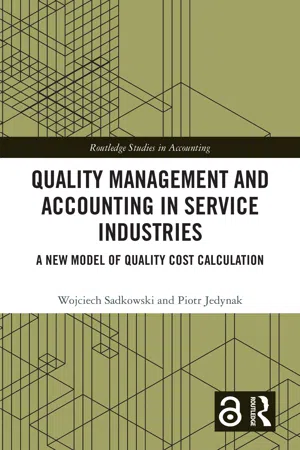
eBook - ePub
Quality Management and Accounting in Service Industries
A New Model of Quality Cost Calculation
- 208 pages
- English
- ePUB (mobile friendly)
- Available on iOS & Android
eBook - ePub
Quality Management and Accounting in Service Industries
A New Model of Quality Cost Calculation
About this book
Information
1 Quality costs as a subject of research in management sciences
DOI: 10.4324/9781003275022-2
1.1 A review of the definitions of quality costs
The existence and functioning of an enterprise in the global market depends on its ability to provide products or services that not only meet customers’ requirements but also are competitive in terms of quality, price, lead time and distribution. To meet these conditions, it is necessary to identify, measure and control all quality-related costs (Skrzypek, 2000; Chiu and Su, 2010; Raßfeld et al., 2015).
The starting point in reviewing the definitions of these costs is to become familiar with the notion of quality. The first mentions of the concept of quality were found in philosophical sciences literature dating back to antiquity (V–IV centuries BCE). Plato related quality to objects and phenomena occurring in life. He also claimed that it is a certain degree of perfection that cannot be defined, but can only be understood through experience. Plato’s idea was further developed by Aristotle, who recognised quality as one of the ten basic philosophical categories. In Aristotelianism, quality defines why a thing is the thing that it is, and it does not depend on the subjective view of the beholder (Biadacz, 2018).
Also, other great philosophers, including R. Descartes, J. Locke, I. Kant, F. Hegel, dealt with the concept of quality. R. Descartes and J. Locke understood quality dualistically: as a primary quality that is objectively present in an object, e.g. shape, and as secondary quality that is emitted by an object, e.g. smell, colour. Their approach was undermined by Kant, who regarded primary qualities as also subjective. Also, F. Hegel did not recognise the dualistic character of quality, treating it as a logical category equivalent to being (Bareja and Giedroyć, 2007).
A significant contribution to the contemporary theory and practice of quality was made in 1931 by W.A. Shewhart (1931) in his study on the economic control of product quality. The reflections of this scientist became the basis for the works of the so-called Great Teachers of Quality, also referred to as Quality Gurus: W.E. Deming, J.M. Juran, Ph.B. Crosby and K. Ishikawa, who were practitioners in the field of quality management. According to W.E. Deming, J.M. Juran and Ph.B. Crosby, product quality meant the degree of freedom from defects and errors, conformity to requirements or suitability for use or application (Bank, 1996). It should be considered in a broad context that includes the producer, the user and the environment; the creation of good quality should be the result of taking into consideration and agreeing on the quality requirements of these three groups of entities (Lisiecka, 2002).
The Polish standard PN-EN ISO 9000:2015 defines quality as the degree to which a set of inherent characteristics of an object meets requirements. According to this standard, quality can be low, good or excellent (ISO 9000…, 2016).
On the other hand, the quality of products and services provided by an organisation is defined by its ability to satisfy customers and exert influence on them (ISO 9000…, 2016). The quality of products and services should refer to not only obtained results but also the customer’s expectations and requirements in relation to a given product, since the entity that verifies the quality of a manufactured product or a provided service is the consumer, and it is their needs and expectations that must be taken into account (Ciechan-Kujawa, 2005). Furthermore, quality is a key element in measuring productivity (Al.-Dujaili, 2013).
According to K. Sato, three types of quality can be distinguished: required quality which is expected by customers in the market, target quality which is in the sphere of desires of the management of an enterprise and conformance quality which means the quality provided by an entity and fulfilling the needs of customers (Sato, 1998).
In fact, it is impossible to define this concept unambiguously. The literature on quality fails to provide a single unambiguous definition (Mohanty and Tiwari, 2005; Mukherjee, 2019). This is related to the fact that quality is an interdisciplinary concept and an object of interest of researchers from different fields of science such as economics, philosophy, law, psychology and pedagogy. Each of these groups perceives the term in its own way, adapted to its own needs and requirements (Bareja and Giedroyć, 2007).
The survival of an enterprise in a business environment where change is the only constant in social and economic development depends on its ability to focus on quality and customer satisfaction (Andrijasevic, 2008). Effective and efficient management very much depends on management by quality, which is regarded as a basic driver of success in an enterprise.
The notion of quality constitutes the starting point in deliberations on quality costs. The first mentions of such costs appeared in the United States in the 1940s (Hellman and Liu, 2013). The growing demand for the supply of military equipment to the Allies during World War II contributed to the growth of interest in the subject of quality (Dahlgaard-Park, 2015). There was a problem of very high defectiveness of manufactured equipment reaching up to 80%, which was caused by the lack of skilled workers in this field. The greatest difficulty was in identifying the costs of quality. It became a priority to find a way of eliminating defects. Production control and inspections were initiated, which began the era of evaluation costs (Szymula, 2005).
The 1940s were the period when the concepts of internal and external quality costs were formulated. Internal quality costs concerned the repair or sale at a lower price of a product whose defectiveness was detected during the production process. External quality costs, on the other hand, were defects detected by users (Szymula, 2005).
The interest in quality costs in the 1950s exceeded all expectations and Japan became the main centre of research on quality: J.M. Juran and W.E. Deming transferred their ideas to the Japanese manufacturing sector, thus launching the great Japanese quality revolution (Wawrzynek, 2013). In that decade, the concept of quality costs was introduced into the scientific literature by J.M. Juran and A.V. Feigenbaum. Developing the concept, the former of them referred to the principle of gold in the mine, i.e. benefits to be delivered by high product quality. It is only possible to acquire knowledge on how to control quality if it is measured. And it was costs that became a tool used to measure quality (McLaughlin, 1995).
The first books on this topic, Total Quality Control by A.V. Feigenbaum and Quality Control Handbook by J.M. Juran, focused on cooperation among employees of different departments of an enterprise based on costs of quality, i.e. the costs of evaluation, prevention and deficiencies (Feigenbaum, 1961; Juran, 1974; Szymula, 2005).
Another important part of the history of quality is a publication issued by the American Quality Control Association in 1967, which classified quality costs as: costs of preventive measures, costs of quality assessment, losses on internal deficiencies and losses on external deficiencies (Wood, 2013).
The increased interest of business entities in costs related to quality resulted from several factors, including the growing pressure to reduce costs and improve profitability. In many countries, an important stimulus raising the importance of quality costs was also the introduction of the ISO 9000 series of international standards, published in 1987, which contained quality assurance and management models and guidelines for building quality systems (Lisiecka, 2002).
Quality costs are not a precisely and unambiguously defined concept. As M. Ciechan-Kujawa points out, “it results from (...) differences in approaches to quality and from the fact that, in business enterprises, the areas of activities related to quality and other processes permeate each other” (Ciechan-Kujawa, 2005). Therefore, the authors have prepared a review of the most important definitions of quality costs. They are presented in Table 1.1.
| Author | Year | Definition |
|---|---|---|
| J.M. Juran | 1951 | An instrument used to measure quality. “Gold in the mine”. |
| A.V. Feigenbaum | 1961 | Costs associated with quality-oriented measures, including: prevention, appraisal and control, consequences of errors, related to an entire product life cycle. |
| American Society for Quality Control | 1967 | Resources used for activities that prevent poor quality, activities related to the evaluation of the quality of products or services, as well as the result of internal and external deficiencies. Having such data allows an organisation to estimate potential savings that can be achieved, thanks to process improvements. |
| J.M. Groocock | 1974 | Costs incurred for defective production and those that would not occur if quality assurance measures were taken and no defects or faults occurred. |
| F. Nixon | 1974 | Costs of ensuring that the consumer receives only those products that have been made in accordance with their requirements. |
| Ph.B. Crosby | 1979 | Quality costs nothing, but lack of quality, i.e. doing the job wrong the first time, is costly. |
| Ministry of the Machinery Industry | 1980 | Expenditures (outlays) incurred for or attributable to establishing and controlling a certain level of product quality. |
| S. Sojak | 1981, 2015 | The costs of those business operations that are carried out as part of a comprehensive quality control system and are aimed at improving the existing quality of manufactured products, reducing costs and losses caused by defective production, as well as costs and losses resulting from it. |
| T. Borys | 1982 | Incurred expenditures or lost profits that are the result of imperfect operations. |
| B. Oyrzanowski | 1984 | Expenditures incurred to achieve a certain level of quality, to analyse costs that affect the achievement of a certain level of quality, as well as measures aimed at minimising quality costs in an enterprise. Referred to as a quality control method. |
| ISO 8402 standard | 1986 | Expenditures incurred for defect prevention, evaluation activities as well as losses caused by internal and external errors. |
| J.M. Juran and F.M. Gryna | 1989 | Certain expenditures associated with ensuring that ... |
Table of contents
- Cover
- Half Title
- Title Page
- Copyright Page
- Table of Contents
- List of figures
- List of tables
- Preface
- Introduction
- 1 Quality costs as a subject of research in management sciences
- 2 A review of the existing quality cost accounting models and quality cost models
- 3 The specificity of the functioning of service enterprises and quality costs
- 4 A quality cost accounting model dedicated to service enterprises
- 5 Empirical research methodology
- 6 Verification of the quality cost accounting model in the assessment of the efficiency of the management systems in the selected service enterprise
- Conclusions
- Appendix 1. Annex
- Index
Trusted by 375,005 students
Access to over 1.5 million titles for a fair monthly price.
Study more efficiently using our study tools.
Frequently asked questions
Yes, you can cancel anytime from the Subscription tab in your account settings on the Perlego website. Your subscription will stay active until the end of your current billing period. Learn how to cancel your subscription
No, books cannot be downloaded as external files, such as PDFs, for use outside of Perlego. However, you can download books within the Perlego app for offline reading on mobile or tablet. Learn how to download books offline
Perlego offers two plans: Essential and Complete
- Essential is ideal for learners and professionals who enjoy exploring a wide range of subjects. Access the Essential Library with 800,000+ trusted titles and best-sellers across business, personal growth, and the humanities. Includes unlimited reading time and Standard Read Aloud voice.
- Complete: Perfect for advanced learners and researchers needing full, unrestricted access. Unlock 1.5M+ books across hundreds of subjects, including academic and specialized titles. The Complete Plan also includes advanced features like Premium Read Aloud and Research Assistant.
We are an online textbook subscription service, where you can get access to an entire online library for less than the price of a single book per month. With over 1.5 million books across 990+ topics, we’ve got you covered! Learn about our mission
Look out for the read-aloud symbol on your next book to see if you can listen to it. The read-aloud tool reads text aloud for you, highlighting the text as it is being read. You can pause it, speed it up and slow it down. Learn more about Read Aloud
Yes! You can use the Perlego app on both iOS and Android devices to read anytime, anywhere — even offline. Perfect for commutes or when you’re on the go.
Please note we cannot support devices running on iOS 13 and Android 7 or earlier. Learn more about using the app
Please note we cannot support devices running on iOS 13 and Android 7 or earlier. Learn more about using the app
Yes, you can access Quality Management and Accounting in Service Industries by Wojciech Sadkowski,Piotr Jedynak in PDF and/or ePUB format, as well as other popular books in Negocios y empresa & Contabilidad. We have over 1.5 million books available in our catalogue for you to explore.