Extreme Habitable Environments
eBook - ePub

Extreme Habitable Environments

A Bridge between Astrophysics and Astrobiology

  1. 146 pages
  2. English
  3. ePUB (mobile friendly)
  4. Available on iOS & Android
eBook - ePub

Extreme Habitable Environments

A Bridge between Astrophysics and Astrobiology

About this book

Extreme Habitable Environments is a book authored with the intention of providing introductory material suitable for those interested in learning about exoplanets. The focal point of this book is to expose its readers to the excitement in identifying exoplanets and exploring the possibility of life on them. This book offers structured content enriched with graphics, flow charts, images and worked examples that make reading and learning a delight. This book further serves as a hands-on perspective of the solar system and exoplanets.

The first two chapters give a thorough insight into the solar system replete with the dynamics of star and planet formation. Exoplanets are introduced in the third chapter. Remaining chapters deal with various aspects of exoplanets, in a phased manner. Every chapter starts with an inspirational quote by a renowned personality. Content for every chapter is written in a down-to-earth style to facilitate readers' understanding and appreciation of the fundamental concepts. While some topics are basically descriptive, others start with a simple concept and progressively become more rigorous and detailed. Every effort has been made to make each chapter as complete as possible with a view of inciting curiosity in the minds of the readers and motivating them towards additional knowledge acquisition. Numerical exercises are included at the end of relevant chapters to help readers develop independent thinking, logical analysis and deductive skills.

It is hoped that this book will cater to the needs of students desirous of pursuing research and a career in the field of Exoplanets.
Frequently asked questions

Yes, you can cancel anytime from the Subscription tab in your account settings on the Perlego website. Your subscription will stay active until the end of your current billing period. Learn how to cancel your subscription.
No, books cannot be downloaded as external files, such as PDFs, for use outside of Perlego. However, you can download books within the Perlego app for offline reading on mobile or tablet. Learn more here.
Perlego offers two plans: Essential and Complete
  • Essential is ideal for learners and professionals who enjoy exploring a wide range of subjects. Access the Essential Library with 800,000+ trusted titles and best-sellers across business, personal growth, and the humanities. Includes unlimited reading time and Standard Read Aloud voice.
  • Complete: Perfect for advanced learners and researchers needing full, unrestricted access. Unlock 1.4M+ books across hundreds of subjects, including academic and specialized titles. The Complete Plan also includes advanced features like Premium Read Aloud and Research Assistant.
Both plans are available with monthly, semester, or annual billing cycles.
We are an online textbook subscription service, where you can get access to an entire online library for less than the price of a single book per month. With over 1 million books across 1000+ topics, we’ve got you covered! Learn more here.
Look out for the read-aloud symbol on your next book to see if you can listen to it. The read-aloud tool reads text aloud for you, highlighting the text as it is being read. You can pause it, speed it up and slow it down. Learn more here.
Yes! You can use the Perlego app on both iOS or Android devices to read anytime, anywhere — even offline. Perfect for commutes or when you’re on the go.
Please note we cannot support devices running on iOS 13 and Android 7 or earlier. Learn more about using the app.
Yes, you can access Extreme Habitable Environments by Madhu Kashyap Jagadeesh,Usha Shekhar in PDF and/or ePUB format, as well as other popular books in Physical Sciences & Biology. We have over one million books available in our catalogue for you to explore.

Information

Publisher
CRC Press
Year
2022
Print ISBN
9780367255268
eBook ISBN
9781000625837
Edition
1
Subtopic
Biology

CHAPTER 1 Basic Astronomy

‘Curiosity is one of the permanent and certain characteristics of a vigorous mind’
– The Rambler (1751)
The word ‘astronomy’ owes its origin to the Greek words - ‘astron’ meaning ‘star’ and ‘nomy’ meaning ‘law’ or ‘culture’. As per dictionary, astronomy is “The study of objects and matter outside the Earth’s atmosphere and of their physical and chemical properties”. Astronomy is one of the oldest natural sciences with a rich history. In modern times, however, astronomy has become synonymous with astrophysics (Unsöld and Baschek 2002). Astronomy is also the latest science that keeps evolving! Exciting discoveries are being made everyday and sophisticated instruments and techniques are being developed to let us peer back into the more distant past. Dedicated amateurs can still make significant contributions to this ‘ever-green’ branch of science.

1.1 Introduction to Stars

On a clear, moonless night, away from the glare of city lights, you can see with naked eyes a milky patch in the sky interspersed with a myriad of tiny and bright twinkling stars. This milky patch is aptly called the Milky Way, the galaxy in which our solar system is situated. There are an estimated 100 billion galaxies in the observable universe and our sun is just a medium star amongst the 100 billion stars in the Milky Way. As you gaze at the stars, you may wonder: What is the pattern or purpose of the starry heavens? You are not alone in asking these questions. The beauty and mystery of space have always fascinated man.
Stars are the most exciting objects in the cosmos since they have been shining brightly ever since they were born billions of years ago, and they are pivotal for scaling the universe: from smaller celestial objects such as planets, asteroids and comets, right up to large structures such as galaxies, open clusters and globular clusters. A star is basically an enormous spherical ball of hot plasma in which gravity tends to pull the stellar matter inwards, while the energy released during thermonuclear fusion reactions tend to push everything radially outwards; this strikes out a balance between gravity and radiation pressure called hydrostatic equilibrium. From a study of the structure and evolution of stars, it is evident that the basic observed quantities like mass, luminosity, radius and chemical composition of a star remain constant almost throughout its life, implying that stars in hydrostatic equilibrium are stable.

1.2 Internal Structure of a Star

Hydrostatic Equilibrium

A star is born due to gravitational contraction of an initially enormous, highly distended cloud of gas and dust particles. During contraction, the entire stellar matter races towards a common center till a stable star is formed. This star will have maximum density and temperature at its core. Density decreases radially as we move from the core to the surface of the star. As per the linear density model, it is assumed that density decreases linearly with radial distance. If ρc is the density at the center of a star of radius R and ρr is density at a radial distance ‘r’, then
ρ r = ρ c ( 1r/R )
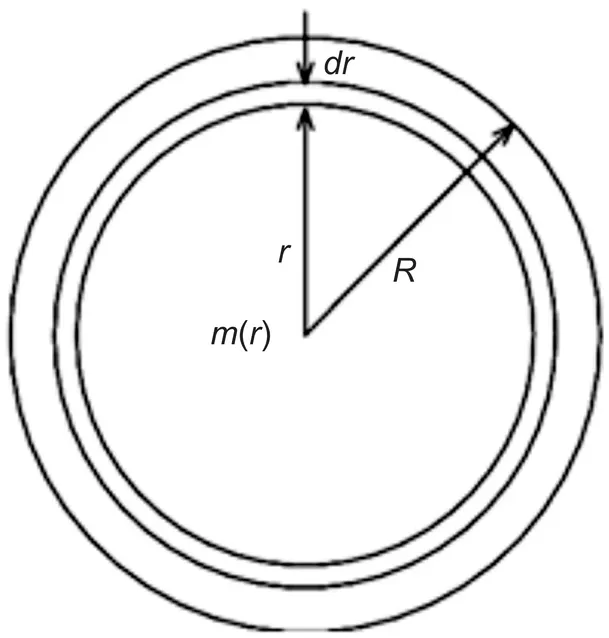
As per the linear density model, a stable star can be imagined as a conglomeration of thin spherical shells of stellar matter from the densest at the core to the rarest at the surface. Consider the equilibrium of one such shell of radius ‘r’ and thickness ‘dr’ as shown in Figure 1.1. Let ρ(r) be the density of stellar matter in that shell and dm = 4πr2ρ(r)dr be the mass of matter contained in the elementary shell. Let m(r) be the mass of stellar matter contained in the sphere of radius ‘r’. The inward gravitational force on matter in the elementary shell is given by
dFg = Gm (r)dm/r 2 = Gm(r)ρ(r)4π r 2 dr/r 2 = 4πGm(r)ρ(r)dr
where, G is the universal gravitational constant.
FIGURE 1.1 Mass distribution of a star in spherical shells
Inward gravitational pressure = 4πGm(r)ρ(r)dr/4π r 2 = Gm(r)ρ (r)dr/r 2 (1.1)
Let P and (P + dP) be the pressure (due to thermal pressure of stellar gas) acting on the lower and upper surfaces of the elementary shell.
Net outward gas pressure acting on matter within the elementary shell is P – (P + dP) = – dp.
Negative sign indicates that gas pressure increases with depth.
Force on elementary area due to gas pressure is
dF P = (area of elementary shell) dP = 4π r 2 dp (1.2)
A star attains mechanical equilibrium when the inward gravitational force on each of its elementary shells is balanced by the outward gas pressure.
i.e. when
dF P = dF G
Condition for hydrostatic equilibrium is obtained by equating (1.1) and (1.2):
dP/dr = Gm(r)ρ (r)/r 2 (1.3)
Equation (1.3) is referred to as the equation of hydrostatic equilibrium which is also known as the pressure gradient of a star (Karttunen et al. 2007). All the main sequence stars in the H-R diagram are in a state of hydrostatic equilibrium.
Equation (1.3) can be used to arrive at the core temperature and pressure of a star. Central temperature of the Sun is around 25 million kelvin and the corresponding pressure is around 26 petapascal (PPa), i.e. 26 × 1015 pascal!

1.3 Energy Production in Stars

The Sun and other main sequence stars have been radiating enormous amounts of energy at nearly constant rates for billions of years. Spectral analysis of star light reveals that most main sequence stars are composed of 90% hydrogen, 9% helium and 1% of other elements. It is now well known that thermonuclear fusion of lighter nuclides to heavier ones is what powers a main sequence star. Typically required temperature and pressure for a thermonuclear reaction are naturally present in the interior of these stars. The actual thermonuclear mechanism or production of energy in a star depends on its mass at birth. In low-mass stars like the Sun, the core temperature does not go beyond 10 to 20 million kelvin. The suggested fusion reaction is the proton-proton cycle or the p-p cycle. It is a three-step process: initially, two hydrogen nuclei, i.e. two protons fuse together to form a deuteron, a heavier isotope of hydrogen. During the fusion, a positron, i.e. the antiparticle of electron along with a massless, chargeless, particle called ‘neutrino’ moving with the speed of light, is given out, according to the equation
p + p = d + e + + n e + Q 1 (1.4)
The deuteron so formed fuses with a...

Table of contents

  1. Cover Page
  2. Title Page
  3. Copyright Page
  4. Dedication
  5. Foreword
  6. Preface
  7. Acknowledgements
  8. Table of Contents
  9. Chapter 1: Basic Astronomy
  10. Chapter 2: Solar System Planets
  11. Chapter 3: Exoplanets
  12. Chapter 4: Missions and Observation Facilities of Exoplanets
  13. Chapter 5: Detection Techniques and Data Archives of Exoplanets
  14. Chapter 6: Salient Features of Exoplanets
  15. Chapter 7: Exoplanet Dynamics
  16. Chapter 8: Exoplanet Formation
  17. Chapter 10: Mathematical Indexing Formulations of Exoplanets
  18. Chapter 11: Astrobiology
  19. Bibliography
  20. Index
  21. About the Authors