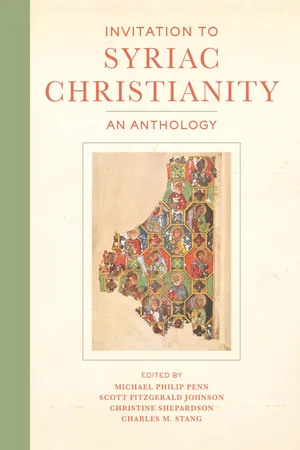
Despite their centrality to the history of Christianity in the East, Syriac Christians have generally been excluded from modern accounts of the faith. Originating from Mesopotamia, Syriac Christians quickly spread across Eurasia, from Turkey to China, developing a distinctive and influential form of Christianity that connected empires. These early Christians wrote in the language of Syriac, the lingua franca of the late ancient Middle East, and a dialect of Aramaic, the language of Jesus. Collecting key foundational Syriac texts from the second to the fourteenth centuries, this anthology provides unique access to one of the most intriguing, but least known, branches of the Christian tradition.
- 462 pages
- English
- ePUB (mobile friendly)
- Available on iOS & Android
eBook - ePub
About this book
Information
PART I
FOUNDATIONS
1
ORIGIN STORIES
The nature of our surviving sources obscures the historical origins of Syriac Christianity. But a rich variety of literary stories about those origins survives in the later traditions themselves. As Syriac traditions divided in the schisms of the fifth and sixth centuries, origin stories for Christianity in the different regions where Syriac Christianity thrived also multiplied. The early traditions of the apostle Thomas’s travels to India and of Christianity arriving in Edessa were supplemented by more extended stories about the adventures of the apostle Addai, and later about the apostle Mari. By the twelfth century, texts like Michael the Great’s Chronicle also included origin stories for the Syriac language itself, which Michael identified as the original human language before the Tower of Babel.
One of the earliest surviving Syriac narratives is the Acts of Thomas, which describe how Christianity arrived east of the Euphrates. In this tradition, after Jesus’s resurrection, Jesus appoints his apostle Thomas to bring Christianity as far east as India. This tradition continues to be formative today, not least in the Syriac Christian communities of modern India in the region of Kerala. By the early fourth century, however, new origin stories focused on the city of Edessa, centered around a letter that King Abgar of Edessa ostensibly wrote to Jesus, and Jesus’s alleged reply. Eusebius of Caesarea’s early fourth-century Church History is our earliest source for this correspondence, a legend that expanded by the time the late fourth-century pilgrim Egeria wrote about her visit to Edessa, and that expanded further still in the early fifth-century Teaching of Addai. Edessa’s long history with Christianity is also recorded in the sixth-century Chronicle of Edessa to 540, which mentions a flood in 201 that damaged an early church in the city. By the seventh century, East Syrian Christians celebrated their origins through the travels of Addai’s disciple, the apostle Mari, whose evangelism in communities all over Mesopotamia is narrated in the Acts of Mar Mari. Other seventh-century Christians produced grander narratives that suggested a prehistory of Christianity in Mesopotamia with a Christianized narrative of Alexander the Great (d. 323 BCE) in the Alexander Romance.
A community’s stories of origin are often closely tied to its efforts to distinguish itself clearly from other communities it sees as outside its boundaries. It is no surprise, therefore, that these origin stories are rife with polemic against religious “others”—Jews, pagans, and a wide variety of “heretical” Christians. The long-lived traditions of Christianity’s arrival in Edessa thanks to the invitation of King Abgar are, for example, built on the anti-Jewish rhetoric of the king’s letter; while other texts criticized Edessa’s traditional worship of such gods as Bel, Nebo, and Atargatis; and the Acts of Mar Mari denigrate other pagan practices. Later traditions like the stories of Mari create a distinct origin story for the East Syrian Church in contrast to the West Syrian traditions. Perhaps most comprehensive in polemical self-definition among the excerpts collected here are the fourth-century writings of the theologian-poet Ephrem (d. 373), who denounces the falsehood of a vast number of other teachings while decrying the injustice of his own community’s earlier followers being denied the name “Christians” in local competitions to claim that contested title.
Further Reading While there are numerous places one could look for introductions to the origins of Syriac Christianity, the following are some of the most common. Two works from the 1970s represent older models of scholarship but nevertheless remain popular introductions. See Judah B. Segal, Edessa: The Blessed City (Oxford: Clarendon Press, 1970; repr., Piscataway, NJ: Gorgias Press, 2001) and Robert Murray, Symbols of Church and Kingdom: A Study in Early Syriac Tradition, rev. ed. (2004; repr., London: Bloomsbury T&T Clark, 2006). A brief overview with bibliography appears in Christine Shepardson, “Syria, Syriac, Syrian: Negotiating East and West in Late Antiquity,” in A Companion to Late Antiquity, ed. Philip Rousseau (Malden, MA: Wiley-Blackwell, 2009), 455–66. On East Syrian traditions, see Wilhelm Baum and Dietmar Winkler, The Church of the East: A Concise History (New York: Routledge Press, 2010). For a French-language study, see Françoise Briquel Chatonnet and Muriel Debié, Le Monde Syriaque: Sur les routes d’un christianisme ignoré (Paris: Les Belles Lettres, 2017).
ACTS OF THOMAS
Third century. Originally Syriac. Taken here from the Greek translation of the Syriac.
The Acts of Thomas form one of many apocryphal Acts that each claims to narrate the life of one of Jesus’s apostles beyond what is known from the New Testament texts. Although originally composed in Syriac, surviving Syriac manuscripts have a substantially edited version of the original text. As a result, the Greek translation of the Syriac often provides a version closer to the original narrative. The story advocates a strongly ascetic form of Christianity with a particular emphasis on celibacy, a theme prevalent in many early Syriac Christian texts. The Acts of Thomas are particularly significant as an origin story for Christianity in India. ...
Table of contents
- Cover
- Half Title
- Subvention
- Title
- Copyright
- Dedication
- Contents
- List of Illustrations
- Acknowledgments
- Note on Translation, Transliteration, and Nomenclature
- Maps by David A. Michelson and Ian Mladjov
- Introduction
- Part I. Foundations
- Part II. Practices
- Part III. Texts and Textual Transmission
- Part IV. Interreligious Encounters
- Appendix A. Translations and Editions
- Appendix B. Biographies of Named Authors
- Appendix C. Glossary
- Index
Trusted by 375,005 students
Access to over 1.5 million titles for a fair monthly price.
Study more efficiently using our study tools.
Frequently asked questions
Yes, you can cancel anytime from the Subscription tab in your account settings on the Perlego website. Your subscription will stay active until the end of your current billing period. Learn how to cancel your subscription
No, books cannot be downloaded as external files, such as PDFs, for use outside of Perlego. However, you can download books within the Perlego app for offline reading on mobile or tablet. Learn how to download books offline
Perlego offers two plans: Essential and Complete
- Essential is ideal for learners and professionals who enjoy exploring a wide range of subjects. Access the Essential Library with 800,000+ trusted titles and best-sellers across business, personal growth, and the humanities. Includes unlimited reading time and Standard Read Aloud voice.
- Complete: Perfect for advanced learners and researchers needing full, unrestricted access. Unlock 1.5M+ books across hundreds of subjects, including academic and specialized titles. The Complete Plan also includes advanced features like Premium Read Aloud and Research Assistant.
We are an online textbook subscription service, where you can get access to an entire online library for less than the price of a single book per month. With over 1.5 million books across 990+ topics, we’ve got you covered! Learn about our mission
Look out for the read-aloud symbol on your next book to see if you can listen to it. The read-aloud tool reads text aloud for you, highlighting the text as it is being read. You can pause it, speed it up and slow it down. Learn more about Read Aloud
Yes! You can use the Perlego app on both iOS and Android devices to read anytime, anywhere — even offline. Perfect for commutes or when you’re on the go.
Please note we cannot support devices running on iOS 13 and Android 7 or earlier. Learn more about using the app
Please note we cannot support devices running on iOS 13 and Android 7 or earlier. Learn more about using the app
Yes, you can access Invitation to Syriac Christianity by Michael Philip Penn in PDF and/or ePUB format, as well as other popular books in Teologia e religione & Storia antica. We have over 1.5 million books available in our catalogue for you to explore.