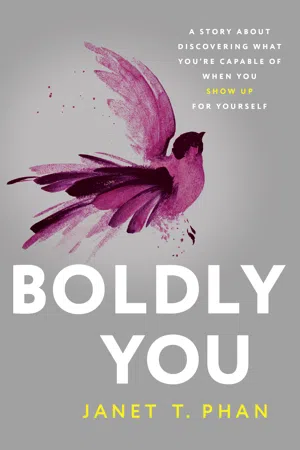
Boldly You: A Story about Discovering What You’re Capable of When You Show Up for Yourself is a close-up look at the hardships, life lessons, and stories of resilience of author Janet T. Phan. In this honest, insightful, heartfelt account of Janet’s experience as a young woman struggling to overcome the obstacles in her life, readers will find wisdom and advice to help them rise above their own circumstances, recognize their limitless potential, and achieve their goals. This book is about what’s possible in a person’s life when they recognize that they have the power to define their future.
As a young woman, Janet faced countless realities that made her path to success difficult. Her family relied on government subsidies, such as housing and free meals at school. Her first-generation Vietnamese parents, in a culture so different from their own, didn’t always understand how to support her curiosity, ambitions, and goals. But she believed in herself and had the courage to act on those beliefs, so she found a way to build a community around her and develop the skills she needed to make top grades throughout her education while working multiple jobs and pursuing her dreams. In her book, Janet shares the key takeaways from her experiences that led to her success today as a driving force impacting the STEM field and as the Founder and Executive Director of Thriving Elements, a nonprofit dedicated to providing access and opportunities for underserved, underrepresented girls through STEM mentorship. Boldly You is a self-help book that reads like a charged and poignant memoir.
Written for high school and college students, young professionals, and all those who are dreaming of their future or figuring out their paths in life, this book will inspire and guide. Every chapter concludes with Thriving Elements, critical learnings from the author’s journey that will help readers show up for themselves, be open-minded, build their confidence, be situationally aware, and be biased for action. Janet’s story is proof that you can be your own person and create the life you want.
eBook - ePub
Boldly You
A Story about Discovering What You're Capable of When You Show Up for Yourself
- 296 pages
- English
- ePUB (mobile friendly)
- Available on iOS & Android
eBook - ePub
Boldly You
A Story about Discovering What You're Capable of When You Show Up for Yourself
About this book
Information
Topic
Personal DevelopmentSubtopic
Personal Success1
Where Do I Belong?
As you read this first chapter, look for how the following Thriving Elements are used, and consider how you would apply them in my scenario and to your own situation:

You’ll get an introduction of how “Show up for yourself” is viewed from a leader’s perspective of showing up for others.
I grew up like a lot of bicultural kids, straddling two cultures. One was the culture of my refugee parents, and the other the culture of my birth country. It took me many years to appreciate why this would have been difficult. I can only tell you at the time, as I was growing up, it was occasionally wonderful but usually painful.
When I was six years old, our parents took my older brother and me from our home in suburban Seattle to visit their birthplace of Vietnam. It felt like a different world. I remember a fragment: an afternoon. The wind, heavy with exhaust and humidity. The sun warming my face. Me, on the back of a motorbike holding my dad tightly as he drove. I took it all in: the hundreds of other motorbikes pressing toward stoplights; street vendors lining the sidewalks; aromatic food sizzling and steaming; horns sounding around me like squawking chickens.
At six, this was my first time in Vietnam, the place my parents fled from and now voluntarily returned to with my brother and me in tow. It was all so strange, the city of Ho Chi Minh (“Saigon,” my mother corrected me1), this country that was mine but not really. Yet that strangeness felt somehow familiar to me. I clutched my father’s shirt as we weaved in and out of bikes and cars, the sticky air holding me close.
Saigon had been a story told to me through my parents’ words, like a movie I’d viewed over several years in short, seemingly disconnected clips. Even though I was young, I’d been able to piece together the basics of my parents’ lives before they met: They’d each escaped in the late ’70s, after the Vietnam War, setting sail illegally to flee as they pushed off the banks of the Saigon River—my mother to the Philippines and my father to Singapore. They were young, single—Mom was just twenty, Dad was twenty-four—and over their weeks at sea, they saw hunger, abuse, rape, suffering, and death; both were lucky compared to other passengers. When they made it to safety, they were both malnourished and weary.
They met only after arriving in America and finding themselves in the same Vietnamese refugee community. They fell in love fast and hard, but their marriage was difficult.
I felt this even at six. But that afternoon, holding close to my dad, I pushed my tense home life out of my mind, instead breathing in Ho Chi Minh City—Saigon. Saigon was crowded everywhere I turned: people on the streets hustled to sell trinkets while others sat outside on tiny plastic chairs, drinking coffee in groups, waiting for the day to pass. A different scene than what I was used to in Tukwila, my small city in the northwestern United States. I wanted simultaneously to be back home with my buttered English muffin for breakfast and a steaming-hot shower before bed, and at the same time to explore every inch of my parents’ home country.
It wasn’t until years later that I’d reflect on that afternoon and realize its importance to my family and my upbringing. I didn’t feel the same connection to Saigon that my parents did. But my parents’ heritage is a part of me, and I felt the familiarity of Vietnam in my body and bones.
It’s a strange thing coming to a place that is you but not you, yours but not yours. Because, while I am every inch Vietnamese, I am also every inch American, and every inch Vietnamese American. Those two words are joined in a way that’s hard for someone who’s not culturally divided to understand.
And this fact—this Vietnameseness, this Americanness—would prove to be a central theme of my life, a conflict not within myself but between the two worlds I always felt myself mentally shifting between: my family life and everywhere else.
I think that trip to Vietnam was my parents’ attempt to connect me to their birthplace, that somehow taking me to Vietnam would make me more Vietnamese, and their culture would become mine. That I’d carry my cultural connection into the schoolyard, my friendships, my studies, and my choices.
Of course, those thoughts came later. Back then, holding on to my dad on the back of that motorbike, I just closed my eyes and imagined how different my life would be if I had been born there instead of in Tukwila, Washington.
After our trip to Vietnam, I went back to life as usual: playing with the neighbors, riding bikes until the streetlamps came on, ignoring the strange behavior of some of the grown-ups who lived nearby.
Our home was situated in a neighborhood unlike most; we lived in a manufactured home on rented land. One man owned the entire plot of land underneath all the manufactured homes and lived in a small shack toward the edge of the property. My parents saved for years, proudly purchased our home for $30,000, and paid rent each month for the land underneath it. After living in government-subsidized housing the first several years they were in the United States, this was their American dream made real. It was a huge accomplishment, which my dad talks proudly about to this day.
Our modest neighborhood was full of noise. Yelling and screaming coming from our neighbors to the left. Constant parties at the neighbors’ house to the right. As I walked to my friends’ houses, I’d see middle-aged men sitting on their decks with their shirts off, beer belly exposed, and drinking. Later, I’d hear yelling coming from their homes too.
My home had its share of drama and yelling too. I got into trouble a lot. When my brother, John, and I were caught breaking one of our parents’ many rules, my dad would make us put our heads against the wall, almost like prisoners, to reflect on our bad behavior. We would stand with our foreheads and hands resting on the wall for thirty minutes, sometimes an hour. It happened so often that I can’t even remember why it happened. My mom would say nothing and pretend not to notice.
Maybe my dad’s punishment had something to do with my anger, or maybe I was reacting to the tension of my household. Whatever the reason, I carried a dull anger deep within my chest throughout childhood and let it out in bursts of rage. When I got mad or frustrated, I would pound my head against the wall over and over until it was numb, as if I was trying to numb the pain in my heart and in my mind. I’d violently throw things around the house, screaming until my throat was sore, saliva stringing around my mouth, tears flooding down my face, to rid my body of anger. It felt good. The only thing that could make me stop was my dad’s booming voice frightening me into submission.
Childhood wasn’t all bad, though. While my parents never hugged me or showed much affection, I felt taken care of. Later, I’d learn that this lack of physical touch was cultural, and shared by many other cultures. As a kid, I didn’t really notice that I wasn’t hugged or kissed—mostly because I didn’t have anything to compare it to. It also didn’t matter that we were poor, or that I had only ill-fitting discounted and hand-me-down clothes. I knew I was lucky to have all I had in America, as my parents continually reminded me.
Growing up, I also watched the diligence of my parents’ work ethic. They were loyal and unwavering in their desire to perform their best, no matter what kind of work they did, whether a cashier at the dollar store or Goodwill, or working as a janitor. I’d watch them routinely prepare their lunches and leave at the same time every day, and at night they often said how lucky they felt to have their jobs. No matter what job it was, they were proud of themselves for “making it” in America.
Looking back, I know my parents tried the best they could. They came from unimaginably hard circumstances and attempted to build a normal life in America for our family while still maintaining their Vietnamese heritage. Food was one way they stayed connected to Vietnam: Mom and Dad would cook phở, bún chả, bánh cuốn, and other delicious traditional dishes. During summers, Mom would give my brother and me Vietnamese lessons every day for thirty minutes after dinner, before we were allowed to go out to play. Both my parents would tell us stories about their lives in Vietnam, recounting memories with tears streaming down the sides of their faces.
I could sense the struggle and it would make my heart tighten up. I would try to hold back my tears as if to stay strong for them. I tried to understand what it was like for them growing up in such a different place, and their complex history felt normal. Why wouldn’t it? The world my parents had created for me was all I knew.
It wasn’t until second grade that I started to feel different. Every other afternoon, I would be pulled away from my classroom and taken to a portable classroom to sit at a round table full of Spanish-speaking students. I remember thinking, What am I doing here?
I later learned that it was an English as a Second Language (ESL) class, and because my first language was Vietnamese, I guess my English wasn’t good enough. That year went by in a blur. I remember looking around the table at all the other kids. When the teacher wasn’t looking, they’d whisper in Spanish, and I envied their ease of belonging. I imagined the rest of the students in my main classroom, getting to do normal lessons and not having to be the only Asian sitting in the portable, learning English. Where did I belong?
I grappled with this question all throughout childhood, both at home and in school. I surprised teachers who had taught my well-behaved older brother, John, by being disruptive and disobedient—I was constantly in trouble for talking with my friends when I was supposed to be working quietly or listening to the teacher. At home, I spent a lot of my time alone, with John often out with friends or holed up in his room playing Street Fighter on his Super Nintendo. I thought of him as a shadow, a figure who was rarely around, and when he was there, he didn’t so much as glance in my direction and definitely never spoke to me unless he absolutely had to. I only saw my dad when I got home from school right before he had to leave for work, and my mom in the evening after work.
By third grade, my mom was already at work before I woke up for school, and my dad was still asleep from his night shift loading trucks at Coca-Cola. I would wake alone each morning to my Mickey Mouse alarm clock at 7:00 a.m., brush my teeth by 7:03 a.m., get dressed by 7:08 a.m., make myself an English muffin with butter and sugar by 7:13 a.m., and watch Sailor Moon on TV for exactly seven minutes while eating breakfast. The second commercial was my cue to walk to the bus stop about a half mile away.
But in school, I felt like an outsider and a failure once again when I wasn’t chosen to line up with the smart kids who got to go to a special classroom as part of the Spark program. My heart sank and I held back tears every time my friends left while I stayed back with the normal kids. I wondered, what did I have to do to prove that I belonged?
Childhood zipped by, as it does. There was a trip to Disneyland, which I knew my parents had scrimped and saved for. There was Tết Trung Thu at the temple, the Vietnamese fall festival; my brother and I would hold animal-shaped lanterns with a lit candle inside made of red wax, the color of luck in Vietnamese culture. There was food—always so much food. I remember sitting on the kitchen floor, rolling out dough on a wooden cutting board for bánh bột lọc, shrimp and pork dumplings. My absolute favorite still today. There were ballet lessons and Double Dutch competitions and basketball games. In middle school, fights with my parents became a norm, filled with anger and crying. Sleepovers with my middle school best friend, Valeri, at her house. Disciplinary measures at school, even though I had good grades. Getting kicked out of classes in elementary and middle school. Feeling embarrassed but invigorated at the same time during the walk of shame from my desk to the door. Being forced to sit in the empty hallway right outside the classroom to reflect on my disturbance to the class.
And then suddenly, it was like I blinked, and I found myself in ninth grade. In a way, that’s where my story begins.
My First Victory Over the Fear of No
At age fourteen, not long into ninth grade, I was sitting in the empty cafeteria of Foster High School, tears streaming down my face.
“Hey, are you okay?” I recognized the voice of my Students Against Violence Everywhere (SAVE) advisor, Mr. Releford.
I could only sniff in reply, my head still in my hands, not looking up. When I finally looked up at him, my eyes still blurry from tears, I said, “I failed.”
“Failed what?”
“Math.”
“What do you mean you failed? Don’t you have the highest grade in the class?”
“I did.” I leaned over, reached into my backpack, and thrust a paper at him. “Until today.”
He righted the paper, looking at it carefully. “This says 85 percent, Janet.”
“I know.”
“Didn’t you say you failed?”
“I failed my 4.0. This test score pushes my average to a 92.9 percent, which means I don’t have an A in math this quarter.” I took a...
Table of contents
- Cover Page
- Title Page
- Copyright Page
- Contents
- Foreword • From Julie Averill, lululemon EVP, CTO
- Introduction
- Chapter 1 • Where Do I Belong?
- Chapter 2 • The Dynamic Duo
- Chapter 3 • Caught at KFC
- Chapter 4 • Moving On
- Chapter 5 • Fundraising for College
- Chapter 6 • Finding My Place
- Chapter 7 • Finding a Way
- Chapter 8 • A Different Path
- Chapter 9 • The Power of a Mentor
- Chapter 10 • Showing Up for Myself
- Chapter 11 • Let’s Thrive
- Epilogue • Dear Reader
- Acknowledgments
- Thriving Elements by Chapter
- Notes
- Q&A with the Author
- About the Author
Trusted by 375,005 students
Access to over 1.5 million titles for a fair monthly price.
Study more efficiently using our study tools.
Frequently asked questions
Yes, you can cancel anytime from the Subscription tab in your account settings on the Perlego website. Your subscription will stay active until the end of your current billing period. Learn how to cancel your subscription
No, books cannot be downloaded as external files, such as PDFs, for use outside of Perlego. However, you can download books within the Perlego app for offline reading on mobile or tablet. Learn how to download books offline
Perlego offers two plans: Essential and Complete
- Essential is ideal for learners and professionals who enjoy exploring a wide range of subjects. Access the Essential Library with 800,000+ trusted titles and best-sellers across business, personal growth, and the humanities. Includes unlimited reading time and Standard Read Aloud voice.
- Complete: Perfect for advanced learners and researchers needing full, unrestricted access. Unlock 1.5M+ books across hundreds of subjects, including academic and specialized titles. The Complete Plan also includes advanced features like Premium Read Aloud and Research Assistant.
We are an online textbook subscription service, where you can get access to an entire online library for less than the price of a single book per month. With over 1.5 million books across 990+ topics, we’ve got you covered! Learn about our mission
Look out for the read-aloud symbol on your next book to see if you can listen to it. The read-aloud tool reads text aloud for you, highlighting the text as it is being read. You can pause it, speed it up and slow it down. Learn more about Read Aloud
Yes! You can use the Perlego app on both iOS and Android devices to read anytime, anywhere — even offline. Perfect for commutes or when you’re on the go.
Please note we cannot support devices running on iOS 13 and Android 7 or earlier. Learn more about using the app
Please note we cannot support devices running on iOS 13 and Android 7 or earlier. Learn more about using the app
Yes, you can access Boldly You by Janet T. Phan in PDF and/or ePUB format, as well as other popular books in Personal Development & Personal Success. We have over 1.5 million books available in our catalogue for you to explore.