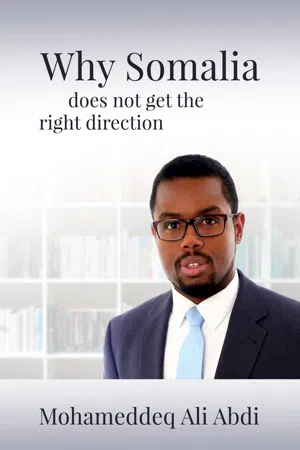
Somalia's problem is complex, but the question is, can the Somalia problem be solved? And can Somalia get the right direction? This book explores profound problems that Somalia has been facing and is still facing while addressing: why Somali politicians not stand up for their country and lead their country towards the right direction; Can the Somalis harness the ideology of clannism and use it to build Somalia's nation-state; why is Al-Shabaab always getting stronger day-by-day, how can it be rooted out from Somalia and how do we integrate the reformed militias? Can Somalia form a national army that has total support from the civilians? Can the Somalis deliberate and provide homegrown solutions and implement them without being put under duress
- 212 pages
- English
- ePUB (mobile friendly)
- Available on iOS & Android
eBook - ePub
Why Somalia does not get the right direction
About this book
Information
Chapter 1
INTRODUCTION
Somalia stands at a critical juncture. The hopes raised in 2017 when President Mohammed Abdullahi ''Farmaajo" won the election - that he could unite the nation to confront its myriad challenges - have dimmed as infighting between the federal government and its member states increases. Meanwhile, the Al-Qaeda franchise Al-Shabaab continues to carry out attacks in cities and the countryside; external actors compete for influence; and both clan conflict and food insecurity persist.
An editorial by Crisis Group (2021) on its website observed.
After Somalia gained independence, it enjoyed nine years of parliamentary democracy, producing the first peaceful and democratic transfer of power in Africa (Samatar A., 2016). But hopes for a prosperous country were quickly shattered when President Abdirashid Ali Shermarke was murdered in 1969. Immediately after his murder,the Supreme Revolutionary Council (SRC) under the commander of the Somali armed forces, Major General Mohamed Siad Barre toppled the government. This was to mark the start of a long journey of 21 years of military rule until a group of clan-based insurgents brought him down.
And as Somalia marked 30 years of crisis since the military government collapsed in January 1991, BBC (2020), in one of its stories about Somalia, ''Hope and fear as Somalia's civil war turns 30'', said:
Somalia is marking 30 years of conflict. Specifically, it's marking the moment the government of President Siad Barre collapsed in January 1991, setting Somalia on a rapid path to fragmentation and anarchy. In recent years a federal government has begun to make some progress in rebuilding the country and Islamist militants have been pushed out of most major towns.
When the military regime was ousted, turmoil, factional fighting, and anarchy followed for ten years with no single legitimate governing authority but factions that appeared well organized and functioned as independent states until the Transitional National Government (TNG) was established in October 2000. And even after the formation of a TNG and subsequent efforts such as the formation of the Transitional Federal Government (TFG) in December 2006 and the formation of an internationally-backed government in 2012, a move that ushered Somalia towards the road of stability, to date, the country is still grappling with turbulence due to political factions and challenges from Al-Shabab insurgents.
The ouster of the military regime was occasioned by the falling apart of all the remaining structures of authority of the Somalia state. The political vacuum that ensued not only prompted the breakdown of law and order but resulted in numerous constituent factions that are relatively strong and have control over various regions in the country. Thus, Somalia as a country has held a strong onto the top spot in both the Index of Failed States and the Fragile States Index (Mwangi S. Kimenyi, 2010). And the country is likely to maintain its lead for the foreseeable future if the actors do not work towards rebuilding Somalia...…
Ed Wheeler and Craig Roberts (2002) observe that,
''By September 1991, Somalia had become a country with no semblance of government, civil society, or essential services. Food supplies dwindled, vegetables and fruits were infested with worms and insects, water sources were poisoned and contaminated, the telephone system was defunct, the army and police force had disbanded, and hospitals and schools shut down. Somalia society rapidly disintegrated into anarchy and clan violence increased. Somalia currency inflated to the point of being valueless and serious fighting intensified by November...…'' (9).
This situation has lasted to date, albeit the various attempt to solve the never-ending crisis. But the political vacuum did not only bring the never-ending political crisis but crises such as civil war, insecurity, terrorism, piracy, corruption, hunger, and diseases.
For the umpteenth time, international actors have convened several conferences to solve this Africa's if not the world's biggest headache to no success. ''How do you solve a problem like Somalia?'' asked Mary Harper, BBC's Africa editor in 2017 (BBC, 2017). Mark Bradbury also asked the very question in 2012 (New Internationalist, 2012). The question asked, though at different times (2012 and 2017), was at the backdrop of meetings convened in London to discuss the Somalia crisis.
Bradbury (2012) writes, ''...…Somalia is a security problem, a 'failed state', a haven for terrorists and pirates, a threat to the well-being of the Global North. But the main threat that misgovernment in Somalia represents is to Somalis themselves, constantly at risk of famine and displacement...…'' And adds, ''But if Somalia is a failed state, the failure is not just a Somali failure. It is a failure also of those who have been intervening in Somalia for the past two decades.'' And even as the world talks about Somalia, it is fundamental for us to echo or repeat the very question that Harper and Bradbury asked: ''How do we solve a problem like Somalia?''
Ed Wheeler and Colonel Craig Roberts (2002) point out,
''With the fall of Barre, no clear leader appeared on the scene. Finally, on July 15, 1991, six Somali factions agreed to a two-year interim government under the provisions of the old 1961 constitution. With Ali Mahdi Muhammad as President and Umar Arteh Ghalib as Prime Minister, the new government had to be reorganized because the country had slid into anarchy. No formal infrastructure was left, and the Somalia armed forces had disbanded. Factional fighting between clans prevented the new government from establishing control, and it finally fell as well.'' (8)
Since then, Somalia has caught the world's attention.
After the fall of the military government, an internal strife between two opposing factions ensued. Somali people died as direct casualties of the civil war and due to diseases and starvation. With the country sliding into the state of anarchy, international actors tried in vain to bring peace.
There have been various efforts to restore Somalia, such as setting up interim civilian regimes. For instance, the United Nations Security Council (UNSC) authorized 'Operation Restoration Hope' under United Nations Operations in Somalia (UNOSOM) to bring stability in Somalia, (Harish Venugopalan, 2017). However, the UNOSOM, which was well-positioned to mediate the conflicting groups to achieve peace, found itself clashing with one of the insurgent's leader, thus failing in its mandate. Thereafter, interim civilian regimes were established between 1991 and 2000, such as the Djibouti [Arta] Peace Process that resulted in a Transitional National Government (TNC) that later paved way for the formation of Transitional Federal Government
So far, according to Khayre (2017), over fifteen peace and reconciliation consultations have been organized outside Somalia to end animosities and establish a working government. Even though the meetings were fruitless to some extent, it led to the creation of Transitional National Government (TNG) and later the Transitional Federal Government (TFG), which aroused the hope for peace and stability in Somalia. Through these interim governments, stakeholders have drawn up and adopted a provisional constitution to guide the day-to-day running of the country. The stakeholders have also been able to nominate members to the various legislatures. These legislatures have elected presidents, who nominated prime ministers that constituted cabinet to run various government departments. (Andrews Atta-Asamoah, 2013). However, these transitional governments have been characterised by incompetent, corrupt and weak leadership.
The wanton incompetence, corruption and ineffective leadership did not just start with transitional governments but with the independence leadership. Mohamed Osman Omar (1996) points out that, ''Ever since the early days of our independence, the Somali people have hardly enjoyed the fruits of freedom, peace and development, and scarcely realised the dreams of the freedom fighters against colonialism. From 1960 to 1969, our rulers failed to lay the foundation of the stable democratic system which we tried to adopt. Corruption, nepotism and mismanagement soon became the hallmark of our administration.''
The newly established state institutions did not meet people's anticipations. Nevertheless, the bloodless and the overthrow of the military government later did not help but worsened the country. The never-ending Somalia's chaos has politically destabilized the country. The country has struggled with extreme cases of conflict causing widespread violence, political instability and fractionalised society, violence from terrorist groups such as Al- Shabaab; proliferation of illegal's arms, economic decline, and disrupted agriculture due to catastrophic weather changes leading to famine, and health care crisis.
But how come, 'the more things change, the more they stay the same' in Somalia (Farlex Dictionary of Idioms, 2015) How come Somalia's road to prosperity has always been full of hurdles? How come most of the Somalis: a single, homogeneous ethnic group, are Muslims and share the same language and culture but one of the most horrific wars in Africa has been fought in this country for about three decades? Why is it that Somalia's protracted crises have always become unsolvable?
To understand why Somalia has always been working hard towards stability but regressing, Ahmed Ali M. Khayre (2016) argues that 'it is essential to identify and analyse the underlying causes of these predicaments that have been unfolding since the colonial era.''
Many of the historical accounts of Somalia tend to focus on 1991[the collapse of the military regime] and the ensuing civil war that has ravaged the country to date. Others stretch it as back as 1960 when Somalia and most African countries gained independence, as the period the country faced challenges of nationalism. In this book, we, however, want to dig deeper into the history of the country to focus on its history before colonialism. We would want to determine, for example, the extent to which colonisation of the country by Italians, the British and French may have fuelled mistrust amongst the various clans and regions of the country that continue to bedevil the country up to now. One of the questions that we hope to answer is whether considering this historical background and despite the supposed homogeneity of the Somali people [both in ancestry and religion], was based on a wrong premise and to what extent the current chaos be accounted for in the pre-1960 history.
Since 1991, the conflict in Somalia has evolved in nature, actors, strategies, and even objectives (World Bank 2005; Lewis 2008, p. 72). There is little success in solving these problems despite the many interventions. It seems like the real problem for Somalia is much deeper and multifaceted: the foreign interventions through such forms as the AMISOM and UN are influenced by the local politics in Somalia. These problems also affect the NGOs and the traditional justice mechanisms that attempt to reintegrate the militia back into the society informally. And since the conflict has taken long, there have been multiple players from militias, pro-government forces, clans, shrewd politicians and businessmen, and power rivalries that pull the mediation process into different directions in ways that the transitional governments have not kept pace. In such a context, there is a need to broaden the scope and support a wider range of interventions; both political and military.
1991 is the year that changed the history of Somalia for the worse. But even then, there is the unacknowledged fact that Somalia was one of the countries in Africa that directly experienced the effects of the cold war that pitted US on the side of Somalia and Cuba and the USSR on the side of Ethiopia in the beginning before the two superpowers switched positions. With the support of the USSR and Cuba, Ethiopia would defeat a US-backed Somali. This support from the two superpowers fuelled the ''arms culture'' in Somalia whose effect was felt in the civil war in 1991.
In the Somali society, the clan serves both as a source of great solidarity as well as conflict. Hence, although Somalia is considered largely ethnically homogenous, it is the clans that are at the heart of the society. Many people give greater allegiance to their lineage than to the nation. Therefore, in such a situation and with the lack of central government control, this arrangement pitted the majority clan members against the minority clan members. The minority clans were often oppressed and exploited by the majority. This clan animosity led each clan to organize itself as a political and military unit that not only solves its internal disputes and protects its members from other feuding clans but also determines their access to resources. Therefore, the clan is at the centre of fixing modern Somalia. The aspiration should then be on addressing the mistrust amongst clans or, better still, determining whether, based on this clan system, a federal system of government would work in the best interest of the majority.
Although Somalia's political culture, especially at independence, was considered democratic, the political and social changes have created a batch of politicians who are mostly educated in Western-type schools and live in urban areas. Most of these politicians are often corrupt and exploit the clan rivalries to obtain local support. These political powerbrokers often work with influential businesspeople and rely on Al- Shabaab and other militia for security, and control of their commercial interests in particular areas, in exchange for a pay. Thus, these politicians thrive from the existence of such militia, the violence they unleash, and the constant clan feuds. They stand to lose a lot when Somalia becomes stable. These politicians have the power to determine the success or failure of any peace process. There needs to be a way to either co-opt or bypass them.
But it has been difficult to realise peace in Somalia even though there have been various initiatives to ensure Somalia finds peace, but it has remained elusive. One of the main reasons for this situation is because the nature and scope of the conflict itself has transformed and created new victims and perpetrators over the years. Therefore, there is a need to appraise the earlier methods, examine current reality and modify the approaches accordingly. Other considerations are combining traditional justice forms and involving the clans more in solving these problems. Another factor that may have bigger ramifications in the approach these processes could take is to recast the assumption that all clans in Somalia must be united, which will take time to achieve. What if Somalia was reimagined as a federal state? We could focus on Somaliland, Puntland, and Jubaland as cases to explore the modalities of how these could work.
How do we rebuild the Somalia army as it is one of the key components in stabilizing Somalia? This is given that militia groups have dominated Somalia's conflict scene, and so a professional army can help obliterate them. The Somali army can best be examined in the context of the militias and the paramilitary forces that arise in civil war contexts; it is at best a porous entity where the army can play a role both in the official state and in clan militias. Since the conflict in Somalia has shifted its objectives and scope over the years, it is expected that they have changed allegiance and crossed over to the other side a couple of times.
In such a situation, creating a new army after the conflict ends will be a difficult task for any new government. Is there a possibility of rehabilitating and reintegrating individuals from the militia into the national army? Another possibility could be reintegrating the army from the clan level upward.
The rise of the Al-Shabaab insurgency has disrupted Somalia's journey towards peace and stability. For the past ten years, the terrorist group has become the image with which Somalia has been associated. There is likelihood that Al-Shabaab will be a permanent feature in Somalia, especially if the conflict in Somalia does not end. If we trace its history, Al-Shabaab started just like the rest of the clan militias to protect its members and gain access to resources, especially in the absence of a central government. However, with the transformation of the conflict, its goals, and players [both local, regional, and international] over the years, the nature of Al Shabaab as an entity has evolved. Therefore, any discussions about resolving the Al- Shabaab menace cannot be addressed without the context of the players who fuel the conflict. For instance, what happens in the case where the local population supports Al-Shabaab because of the security they provide to them? How can their security be guaranteed first? The questions that such a situation raises, and that we hope to address here include; whether the military approach that has been used so far is effective or a political angle should complement it, and if this approach is advanced, then what role should the clans and the traditional justice systems play in it? A possible consideration, for example, would be to rehabilitate and reintegrate them into the national army; how implementable is this, what other cases can be used to advance such an argument?
Despite its past and chronic problems, can Somalia rise from its dust? Somalia can invoke both elements of economic optimism and political pessimism, depending on how one looks at it. Part of the focus should be on the resilience amidst the vulnerability ...
Table of contents
- Acknowledgements
- Author's Note
- Table of Contents
- Acronyms
- Overview
- Chapter 1: Introduction
- Chapter 2: History of Somalia
- Chapter 3: The Problem with Somalia
- Chapter 4: Why Foreign Countries are Interested in Somalia Affairs
- Chapter 5: Clannism: The Heart of the Somali Society
- Chapter 6: The Nature and Character of a Somalia Politician
- Chapter 7: Chasing Elusive Peace
- Chapter 8: Rebuilding an Army for Somalia
- Chapter 9: The Al-Shabaab Menace
- Chapter 10: Can Anything Good Come Out of Somalia?
- Chapter 11: Way Forward
- Chapter 12: Conclusion
- Appendix
- References
- Index
- Imprint
Trusted by 375,005 students
Access to over 1.5 million titles for a fair monthly price.
Study more efficiently using our study tools.
Frequently asked questions
Yes, you can cancel anytime from the Subscription tab in your account settings on the Perlego website. Your subscription will stay active until the end of your current billing period. Learn how to cancel your subscription
No, books cannot be downloaded as external files, such as PDFs, for use outside of Perlego. However, you can download books within the Perlego app for offline reading on mobile or tablet. Learn how to download books offline
Perlego offers two plans: Essential and Complete
- Essential is ideal for learners and professionals who enjoy exploring a wide range of subjects. Access the Essential Library with 800,000+ trusted titles and best-sellers across business, personal growth, and the humanities. Includes unlimited reading time and Standard Read Aloud voice.
- Complete: Perfect for advanced learners and researchers needing full, unrestricted access. Unlock 1.5M+ books across hundreds of subjects, including academic and specialized titles. The Complete Plan also includes advanced features like Premium Read Aloud and Research Assistant.
We are an online textbook subscription service, where you can get access to an entire online library for less than the price of a single book per month. With over 1.5 million books across 990+ topics, we’ve got you covered! Learn about our mission
Look out for the read-aloud symbol on your next book to see if you can listen to it. The read-aloud tool reads text aloud for you, highlighting the text as it is being read. You can pause it, speed it up and slow it down. Learn more about Read Aloud
Yes! You can use the Perlego app on both iOS and Android devices to read anytime, anywhere — even offline. Perfect for commutes or when you’re on the go.
Please note we cannot support devices running on iOS 13 and Android 7 or earlier. Learn more about using the app
Please note we cannot support devices running on iOS 13 and Android 7 or earlier. Learn more about using the app
Yes, you can access Why Somalia does not get the right direction by Mohameddeq Ali Abdi in PDF and/or ePUB format, as well as other popular books in Politics & International Relations & Politics. We have over 1.5 million books available in our catalogue for you to explore.