During a stay in Kentucky horse country, a husband-and-wife detective team race to find a killer . . .
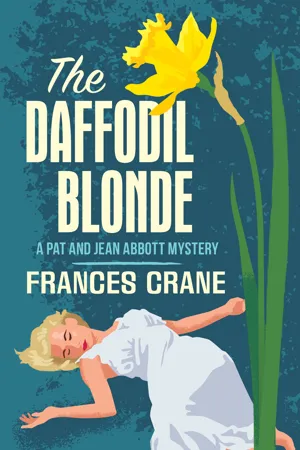
PI Pat Abbott and his wife, Jean, are vacationing in Kentucky horse country and visiting Pat's old friend Rob Murray, who lives there with his sister and daughter. But when Rob's trainer is found dead, Pat is willing to bet it's murder despite the local doctor's verdict of suicide. The quest to find the truth will involve a fainting blonde at the Abbotts' hotel and some of the more colorful citizens of Lexington in this suspenseful Golden Age classic featuring "one of the more interesting married teams of detectives" (
Thrilling Detective).
Praise for the Pat and Jean Abbott Mysteries
"Lively and exciting." —
The New York Times
"[A] well-plotted and mystifying case." —
Saturday Review
"Nasty characters and clues pointing off in all directions—quite good." —
The Miami News
- 243 pages
- English
- ePUB (mobile friendly)
- Available on iOS & Android
eBook - ePub
The Daffodil Blonde
About this book
Information
Topic
LetteraturaSubtopic
Letteratura poliziesca e gialliChapter 1
The Adriance house stood a short distance from the winding, locust-shaded pike. In the bright moonlight you could see it clearly. It was painted white, with tall chimneys at each end of the front wing, and it stood, as is usual in the bluegrass country, slightly higher than its surroundings and in a grove of oaks and elms. The trees were not quite in full leaf. They threw elegant black shadows. Frogs were shrilling like mad and you could smell lilacs and see the white plank fences marching over the rolling pastures far and wide.
Because of the beauty of the night and the horror of what we knew was waiting us I felt very excited.
Patrick turned off the pike, opened the patent gate from the car, drove into the lane, closed the gate, and we moved very slowly toward the house.
“So this is where Guy Adriance lives,” I said.
“According to his mother he no longer lives, Jean.”
“She could be wrong.”
“In this case I think it unlikely.”
“I took one of my dislikes to Kitty Adriance.”
“That has nothing to do with it.”
“Yes, but it has. Because I dislike her I distrust her. She’s a man-eater. She doesn’t give a hoot what women think of her. She acts as if she wears a badge on her expensively harnessed bosom which says ‘I’m a Lady.’”
Patrick said, “Nevertheless, she didn’t strike me as a hysterical type. Therefore she would probably be sure her son was dead before she telephoned anyone. She explained that she couldn’t get hold of her doctor and didn’t like to call in the police before the family doctor came. She was quite right in doing that.”
“Why didn’t she call the Murrays? They live right back yonder.”
“She explained that too. She said her son’s death would be such a blow to his fiancée, Alexis Murray, that she thought the doctor or her father should break the news to Alex himself.”
“Ha!” I said. “Kitty Adriance and Rob and Faye Murray are mortal enemies. You don’t have to be a genius to sense that. She doesn’t want them to know because she’s up to something, I bet.” Patrick said nothing, so I said, “She’s got two servants. What about them?”
“She spoke of them. She said they were an old couple and would just be another problem on her hands if she called them. They live in a cabin somewhere behind the main house.”
We had arrived outside the yard gate. Patrick turned off the headlights and we sat there looking at the house. It looked exquisite. It was old, but it was smaller than the usual Georgian country house of its period. It was only one story, with a kitchen wing. It had a wide doorway with pilasters, and two wide front windows, with eight panes of glass in each sash, on either side of the entrance. The shutters were painted sky-blue, as we saw later by daylight. There was a light on in the hall and the old glass of the fanlight above the door showed greenish and quivery. The white shades were drawn at the windows and the gate and the brick walk looked spotless in the moonlight, and the air, after an earlier shower, smelled spotless as well as flower-sweet.
“I wonder if he had a bad heart,” Patrick said.
“Or a lot of money, as she said, and herself the heir. Oh, I’m sorry, Pat. He certainly was handsome.”
“Handsome? Guy Adriance had cobra’s eyes!”
“Pat, he was simply handsome. Tall and dark and lithe and so perfectly dressed and such manners and a voice that made you simply swoon.…”
“Nuts. He was cold and deliberate as a snake.”
“Maybe that was shell-shock, Pat. He just got back from Europe, they said. Maybe he has been in a hospital.” Patrick made no comment. He was just sitting there in the car looking at the house. “Don’t you think it odd that his death comes right after Sam Casey’s? Casey’s cabin is just over there.”
The lights came on outside the chaste front door. The brass knocker gleamed. We got out of the car and walked toward the yard gate.
“I’ll grant you one thing, Jeanie. He got the eyes from his mother.”
I said, “Nuts yourself. Hers are bright blue. His were coffee brown.”
“Color had nothing to do with it.”
We walked along the walk between beautifully groomed beds of tulips and smelled the heavy scent of the lilacs which made a hedge at the back of the white brick house. The name of this house was The Lilacs, too. Patrick let the knocker fall with a single clack. After a decent interval, as if she had gone away after turning on the lights, Kitty Adriance opened the door. She looked very plump. She was wearing a pink quilted-satin robe. Her stubby little feet were in gold sandals. Her blue-white curls were perfect, just as they had been at the Murrays’ two hours or so earlier, and her pink-and-white make-up was perfect. Her perfume was lilac too, a good lilac.
Her voice was carefully pitched.
“How kind of you to come,” she said.
I wondered.
We had planed in from our home in San Francisco two days ago for the final week in the Keeneland Race Meeting. We had hired a car and when we weren’t at Keeneland we were driving around the beautiful country and visiting with the Murrays whom Patrick had met five years ago in Houston, Texas.
The landscape was heavenly. The pastures were emerald-green, everything bloomed, the redbud, dogwood, the early tulips and the early lilacs. In the paddocks the little foals gamboled on their long legs and the mares grazed, and everywhere there were yearlings, stallions, geldings, and such. In Kentucky they speak categorically of the genus horse. Indeed, in the bluegrass, people are so horse-minded, they say, that a pregnant woman is often referred to as in foal.
We had left our second little foal, a girl named Mary Holly, with a nurse, and the Kentucky jaunt was especially a holiday for me. Patrick had declined an invitation to stay with the Murrays because I had not previously met them, but we were seeing a lot of them though stopping at a Lexington hotel. And after our first dinner at Murray Farm I regretted that we had decided for the hotel. I had liked all three, Rob Murray, his daughter Alexis, his sister Faye. His wife had died ten years ago and Faye had since been his housekeeper. The house was apparently run well but casually enough so that house guests would be quite at their ease.
The name of Sam Casey came up over coffee, after dinner tonight, our second evening.
“Rob’s got a runner he wants to enter for the Derby,” Faye had said.
“But Casey won’t let him,” said Alex.
“And what Casey says goes,” Faye said. She smiled her wide gay smile at her brother.
Rob said, good-naturedly, “What Casey says usually goes. But this time he’s wrong. That colt is big and strong and has what it takes to make a winner. For once I’m having my say.”
“Casey is superstitious, or something. That is one reason he doesn’t want to enter the horse,” Alex said. “I’m betting on Rob though.” Being a modern kid she called her father by his first name. “When the going gets tough Rob sticks longer than Sam Casey.”
Alex’s father eyed her affectionately and Faye smiled.
Faye was a tall trim woman. There was no gray in her black hair and her long deep-blue eyes, like her brother’s, were warm and young and sparkling. Her face was triangular, the cheekbones high and trim, the chin small. She carried her head beautifully. She had shapely, quiet hands, and used a bold red nail polish. She wore a tweed suit in a color we used to call Schiaparelli blue, a black cashmere sweater, and heavy gold earrings. Her hair was drawn back from a middle parting to a heavy bun on the back of her neck. Her voice, like her smile, was light and gay.
“I’ll take you on that, Alex,” she said.
I said, “Who is Sam Casey?”
“I’m sorry,” Faye said. “I thought you’d met him. He’s Rob’s trainer. And he’s always right and Rob knows it and it will be Rob who gives in to Casey, as usual. If he doesn’t Casey will leave and Murray Farm’s stables will stop showing a profit.”
“I guess you’re right,” Rob said, in his deep slow voice. He turned to Patrick. “You’ve got to respect an expert in any line, Pat, even when you hate him like hell, the way I sometimes hate Sam Casey. He’s been with me ever since I started raising thoroughbreds and he’s never made a serious mistake. He has hunches, and, by God, they’re always right. But sometimes he makes me so mad I can’t think straight for a week.”
“I’d like to see that horse,” I said.
“You have,” Rob said. “He’s the young stallion in one of the stalls in the barn where I have my office. The one we call Red for short. He’s the only horse in that barn just now. Red won’t stay alone nights so Casey has been sleeping on a cot near his stall. Casey always spoils his favorites.” He grumbled, “It must be nice to be boss around your own farm. Red’s a bluegrass horse. It’s right to make his start at the Derby. I’m going to put my foot down on that subject. I don’t mean maybe.”
“Hear, hear,” cried young Alexis. In appearance she was a young Faye, with all the loveliness of youth, and without the baffling countenance of her Aunt. Her father adored her. He accepted her banter with a loving smile and had we left the house just at that moment we would have gone with the feeling that in the big Georgian-style structure all was peace and harmony.
Rob Murray was one of the lucky ones. He had succeeded the way he wished. He had had to leave the bluegrass when young because he was a poor man and had to find a means to support himself and his family. He had returned just before the war rich enough to restore the place where he was born and buy a thousand more acres around it. He not only made money from horses now but he had oil wells in Texas to keep the horses going in the elegant style to which they were accustomed if bad years came. And he had done it himself. He hadn’t rolled in to Fayette County as a furriner, in Kentucky talk. This was Home.
“I wish we had met Casey,” I said.
“You will,” Rob said.
“He’s a character,” Alex said.
“You’ll love him,” Faye said. “So does Rob when he’s not mad at him.”
“Which is ninety per cent of the time,” Alex said.
“You exaggerate, honey,” Rob said fondly.
The doorbell rang and Alex, her face alight, bounced out of the room, and Rob’s eyes clouded, and Faye ground out a cigarette merely to be busy lighting another.
Alex came back almost at once.
“It’s Guy, and he’s in a rush,” she said. “See you around,” she said to us. She grabbed up a white coat in the hall. The front door slammed. We heard wheels in the drive. Neither Faye nor Rob mentioned what was wrong but whatever it was was serious.
On the way into town I said so. Patrick said I imagined it. I asked who Guy was and he said he didn’t know. I said probably Rob wouldn’t think anybody good enough for his one and only daughter and Patrick said probably so.
“In a way I bet Rob Murray’s sort of ruthless,” I said.
“Could be,” Patrick said. “Maybe it’s the way he got rich. The oil fields ain’t no kindergarten, darling.”
“Faye is the interesting one,” I said.
“She’s darned attractive,” Patrick said. “That gal is simply loaded with sex appeal. I wonder why she never got married?”
Chapter 2
Back in our room Patrick grabbed the first bath, a quick shower, and was in bed reading a race-horse magazine while I bathed and fixed up my hair and hoped this cap-style haircut, which I was now wearing—as was also Alexis Murray—would stay in forever because it makes you look younger. When you are the mother of two you think about things like that. I examined my eyebrows and tweezed out two strays. Through the partly open bathroom door as I brushed my black wig, as I frequently refer to my locks, I could see Patrick, lean and quiet, dark-haired, blue-eyed, with, black level eyebrows and sun-lines in his lean tanned face, smoking lazily as he read with concentration something or other on the subject dearest of all to the bluegrass—the horse. Patrick never looked a day older. That’s your Westerner, I thought. Nothing like growing up in a mountain state.
Kentucky was all right to grow up in, too. Beautiful country, beautiful horses, beautiful people.
Creaming my face, removing the cream so it wouldn’t shine, tying a blue ribbon around my now anchored bob so as to look pretty in bed, I decided I ought to read a few things about the horse myself. In Kentucky you need to know about horses. It might...
Table of contents
- Cover
- Title Page
- Chapter 1
- Chapter 2
- Chapter 3
- Chapter 4
- Chapter 5
- Chapter 6
- Chapter 7
- Chapter 8
- Chapter 9
- Chapter 10
- Chapter 11
- Chapter 12
- Chapter 13
- Chapter 14
- Chapter 15
- Chapter 16
- Chapter 17
- Chapter 18
- Chapter 19
- Chapter 20
- Chapter 21
- Chapter 22
- Chapter 23
- Chapter 24
- About the Author
- Copyright
Trusted by 375,005 students
Access to over 1.5 million titles for a fair monthly price.
Study more efficiently using our study tools.
Frequently asked questions
Yes, you can cancel anytime from the Subscription tab in your account settings on the Perlego website. Your subscription will stay active until the end of your current billing period. Learn how to cancel your subscription
No, books cannot be downloaded as external files, such as PDFs, for use outside of Perlego. However, you can download books within the Perlego app for offline reading on mobile or tablet. Learn how to download books offline
Perlego offers two plans: Essential and Complete
- Essential is ideal for learners and professionals who enjoy exploring a wide range of subjects. Access the Essential Library with 800,000+ trusted titles and best-sellers across business, personal growth, and the humanities. Includes unlimited reading time and Standard Read Aloud voice.
- Complete: Perfect for advanced learners and researchers needing full, unrestricted access. Unlock 1.5M+ books across hundreds of subjects, including academic and specialized titles. The Complete Plan also includes advanced features like Premium Read Aloud and Research Assistant.
We are an online textbook subscription service, where you can get access to an entire online library for less than the price of a single book per month. With over 1.5 million books across 990+ topics, we’ve got you covered! Learn about our mission
Look out for the read-aloud symbol on your next book to see if you can listen to it. The read-aloud tool reads text aloud for you, highlighting the text as it is being read. You can pause it, speed it up and slow it down. Learn more about Read Aloud
Yes! You can use the Perlego app on both iOS and Android devices to read anytime, anywhere — even offline. Perfect for commutes or when you’re on the go.
Please note we cannot support devices running on iOS 13 and Android 7 or earlier. Learn more about using the app
Please note we cannot support devices running on iOS 13 and Android 7 or earlier. Learn more about using the app
Yes, you can access The Daffodil Blonde by Frances Crane in PDF and/or ePUB format, as well as other popular books in Letteratura & Letteratura poliziesca e gialli. We have over 1.5 million books available in our catalogue for you to explore.