This illustrated history explores the cruiser forces of the Italian and British Royal navies, the jack-of-all trades warships of the Mediterranean Naval War.
In 1940, when Italy entered World War II, the Royal Navy was badly overstretched, and its Mediterranean Fleet had to face both the Italian Navy and the German and Italian Air Forces in a battle for supremacy. Although the British and Italian battle fleets squared off against each other, they were both often held in reserve, in case the enemy fleet put to sea. So, it was left to the cruisers to wage their own naval war in the Mediterranean. This involved a range of missions, from escorting convoys and hunting enemy ones, to fighting for control of the sea around key locations such as the waters off Malta and Crete.
This superbly illustrated study, written by renowned naval expert Angus Konstam, compares and contrasts the design, weapon technologies and combat performance of the opposing cruiser forces. It also documents several major clashes between British, Commonwealth and Italian cruisers, including spirited actions fought off Cape Spada in 1940, a string of actions in the Gulf of Sirte throughout 1941, battles against Axis convoys in 1941–42, and the Battle of Pantelleria in 1942. Among the subjects of the specially commissioned colour artworks are HMAS Sydney, HMS Naiad, RM Trento and RM Raimondo Montecuccoli.
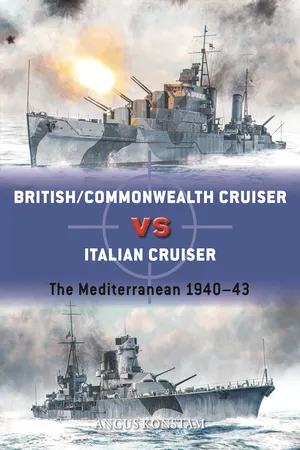
eBook - ePub
British/Commonwealth Cruiser vs Italian Cruiser
The Mediterranean 1940–43
- 80 pages
- English
- ePUB (mobile friendly)
- Available on iOS & Android
eBook - ePub
About this book
Information
DESIGN AND DEVELOPMENT
THE BRITISH CRUISER FLEET
During World War I, Britain concentrated on building small light cruisers armed with 6in. guns, designed primarily for operations in the North Sea. A total of 44 of these warships were built during the war, and many of these would still be in service in 1940. The best of them, and those which survived the interwar years, were the so-called C-class cruisers, which were actually a group of similarly designed cruisers divided into several smaller classes (Caledon, Ceres and Carlisle), as well as the D-class cruisers which entered service during the closing months of World War I. The two E-class cruisers laid down at the same time didn’t enter service until 1926.
By then though, Britain had already begun building a class of three larger Hawkins-class cruisers, designed for ocean cruising, and armed with 7.5in. guns. While these weren’t particularly innovative ships, their construction had an influence on the disarmament negotiations, which led to the Washington Naval Treaty of 1922. Effectively, these large, well-armed cruisers led to their accommodation in the treaty ceiling for cruisers, of a 10,000-ton displacement and a maximum gun calibre of 8in. From that point on, until 1930, all British interwar cruisers would be built to conform to this ceiling. Also, as the treaty never specified a maximum number of these large cruisers, the major naval powers embarked on what was essentially a cruiser race.
Concerns about the sustainability of this race led to a call for further international discussions. The result was the London Naval Treaty of 1930, which not only limited the number of cruisers each maritime power could have, but also recognized two different types of cruiser. The 8in. ‘treaty cruisers’ built to conform to the Washington treaty limits formed one category, which unofficially came to be labelled the ‘heavy cruisers’. These were now distinct from cruisers with a gun calibre of up to 6.1in., which became known as ‘light cruisers’. So, Britain’s wartime C, D and E classes were now deemed light cruisers, while the Hawkins class, with their 7.5.in guns, became heavy cruisers. From that point on, Britain’s naval shipbuilding programme concentrated on the production of light cruisers, which gradually came to outnumber the heavy cruisers in the fleet.
THE HEAVY CRUISERS
During the war, the three Hawkins-class cruisers were ordered to counter the threat posed by German ocean raiders. However, all but one of them entered service after the war was over. Even then, the first of these, Cavendish, was converted into the aircraft carrier Vindictive while still under construction. She would eventually be rebuilt as a cruiser. These were long, elegant ships, carrying their 7.5in. guns in seven single mounts. Their armoured belt was up to 3in. thick, which gave them a modicum of protection, but they could only make just under 30 knots. When the war began in September 1939 Hawkins, Frobisher and Effingham were still in service, albeit held in the mothballed reserve fleet. Although all three were brought int...
Table of contents
- Cover
- Title Page
- Table of Contents
- Introduction
- Chronology
- Design and Development
- The Strategic Situation
- Technical Specifications
- The Combatants
- Combat
- Analysis
- Aftermath
- Bibliography
- eCopyright
Trusted by 375,005 students
Access to over 1.5 million titles for a fair monthly price.
Study more efficiently using our study tools.
Frequently asked questions
Yes, you can cancel anytime from the Subscription tab in your account settings on the Perlego website. Your subscription will stay active until the end of your current billing period. Learn how to cancel your subscription
No, books cannot be downloaded as external files, such as PDFs, for use outside of Perlego. However, you can download books within the Perlego app for offline reading on mobile or tablet. Learn how to download books offline
We are an online textbook subscription service, where you can get access to an entire online library for less than the price of a single book per month. With over 1.5 million books across 990+ topics, we’ve got you covered! Learn about our mission
Look out for the read-aloud symbol on your next book to see if you can listen to it. The read-aloud tool reads text aloud for you, highlighting the text as it is being read. You can pause it, speed it up and slow it down. Learn more about Read Aloud
Yes! You can use the Perlego app on both iOS and Android devices to read anytime, anywhere — even offline. Perfect for commutes or when you’re on the go.
Please note we cannot support devices running on iOS 13 and Android 7 or earlier. Learn more about using the app
Please note we cannot support devices running on iOS 13 and Android 7 or earlier. Learn more about using the app
Yes, you can access British/Commonwealth Cruiser vs Italian Cruiser by Angus Konstam,Ian Palmer in PDF and/or ePUB format, as well as other popular books in History & Italian History. We have over 1.5 million books available in our catalogue for you to explore.