Bioaugmentation Techniques and Applications in Remediation
  1. 168 pages
  2. English
  3. ePUB (mobile friendly)
  4. Available on iOS & Android
eBook - ePub

About this book

It has been observed that rapid population expansion has raised the amount of anthropogenic activity, resulting in high levels of pollution in water, air, and solid waste as well as an increase in the pressure placed on agricultural lands. Bioaugmentation Techniques and Applications in Remediation provides detailed information on bioaugmentation approaches for the remediation of sediments, water, and soil polluted with organic and inorganic pollutants.

Practical applications of bioaugmentation techniques performed in restricted systems under controlled conditions, laboratory investigations, and in the field are addressed. Special emphasis is placed on the applications of nanomaterials in combination with bioaugmentation techniques for enhanced bioremediation efficiency.

FEATURES


  • Explores abiotic and biotic factors that enhance and facilitate environmental remediation of contaminants


  • Provides a primer on the elementary microbial processes entailed in bioaugmentation


  • Summarizes methods and approaches for executing bioaugmentation technology


  • Details commercially available products and instrumentation

This book is an ideal resource for researchers, students, and engineers working in materials science and bioremediation.

Frequently asked questions

Yes, you can cancel anytime from the Subscription tab in your account settings on the Perlego website. Your subscription will stay active until the end of your current billing period. Learn how to cancel your subscription.
No, books cannot be downloaded as external files, such as PDFs, for use outside of Perlego. However, you can download books within the Perlego app for offline reading on mobile or tablet. Learn more here.
Perlego offers two plans: Essential and Complete
  • Essential is ideal for learners and professionals who enjoy exploring a wide range of subjects. Access the Essential Library with 800,000+ trusted titles and best-sellers across business, personal growth, and the humanities. Includes unlimited reading time and Standard Read Aloud voice.
  • Complete: Perfect for advanced learners and researchers needing full, unrestricted access. Unlock 1.4M+ books across hundreds of subjects, including academic and specialized titles. The Complete Plan also includes advanced features like Premium Read Aloud and Research Assistant.
Both plans are available with monthly, semester, or annual billing cycles.
We are an online textbook subscription service, where you can get access to an entire online library for less than the price of a single book per month. With over 1 million books across 1000+ topics, we’ve got you covered! Learn more here.
Look out for the read-aloud symbol on your next book to see if you can listen to it. The read-aloud tool reads text aloud for you, highlighting the text as it is being read. You can pause it, speed it up and slow it down. Learn more here.
Yes! You can use the Perlego app on both iOS or Android devices to read anytime, anywhere — even offline. Perfect for commutes or when you’re on the go.
Please note we cannot support devices running on iOS 13 and Android 7 or earlier. Learn more about using the app.
Yes, you can access Bioaugmentation Techniques and Applications in Remediation by Inamuddin, Charles Oluwaseun Adetunji, Mohd Imran Ahamed, Tariq Altalhi, Inamuddin,Charles Oluwaseun Adetunji,Mohd Imran Ahamed,Tariq Altalhi in PDF and/or ePUB format, as well as other popular books in Physical Sciences & Biotechnology. We have over one million books available in our catalogue for you to explore.

Information

Publisher
CRC Press
Year
2022
Print ISBN
9781032034997
eBook ISBN
9781000600605

1 Bioaugmentation Techniques for Removal of Heterocyclic Compounds and Polycyclic Aromatic Hydrocarbons

Ulrich Vasconcelos, Luiz Gustavo Pragana, and Eduardo Santos da Silva
Universidade Federal da Paraíba
DOI: 10.1201/9781003187622-1

Contents

  • 1.1 Introduction
  • 1.2 Principles of Bioaugmentation Strategies for the Removal of Recalcitrant Hydrocarbons
  • 1.3 On Methods and Perspectives of Bioaugmentation in the Removal of Recalcitrant Hydrocarbons
  • 1.4 Conclusion
  • References

1.1 Introduction

Approximately 90% of the discharge of contaminants into the environment originates from human activity; of this total, about 70% of the contaminants are oil hydrocarbons (Cavalcanti et al., 2016), highly hydrophobic compounds with low solubility (Guo et al., 2011). The weathering of these oil hydrocarbons in sediment decreases the bioavailability of contaminant uptake by microorganisms due to different factors such as soil texture, partitioning, sorption rate, pH, organic matter content, and aging (Aljerf and Al Masri, 2018). This weathering also includes processes of adsorption, dissolution, volatilization, biotransformation, oxidation, and photolysis (Oualha et al., 2019).
Hydrocarbons composed of cyclic, heterocyclic, aromatic, and polycyclic aromatic molecules (PAHs) are chemically more stable molecules when compared to oleophins (Poater et al., 2018). This characteristic is due to the organization of the carbonic skeleton, composed of at least two aromatic rings and condensed cyclopentanes, arranged in lines, angles, or groups (Vo-Dinh et al., 1998). Some of these are associated with nitrogen, oxygen, or sulfur atoms (Asif and Wenger, 2019). As a result, these hydrocarbons show greater recalcitrance when disposed of in the environment and, therefore, less bioavailability (Lladó et al., 2013; Huesemann et al., 2004).
Heterocyclic compounds and, mainly, PAHs exhibit greater complexity in terms of recalcitrance. In addition, PAHs comprise a family of hundreds of organic substances, formed by incomplete combustion, considered to be one of the most frequent classes of molecules in the environment (Pope et al., 2000). There are 16 priority PAHs listed by the United States Environmental Protection Agency (USEPA) (Table 1.1). These are representative compounds of the class in terms of toxicity, as well as occurring in concentrations higher than the other PAHs (Ravindra et al., 2008; Thomas and Wornat, 2008).
TABLE 1.1 Physicochemical and Genotoxic Characteristics of the 16 Priority PAHs Listed by the United States Environmental Protection Agency
PAHs R MW Ga S VP Kow FP BP D
Naphthalene 2 128.17 2B 31.0 8.9 × 10⁻² 3.4 80 218 1.14
Acenaphthene 3 154.21 3 3.8 3.8 × 10⁻³ 3.9 94 280 1.02
Acenaphthylene 3 152.20 3 16.1 2.9 × 10⁻² 4.1 91 280 1.01
Fluorene 3 166.22 3 1.9 3.2 × 10⁻³ 4.2 116 295 1.20
Phenanthrene 3 178.23 3 1.1 6.8 × 10⁻⁴ 4.6 101 339 1.25
Anthracene 3 178.23 3 0.05 2.6 × 10⁻⁵ 4.5 218 340 1.25
Fluoranthene 4 202.26 3 0.26 8.1 × 10⁻⁶ 5.2 111 375 1.25
Pyrene 4 202.26 3 0.13 4.3 × 10⁻⁶ 5.2 146 404 1.27
Benzo[a]anthracene 4 228.29 2B 0.01 1.5 × 10⁻⁷ 5.6 162 435 1.27
Chrysene 4 228.29 2B 0.002 7.8 × 10⁻⁹ 5.9 254 448 1.27
Benzo[b]fluoranthene 5 252.32 2B 0.002 8.1 × 10⁻⁸ 6.1 168 481 1.24
Benzo[k]fluoranthene 5 252.32 2B 0.001 9.6 × 10⁻¹¹ 6.8 217 480 1.24
Benzo[a]pyrene 5 252.32 1 0.004 4.9 × 10⁻⁹ 6.5 179 495 1.24
Dibenzo[ah]anthracene 5 276.34 2A 0.005 2.1 × 10⁻¹¹ 6.5 267 324 1.28
Benzo[ghi]perylene 6 278.35 3 3 × 10⁻⁴ 1.0 × 10⁻¹⁰ 6.6 278 550 1.30
Indeno[1,2,3-cd]pyrene 6 278.35 2B 0.062 1.4 × 10⁻¹⁰ 7.1 164 536 1.30
Source: International Agency for Research on Cancer (2021), Bojes and Pope (2007), Cai et al. (2007), Eom et al. (2007), Zhang et al. (2006), Daugulis and McCracken (2003), Pope et al. (2000).
R, rings; MW, molecular weight; G, genotoxicity (a classes: 1, Carcinogenic to humans; 2A, Probably carcinogenic to humans; 2B, Possibly carcinogenic to humans; 3, Not classifiable as to its carcinogenicity to humans); S, solubility; VP, vapor pressure (mmHg); Kow, octanol-water partition coefficient (log); FP, fusion point (°C); BP, boiling point (°C); D, density (g/L).
The hydrophobic properties of PAHs result in high affinity with many substrates, including soil particles. Soil is considered the main environment susceptible to oil hydrocarbons contamination (Gong et al. 2007; Mater et al., 2006; Enell et al., 2005; Watanabe, 2001). Soil is a very complex biological system, and extremely biodiverse. In terms of contamination by complex hydrocarbons, microbial reactions play a key role in its recovery (Orgiazzi et al., 2015; Watanabe and Hamamura, 2003). Exposure to PAHs and/or heterocyclic hydrocarbons promotes negative impacts on all layers of the soil, causing the reduction of fertility as well as imbalance in the trophic chain (Herwijnen et al., 2003).
Additionally, the exposure of the microbiota to hydrocarbons causes drastic changes, requiring rapid adaptation and tolerance to the contaminant (Sarkar et al., 2016). The stress caused to the ecosystem promotes selective pressures, allowing generations of hydrocarbonoclastic individuals to establish themselves (Yang et al., 2016; Röling et al., 2002). This involves two important factors: hydrocarbon toxicity on cells and abundance of carbon from the hydrocarbons on the carbon content in the environmental organic matter, resulting in an imbalance of the C:N:P ratios (Sutton et al., 2013).
The use of hydrocarbons as a source of carbon and energy by some microbes has been known since the beginning of the 20th century. Starting in the 1940s, the mechanisms began to be unveiled (Bushnell and Haas, 1941). Microbes that exhibit the ability to assimilate hydrocarbons are highly distributed in the environment, although they do not use these compounds as a preferred source of carbon and energy (Dashti et al., 2015). After exposure to hydrocarbons, however, the population of hydrocarbonoclastic microbes becomes more prevalent (Teramoto et al., 2013). The process of hydrocarbon mineralization by microorganisms is divided into two distinct stages. The first one, more accelerated, is mediated by the bioavailability of the contaminant. The second slower stage is controlled by the hydrocarbon sorption/desorption ratio (Kaplan and Kitts, 2004).
Hydrocarbonoclastic microbes exhibit different mechanisms to promote the assimilation of hydrocarbons such as synthesis of nonspecific enzymes that recognize cyclic compounds (De Boer et al., 2005), expression of oxidoreductases (Limongi et al., 2020), synthesis of biosurfactants (Martínez-Toledo and Rodríguez-Vasquez, 2013), biofilm formation (Nie et al., 2016), and production or assimilation of compatible solutes (Welsh, 2000). It is noteworthy that the process of biological removal of recalcitrant hydrocarbons is more effective when simple molecules, with greater bioavailability, are present assuming the role of cosubstrates (Nascimento et al., 2013).
In the case of environments containing high concentrations of recalcitrant hydrocarbons, the indigenous microbiota may be moderate or h...
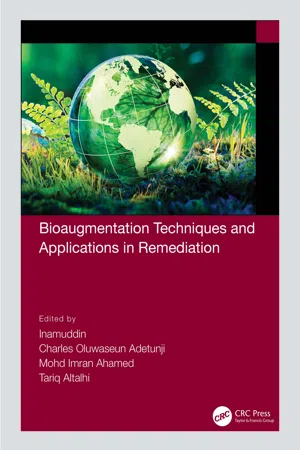
Table of contents

  1. Cover
  2. Half Title Page
  3. Title Page
  4. Copyright Page
  5. Table of Contents
  6. Preface
  7. Editors
  8. Contributors
  9. Chapter 1 Bioaugmentation Techniques for Removal of Heterocyclic Compounds and Polycyclic Aromatic Hydrocarbons
  10. Chapter 2 Bioaugmentation for Lignin Removal from the Paper Industry
  11. Chapter 3 Bioaugmentation of Pesticide-Contaminated Environment
  12. Chapter 4 Bioaugmentation in the Bioremediation of Petroleum Products
  13. Chapter 5 Bioaugmentation for Removal of Cyanides
  14. Chapter 6 Bioaugmentation to Remove Recalcitrant Pollutants in Industrial Wastewater
  15. Chapter 7 Application of Nanomaterials in the Bioaugmentation of Heavily Polluted Environment
  16. Chapter 8 Plasmid-Mediated Bioaugmentation
  17. Chapter 9 Bioaugmentation in Rhizoengineering for Xenobiotic Biodegradation
  18. Chapter 10 Bioaugmentation of Municipal Waste: Recycling of Electronic Wastes through Biohydrometallurgical Technology
  19. Chapter 11 Bioaugmentation in the Bioremediation of the Heavy Metals and Radionuclides
  20. Index