This engaging and timely book showcases practical ways that PreK–12 teachers and school leaders can create and implement sustainability-focused projects and practices in their classrooms and schools, helping promote a healthy, sustainable environment and curriculum for students and leading the way towards becoming a green school.
Sharing real-world case studies and detailed walk-throughs of sustainable schools in action – from Madison, Alabama, to Bali, Indonesia – author Linda H. Plevyak lays out the benefits, principles and practices of creating a sustainable school from beginner classroom projects like creating a garden, recycling and composting to more complex and school-wide initiatives like energy audits, creating an environmental management system, engaging with policy and building and leveraging community partnerships. Plevyak highlights sustainable practices that can be developed with little to no budget and focuses on those that support the development of critical thinking skills, promote project-based learning and consider the environment as a learning tool, incorporating sustainability as a natural progression of the learning process.
The book outlines extensive resources teachers and schools can use to embed sustainability in their programs and curriculum, offering teachers, school leaders and policy makers the tools they need to provide this generation of students with the knowledge and skills to create a more sustainable world.
“I don’t want to protect the environment. I want to create a world where the environment does not need protecting.”
Unknown
Vignette
What do you imagine when you think of a green school? Is there a lot of natural light, plenty of warm paint tones, solar panels on the roof and classrooms with hydroponic plants and a farm-to-table cafeteria? These schools exist and are likely even more amazing than what you imagined. One such place, North Park School for Innovation in Columbia Heights, MN captures all parking lot and playground runoff in rain gardens populated with native pollinator plants. They have also planted hundreds of trees, bushes and pollinating plants throughout the school’s property and recently acquired a biodigester to turn their food scraps, milk cartons and paper towels into compost for their garden and plants.
Chapter Objectives
Discuss the evolution of green schools.
Focus on historical aspects of environmental education (EE), sustainability and their connection to green schools.
Green School Movement
Approximately 56.4 million students spend five days a week in a school building (National Center for Education Statistics, 2020). If you add public school employees, including teachers and staff members (6.7 million), there are 63.1 million people working or learning in U.S. K–12 schools, which equates to almost 20% of the U.S. population (IBISWorld, 2020; National Center for Education Statistics, 2020). It makes sense that schools should be a place that focuses on the social, emotional and physical health of those who spend their days there.
The green school movement has gained popularity as climate change and compounding research suggest that the overuse of natural resources and global warming are requiring a rethinking in how we live. As of 2019, approximately 9%–12% of schools in the United States have some type of green school program, and “more one third of all K–12 schools use outdoor gardens, natural classrooms and onsite habitats as part of their educational approach” (Coyle, 2020, p. 385). Eco-Schools, the largest global sustainable school program, has registered green schools in 77 countries, involving over 59,000 schools across the world (1994). Approximately 60% of K–12 schools in Hong Kong belong to a national Green School Network called Green Power, which focuses on developing environmentally focused curriculum, eco-monitoring, waste reduction and recycling. In the U.S., there are 300 sustainability coordinators that work in medium and large K–12 school districts (P. Beierle, personal communication, March 25, 2021), with a 15%–20% per year growth. To achieve a greater number of schools identifying as a “green school,” an understanding of how to navigate terminology, finding appropriate resources and clarifying goals are needed.
The Emergence of Green Schools
Over the last 40–50 years, educational initiatives have sought to establish a new paradigm for PreK–12 schools that goes beyond the traditional classroom through projects that emphasize “learning beyond the classroom, reorienting school infrastructure” and engaging learners (Tilbury & Wortman, 2005, p. 22). One of those initiatives is the United Nations Sustainable Development Goals (SDGs), which have established a blueprint for how to “tackle climate change and work to preserve our oceans and forests” (UN, 2021, para. 1). The 17 SDGs, which were put into practice in January 2016 and were established as part of Agenda 2030 by the UN General Assembly, focus on the following:
Vienna International School, Vienna, Austria Promoting SDGs
Over the past four years, Vienna International School (VIS), integrated the UN Sustainable Development Goals (SDGs) into their curriculum. VIS has a certified ESD-School coordinator who is also a Global Schools Advocate that has embedded a sustainability strand in the science curriculum and promotes the social, economic and political aspects of the SDGs into all aspects of the schools community. Teachers are also trained in how to integrate EE concepts into all subject areas.
Poverty eradication. Poverty reduction is inextricably linked to health and sustainable development.
Sustainable consumption and production.
Governance.
Urban development.
Environmental sustainability (UN, 2021).
Various organizations have taken the call from the UN to incorporate the SDGs into their own mission and vision. For example, Eco-Schools, which was established by the Foundation for Environmental Education (FEE), a non-governmental, non-profit organization, has eight Educational Principles that guide their work in environmental education and sustainability:
Ensure that participants are engaged in the learning/teaching process
Empower participants to take informed decisions and actions on real life sustainability issues
Encourage participants to work together actively and involve their communities in collaborative solutions
Support participants to examine their assumptions, knowledge, and experiences, in order to develop critical thinking, and to be open to change
Encourage participants to be aware of cultural practices as an integral part of sustainability issues
Encourage participants to share inspirational stories of their achievements, failures, and values, to learn from them, and to support each other
Continuously explore, test, and share innovative approaches, methodologies, and techniques
Ensure that continuous improvements through monitoring and evaluation are central to our programs (FEE, 2001, para. 1).
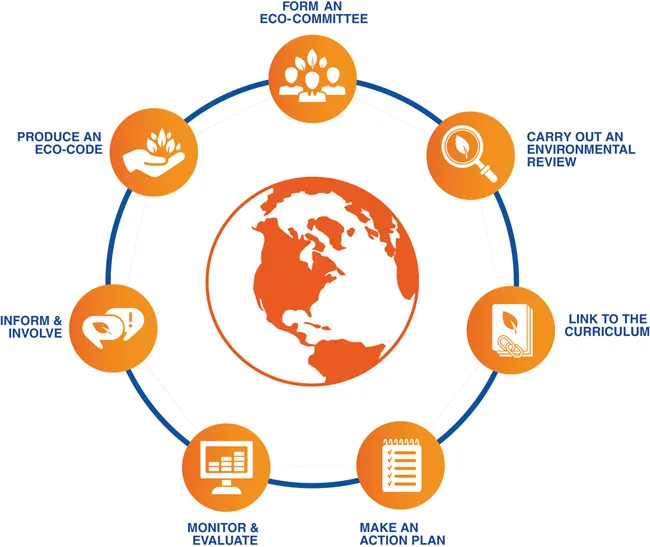
Eco-Schools also has a Seven Step process that requires schools to focus on “environmental, climate and sustainability issues,” (FEE, 2001, para. 8). See Figure 1.1 and Chapter 3 for a more detailed approach to developing a green school.
After schools complete the Seven Step process, they can apply for the Green Flag Award, though that is usually after two years of program implementation. Schools can continue to achieve up to four Green Flags, at which point they are considered a permanent Eco-School. This achievement means that sustainability has been integrated into all aspects of the school’s culture. Between 2011 and 2019, there were 141 U.S. schools that had achieved the highest honor of four green flags.
Another organization that connects to the UN SDGs and promotes sustainability in schools is the Global Environmental Education Partnership (GEEP). Established in 2014, the GEEP’s mission is to “create a vibrant and inclusive learning network designed to build capacity in countries around the world to strengthen environmental education leading to a more sustainable future” (para. 1). Using environmental education and citizen engagement as the foundation, the GEEP organization strives to focus on the following:
Professional development
Globalization of environmental education standards guidelines
Legislation and national-level policies that support environmental education
Access to effective and promising practices
Research and evaluation
How environmental education can best address key issues, such as climate change, water shortages, and loss of biodiversity (2021)
FIGURE1.1 Eco-Schools seven-step processCREDIT Eco-Schools, Foundation for Environmental Education (FEE) www.fee.global
Taiwan, one of the original partners of the GEEP organization, established the Taiwan EE Act (TEEA) in 2011 (TEEA, 2011). The TEEA goal is “for people to understand their ethical relationship with the environment, as well as to improve environmental knowledge, skills, attitudes, and values” (GEEP, 2021, para. 2), and requires that, “all students and any staff in government and business engage in 4 hours of government funded environmental education curriculum each year” (GEEP, 2021, para. 1).
The U.S. has also provided leadership in developing and supporting green schools. In 2011, numerous non-profit organizations, including the Center for Green Schools, the National Wildlife Federation and the Campaign for Environmental Literacy, came together to request the U.S. Department of Education, “honor schools for their sustainable facilities, health practices, and effective environmental education” (2021, para. 1). The Green Ribbon School award (ED-GRS) was created from this petition, and through 2021, the U.S Department of Education has recognized 489 PreK–12 schools, 92 school districts (started in 2013) and 54 postsecondary institutions (started in 2015). With 98,300 public schools and 34,576 private schools in the U.S., less than 1% of these schools have achieved the ED-GRS award (NCES, 2020), with approximately 20 states not submitting ED-GRS applications. The ED-GRS is a recognition award only; the schools do not receive any ED funding. Also, ED-GRS schools are not certified, though some U.S. states may connect the ED-GRS to existing state-based certification programs (2020). To further engage schools, Green Strides was created as the outreach arm of the ED-GRS award, with webinars, videos and resources that highlight a connection to the environment, sustainability, reducing environmental impact and health and wellness (2013).
Green schools are relatively new; their historical background dates back only a few decades. The establishment of the U.S. Green Building Council (USGBC) in 1993 and the launching of Eco-Schools in 1994 by the Foundation for Environmental Education (FEEE) in Europe were impactful in the development of green schools (Iwan & Rao, 2017). In 2000, the USGBC created the Center for Green Schools (CGS), and the FEEE became a global non-governmental organization (NGO) in 2001 and simplified its acronym to FEE.
Importantly, major public school districts such as Atlanta, Austin, Baltimore, Fairfax County, Houston, Philadelphia, and New York City are using Eco Schools to encourage students to participate in implementing sustainability goals by conducting energy audits, tracking recycling performance, planting trees and gardens for climate mitigation and more. The fact that NWF Eco Schools U.S.A. is part of an international network of Eco Schools also helps connect these schools with green schools in other nations. (Coyle, 2020, p. 397)
As of 2019, Eco-Schools has nearly 20 million students participating in their programs in over 55,000 schools and 68 nations (National Wildlife Federation).
Connection to Environmental Education and Sustainability
The green school movement has been evolving for the last couple of decades, with the field of environmental education (EE) being considered a foundation to the movement. EE focuses on “how people and nature can exist in productive harmony” (NAAEE, n.d., para. 3). The U.S. Environm...
Table of contents
Cover
Half Title
Series
Title
Copyright
Dedication
Contents
List of Illustrations
Meet the Author
Preface
Acknowledgments
1 Introduction to Green Schools
2 Whole School Framework and the Green Ribbon Award
3 Getting Started in Creating a Green School
4 What Does a Successful Green School Look Like?
5 Teaching Project- and Problem-Based Learning in a Green School
6 The Management, Aesthetics and Efficiency of a Green School
7 Policy, Safety and Diversity, Equity and Inclusion Within a Green School
8 Cost Benefits of Green Schools and How to Leverage Funding and Partnerships
9 How to Evaluate Campus, Curriculum and Community Sustainability Initiatives
Additional Resources
Trusted by 375,005 students
Access to over 1.5 million titles for a fair monthly price.
Study more efficiently using our study tools.
Frequently asked questions
Yes, you can cancel anytime from the Subscription tab in your account settings on the Perlego website. Your subscription will stay active until the end of your current billing period. Learn how to cancel your subscription
No, books cannot be downloaded as external files, such as PDFs, for use outside of Perlego. However, you can download books within the Perlego app for offline reading on mobile or tablet. Learn how to download books offline
Perlego offers two plans: Essential and Complete
Essential is ideal for learners and professionals who enjoy exploring a wide range of subjects. Access the Essential Library with 800,000+ trusted titles and best-sellers across business, personal growth, and the humanities. Includes unlimited reading time and Standard Read Aloud voice.
Complete: Perfect for advanced learners and researchers needing full, unrestricted access. Unlock 1.5M+ books across hundreds of subjects, including academic and specialized titles. The Complete Plan also includes advanced features like Premium Read Aloud and Research Assistant.
Both plans are available with monthly, semester, or annual billing cycles.
We are an online textbook subscription service, where you can get access to an entire online library for less than the price of a single book per month. With over 1.5 million books across 990+ topics, we’ve got you covered! Learn about our mission
Look out for the read-aloud symbol on your next book to see if you can listen to it. The read-aloud tool reads text aloud for you, highlighting the text as it is being read. You can pause it, speed it up and slow it down. Learn more about Read Aloud
Yes! You can use the Perlego app on both iOS and Android devices to read anytime, anywhere — even offline. Perfect for commutes or when you’re on the go. Please note we cannot support devices running on iOS 13 and Android 7 or earlier. Learn more about using the app
Yes, you can access Teaching Towards Green Schools by Linda H. Plevyak in PDF and/or ePUB format, as well as other popular books in Education & Sustainability in Architecture. We have over 1.5 million books available in our catalogue for you to explore.