- English
- ePUB (mobile friendly)
- Available on iOS & Android
eBook - ePub
About this book
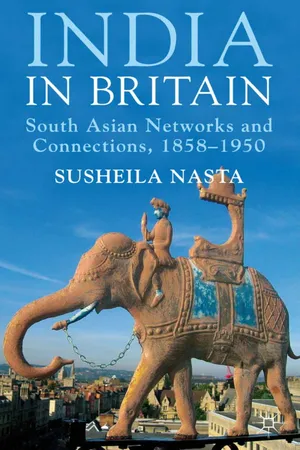
Moving away from orthodox narratives of the Raj and British presence in India, this book examines the significance of the networks and connections that South Asians established on British soil. Looking at the period 1858-1950, it presents readings of cultural history and points to the urgent need to open up the parameters of this field of study.
Information
1
The Zigzag Lines of Tentative Connection: Indian–British Contacts in the Late Nineteenth Century
This essay explores some of the indirect, tentative and imagined dimensions of early encounters between Britons and Indians within the spaces for contact that southern England made available in the final decades of the nineteenth century. The indirection I refer to – which I will describe as both zigzag and fuzzy – manifests at the levels both of what happened between, in each case, an individual Indian and an individual Briton, and also how the connections were understood and represented by these partners to the encounter. The essay asks in what ways these somewhat roundabout and diffident attempts to reach out were expressed. The beginning of an answer may lie in a highly suggestible, layered channel outside the conventional public sphere, namely, the medium of poetry, in some cases experimental, modern and avant garde, in some cases the work of tentative beginners. It is no accident therefore that each of the three pairings featured below includes at least one poet. Poets, I suggest, explore in their work some of the oblique and hitherto uncharted dimensions of the Indian–British encounter in particularly rich, evocative ways.
The effort of producing a meshed picture of Indian–British encounters, as in this essay, entails an important task of historical decoding – important because it gives texture to our understanding of British as well as Indian identity in this period, as well as of the place of the metropolis within the British empire. That Indians at the time of formal imperialism contributed to British social, political and cultural life at every level, participating in political and religious debates, and sharing ideas on the economy, mathematics, the arts and sciences, significantly augments our sense that the empire was no Manichaean realm divided into warring opposites such as it was seen some twenty years ago. Instead, as Nicholas Thomas, Antoinette Burton and P. D. Morgan, amongst others, observe, it formed a complicated, cross-linked ‘interactive system, one vast interconnected world’.1 Moreover, the interaction of Indians and Britons in the period, whether in the street, the salon or on the printed page, powerfully dramatizes two things, as we will see: first how British metropolitan history was profoundly shaped by colonial migration for a lot longer than was once assumed to be the case, and then how dynamic, lateral and horizontal such migratory interactions were. Indeed, these interactions anticipated, even laid down a template for, the cross-border creative exchanges and partnerships that would characterize Britain’s diasporic future following the Second World War. As I discuss elsewhere, Indian travellers, thinkers, seers, politicians and students, in encountering London, the capital of the modern world, did not necessarily see themselves as secondary or belated in relation to it. Urban dwellers themselves, citizens of Bombay, Calcutta, Lahore or Delhi, they met the city of London on relatively equal terms, as self-consciously modern inhabitants of a rapidly expanding imperial but also globalized world.2
In examining the subject of early Indian–British relations on British soil, it is an incontrovertible fact, too, that no matter how well-intentioned the approaches of travelling Indians were to their British counterparts in these cross-culturally formative years, nor how interested were their liberal hosts in reciprocating their overtures – in practice, within the public arena, outside the privileged islands of hospitality provided by universities or literary salons, considerable wariness still beset attempts at reaching across the cultural divide. To be clear, it was a wariness that pertained in the capital as well as on the colonial periphery. The Indian Great Rebellion of 1857–8 had, at least on Indian soil, soured possibilities for friendly interaction and mutual trust between Indians and Britons for over a generation. Yet in the metropolis, too, in these decades, Indians in the press and popular literature as well as in exhibition spaces were still indiscriminately ‘othered’, represented as exotic strangers or richly robed Orientals, which was not that surprising given the dominance of ethnographic vocabularies to categorize other races at this time. As Anne McClintock writes in Imperial Leather, in the phase of high imperialism, what she calls ‘commodity racism’ came increasingly to promote and to an extent replace earlier, ideologically driven ideas of ‘scientific racism’. Social Darwinist ideas of imperial progress via the struggle of the fittest gave way to mass-produced spectacles of racialized ideas, reflected in ‘advertising and photography, the imperial Expositions and the museum movement’.3 In the great colonial exhibitions, such as the 1886 Indian and Colonial Exhibition, Indians and Indian cultures were invariably represented as quintessentially ‘Eastern’, associated with such standard signifiers as jewels, spices, peacocks, brocades and silks, elephants, and fabulously wealthy rajahs.
Yet, although the divide between colonizer and colonized may have yawned wide especially on the imperial periphery of India after 1857, at the onset of high imperialism, a somewhat different set of expectations at times applied when it came to areas within the metropolis of London, as many travelling colonials, not least Indians, discovered. Here, though Indians outside the colonial exhibitions with their hierarchical displays of ‘native’ customs were still few and far between, they did in some cases find themselves, and were regarded as, making up an intrinsic part of the rich panoply of the city’s diverse life and in consequence were made relatively welcome. The following remarks in the Daily News by an anonymous Ceylonese visitor to the 1886 Indian and Colonial Exhibition, underline both this perception on the part of visiting South Asians of a British hospitality granted on the basis of a perceived unique status, and a vivid sense of forming part of a teeming cosmopolitan diversity. Similar impressions are echoed in the work of a slightly later Indian traveller, the social reformer B. M. Malabari.4 The Ceylonese correspondent writes:
The Englishman here is very common. When he comes to Ceylon he is a great man; but a black man is a great man in England. …Still a large number of people come to the Exhibition. … Who thought when I first said I would come to England on account of the sea, that I would see peoples of all the world [‘Africans, Maoris, Fijians, Cypriots, Rajpoots, Chinese, Japanese, Russians, French, Americans’, he glosses elsewhere]? … It must be owing to this that everyone likes to see England.5
Notice in particular how this Ceylonese participant inscribes himself as what Michel de Certeau and Mary Lou Emery after him call ‘a subject who sees’;6 how he draws explicatory analogies between home and abroad, Ceylon and London, while at the same time cross-cutting these with shifting ideas of relative scale: ‘A black man is a great man in England.’ As his remarks imply, social configurations existed whereby a South Asian traveller might be made to feel welcome in the capital. Indeed, in certain cases his or her presence could be regarded as an enhancement of the imperial and ‘world’ status of the host-city.
As commentators have observed, in imperial London in the late nineteenth century, in sharp contrast with what occurred on the stratified periphery, differences of race and ethnicity were mediated and to an extent suspended within a more dominant hierarchy of class, especially when it came to encounters with Indians perceived to be of high status. So it is probably no accident that all three of the Indians who feature in this essay, Mohini Chatterjee, Manmohan Ghose and Toru Dutt, were high ranking Bengali Brahmins – and indeed that many of Britain’s early Indian travellers (not including lascars) were either Brahmins or Bombay Parsis, who long since had positioned themselves as imperial go-betweens. In the case of all three there is evidence to suggest that their social status elided their racial difference in the eyes of their closest British interlocutors. In an analysis that complicates some of the homogenizing implications of David Cannadine’s thesis of class-to-class bonding or ‘ornamentalism’ across cultural borders, historian Martin Wainwright contends, for example, that differences of race could be trumped by those of rank within Britain’s idealized hierarchy of class.7 Far removed from the places in which authority had often been brutally imposed, the British metropolis provided a ‘unique zone of encounter’ where, in accordance with the ideals of the civilizing mission, British subjects, ‘regardless of the colour of their skin’, were given relative freedom to manipulate their status to secure recognition in an alternative class hierarchy.8
As my opening implies however, the aim of this essay is not merely to assert that successful cross-cultural encounters took place within large British or Irish cities (here including Dublin), piecemeal and sporadic though they often were. The case for early encounter and exchange has been conclusively made by pioneering historians of the South Asian diaspora such as Antoinette Burton, Rozina Visram and Kusoom Vadgama, as well as by the 2007–10 research project ‘South Asians Making Britain’ from which this volume of essays partly derives.9 In their different though related areas these historians and cultural critics have already investigated foundational Indian–British contacts in considerable detail.
Building on this important research, the intention of this essay is rather to probe more deeply the subjective and hence less accessible dimensions of these encounters, given that they mostly took place along one-to-one axes between individuals, and were described, if at all, in the private forms of diary and letter, as well as, importantly for my purposes, in the intimate though also oblique recesses of the lyric poem, through what might be termed a poetics of cross-border connection. Whereas large-scale, formal contacts between Britons and Indians, whether they were durbars, exhibitions or performances, tended to be documented in a variety of public media, including newspapers and court circulars, the connections under investigation here were generally halting, shy, tacit, hit-and-miss – or, in a word, indirect. They were also, in many cases, unrecorded, or, at least, not directly, consciously or immediately so. This range of connotations pointing to indirection I group under the headings zigzag, signifying changes of tack, and fuzzy, suggesting the perceptual indeterminacy that is consequent on such indirection for commentators both at the time and in the present day. A high degree of evidential uncertainty, in other words, exacerbates the epistemological indeterminacy that besets any attempt to read a subjective encounter: one mode of indirection is reinforced by another. Even those cultural historians like Burton or Leela Gandhi who have offered an account of intercultural proximity in the period by presenting focused portraits of individuals interacting in the private sphere, concede how complicated, difficult and tentative many of these connections were, and how challenging they remain to historical interpretation.10
What was it that took place between the two young Theosophists, Mohini Chatterjee and W. B. Yeats, the one a travelling teacher and seer, the other an acolyte and seeker, when they first met in 1885 in Dublin? Both were seeking new perceptions and understanding: Chatterjee of the west; Yeats of the ancient belief systems and related mythologies of the subcontinent. In both cases, as for all the encounters examined here, there was perhaps some mutual stereotyping, the all-too-predictable perceptions of us-against-them that the media of the time made available. However, at the same time, as we know from Yeats’s early writings, such inherited criteria would not have waylaid him for long, keen to test accepted categories as he was.11 As for Chatterjee, he left no written travelogue of his time in England and Ireland helping to set up the still emergent transcultural hub of the Theosophical Society.12 Nonetheless, it is clear from the eyewitness reports of fellow Theosophists that he found European society congenial and himself presented an attractive personality to Europeans (especially, it must be said, to women), in ways that helped to override the issues of racial and cultural difference that might otherwise have obtained. As we can extrapolate from the poetic evidence, the shy young Yeats, sexually gauche to the extreme, was intrigued by this dynamic charm. Indeed, he was intrigued to the extent that Chatterjee became the formative first in a chain of Indians that the Anglo-Irish poet befriended across his long career as a seeker (notable later contacts being Sarojini Naidu, Rabindranath Tagore and Shri Purohit Swami). Yet none of these key figures, till very recently, have merited a thoroughgoing treatment in studies of his life and work, though they are on occasion recognized as having had an impact on his understanding of tradition and the modern.
British art scholar Laurence Binyon’s encounter at St Paul’s School and then at Oxford University in the mid-to-late 1880s with the Bengali poet Manmohan Ghose, older brother of Aurobindo (later Sri Aurobindo), was to shape his later career as curator working on eastern manuscripts in the British Museum.13 What, we might again ask, passed between these two young men when they first met at school as aspiring classicists and fellow admirers of the work of Matthew Arnold? Binyon recalled something of the encounter in later years, in a synoptic preface to Manmohan’s work, remarking on the ‘immediate sympathy’ he felt with Ghose’s ‘dramatic emotion’, and noting besides that ‘anyo...
Table of contents
- Cover
- Title
- Copyright
- Contents
- List of Figures
- Acknowledgements
- Notes on Contributors
- Foreword: The Importance of Strangers
- Introduction
- 1 The Zigzag Lines of Tentative Connection: Indian–British Contacts in the Late Nineteenth Century
- 2 Writing Empire, Fighting War: India, Great Britain and the First World War
- 3 Tracing the Legacy of an Experimental Generation: Three Iconic Indian Travellers in 1890s London
- 4 Forging Global Networks in the Imperial Era: Atiya Fyzee in Edwardian London
- 5 ‘A Mosque in London worthy of the tradition of Islam and worthy of the capital of the British Empire’: The Struggle to Create Muslim Space, 1910–1944
- 6 Crafting Connections: The India Society and the Formation of an Imperial Artistic Network in Early Twentieth-Century Britain
- 7 Dialoguing with Empire: The Literary and Political Rhetoric of Sarojini Naidu
- 8 ‘Best Sellers’: India, Indians and the British Reading Public
- 9 ‘A Flute of Praise’: Indian Theatre in Britain in the Early Twentieth Century
- 10 Calling from London, Talking to India: South Asian Networks at the BBC and the Case of G. V. Desani
- 11 ‘Civilizing Sabu of India’: Redefining the White Man’s Burden in Twentieth-Century Britain
- 12 Connective Tissue: South Asians and the Making of Postcolonial Histories in Britain
- Select Bibliography
- Index
Trusted by 375,005 students
Access to over 1.5 million titles for a fair monthly price.
Study more efficiently using our study tools.
Frequently asked questions
Yes, you can cancel anytime from the Subscription tab in your account settings on the Perlego website. Your subscription will stay active until the end of your current billing period. Learn how to cancel your subscription
No, books cannot be downloaded as external files, such as PDFs, for use outside of Perlego. However, you can download books within the Perlego app for offline reading on mobile or tablet. Learn how to download books offline
We are an online textbook subscription service, where you can get access to an entire online library for less than the price of a single book per month. With over 1.5 million books across 990+ topics, we’ve got you covered! Learn about our mission
Look out for the read-aloud symbol on your next book to see if you can listen to it. The read-aloud tool reads text aloud for you, highlighting the text as it is being read. You can pause it, speed it up and slow it down. Learn more about Read Aloud
Yes! You can use the Perlego app on both iOS and Android devices to read anytime, anywhere — even offline. Perfect for commutes or when you’re on the go.
Please note we cannot support devices running on iOS 13 and Android 7 or earlier. Learn more about using the app
Please note we cannot support devices running on iOS 13 and Android 7 or earlier. Learn more about using the app
Yes, you can access India in Britain by Susheila Nasta in PDF and/or ePUB format, as well as other popular books in Literature & Literature General. We have over 1.5 million books available in our catalogue for you to explore.