eBook - ePub
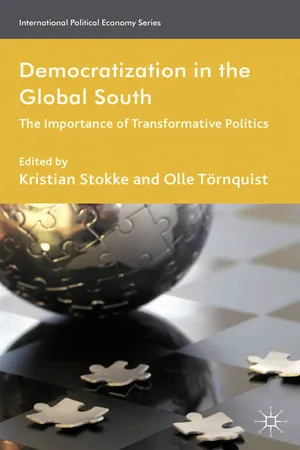
Democratization in the Global South
The Importance of Transformative Politics
- English
- ePUB (mobile friendly)
- Available on iOS & Android
eBook - ePub
Democratization in the Global South
The Importance of Transformative Politics
About this book
Given the weaknesses of mainstream democratisation since the 1980s, the authors present a cutting edge examination of dynamics of political change in the direction of more substantive democracy. While focusing on the Global South, they also draw comparisons from historical and contemporary experiences from Scandinavia.
Information
Part I
Transformative Politics in Historical and Comparative Perspective
1
Transformative Democratic Politics
Kristian Stokke and Olle Törnquist
The background
The third wave of democracy in the Global South in conjunction with market-driven globalization since the mid-1980s has not only undermined authoritarianism, but has also swept away many preconditions for political advances. Moreover, it could be argued that there has been a stagnation of democracy in many post-transition states, seen in the depoliticization of public affairs and problems of flawed popular representation in particular (Harriss et al. 2004; Törnquist et al. 2009). This means that there is a need for substantive and more extensive democratization – a process that will work towards improved popular control of more widely defined public affairs on the basis of political equality. But how will this come about? It is increasingly accepted that those with power tend to dominate and manipulate democratic institutions, while those who are marginalized have insufficient power to use the rules and regulations. While advocating the need to go beyond the predominant elitist crafting of democratic institutions, we would nevertheless argue that it is possible in most cases to make advances without the postponement of fledgling democracy in favour of authoritarian revolutionary changes. The most general answer provided in this book is to thus draw attention to the importance of transformative democratic politics. By this we mean political agendas, strategies and alliances that use formal and minimalist democracy to introduce politics and policies that may enhance people’s opportunities for improving democracy and making better use of it. The twofold purpose of this introduction is to first provide some conceptual pointers to the need for and meaning of such transformative democratic politics, and thereafter to outline how the different chapters in the book provide key insights into the dynamics of such politics.
This is our third book on democratization in the Global South. Like its predecessors, it is produced by an international network of scholars with a common interest in the challenges of analysing both the problems of existing formalistic and minimal democracy that has evolved, and the efforts made at moving ahead towards more substantive and substantial transformation. Our first joint book, Politicising Democracy, focused on critical analyses of the efforts at building democracy by crafting what are commonly viewed as universally ‘correct’ liberal-democratic institutions (Harriss et al. 2004). The book highlights that efforts at crafting liberal democracy have increasingly tended to emphasize decentralization and local democracy. The major weakness of this predominant strategy, as we see it, is that the model of liberal-democratic institution-building has been uncritically applied, irrespective of the fact that there may be alternatives and irrespective of the need to pay close attention to contextual preconditions and dynamics. Our primary argument is that supposedly universal institutions are being introduced and analysed without considering context, actors and relations of power. This is what we describe as the depoliticization of democracy. Moreover, the results have been limited. In contrast to the mainstream assumption that if ideal liberal-democratic rules, regulations and organizations are introduced most actors will adjust and become democratic, the overwhelming empirical evidence is that powerful actors have instead dominated and adjusted the ‘parachuted’ institutions in their own interest.
What are the main characteristics of the depoliticized form of democratization? Politicising Democracy identifies the following key features:
(a) Pacts between powerful elites on building core institutions of democracy (related to rule of law, human rights, free and fair elections, Weberian administration and civil society) that simultaneously exclude ordinary people and their representatives
(b) Privatization to the market, and affluent civil society organizations (CSOs) and ethnic and religious communities
(c) Decentralization of government based on ‘subsidiarity’ and the idea that people in local communities have common interests, and that relations of power between people and regions are unimportant
(d) Technocratic and ‘non-interest’ based ‘good governance’ involving government, market actors, civil-society organizations and ethnic and religious communities, again without considering power relations
(e) A number of problems of abuse and privileged control of institutions of democracy such as unequal citizenship, unequal access to justice, poorly implemented human rights, elite and moneydominated elections, corrupt administration, middle-class dominated civil society and otherwise predominance of ‘illiberal’ democratic practices
(f) Some popular-oriented civil-society projects that contest negative politics and authoritarian states, but often neglect that it is necessary to foster progressive political projects such as participatory budgeting, planning and the like, and thus try to implement these ideas and projects within the hegemonic framework.
Given these tendencies towards the depoliticization of democracy, the book concludes that it is necessary to politicize democracy by considering the context for democratic institutions, that is, to pay close attention to power relations and the various actors’ will and capacity to promote and use the institutions. In other words, democracy cannot be crafted by just building the supposedly appropriate institutions. It is also necessary to consider what relations of power need to be changed, what actors have the potential to achieve this and how such processes can be supported.
What might the core elements of attempts at building more substantive democracy be? This was the main question addressed in the second collective book, Rethinking Popular Representation (Törnquist et al. 2009). To answer this question it is necessary first to identify the roots of the problem and then analyse these causes more closely. Our answer in the second book was that problems such as corruption and the elite capture of democratic and decentralized institutions are rooted in the poor democratic representation of ordinary people and middle-class interests and aspirations. This calls for the need to rethink popular democratic representation, which we argue, primarily requires the need to:
(a) Examine the political construction of the people (demos) and public affairs, and related problems of democracy such as unclear definitions of what people are supposed to control what public affairs
(b) Examine problems of democratic representation in relation to all forms of governance of what are widely deemed to be public affairs, even if the means of governance have been privatized and even if some actors argue that a number of issues are no longer of common concern
(c) Examine problems of democratic representation in relation to all linkages between people and institutions of governance (i.e. direct as well as indirect representation, informal and claimed representation and so forth)
(d) Examine how symbolic, descriptive and substantive representation are legitimized and authorized
(e) Examine both the input side of democratic representation, which is to be based on politically equal generation of decisions, as well as the output side, which is to be based on impartial implementation.
From this we draw a set of major conclusions regarding political principles and dynamics towards improved popular representation. We argue that popular representation calls for empowered citizens and stronger popular organizations with a voice and with the capacity to reform the system. It also calls for improved institutional nodes and clear democratic principles of representation that ensure strong linkages between popular organizations and institutions of public governance. Substantive popular representation rests, moreover, with the distribution of resources and relations of power as well as with resistance and organized struggle for change. Yet pressure from below is not in itself sufficient for the generation of political change towards more substantial democratization. The design of public institutions for participation and representation are also crucial as they affect the ways in which people organize and mobilize. The successful introduction of institutions that are favourable for democratic popular organization and mobilization rests with a combination of leadership and demands from below.
Defining transformative democratic politics
Taken together, these conclusions call for transformative democratic politics, by which we mean, once again, political agendas, strategies and alliances for using fledgling democracy in order to introduce politics and policies that may enhance people’s chances of improving democracy as well as their capacity to make better use of it to foster their aims.
Transformative politics thus defined may be specified by way of a comparison with six other major but non-democratic forms of transformative politics. First, transformative democratic politics means an emphasis on transformation by way of politics, in contrast to the economistic thesis of Marx and Kautsky that the development of capitalism generates conflicts that in turn inevitably fosters movements to transform societies from capitalism to socialism. Second, transformative democratic politics implies a gradualism that is counterposed to Lenin’s (and others’) ‘political power first’ thesis. This position holds that transformation calls for the capture of state power followed by ‘Marxist scientifically guided politics’ to alter the dominating and repressive relations of power. Third, transformative democratic politics rests on an emphasis on state–society relations that can be contrasted with Putnam’s society-first thesis – that interpersonal trust (social capital) between people will resolve the collective action problem between people, and thus enable them to transform their societies. Similar arguments also inform many of the current ideas around civil society-based transformative politics. Fourth, transformative democratic politics is based on a continued centrality of the state, in contrast to the communitarian thesis that emphasizes the importance of national, ethnic, religious and other communities for achieving the common good. It is certainly also contrary to the idea of authoritarian political leadership to promote communitarian politics, such as in fascism and Nazism. Fifth, transformative democratic politics implies an emphasis on collective action that is opposed to the liberal idea that as long as there are civil, economic and political freedoms, people can decide and implement transformative politics. Sixth, and finally, the focus on democratic politics is counterposed to Huntington’s thesis that transformative politics presupposes stable institutions, constitutions, the rule of law and the politics of order.
In contrast to these alternative positions, we envision a form of transformative democratic politics that is instead based on democratization and rooted in two major ‘most successful’ traditions: (a) Bernsteinrooted Scandinavian social democracy, especially in the 1930s, and (b) new popular politics as in Brazil and (for a period) in the Indian state of Kerala. We will return to the specificities in subsequent chapters (see especially Chapters 2 and 3), but we argue tentatively that there are some common features. The first key feature is the aforementioned primacy of politics via popular organizations and public institutions. In addition to this comes, second, the centrality of citizenship-based democracy. This implies liberal-democratic constitutionalism and elections as well as democratic institutions for issue- and interest-based representation, plus citizens’ right to participation in, for instance, urban and resource-based planning as well as ‘participatory budgeting’. It also means giving almost equal importance to the output side of democracy (the capacity to implement in an impartial way the democratically decided policies) as to the input side of democracy (the democratically decided policies). Third, there is a strong tradition of developing political demands from below for political reform and universal (non-targeted) and individualistic (non-family based) public policies and thus inclusive and equal welfare and economic policies from above. Finally, and most importantly, is the centrality of demands from below for the institutionalization from above of issue- and interest-based representation and citizen participation, fostering individual autonomy combined with strong popular organizations as well as accountability of and trust in public institutions, which (as emphasized in Rothstein 2005) may also foster interpersonal trust.
While transformative democratic politics is not the same as reform, it nevertheless has a lot to do with ‘reforms that are conducive to new reforms’ (Przeworski 1985: 242). In commenting on Willy Brandtet al.’s (1976) book on the challenges of social democracy, Adam Przeworski observes that post-World War II leaders only seemed to be ‘ready to cope with whatever problems that are likely to appear, rather than to transform anything’. Yet, while ‘not all reforms are conducive to new reforms’, some are. As Walter Korpi (1978, 1983) has shown empirically with regard to the formative years of Swedish social democracy, ‘each new wave of reforms [ . . . ] had a mobilizing impact upon the [ . . . ] working class’. And the major outcome was that democratic political institutions did not just create more positive freedom for ordinary citizens than the national-socialist and communist models, but also created more freedom than the market-based welfare regimes. The crucial questions that call for further studies are thus (a) what democratically fostered political reforms contribute to mobilization and civic freedom and (b) when and how these can be politically feasible (Przeworski 1985: 247).
The notion of transformative democratic politics is to be contrasted, then, to the two mainstream strategies for promoting democracy. The first is the aforementioned elitist introduction of supposedly ideal and universal liberal-democratic institutions without altering the basic relations of power. The second is the equally elitist but more conservative crafting of strong institutions of rule of law and governance ahead of democracy. The first idea is based on the expectation that the actors will adjust to new liberal-democratic institutions and become full-scale democrats. The second position, giving prime importance to the rule of law, holds that sustained government by the existing elites – what Samuel Huntington (1965) used to call ‘politics of order’ – is a necessary precursor to political liberalization because it allows for the development of a solid institutional framework that will reduce the capacity of powerful actors to abuse institutions such as freedoms and elections (Carothers 2007; Mansfield and Snyder 2007).
As should be clear, we argue instead for transformative politics, in much the same way as Thomas Carothers argues in favour of gradualism.1 This position acknowledges that the principled defence of building liberal-democratic institutions is worthy of support because autocrats rarely initiate the building of ‘good governance’ and the rule of law.2There is also a need to develop democratic politics in order to alter the relations of power and to be able to build a substantive and substantial democracy that can generate and implement the laws and policies that people want. The main aim of this book is, therefore, to (i) analyse and compare past and present experiences of transformative politics; and (ii) analyse whether and how new tendencies (new models of accumulation and popular engagem...
Table of contents
- Cover
- Title Page
- Copyright
- Contents
- List of Figures and Tables
- Preface
- Abbreviations
- Notes on Contributors
- Part I: Transformative Politics in Historical and Comparative Perspective
- Part II: Transformative Politics in the Context of Growth Economies
- Part III: Potentials for Post-clientelist Transformations
- Index
Trusted by 375,005 students
Access to over 1.5 million titles for a fair monthly price.
Study more efficiently using our study tools.
Frequently asked questions
Yes, you can cancel anytime from the Subscription tab in your account settings on the Perlego website. Your subscription will stay active until the end of your current billing period. Learn how to cancel your subscription
No, books cannot be downloaded as external files, such as PDFs, for use outside of Perlego. However, you can download books within the Perlego app for offline reading on mobile or tablet. Learn how to download books offline
Perlego offers two plans: Essential and Complete
- Essential is ideal for learners and professionals who enjoy exploring a wide range of subjects. Access the Essential Library with 800,000+ trusted titles and best-sellers across business, personal growth, and the humanities. Includes unlimited reading time and Standard Read Aloud voice.
- Complete: Perfect for advanced learners and researchers needing full, unrestricted access. Unlock 1.5M+ books across hundreds of subjects, including academic and specialized titles. The Complete Plan also includes advanced features like Premium Read Aloud and Research Assistant.
We are an online textbook subscription service, where you can get access to an entire online library for less than the price of a single book per month. With over 1.5 million books across 990+ topics, we’ve got you covered! Learn about our mission
Look out for the read-aloud symbol on your next book to see if you can listen to it. The read-aloud tool reads text aloud for you, highlighting the text as it is being read. You can pause it, speed it up and slow it down. Learn more about Read Aloud
Yes! You can use the Perlego app on both iOS and Android devices to read anytime, anywhere — even offline. Perfect for commutes or when you’re on the go.
Please note we cannot support devices running on iOS 13 and Android 7 or earlier. Learn more about using the app
Please note we cannot support devices running on iOS 13 and Android 7 or earlier. Learn more about using the app
Yes, you can access Democratization in the Global South by K. Stokke, O. Törnquist, K. Stokke,O. Törnquist in PDF and/or ePUB format, as well as other popular books in Social Sciences & International Relations. We have over 1.5 million books available in our catalogue for you to explore.