eBook - ePub
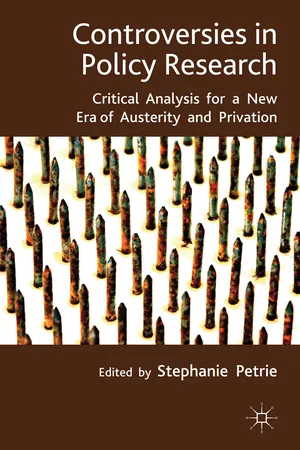
Controversies in Policy Research
critical analysis for a new era of austerity and privation
- English
- ePUB (mobile friendly)
- Available on iOS & Android
eBook - ePub
Controversies in Policy Research
critical analysis for a new era of austerity and privation
About this book
Under the themes of Justice, Participation and Social Exclusion contributors explore and discuss the impact on those targeted or excluded by important public and social policies in European countries. Contexts, consequences and controversies current in the global North are uncovered highlighting the ethical implications for policy research.
Information
1
Policy Contexts, Consequences and Controversies
Stephanie Petrie
What is ‘policy?’
Definitions of ‘policy’ are elusive but invariably concur that contemporary public and social policies are constructed within power structures in order to inform rational and consistent decision-making that ensures beneficial outcomes. For example, Torjman (2005) suggests, ‘ ... the formulation of public policy involves a process of making good decisions – for the public good (p. 18)’. This raises, of course, a number of questions such as who decides policy, who is subject to policy and what is ‘good’. Consequently it is important and thus critical to investigate policies by subjecting their genesis, implementation and evaluation to scrutiny. Whose interests are being served, whose are being overlooked and are there consequences that are unintended or hidden?
In one sense ‘policy’ is not a recent phenomenon. The purposeful organisation of community activities by the powerful to bring about specific outcomes stretches back into prehistory. England’s most iconic ancient monument, Stonehenge, is now understood to be only one part of a vast ceremonial landscape where large groups of people were brought together for ritual activities that bound them to a common and cohesive cause (University of Sheffield, 2012). Similar evidence in many countries reveals that from earliest times it has been usual for hierarchies and elites to direct the activities of groups of people to help establish and maintain their power bases necessary for social control (e.g. see Kahn and Kirch, 2011). Of course for many centuries, and still in many countries and communities, religions have been the framework within which the behaviours and interactions of people have been regulated and directed. It has always been essential for humankind to believe that they have some control, however spurious, over frightening phenomena such as eclipses and earthquakes. Consequently one reason for rituals and rules directing human behaviour was to avert environmental and human disasters. If crops failed or plagues came they were linked to a failure to observe these practices. It has been theorised that people move in natural stages from magic to religion to science (Frazer, 1922), and indeed in the West ‘science’ came to be seen as the apotheosis of human endeavour that revealed pathways to objective truths and control over many phenomena. Yet although the causes of eclipses and earthquakes are widely understood, humankind is no better able to control environmental phenomena and while the pathologies of many diseases are known ‘cures’ for some remain elusive. Personal and collective vulnerability to environmental, social and bodily catastrophe and fear of the ‘Other’ remain the prevailing discourses within which public and social policies are forged even in contemporary complex and affluent societies. The desire to make our localities safe and promote ‘well-being’1 is a strong motivating factor underpinning contemporary policies aimed at benefitting people in place and people in groups.
Policy contexts
From the 20th century onwards there has been a sea-change in the way in which knowledge is communicated, as a result of the expansion of technology and digital communication. Virtual yet immediate exposure to environmental disasters and societal breakdown of all kinds is common for many across the globe. However, the contemporary desire to promote well-being has sometimes resulted in partial and partisan use of data for political and ideological purposes rather than any public good. In some instances policies have been covert or information in the public domain misleading. The most far-reaching controversy in recent time arose from the mass of material released by Wikileaks, the whistle-blowing website (BBC, 2010). A significant revelation concerned rendition policies that permitted those suspected of terrorist involvement to be kidnapped by US and UK personnel and forcibly transported to countries where they were tortured. In these instances, policies directed the actions of military, security and administrative personnel with the intention of protecting populations from violent terrorism. Yet rendition policies were not only covert but were in direct breach of national and international laws and conventions. The horrific impacts and the unfolding negative consequences were only revealed through the exposure of secret information and the experiences of those involved (Jenkins, 2012).
Researching policy consequences
So how are policies to be analysed and over what period? How can it be determined whether or not a policy is contributing to a ‘public good’? Is there one research method that can identify rational and consistent decisions with beneficial outcomes? A dominant influence underpinning the analysis of contemporary policy in many societies is the ‘scientific method’ derived from 8th-century Islamic scholarship. This approach offers a way of defining problems and identifying solutions that is understood to ensure rigour, validity, replicability and reliability. Although the scientific method has been associated with the natural sciences, social scientists, from Comte in the 19th century (who first defined sociology as social physics) to Durkheim in the 20th century, have been influenced by this approach. Rigorous observation of phenomena and subjecting empirical data gathered to quantifiable testing using logical and mathematical tools came to be seen in the 20th century as gold standard of research and analysis, and evaluation of policies have drawn on this method too (Becker et al., 2006).
Yet science, as well as policy, is a slippery concept that has changed over time. Historically, knowledge studied in the West in religious and later in academic institutions by male elites was considered ‘scientific’ and included disciplines such as Music and Ethics, now seen as Arts subjects. Alchemy and Astrology were also included as serious subjects worthy of scientific study – a very different perspective from 20th-century understanding of science as the prominent English economist Keynes pointed out. ‘In 1947 the economist John Maynard Keynes shocked the academic world by announcing that “Newton was not the first of the age of reason. He was the last of the magicians” ’ (cited in Fara, 2010: 121; see also for a detailed discussion of the history of science). Practical learning connected with crafts, such as the construction of buildings or equipment, was considered to be of a lesser order – knowledge derived from technology rather than science. It was only with developments such as electro-magnetism in the 19th century that the separation of Arts and Sciences as understood in contemporary times began to be solidified. Within a century, however, the associated belief that science can identify certainties and universal laws can be uncovered began to be questioned by 20th-century scientists with the development of quantum mechanics and application of probability theory (Farmelo, 2010). The Second World War (1939–45) and the construction of the atom bomb, resulting from the research of scientists from many nations into the nature of matter, further undermined the notion that science can be an objective route to a ‘truth’ without moral or ethical complexities. Jim Al-Khalili, Professor of Theoretical Physics and Chair in Public Engagement in Science at the University of Surrey in the United Kingdom, said that the days of the naive scientist are over. Scientists are now more aware of the need to take moral and ethical responsibility for the consequences and policy applications of their research (The Guardian, 2012a). It is ironic that as the natural sciences have returned to ambiguities and relativities, public and social policies are still expected to deliver certainties and solutions. It seems then that in some ways contemporary times are still characterised by belief systems that offer apparent safety from dangerous phenomena – although these beliefs now rest on economic theories rather than spiritual constructs. According to Nelson (2001) economic progress has become the religion for contemporary times, offering protection from dangers that could overwhelm societies:
The most vital religion of the modern age has become economic progress ... . By promoting a culture of civic commitment to the market system, economists have put the power of religion to work in fending off these newer temptations of a modern kind of ‘devil’. (p. 331)
Policy controversies and austerity politics
Social and public policies forged in the latter half of the 20th and first decade of the 21st centuries have been characterised by the domination of neo-liberal economics allied to centre-right political systems in an increasing number of countries. Chang describes this trend as an ‘unholy alliance between neoclassical economics, which provided most of the analytical tools, and what may be called the Austrian-Libertarian tradition, which provided the underlying political and moral philosophy’ (Chang, 2001: 5). In the latter years of the first decade of the new millennium, governments of country after country have informed their citizens that a period of austerity is now necessary leading to cuts in welfare, health, education and other public-sector services. These policies triggered mass protests and civil unrest especially in Europe. In February 2012 ahead of an European Union (EU) summit aimed at boosting economic growth and tightening fiscal responsibility, students, trade unionists and citizens across Spain, France, Greece, Portugal and Belgium held protest rallies against the policies of austerity (BBC, 2012). The United Kingdom had already been rocked by urban riots in the summer of 2011 (The Guardian, 2012b) and regular student demonstrations against increased university fees (The Guardian, 2011). Financial institutions such as the International Monetary Fund (IMF) imposed market requirements on developing countries as a condition of loans to governments and similar strictures were placed on member countries judged to be failing economically by their financially robust peers in the EU. In 2012 cataclysmic reverberations throughout the EU threatened the future of the Euro as a common currency. The dominant economic policy driven by Germany was increasingly challenged as an affront to national political autonomy as the party spokes-person for the newly elected French President, Françoise Hollande, commented, ‘We didn’t have an election to get a European president called Mrs Merkel who has the power to decide everyone else’s fate’ (Trayner, 2012).
Neo-liberal economic theories have become the leading determinant factors in public and social policies, developed and implemented by many states for their citizens and has led to an unprecedented period of widespread economic instability described by Shiller (2008: 9) as:
... a historic turning point in our economy and our culture ... , the result of the deflating of a speculative bubble in the housing market that began in the United States in 2006 and has now cascaded across many other countries in the form of financial failures and a global credit crunch.
Jenks’ (2003: 3) concept of ‘transgression’, ‘ ... conduct which breaks rules or exceeds boundaries’ could well be applied to the behaviour of the bankers and financiers operating a derivatives market on an international scale that led to the worst global financial crisis since the great depression of the 1930s, also triggered by financial speculation in the United States. The evidence used to demonstrate economic ‘progress’ relies on statistical and quantifiable data yet, as Nelson suggests, the practice of neo-liberal economics is ideological not technical in nature. The complicity between unregulated lender/trader enterprises in the United States and United Kingdom has been savagely criticised as representing a moral and ethical malaise rather than simply a technical failure of one part of the global financial market (Gowan, 2009).
It has been argued that an inevitable consequence of neo-liberal economic policies has been not only an increase in world poverty as a result of the global recession but also a growing gap between the rich and poor in affluent societies with adverse consequences for all citizens (Dorling, 2011).
In recent years comparative statistical studies of health and well-being indicators relating to children and young people in more than 20 affluent countries have been undertaken on behalf of organisations such as UNICEF (2007), CPAG (2009) and the OECD (2009). Not surprisingly the United Kingdom and the United States have higher rates of teenage pregnancy; young people not in education, employment or training and child poverty than most countries sampled. Wilkinson and Pickett (2009) analysed data from 21 developed countries and different American states. Findings reveal a correlation between the level of economic inequality in each country (or state) and a range of outcomes such as mental illness, life expectancy, murders, imprisonment rates and social mobility. They argue that the greater the gap between the affluent members of a society and the poor, the greater the incidence of mental ill-health, homicides, acquisitive crime and so on. Rosenfeld’s study in the United States (2009) examined the relationship between economic conditions and street crimes committed for monetary gain and the effect of changing economic conditions on violent crime. Acquisitive crime and homicide rates between 1970 and 2006 were analysed and findings revealed that the economy stimulates violent crime indirectly through its effect on acquisitive crime.
McKee and Stuckler (2011) point out that although categorisation and vilification of the ‘undeserving’ poor is not new, there is now a growing body of evidence that shows this has significant and measurable negative social consequences for all. Their 2009 study analysed mortality, employment, GDP and social security expenditure data from 26 EU-countries from 1970 to 2007. The findings revealed that for every 1 per cent rise in unemployment, suicides and homicides rose by 0.8 per cent. When employment fell by 3 per cent or more, suicides leapt by 4.4 per cent and homicides by 6 per cent (Stuckler et al., 2009). Dorling’s comparative analysis of key health and well-being datasets overtime in the United Kingdom (from the early 19th century in relation to educational achievement, immigration and mortality) with comparable countries such as the Netherlands, the United States and Australia is equally stark. He concludes that the five social evils – Ignorance, Want, Idleness, Squalor and Disease – identified by Beveridge and that the UK Welfare State was established to eradicate have been superseded by six evils. These are Inequality, Elitism, Exclusion, Prejudice, Greed and Despair that have global consequences as ‘ ... want rose in many places as food prices spiked again to their highest ever levels, and absolute misery threatened billions by the start of 2011 ... Worldwide rising disease and despair was an inevitable consequence where poverty rose’ (2011: 324).
The aim of the chapters that follow then is to explore and discuss the impact on those targeted or overlooked by important public and social policies in European countries, developed, implemented and evaluated at a time of austerity. Contributors address the contexts, consequences and controversies current in the global North and argue that there are ethical implications for policy research and the role of the academic.
Policy research: methods and motives
Contributors to this book include experienced academics and those at the beginning of their careers who have used different methods to interrogate their chosen policy area. Each chapter outlines the methodological approach used and how this was applied to policy research. Methods include theoretical and statistical analysis, ethnography, cognitive mapping, participatory research, empiri...
Table of contents
- Cover
- Title Page
- Copyright
- Contents
- List of Figures and Tables
- Notes on Contributors
- 1. Policy Contexts, Consequences and Controversies
- Section I: Justice
- Section II: Participation
- Section III: Social Exclusion
- Index
Trusted by 375,005 students
Access to over 1.5 million titles for a fair monthly price.
Study more efficiently using our study tools.
Frequently asked questions
Yes, you can cancel anytime from the Subscription tab in your account settings on the Perlego website. Your subscription will stay active until the end of your current billing period. Learn how to cancel your subscription
No, books cannot be downloaded as external files, such as PDFs, for use outside of Perlego. However, you can download books within the Perlego app for offline reading on mobile or tablet. Learn how to download books offline
Perlego offers two plans: Essential and Complete
- Essential is ideal for learners and professionals who enjoy exploring a wide range of subjects. Access the Essential Library with 800,000+ trusted titles and best-sellers across business, personal growth, and the humanities. Includes unlimited reading time and Standard Read Aloud voice.
- Complete: Perfect for advanced learners and researchers needing full, unrestricted access. Unlock 1.5M+ books across hundreds of subjects, including academic and specialized titles. The Complete Plan also includes advanced features like Premium Read Aloud and Research Assistant.
We are an online textbook subscription service, where you can get access to an entire online library for less than the price of a single book per month. With over 1.5 million books across 990+ topics, we’ve got you covered! Learn about our mission
Look out for the read-aloud symbol on your next book to see if you can listen to it. The read-aloud tool reads text aloud for you, highlighting the text as it is being read. You can pause it, speed it up and slow it down. Learn more about Read Aloud
Yes! You can use the Perlego app on both iOS and Android devices to read anytime, anywhere — even offline. Perfect for commutes or when you’re on the go.
Please note we cannot support devices running on iOS 13 and Android 7 or earlier. Learn more about using the app
Please note we cannot support devices running on iOS 13 and Android 7 or earlier. Learn more about using the app
Yes, you can access Controversies in Policy Research by S. Petrie in PDF and/or ePUB format, as well as other popular books in Social Sciences & European Politics. We have over 1.5 million books available in our catalogue for you to explore.