- English
- ePUB (mobile friendly)
- Available on iOS & Android
eBook - ePub
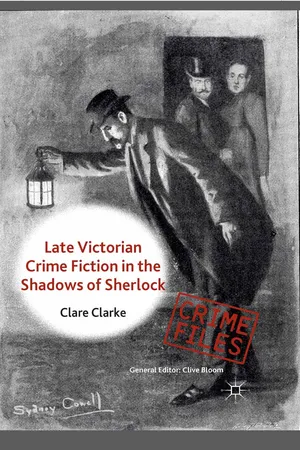
Late Victorian Crime Fiction in the Shadows of Sherlock
About this book
This book investigates the development of crime fiction in the 1880s and 1890s, challenging studies of late-Victorian crime fiction which have given undue prominence to a handful of key figures and have offered an over-simplified analytical framework, thereby overlooking the generic, moral, and formal complexities of the nascent genre.
Information
1
‘Ordinary Secret Sinners’: Robert Louis Stevenson’s Strange Case of Dr Jekyll and Mr Hyde (1886)
Dr Jekyll is rather a worse kind of fellow than Mr Hyde.
Andrew Lang, ‘Modern Man: Mr R.L. Stevenson.’
Scots Observer 20 Jan. 1889: 264
Scots Observer 20 Jan. 1889: 264
This chapter focuses on Strange Case of Dr Jekyll and Mr Hyde (1886),1 a ‘Christmas crawler’ produced by Robert Louis Stevenson in answer to his publisher’s request for something sensational for the 1885 Christmas literary marketplace (Stevenson, Jekyll and Hyde xvii). The novel, recounting a respectable doctor’s transformation into a hideous criminal, was published in January 1886. Early reviews were extremely positive – writing in the Saturday Review, Andrew Lang called the novel ‘excellent and horrific and captivating’; likewise, for The Times it was a ‘finished study in the art of the fantastic’ comparable to classic works such as ‘the sombre masterpieces of Poe’ (Lang, ‘Stevenson’s New Story’; ‘Strange’). Indeed, it created an immediate sensation – selling over 40,000 copies in its first few months and running to seven editions. By February 1886, just one month after publication, it had already been parodied by that up-to-the-minute cultural barometer, Punch. The magazine ran a pastiche story ‘to make your flesh creep’ featuring ‘Mr Hidanseek’, a character with ‘an acquired taste for trampling out children’s brains and hacking to death … Baronets’ (‘The Strange Case of Dr T.’). In the spring of 1887 a stage adaptation opened in Boston and New York, soon moving to London, where it ran for almost two years. By June 1889 a further 29,000 copies had been sold in the UK alone and the novel had reached a sixteenth edition.
Jekyll and Hyde has since become one of the canonical texts of late Victorian literature and its story of divided selves has become so frequently retold that almost everyone feels they know the novel and all that it is supposed to symbolise. In fact, despite having taken on the quality of a ‘modern myth’, Jekyll and Hyde is an endlessly perplexing, morally and formally ambiguous generic hybrid of sensation, gothic and detective fiction which still offers much to chew on (Luckhurst vii). In this chapter I argue that the story plays a pivotal role in the development of the tropes and themes that would come to dominate later Victorian crime fiction. In particular, I focus on how Stevenson co-opted a number of contemporary late Victorian anxieties about middle- and upper-middle-class villainy, based on true crime cases such as ‘The Maiden Tribute of Modern Babylon’ (1885) that were scandalising readers in the years before Jekyll and Hyde’s composition. Specifically, Stevenson developed the tropes of both the gentleman criminal hiding behind his outward appearance of respectability – and emanating from a familiar, respectable location – and the morally ambiguous, corrupt or compromised detective which came to dominate detective fiction of the 1890s, such as Arthur Conan Doyle’s Sherlock Holmes stories, E.W. Hornung’s Raffles gentleman-criminal tales, and works by popular, if less enduring, crime writers such as Arthur Morrison, Israel Zangwill and Guy Boothby.
Despite the widespread critical enthusiasm with which Jekyll and Hyde was received, early reviewers were often uncertain what to make of its generic status, since the novel came from the pen of a rising literary star but was marketed as a lowly ‘shilling shocker’. The Times, for instance, opined that Jekyll and Hyde ‘strongly impressed us with the versatility of his very original genius’, but remarked also on its lowly publication in a ‘sparsely printed little shilling volume’ (‘Strange’). On a similar note, the January 1886 issue of The Academy complained that the novel’s ‘paper cover’ and ‘popular price’ marked Jekyll and Hyde as one of the lowest literary forms – a penny dreadful of the type that Stevenson describes in the pages of the novel itself, sold alongside ‘twopenny salads’ in a dingy Soho shop adjoining a gin palace (Noble 55; Jekyll and Hyde 8). Its ‘appearance’, then, much like the protagonists within, was ‘deceitful’, misleadingly suggesting that Jekyll and Hyde belonged to ‘a class of literature familiarity with which has bred in the minds of most readers a certain measure of contempt’ (Noble 55). The Pall Mall Gazette commented upon the relationship of Jekyll and Hyde to the burgeoning detective genre, decreeing that Stevenson’s novel was ‘not only too sensational but too literary to rank among detective stories so called’ (‘Function’ 3).
Indeed, Jekyll and Hyde’s confusing conflation of high and low genres and forms continued to trouble some of the most esteemed writers and critics of the twentieth century. Most famously, in a lecture on the novel delivered at Cornell University in March 1951, Vladimir Nabokov passionately implored his students to ‘completely forget, disremember, obliterate, unlearn, consign to oblivion any notion you may have had that Jekyll and Hyde is some kind of a mystery story, [or] a detective story’ (Nabokov, Bowers and Updike 171). For Nabokov, Stevenson’s novel belonged to the canon of great literature and to categorise it merely as detective fiction debased its elevated literary status. Detective fiction and so-called ‘low’ forms of literature have been valid objects of academic enquiry for more than 30 years, yet the generic status of Jekyll and Hyde remains critically contentious. It is largely accepted as playing a pivotal role in histories of the gothic and horror genres, but it is still often neglected by historians of the detective genre, who consider it an ‘impure’ and perplexing hybrid of generic forms (Dryden, Arata and Massie 54). Julian Symons’s Bloody Murder, for instance, suggests that Stevenson ‘hovered on the brink’ of detective fiction, but concludes that he never fully committed or contributed to the genre (62). Likewise, Stephen Knight argues that the 1880s was ‘a period of rapid expansion in both the numbers and the kinds of crime fiction published’ for which Stevenson was ‘a model’ with works such as The Suicide Club and The Dynamiter (1885) (Crime 54; Form and Ideology 68). He concludes, however, that Stevenson ‘wrote no specifically detective stories’ and remained more interested in ‘identification with the criminals’ (Form and Ideology 69; Crime 63). Similarly, the novel doesn’t feature in Ian Ousby’s genealogy of nineteenth-century crime literature (Bloodhounds), in which he argues that no significant advances were made in the Victorian detective genre between the publication of Wilkie Collins’s The Moonstone in 1868 and the first appearance of Sherlock Holmes in 1887.
In the novel, however, Stevenson does employ many of the structuring features of the nascent detective story. As its full title signals, Stevenson’s Strange Case of Dr Jekyll and Mr Hyde is formally constructed as a mystery that in many ways resembles works of pivotal importance to the burgeoning detective genre, such as Edgar Allan Poe’s ratiocinative story ‘The Murders in the Rue Morgue’ (1841) or Wilkie Collins’s sensation novel The Moonstone (1868). The medico-legal term ‘case’ itself links Stevenson’s novel with earlier pioneering works of crime fiction such as the bestselling Leavenworth Case (1878) by ‘founding mother of the detective genre’, Anna Katherine Green, and later canonical crime works such as Arthur Conan Doyle’s Case-Book of Sherlock Holmes (1927) (Sussex 2). Its epistolary format, complete with letters, diary entries and legal documents, recalls Collins’s The Moonstone and The Woman in White, and prefigures Hume’s Mystery of a Hansom Cab (1886). As Gordon Hirsch has also pointed out, the ‘three elements’ which together comprise ‘the formula for the detective story’ are all present in Stevenson’s novel – there is a mystery, the story is structured around an enquiry into this mystery and some of the concealed facts are made known at the end (229). In fact, at Jekyll and Hyde’s heart are a number of mysteries and at least two crimes. Eight of its ten chapters are concerned with unravelling the mystery of the baffling circumstances surrounding Jekyll’s will and uncovering the nature of the puzzling relationship between the respectable doctor, who is ‘the very pink of the proprieties’, and Mr Hyde, ‘a really damnable man’ (9). The narrative is also punctuated by two of Hyde’s ‘monstrous’ crimes – the ‘trampling’ of a young girl and the bludgeoning of Sir Danvers Carew, an ‘aged and beautiful gentleman’ (60).
Detection is also central to the narrative. Early in the novel, Jekyll’s lawyer and close companion, Mr Utterson, takes on the role of amateur sleuth, embarking on an investigation into the nature of the malign Hyde’s relationship with his friend: ‘If he be Mr Hyde … I shall be Mr Seek’ (14). After the Carew murder, Utterson’s amateur (and largely unsuccessful) enquiries are augmented by an (also unsuccessful) investigation conducted by Inspector Newcomen of the Metropolitan police. Despite their lack of success in ‘solving’ any of the novel’s crimes, and the novel’s disarmingly ambiguous ending, where Jekyll (or is it Hyde?) commits suicide, some of the previously concealed facts are made known at the end of the novel. We know, for instance, that Hyde was Carew’s murderer and that he was Jekyll’s alter ego, brought into being by a scientific experiment. Even the titles of the chapters themselves – ‘The Carew Murder Case’, ‘Search for Mr Hyde’, ‘The Incident of the Letter’ and ‘Remarkable Incident of Dr Lanyon’ – foreground the importance of clues, details and crimes, as well as the practices of searching and detecting, and in doing so prefigure the common features of later detective fiction.
Part of the reason that many critics have such trouble considering Jekyll and Hyde a work of detective fiction, however, may be that, despite its adherence to some of the characteristics later taken to conceptualise the genre, the novel also repeatedly disavows and disrupts some of its nascent conventions – particularly with regard to narrative resolution and the appearance of a successful, heroic detective. Despite the fact that Utterson conducts enquiries, his motivations seem misguided. He is not motivated by a neutral quest for the truth, but rather by the desire to see his friend escape scandal. Although his investigation is augmented by that of Scotland Yard’s Inspector Newcomen, the police detective’s investigations are characterised by an almost total lack of success. Newcomen drops unceremoniously out of the narrative early in the proceedings and Utterson fades away at the novel’s close. The ‘Full Statement of the Case’ is thus provided by way of the criminal’s (or is it the victim’s?) epistolary confession, rather than through a flourish of deductive skill and an exposition of the full story of the crime. In doing so, it prefigures the shock ending of Agatha Christie’s most morally and formally subversive novel, The Murder of Roger Ackroyd (1926), in which the narrator is revealed to be the murderer. However, the closure provided at the novel’s end is partial at best – Jekyll’s ‘Full Statement of the Case’ is ironically named, being marked by a distinct lack of fullness. Many of the novel’s central questions therefore remain unanswered or ambiguous at its close – what, for instance, are the ‘undignified’ and ‘monstrous’ activities that Jekyll has always enjoyed? Why did Hyde trample a child and kill Sir Danvers Carew? Did Jekyll commit suicide or was he killed by Hyde? Overall, then, this is a novel which firmly resists the impulses towards closure and resolution often read as so characteristic of the burgeoning detective genre. It seems, therefore, perfectly to illustrate Stevenson’s ambivalence to the genre, detailed in the preface to The Wrecker, where he admitted that he was both ‘attracted and repelled by that very modern form of the police novel or mystery story’ (589).
In the last few years, a growing body of scholarship has begun to challenge ideas about the ‘accepted (but overly schematic) development of detective fiction as a genre’ put forward by early historians of crime fiction (Pittard, Purity 24).2 Many early critics had argued that detective fiction was developed through a small number of canonical works featuring certain common generic features, such as a heroic detective and a satisfying resolution in which the case is solved and the status quo is restored. More recent work on detective fiction, however, has argued for the importance to the history of the crime genre of works that do not conform perfectly to these previously prescribed ‘rules’ about genre and form. In this chapter, I join a number of recent crime fiction scholars who make particular claims for the importance of Jekyll and Hyde to the genealogy of the nineteenth-century detective genre.3
In this chapter, I build upon this body of work, continuing to redress the omission of Jekyll and Hyde from studies on the detective genre, by providing a detailed demonstration of the impact of Stevenson’s novel upon the establishment of some of the formal and thematic features that would later define much of the canonical (and non-canonical) crime fiction that came to popularity in the 1890s. In particular, I suggest that the very features that make Stevenson’s novel so problematic for many historians of the detective genre (respectable criminal protagonist, unsuccessful/immoral detectives, lack of resolution) in fact link it strongly to much of the crime and detective fiction that appeared later in the century. It is important to remember that, with Jekyll and Hyde, the already popular Stevenson sealed his place as respected member of the literary establishment; it therefore makes sense that later fledgling crime writers would attempt to emulate one of his biggest critical and commercial successes by employing and pushing further the tropes and characterisations which structured that novel. Indeed, the ambiguous formal and moral features of Jekyll and Hyde can be traced in later works such as Morrison’s The Dorrington Deed-Box (1897), Zangwill’s The Big Bow Mystery (1891), Boothby’s A Prince of Swindlers (1897) and many of Doyle’s Sherlock Holmes stories, where crimes emanate from the middle classes, from geographically respectable areas, where criminals escape, commit suicide or go free, and where the detectives may be unsuccessful, or even implicated in the crimes.
Specifically, I read Stevenson’s novel in relation to changing late Victorian perceptions about the social class of criminals which had developed in light of a number of scandals featuring middle- and upper-middle-class offenders. I examine how not just Hyde but all of the novel’s group of respectable gentlemen share a penchant for sexual tourism with the protagonists of W.T. Stead’s ‘Maiden Tribute’ exposé. I unpick the related cultural contexts for the novel’s depictions of blackmail, slumming and sexual crime. I consider how the novel’s crimes were re-evaluated in light of the Ripper murders in 1888, and the ways in which its portrayal of respectable criminality was employed to bolster theories that the Ripper was a member of the middle or upper classes, perhaps even a doctor. Lastly, I examine the consequences of Stevenson’s ambivalent portrayal of detection in the novel. In particular, I read the proto-detective Utterson’s desire to subvert justice and protect his friend against dominant ideas about the moral uprightness of the Victorian detective.
In an early review of the novel, the poet and critic Andrew Lang – a great friend of Stevenson – noted what for him was the most striking feature of his associate’s latest work: ‘he has chosen the scene for his wild “Tragedy of a Body and Soul”, as it might have been called, in the most ordinary and respectable quarters of London’ and ‘his heroes (surely this is original) are all successful middle-aged professional men’ (emphases in original) (‘Stevenson’s New Story’ 55). In Lang’s view, then, the novel was just as much about the respectable middle-class Jekyll and his circle as it was about the degenerate criminal Hyde. Indeed, Jekyll and Hyde opens with Stevenson repeatedly foregrounding the respectability of Jekyll and the wider group of gentlemen with whom he associates. Their professional and bourgeois sensibilities could hardly be more clearly delineated: Gabriel Utterson, we are told, is a ‘reputable’ lawyer, Jekyll is an ‘honourable and distinguished’ doctor of both medicine and law with a string of academic qualifications – ‘M.D., D.C.L., LL.D., F.R.S., &c.’ – Hastie Lanyon is a ‘great’ doctor, Mr Guest is ‘a man of counsel,’ and the other unnamed members of the social circle are ‘all intelligent, reputable men’ (6; 55; 11; 12; 29; 19).4 As Lang’s review recognised, if Jekyll and Hyde is a discourse on a number of late Victorian anxieties about crime and degeneracy, then Stevenson emphatically situates those concerns in the ‘ordinary and respectable’ yet immoral and hypocritical world of middle-class London men (Lang, ‘Stevenson’s New Story’ 55). Indeed, as Lang was later to put it, ‘Dr Jekyll is rather a worse kind of fellow than Mr Hyde’ (‘Modern Man’ 264).
Stevenson had already begun to explore the themes of duplicity and the types of criminality found in the respectable world in earlier works such as ‘The Suicide Club’ (1878), ‘The Body Snatcher’ (1884) and ‘Markheim’ (1885). The middle- and upper-class gents who are members of ‘The Suicide Club’, and who draw lots to decide which of their number will be murdered and which will commit the crime, serve as a reminder that criminality is not only the provenance of London’s lower classes. Likewise, in ‘The Body Snatcher’, Stevenson’s fictional reworking of the Burke and Hare murders produced for the 1884 Christmas edition of the Pall Mall Gazette, the story’s criminals are all outwardly respectable doctors and medical men. Medical student Fettes’s ‘roaring blackguardly’ behaviour by night is hidden by ‘unimpeachable’ daytime professionalism and industry (79). And whilst his accomplice, the murderer Dr Wolfe Macfarlane, is ‘clever’ and ‘agreeable’, he is also ‘dissipated, and unscrupulous to the last degree’ (80). In Jekyll and Hyde, Stevenson once again situates criminal appetites within the home and body of an outwardly respectable medical man. Jekyll enjoys ‘disgrace[fu...
Table of contents
- Cover
- Title
- Copyright
- Contents
- List of Illustrations
- Acknowledgements
- Introduction
- 1 ‘Ordinary Secret Sinners’: Robert Louis Stevenson’s Strange Case of Dr Jekyll and Mr Hyde (1886)
- 2 ‘The Most Popular Book of Modern Times’: Fergus Hume’s The Mystery of a Hansom Cab (1886)
- 3 ‘L’homme c’est rien – l’oeuvre c’est tout’: The Sherlock Holmes Stories and Work
- 4 Something for ‘the Silly Season’: Policing and the Press in Israel Zangwill’s The Big Bow Mystery (1891)
- 5 Tales of ‘Mean Streets’: The Criminal-Detective in Arthur Morrison’s The Dorrington Deed-Box (1897)
- 6 ‘A Criminal in Disguise’: Class and Empire in Guy Boothby’s A Prince of Swindlers (1897)
- Conclusion
- Notes
- Bibliography
- Index
Trusted by 375,005 students
Access to over 1.5 million titles for a fair monthly price.
Study more efficiently using our study tools.
Frequently asked questions
Yes, you can cancel anytime from the Subscription tab in your account settings on the Perlego website. Your subscription will stay active until the end of your current billing period. Learn how to cancel your subscription
No, books cannot be downloaded as external files, such as PDFs, for use outside of Perlego. However, you can download books within the Perlego app for offline reading on mobile or tablet. Learn how to download books offline
Perlego offers two plans: Essential and Complete
- Essential is ideal for learners and professionals who enjoy exploring a wide range of subjects. Access the Essential Library with 800,000+ trusted titles and best-sellers across business, personal growth, and the humanities. Includes unlimited reading time and Standard Read Aloud voice.
- Complete: Perfect for advanced learners and researchers needing full, unrestricted access. Unlock 1.5M+ books across hundreds of subjects, including academic and specialized titles. The Complete Plan also includes advanced features like Premium Read Aloud and Research Assistant.
We are an online textbook subscription service, where you can get access to an entire online library for less than the price of a single book per month. With over 1.5 million books across 990+ topics, we’ve got you covered! Learn about our mission
Look out for the read-aloud symbol on your next book to see if you can listen to it. The read-aloud tool reads text aloud for you, highlighting the text as it is being read. You can pause it, speed it up and slow it down. Learn more about Read Aloud
Yes! You can use the Perlego app on both iOS and Android devices to read anytime, anywhere — even offline. Perfect for commutes or when you’re on the go.
Please note we cannot support devices running on iOS 13 and Android 7 or earlier. Learn more about using the app
Please note we cannot support devices running on iOS 13 and Android 7 or earlier. Learn more about using the app
Yes, you can access Late Victorian Crime Fiction in the Shadows of Sherlock by C. Clarke in PDF and/or ePUB format, as well as other popular books in Literature & Literature General. We have over 1.5 million books available in our catalogue for you to explore.