eBook - ePub
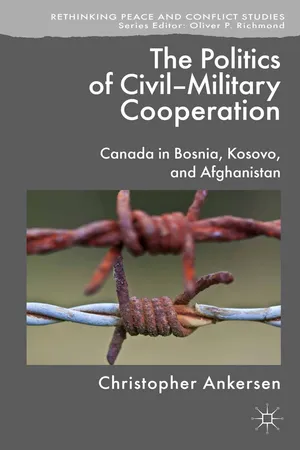
The Politics of Civil-Military Cooperation
Canada in Bosnia, Kosovo, and Afghanistan
- English
- ePUB (mobile friendly)
- Available on iOS & Android
eBook - ePub
About this book
Ankersen examines Canada's civil-military cooperation efforts in Kosovo, Bosnia, and Afghanistan through the lens of Clausewitz's 'Remarkable Trinity'. The book reveals how military action is the product of influences from the government, the armed forces, and the people at home.
Information
1
Introduction: The Politics of Civil–Military Cooperation
“There is no irony,” declared The Times editorial, “in the fact that those who are so supremely competent at war should also prove so adept at picking up the pieces after the conflict.”1 Speaking of the efforts of the British army following the combat phase of Operation Iraqi Freedom (the US-led coalition’s intervention into and occupation of Iraq), the stoic editors captured, but failed to adequately resolve, the tension inherent in contemporary military ‘stability’ operations. There is something ironic in having soldiers act as peacebuilders, calling upon them to combine the management of violence with humanitarian relief, social development, and economic renewal.
An earlier war occasioned a similar juxtaposition. In 1999, during Operation Allied Force (NATOs bombing campaign over The Federal Republic of Yugoslavia) Prime Minister Tony Blair visited the Alliance headquarters to see the staff and thank them for their efforts. He wanted to let the officers know that he appreciated not just “the military actions, but also the humanitarian work”2 that NATO was conducting in Kosovo, Serbia, and Albania. What an odd thing to say—the juxtaposition of high-level bombing and caring for refugees jangles our senses. How could the occasion arise whereby an organization designed with warfighting in mind, was not only carrying out so-called ‘humanitarian tasks’, but doing so while applying overwhelming and destructive military force at the same time?
In Afghanistan, as a way of extending Western military control over the country, several Provincial Reconstruction Teams (PRTs) have been established, each comprising civilian development experts and military personnel. Jointly these professionals engage in a variety of activities, ranging from monitoring the security situation to (re)building infrastructure and advising on matters of governance and security sector reform. These civil–military teams are seen as a vital component of success within Afghanistan, achieving the dual aim of improving the situation of the local population as well as overseeing and pacifying them. However, the controversy surrounding civil–military cooperation has reached new heights in Afghanistan. During the air campaign of early 2002, American forces were chastised for dropping food as well as ordnance; much of the food was unsuited to the needs of the Afghan population and the yellow colour of the packages could be confused with unexploded components from cluster bomb units (CBUs), often with catastrophic results. Furthermore, in a press release explaining their withdrawal from Afghanistan, the international relief non-governmental organization (NGO) Médecins Sans Frontières (MSF) blamed US civil–military cooperation practices for an increase in the level of violence against aid workers in the country. American soldiers were operating out of white vehicles and wearing civilian clothes, distributing food and medicine. MSF believes they went beyond ‘winning the hearts and minds’ of the Afghans, using aid as a lever to gain intelligence and cooperation in return for food.3 The military, according to MSF, endangered aid workers by confusing the distinction between humanitarian relief and more instrumental military activities.
This confusion of role has been felt not only by NGOs. In the Balkans, for instance, the military, “found themselves embroiled in activities—whether intentionally or otherwise—traditionally outside [their] remit.”4 A senior military officer frankly admitted “it is still difficult engaging with the staff of international organisations and NGOs … This is a two way problem.”5 On ‘both sides’ of the debate, practitioners and commentators were asking what role, if any, the ‘other’ should play in these complicated and overlapping missions.6 A review of some of the titles of recent articles reveals the extent to which civil–military cooperation is regarded as an uncomfortable practice, with observers remarking on its ‘impossible necessity’,7 likening it to ‘herding cats’,8 speaking of ‘uncertain partners’,9 or ‘strange bedfellows,’10 and commenting on a relationship plagued by ‘cultural dissonance’.11 In sum, as Michael Pugh notes, “the certainties of military and civilian roles … have become hazy”.12
Key terms and concepts
Hazy or not, the performance or coordination of humanitarian- or development-related tasks by military personnel, known (within NATO countries at least) by the military term ‘civil–military cooperation’ (or CIMIC as it is abbreviated) is a characteristic of contemporary military operations. Civil–military cooperation can be defined as,
All measures undertaken between commanders and national authorities, civil, military and para-military, which concern the relationship between [military forces], the national governments and civil populations in an area where … military forces are deployed or plan to be deployed, supported, or employed. Such measures would also include cooperation and co-ordination of activities between commanders and non-governmental or international agencies, organizations and authorities.13
I will use the term civil–military cooperation (and its acronym CIMIC), throughout this book because it is the current term of art, despite the fact that it is problematic for two important reasons. First, the term is a value-laden one, in that it assumes a degree of cooperation or partnership that is by no means universally present. However, it is the term most used by the participants themselves, especially in military and government circles. Other authors have used other terms such as ‘civil–military interactions’ and ‘civil–military relations’.14 These terms eschew the normative assumptions of ‘civil–military cooperation’ but they are not widely known (not to mention recognized or adopted) by the military organizations conducting the activity in question.
Second, the term connotes collaboration or coordination of, not necessarily direct involvement in, a range of activities. This does not accord with the practice of contemporary civil–military cooperation. As Donna Winslow notes, “military mandates have become wider and more ambiguous and the tasks more multi-dimensional and multi-functional.”15 I intend to use civil–military cooperation in its widest possible sense, noting the term ‘all measures’ in the definition provided above. Civil–military cooperation, then, describes those practices where elements of armed forces coordinate or engage with civilian entities, such as local authorities or other government agencies; NGOs, international/intergovernmental organizations; and local populations. This practice takes place during some form of crisis situation, whether it be after a natural disaster, during or after a war, or, increasingly, during complex peace support and stability operations. It can not only take the form of contingency planning or the high-level coordination of resources and objectives but can also manifest itself as aid delivery or reconstruction activity by military forces, with or without the involvement of other agencies or organizations. Paradoxically, civil–military cooperation does not always involve cooperation at all.
It is important to note here that to understand the full dimension of civil–military cooperation it must be examined not merely as an idea, a theory, or a doctrine, but rather as a practice. Doctrine is important, of that there can be no doubt. As John Gooch rightly states, “doctrine is the bridge between thought and action. It interprets the higher conceptualization of war, embodied in strategic theories and operational plans, into working guidelines for action. In a word, doctrine articulates war.”16 Christopher Lord further highlights the importance of doctrine by reminding us that “doctrine ideally combines experience … in a balanced and reasoned whole, in such a manner as to provide a framework of understanding … Military doctrine … is a curious hybrid of analysis and folk wisdom, tradition and careful innovation.”17
However, an investigation that looked solely at doctrine would only examine part of the picture. In terms of Gooch’s metaphor, by looking only at the bridge of doctrine, and not the abutments critical to its existence (namely thought and action), much would be lost. This is extremely important in an area where, as we shall see, doctrine is sparse—and not necessarily followed. Lord is correct when he states that ideally doctrine combines a number of important pieces of information. The reality can be far from ideal, however; doctrine is often unconnected from operational requirements and may not reflect ‘what actually happens’. As Dominick Donald helpfully points out “doctrine can only achieve so much; the best doctrine is of no use at all if soldiers, or their political masters, will not apply it.”18
My focus, then, is on civil–military cooperation as practice, incorporating its ideas, its doctrine, and its actions. This reflects Iver Neumann’s assertion that examining only “textual approaches … brackets out the study of other kinds of action, and so cannot account for social life understood as a whole.” He continues by calling for International Relations scholars to examine “not just … narrative discourse and rhetoric, but how politics is actually effected … [This] must include the analysis of practice understood as the study of social action itself.”19
One difficulty in presenting civil–military cooperation in an institutionalized form is that it connotes a coherent, well-oiled set of practices. In fact, it is not, but rather depends on “the creativity and improvisational skills of its practitioners” for its success.20 Civil–military cooperation appears highly differentiated across national approaches and variable across the geographies in which it has been deployed. Observers speak of peacekeeping missions as being ad hoc affairs21 and comment on how different personalities and perspectives have enormous effect on the conduct and outcome of such practices. For example, in Somalia, the ham-fisted and unsuccessful efforts of the US Army can be contrasted with the nuanced, and consequently more harmonious, approach of the US Marine Corps.22 Stuart Gordon states that civil–military cooperation practices are ‘highly context dependent’ and while there has been a move towards its institutionalization, it is at best incomplete:
[Western states] have begun the process of creating civil affairs-type capabilities that may, with time, enable a more structured, predictable, and enduring civil–military relationship to be created … Nevertheless … this … relationship [between military forces and aid agencies] … is likely to continue to defy predictability.23
There is no single version that has been institutionalized, but rather several coexisting brands of civil–military cooperation. Even in situations governed by a common mandate and, presumably, similar situational demands (e.g. the need to provide emergency shelter, the need to feed hungry populations) the fact that different national perspectives exist leads to a host of mission interpretations, and therefore, different civil–military cooperation practices.
This is because civil–military cooperation is not simply motivated by an overarching globally connected master narrative (whether that is neoliberalism or cosmopolitanism), nor is it an ‘objective’ response to situations on the ground. It is a reflection of the people who carry it out; civil–military cooperation is a based on the norms and expectations of those who practice it, not only of the actual soldiers but also of the collectivities (organizational, social, and political) in which they are embedded. Michael Ignatieff insists “we are more interested in ourselves than we are in the places, like Bosnia, that we take up as causes.”24 Robert Cooper has stated that a country’s foreign policy needs to “get under the domestic skin”25 to be successful. In fact, this is only partially correct: foreign policies are born of the domestic flesh that makes up a country. If we believe that the same applies to military roles and missions then this perspective can help clarify the ironic tension inherent in the notion of warfighters also being peacebuilders.
Seen in this light, military activity is a process, “a set of relationships [rather] than an individual event.”26 Even within the most hierarchical aspect of these relationships—the relationship between the government and the army—efficiency relies to a large degree on cooperation, bound up in “a complex interplay of societal, political and military interests, values, and expectations.”27 If military action results from a process of relations, and if that process is a dynamic and multi-faceted one, war cannot help but be affected. Clausewitz states that policy does not just initiate military action but also “will determine its character.”28 A contemporary example of this can be seen in the course of military operations in Bosnia. Despite desperate cries from journalists, analysts, commanders, and diplomats on the ground, Western countries were loathe to do much, as Sarajevo was torn apart, and then enclave after enclave of Bosnian Muslims were attacked and, infamously in Srebrenica, slaughtered. The people of Europe and North America may have been transfixed by the nightly news, but their passions were not sufficiently aroused to call for an immediate, robust response. Instead, their cry was that ‘something must be done’.29 Following from this sentiment, but lacking any clear vision of what that something might look like, “the head-shaking and hand-wringing of politicians [was] eventually translated into military action.”30 Born of dithering, the military action that eventually took place bore the hallmarks of trepidation, caution, and failure to act. While aerial bombing took place, the commitment of ground troops was ruled out as being too risky.31 The people, the government, and the army all play a part in creating the type of ‘war’ that occurs, be it savage and brutal or effete and ineffectual....
Table of contents
- Cover
- Title
- Copyright
- Contents
- List of Figures
- Preface
- Acknowledgements
- 1 Introduction: The Politics of Civil–Military Cooperation
- 2 Missing Pieces: Thinking about Civil–Military Cooperation
- 3 The Evolution of Civil–Military Cooperation in Peace and War
- 4 A Clausewitzian Framework for Analysis
- 5 The People: Ambivalent Supporters
- 6 The Government: Delicious Ambiguity
- 7 The Military: Ambitious Institution, Ad lib Individuals
- 8 Putting It All Together: Building an Effective Strategic Narrative
- 9 Conclusion: The Many Whys of Civil–Military Cooperation
- Notes
- Bibliography
- Index
Trusted by 375,005 students
Access to over 1.5 million titles for a fair monthly price.
Study more efficiently using our study tools.
Frequently asked questions
Yes, you can cancel anytime from the Subscription tab in your account settings on the Perlego website. Your subscription will stay active until the end of your current billing period. Learn how to cancel your subscription
No, books cannot be downloaded as external files, such as PDFs, for use outside of Perlego. However, you can download books within the Perlego app for offline reading on mobile or tablet. Learn how to download books offline
Perlego offers two plans: Essential and Complete
- Essential is ideal for learners and professionals who enjoy exploring a wide range of subjects. Access the Essential Library with 800,000+ trusted titles and best-sellers across business, personal growth, and the humanities. Includes unlimited reading time and Standard Read Aloud voice.
- Complete: Perfect for advanced learners and researchers needing full, unrestricted access. Unlock 1.5M+ books across hundreds of subjects, including academic and specialized titles. The Complete Plan also includes advanced features like Premium Read Aloud and Research Assistant.
We are an online textbook subscription service, where you can get access to an entire online library for less than the price of a single book per month. With over 1.5 million books across 990+ topics, we’ve got you covered! Learn about our mission
Look out for the read-aloud symbol on your next book to see if you can listen to it. The read-aloud tool reads text aloud for you, highlighting the text as it is being read. You can pause it, speed it up and slow it down. Learn more about Read Aloud
Yes! You can use the Perlego app on both iOS and Android devices to read anytime, anywhere — even offline. Perfect for commutes or when you’re on the go.
Please note we cannot support devices running on iOS 13 and Android 7 or earlier. Learn more about using the app
Please note we cannot support devices running on iOS 13 and Android 7 or earlier. Learn more about using the app
Yes, you can access The Politics of Civil-Military Cooperation by C. Ankersen in PDF and/or ePUB format, as well as other popular books in Politics & International Relations & European Politics. We have over 1.5 million books available in our catalogue for you to explore.