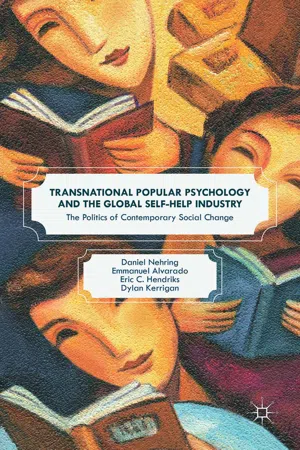
eBook - ePub
Transnational Popular Psychology and the Global Self-Help Industry
The Politics of Contemporary Social Change
- English
- ePUB (mobile friendly)
- Available on iOS & Android
eBook - ePub
Transnational Popular Psychology and the Global Self-Help Industry
The Politics of Contemporary Social Change
About this book
Self-help books aim to empower their readers and deliver happiness and personal fulfilment but do they really live up to this? This book offers a fresh perspective on self-help culture and popular psychology. Research on this subject matter has generally focused on the USA and the Global Northwest. In contrast, this book explores the production, circulation and consumption of self-help books from an innovative transnational perspective. Case studies on Trinidad, Mexico, the People's Republic of China, the UK and the USA explore the roles which self-help's therapeutic narratives of self and social relationships play in the contemporary world. In this context, the book questions the extent to which self-help fulfils its promise of individual autonomy and contentment. At the same time, it addresses debates about contemporary political change under transnational processes of cultural standardization.
Information
1
Self-Help Worlds
How to survive
A Survival Guide for Life was published in 2012 by Bantam Press in London. Bear Grylls, the book’s author, is a well-known British media personality. On his website, Grylls portrays himself as an outdoorsman, adventurer and survivalist:
Bear Grylls has become known around the world as one of the most recognized faces of survival and outdoor adventure. His journey to this acclaim started in the UK on the Isle of Wight, where his late father taught him to climb and sail. Trained from a young age in martial arts, Bear went on to spend three years as a soldier in the British Special Forces, serving with 21 SAS. It was here that he perfected many of the skills that his fans all over the world enjoy watching him pit against mother-nature. (Grylls, no date-c)
Along these lines, the story continues. A biographical sketch tells readers of free-fall parachuting accidents in Africa, journeys to remote regions – from Antarctica to the Arctic – and mountaineering expeditions to Mount Everest. It also highlights his high-profile media work for Channel 4 and Discovery Channel, claiming that the ‘Discovery Channel’s Emmy nominated TV show Man Vs. Wild and Born Survivor […] has become one of the most watched shows on the planet, reaching an estimated 1.2 billion viewers’ (Grylls, no date-c). Bear Grylls maintains his media presence through numerous channels. All of these highlight his credentials as a tough-as-nails survivalist. His Facebook page (Grylls, no date-a) shows him on what looks like a mountain top in an advertisement for the NBC television show Running Wild with Bear Grylls. YouTube carries videos with titles such as Bear Grylls eats raw snake (Grylls, 2012a). His online shop, The Official Bear Grylls Store (Grylls, no date-b), shows an image of the adventurer with raised arms, holding what looks like an alligator jaw. This online shop sells a broad range of clothing and hiking gear. Similarly, online shopping malls like amazon.com offer numerous Bear Grylls-themed items, such as the Bear Grylls Ultimate Knife, the Bear Grylls Survival Hatchet, and the Ultimate Bear Grylls Survival Pack with Multitool, Flashlight, and Fire Starter. Grylls’ books, moreover, span a variety of genres. There are, for example, his autobiography, Mud, Sweat and Tears (Grylls, 2011), True Grit (Grylls, 2013), a collection of real-life adventure stories, the exercise manual Your Life: Train for It (Grylls, 2014), and Mission Survival: Gold of the Gods (Grylls and Madden, 2008), the first part of a series of adventure novels for young adults.
Much of Grylls’ work explores survivalism in terms of the skills needed to overcome extreme and hazardous environmental conditions. It is therefore perhaps unsurprising that, in September 2014, online bookseller amazon.co.uk listed A Survival Guide for Life (Grylls, 2012b) as the number two bestseller in the rubric ‘outdoor survival skills’. A Survival Guide for Life, however, marks a noteworthy shift in Grylls’ work, in that it sets out survival strategies for ‘dangerous’ and difficult everyday situations. The book offers readers a pathway to a successful life, loosely defined through the metaphor of the dream. The book’s opening paragraphs set out the case for dreams:
Dreams are powerful. They are among those precious few intangibles that have inspired men and women to get up, go to hell and back, and change the world. […] Our job is to be the dangerous type. The one who dreams day by day and acts to make those dreams come alive and actually happen. So take some time to get this right. Go for a long walk. Think big. Think about what really makes you smile. Ask yourself what you would do if you didn’t need the money. Ask yourself what really excites you. Ask what would inspire you to keep going long after most people would quit. (Grylls, 2012b: 1)
Grylls here offers a notably individualistic vision of dreams and their pursuit. Dreams, in the sense of overarching goals and ambitions that define and motivate one’s life, appear as the outcome of introspection, and Grylls characterises them as the source of true personal fulfilment – what really makes you smile, what really excites you, and so forth. Throughout the book, Grylls then portrays the pursuit and achievement of one’s dreams as a journey whose successful conclusion relies on the cultivation of certain values and attitudes. The image he uses to depict this journey is that of a perilous trek to the top of a mountain:
The greatest journeys all start with a single step. When you stand at the bottom of a mountain, you can rarely see a clear route to the top. It is too far away and the path too twisty and hidden behind obstacles. The only way to climb the sucker is to start – and then keep putting one foot in front of the other, one step at a time. (Grylls, 2012b: 7; emphasis in original)
He sets out the values and attitudes that are needed to make it to the peak in a series of 75 short chapters with titles such as ‘To be brave, you first must be afraid’, ‘Paddle our own canoe’, ‘Failure isn’t failure’, and ‘Humility is everything’. For instance, under the heading ‘Cheerfulness in adversity’, he invokes his experiences with the Royal Marine Commandos to remind his readers of the importance of positive thinking:
The Royal Marine Commandos, with whom I worked a lot in my military days, have the phrase ‘Cheerfulness in Adversity’ as one of their founding principles – and it is a great one to live by. […] You can’t always choose your situation, but you can always choose your attitude. […] So learn from the Commandos, smile when it is raining, and show cheerfulness in adversity – and look at the hard times as chances to show your mettle. ‘Breakfast is comin’!’ (Grylls, 2012b: 246; emphasis in original)
Grylls shares his metaphor of the journey and his belief in the importance of positive thinking with numerous other self-help authors. In certain ways, there is direct continuity between Grylls’ prescriptions for a good life and those of much earlier works. Positive thinking, for instance, is central to the argument of Norman Vincent Peale’s classic and still popular The Power of Positive Thinking (1952/2003). This may be seen as an illustration of the continuing popularity of self-help texts and the persistence of well-trodden narrative paths in this genre. This continuity between self-help texts in the past and in the present is an important concern for this book, and we will explore it at several points in the following chapters.
With its survivalist tone and its emphasis on the harsh realities of life, however, Grylls’ narrative also differs markedly from those of earlier self-help bestsellers. For example, in the opening paragraph of The Power of Positive Thinking, Norman Vincent Peale promises:
This book is written to suggest techniques and to give examples which demonstrate that you do not need to be defeated by anything, that you can have peace of mind, improved health, and a never-ceasing flow of energy. In short, that your life can be full of joy and satisfaction. Of this I have no doubt at all for I have watched countless persons learn and apply a system of simple procedures that has brought about the foregoing benefits in their lives. These assertions, which may appear extravagant, are based on bona-fide demonstrations in actual human experience. (Peale, 1952/2003: 1)
While Bear Grylls does offer his readers solutions to important life problems, such easy promises of joy and satisfaction are not to be found in A Survival Guide to Life. On the one hand, this leaner, darker approach to self-help writing may be explained through the way in which Grylls has consistently marketed himself as a tough survivalist with a life full of extreme, risky and sometimes painful moments. On the other hand, his book is part of a noteworthy trend in self-help writing in an age of austerity and diminishing opportunities. In the wake of the 2008 financial crisis, the subsequent Eurocrisis, and slowing worldwide growth in the 21st century (Binkley, 2011; Davies, 2015). Instead of promising far-reaching professional success, easy get-rich-quick schemes, or lasting love, some self-help bestsellers in recent years have offered strategies for simply getting by, surviving, or opting out of society’s pressures altogether. Examples of this kind of survivalist self-help include F∗∗ck It Therapy: The Profane Way to Profound Happiness (2012) by John Parkin and Emergency: This Book Will Save Your Life (2009) by Neil Strauss, who suddenly turned to ‘survivalism’ right after having presented himself as a dating coach in The Game (2005) and Rules of the Game (2007).
A Survival Guide for Life might thus be regarded as a fairly typical contemporary self-help book. The activities of the book’s author are less easily classified, however. Bear Grylls has contributed to a wide variety of media genres, from adventure shows on TV to young adult novels, and this makes it difficult to simply describe him as a self-help writer. However, there are interesting parallels between the form of his professional activities and that of many prominent self-help writers. Like many other authors of bestselling self-help texts, Grylls has strategically promoted himself through a wide variety of media channels and public appearances. This strategic self-promotion has allowed him to consolidate the image of a tough, worldly adventurer. The products associated with his name, for instance, are consistently themed – his self-help book is titled A Survival Guide for Life, his adventure novels are titled Mission Survival, his online shop sells the Bear Grylls Survival Hatchet, and so forth. Bear Grylls has accordingly turned himself into a brand that stands for a rugged, survivalist approach to life. Self-branding allows Grylls to claim narrative authority when it comes to giving his readers advice in A Survival Guide for Life. In addition, there is a notable entrepreneurial dimension to his activities, and this brand image consistently underpins the generation of revenues from product sales and public appearances. The emphasis on survivalism and adventure in the titles of his books is just one of many obvious examples here. A Survival Guide to Life in this sense both contributes to and draws on the self-branding on which Bear Grylls’ success as an entrepreneur depends; it is as much an instrument in a commercial strategy as a self-help book.
These activities – strategic self-promotion, self-branding, the creation of narrative authority through self-branding, and the pursuit of brand-based commercial success – characterise the work of many prominent self-help authors. The ways in which self-help books are written and marketed therefore must be understood in the context of the entrepreneurial strategies of these authors, which might also be connected to ‘neoliberal governmentality’ (Binkley, 2011), and its project of shaping our emotions and moods to the pursuit of economic success. The ostensible purpose of self-help texts is to guide their readers through a range of personal troubles, from money worries to unhappy marriages. At the same time, self-help books are written and instrumentalised as part of their writers’ entrepreneurial strategies geared towards commercial success.
Our brief review of A Survival Guide to Life points to the key concerns of this book. We will explore self-help books and the work of their authors, and we will consider what self-help narratives may reveal about the social worlds in which they are written. First, we offer insight into self-help’s understudied transnational presence in a globalising world. Second, we explore the tension between, on the one hand, the cultural heterogeneity and broad (surface-level) diversity of self-help narratives and, on the other, self-help’s overwhelming political-ideological homogeneity as a (neo)liberal recipe for individual survival under conditions of hypercompetitive global capitalism.
What are self-help books?
Self-help books offer advice and guidance on a very broad range of topics, such as intimate relationships, sexuality, marriage, divorce, friendship, serious illness, weight loss, workplace relationships, professional success, financial gain, business management, and the achievement of a generally happy and fulfilling life. The narrative form of self-help texts likewise varies considerably, including, for instance, novels, parables, autobiographies, science-based narratives, and myths.
Moreover, the boundaries between self-help and other advice genres – in particular philosophical ethics, theological ethics, medical advice, and how-to guides for narrow practical tasks – often blur. One interesting example of self-help’s weak delineation as a literary genre can be found in Tom Wolfe’s 1998 novel A Man in Full. In Wolfe’s portrait of US society in the late 1990s, Conrad Hensley, a young working-class man who has fallen on hard times, comes across the writings of the ancient philosopher Epictetus (55–135 CE) and begins to rely on Stoic philosophy to get by. Similarly, the popularity of historical figures such as Sun Zi, a legendary Chinese general who may have lived in the 6th century BCE, and Niccolò Machiavelli, an Italian politician and philosopher whose work spanned the late 15th and early 16th century, has arguably been amplified recently because they have come to provide the basis for self-help books such as Dial ‘M’ for Machiavelli: Machiavellian Metaphors for Managers (Attar, 2013), The New Machiavelli: Renaissance Realpolitik for Modern Managers (McAlpine, 1997), and Sun Tzu The Art of War for Executives (Krause, 1996).
Given this ease with which self-help appropriates subject matters, narrative forms and disparate literary sources, it is useful to begin our discussion with a brief characterisation of the genre. A common and defining feature of self-help texts is that they propose a careful and systematic self-examination of certain aspects of readers’ conduct in everyday life. Consider the following paragraphs from American pastor Joel Osteen’s Become a Better You:
Each of us has an internal dialogue, an inner conversation going on with ourselves throughout the day. In fact, we talk more to ourselves than we do to anybody else. The question is, what are you saying to yourself? What do you meditate on? Positive thoughts? Empowering thoughts? Affirming thoughts? Or do you go around thinking negative, defeated thoughts, telling yourself things like ‘I’m unattractive. I’m not talented. I’ve made many mistakes. I’m sure God is displeased with me.’ That kind of negative self-talk keeps millions of people from rising higher. […]
Our internal self-dialogue should always be positive and hopeful. We should always talk to ourselves with empowering, affirming thoughts. We have to get out of the habit of thinking negative thoughts about ourselves. Don’t ever say, ‘I’m so slow. I’m unattractive. I’ll never overcome my past.’ No, get those phrases out of your vocabulary. If you make the mistake of dwelling on that junk, it will set the limits for your life. (Osteen, 2007: 121f.)
These sentences are taken from the opening pages of a chapter titled ‘Have Confidence in Yourself’. Osteen here asks his readers to scrutinise their internal conversation for ‘negative self-talk’. The purpose of such self-scrutiny is to enable readers to diagnose their condition, such as ‘thinking negative thoughts’, and to adopt new forms of conduct in order to achieve greater success in specific arenas of their lives.
In this sense, self-help books like Become a Better You propose techniques for self-control, such as constant self-scrutiny for negative thoughts. In turn, successful self-control may enable readers to gain a sense of self-actualisation, that is to say achievement and personal fulfilment to the fullest of their potential. Thus, Osteen explains that he would like his readers to ‘talk to themselves with empowering, affirming thoughts’ and avoid the ‘negative’ mode of thought that ‘keeps millions of people from rising higher’. Self-help texts therefore have clear and explicitly stated didactical objectives, and they articulate specific sets of social norms and beliefs about the nature of social life and the relationship between individual and society. With his call for positive thinking, for example, Joel Osteen draws on a much-discussed trope in US popular culture (Ehrenreich, 2009). His declaration that ‘negative self-talk keeps millions of people from rising higher’ articulates the belief that it is individuals’ attitudes that determine their chances for upward social mobility, rather than the social-structural constraints of economy, politics and culture. If this belief is accepted, pushing oneself to maintain a consistently positive attitude might indeed lead to self-actualisation, and it becomes sensible to turn positive thinking into a behavioural norm.
This suggests that self-help books are never just concerned with advising individual readers on how to improve their lives. In order for their advice to become meaningful and turn into behavioural norms, they also have to promote and convince their readers of particular beliefs about the social world. This gives self-help an important political dimension that will concern us later in this book.
Exploring self-help
In this book, we seek to offer an original perspective on self-help books and, by extension, therapeutic culture. With our analysis of self-help books, we seek to contribute to broader debates about the roles which therapeutic narratives of self and personal development play in contemporary societies and their implications for the politics of contemporary social change. Self-help books are a significant topic of sociological research because they constitute an interface between psychological, medical and religious forms of expert knowledge and public narratives of the self, self-development, and the relationships between self and society. As an genre of popular literature, they highlight the importance of therapeutic culture in the contemporary world, i.e. the role which psychological and psychotherapeutic narratives play in shaping popular understandings of self and social relationships.1
Self-help culture is highly prominent, not just in the United States, but in many countries around the globe. The size of the entire American self-help industry, including self-help books, infomercials, seminars and trainings, has been estimated to be around 10.5 billion dollars (Marketdata Enterprises, 2010: 2). The German market for self-help books has annual revenue of around 550 million euros (Börsenverein des Deutschen Buchhandels, 2015; see Chapter 3). Certain self-help bestsellers climb the charts all around the g...
Table of contents
- Cover
- Title Page
- Copyright
- Contents
- List of Tables and Figures
- Acknowledgements
- About the Authors
- 1. Self-Help Worlds
- 2. Self-Help and Society
- 3. Self-Help’s Transnationalisation
- 4. Self-Help Entrepreneurs in China
- 5. Self-Help in Crisis
- 6. Cultural Struggles, Intimate Life and Transnational Narratives
- 7. The Uses of Self-Help Books in Trinidad
- 8. The Politics of Self-Help
- Notes
- References
- Index
Trusted by 375,005 students
Access to over 1.5 million titles for a fair monthly price.
Study more efficiently using our study tools.
Frequently asked questions
Yes, you can cancel anytime from the Subscription tab in your account settings on the Perlego website. Your subscription will stay active until the end of your current billing period. Learn how to cancel your subscription
No, books cannot be downloaded as external files, such as PDFs, for use outside of Perlego. However, you can download books within the Perlego app for offline reading on mobile or tablet. Learn how to download books offline
Perlego offers two plans: Essential and Complete
- Essential is ideal for learners and professionals who enjoy exploring a wide range of subjects. Access the Essential Library with 800,000+ trusted titles and best-sellers across business, personal growth, and the humanities. Includes unlimited reading time and Standard Read Aloud voice.
- Complete: Perfect for advanced learners and researchers needing full, unrestricted access. Unlock 1.5M+ books across hundreds of subjects, including academic and specialized titles. The Complete Plan also includes advanced features like Premium Read Aloud and Research Assistant.
We are an online textbook subscription service, where you can get access to an entire online library for less than the price of a single book per month. With over 1.5 million books across 990+ topics, we’ve got you covered! Learn about our mission
Look out for the read-aloud symbol on your next book to see if you can listen to it. The read-aloud tool reads text aloud for you, highlighting the text as it is being read. You can pause it, speed it up and slow it down. Learn more about Read Aloud
Yes! You can use the Perlego app on both iOS and Android devices to read anytime, anywhere — even offline. Perfect for commutes or when you’re on the go.
Please note we cannot support devices running on iOS 13 and Android 7 or earlier. Learn more about using the app
Please note we cannot support devices running on iOS 13 and Android 7 or earlier. Learn more about using the app
Yes, you can access Transnational Popular Psychology and the Global Self-Help Industry by Daniel Nehring,Emmanuel Alvarado,Eric C. Hendriks,Dylan Kerrigan in PDF and/or ePUB format, as well as other popular books in Psicologia & Sanità, amministrazione e assistenza pubblica. We have over 1.5 million books available in our catalogue for you to explore.