
- English
- ePUB (mobile friendly)
- Available on iOS & Android
eBook - ePub
Managing the Olympics
About this book
The Olympic Games are the world's most complex and challenging sport mega-event to organize. Managing the Olympics is the first ever attempt to bring together the world's leading Olympic management researchers in one book and draws on the latest research into the management challenges faced by the organizers and key stakeholders of the Games.
Information
1
The Olympic Games: Managerial and Strategic Dimensions
The Olympics are, without doubt, the largest and most significant mega-event in the world, taking in a multitude of sports at both Summer and Winter Games every two years. Planning for and staging the Olympics is one of the most complex tasks that event organizers and project management teams will ever undertake. The ambulatory nature of the Games, moving from one Olympic city to another every four years, means that there are context-specific challenges for hosts, as well as start-up knowledge required for each event. Given the scale, scope and complexity of all this, it is surprising that relatively little research has been published about the underlying logistics, organization and operation of the Olympic Games from event and project management perspectives. The planning and delivery of such a massive enterprise, several years in the making but only two weeks by way of performance, is of substantial interest to those vested with the responsibility of Olympic hosts. Beyond that, the planning and management of the Games is also important to those who analyse the Olympics, such as academics and journalists, as well as those with an interest in learning about how they are staged, such as teachers and students.
There are now numerous academic texts devoted to the Olympic Games. Recent topical issues include the political machinations underlying bids to host the Games (including examples of corrupt practices), governance challenges and reforms within the International Olympic Committee (IOC), the growing power of multinational sponsors and their indelible role in the hypercommercialization of the Games, the question of what the Olympics bring to a host city and country in terms of legacies (and indeed whether the cost benefit ratio is positive or negative), and so on. The broad genre of ‘Olympic Studies’ now involves hundreds of academics around the world, and the volume of outputs is so vast that it is probably beyond the scope of one individual to stay abreast of all that is being produced.
This book is not a survey or critique of that vast body of scholarship, although the contributing authors are certainly influenced by it. Instead the volume has a defined goal: to critically examine the planning, management and operation of the Olympics as a mega-event. It is, in short, a discussion about how organisers might effectively deliver the Games, taking into account what can be learned from previous Olympics, as well as the emergence of models of best practice. This is an under-explored aspect of the Games, and so the book is merely a step towards gaining a more sophisticated understanding of what is required to run an Olympic mega-event. It is comprehensive, but by nature not conclusive. A selection of what we regard as core areas of Olympic programme delivery are covered: strategising and managing the legacy of an Olympic Games, planning for and delivering sport participation legacies; managing the goals of Olympic stakeholders and negotiating effective outcomes; gathering and archiving mega-event operational information and knowledge management (IKM) transfer from the Olympic Games; transport planning and management during the Games and legacies thereafter; best practice management of the Olympic sport programme and competition venues; broadcast revenues, programming and provisions for media at the Games; the logistics of marketing and sponsorship leading into and during the Olympics; and protocols associated with staging Olympic ceremonies.
A single volume cannot do justice to the vast operational repertoire required of Olympic Games organizers, but this book is designed to provide key insights as a step towards further research. In a further volume we would like to cover other important operational aspects of Olympic Games planning and delivery: examples include logistics and supply chain management, technology and new media, accreditation and ticketing management, medical risk and response protocols, safety and security management, the design and function of the athletes’ village, as well as provision for drug testing and storage of samples.
This opening chapter now provides some background discussion about the characteristics of the Olympic Games as both a mega-sport event and a mega-project. In doing so, it briefly surveys literature devoted to an understanding of how the Olympic Games are organized and managed. The chapter concludes by providing a succinct overview of the book structure, outlining the key themes discussed in each chapter.
The Olympic Games as a mega-sport event/mega-project
Mega-sport events, such as the Olympic Games and the Football World Cup, can be understood as comprising two essential characteristics (Malfas, Theodoraki and Houlihan, 2004). The first relates to the external organizing features of such events. These include aspects such as the level and intensity of media coverage generated by the event, the attractiveness of the event to international tourists and the types of impacts derived from the hosting of an event (Jones, 2001; Parent, 2005). The second characteristic relates to the internal organizing features. These encompass the elements that influence the overall complexity of the event: organizational aspects such as the size and scale of the event, its timeline and duration and the number of athletes and fans in attendance (Chappelet and Bayle, 2005).
Other mega-sport event research has also highlighted the influence of internal and external characteristics that influence the organization of such events (Frawley and Toohey, 2005, 2009; Frawley, 2010). Horne and Manzenreiter (2006), for instance, describe mega-sport events as occasions that are large enough in size and scale to impact national economies, as well as having the capability to generate significant international media coverage. Likewise, Roche (2000) has argued that mega-sport events have ‘a dramatic character, mass popular appeal and international significance’ (p. 1). In a similar vein, Waitt (2001) has stated that mega-sport events like ‘the Olympics . . . generate a euphoric mass consciousness through the excitement, civic achievement and party syndrome associated with the occasion’ (p. 251).
The Olympic Games can be considered not only a mega-sport event but also a mega-project. This stems from Leonardsen (2007), who has asserted that ‘the modern Olympic Games have become an illustrative case for what have become known as the terms “mega-event” or “mega-project”’ (p. 11). While project management literature and event management literature have evolved as separate and distinct academic fields, each with their own professional journals and theories, in recent years they have increasingly informed each other (Gold and Gold, 2008).
A mega-event project can be described in the following manner: it is an organizational activity that has ‘a specific finite task’ (Meredith and Mantel, 1989, p. 4); it is a ‘once only’ activity established to achieve a clearly defined temporally bound set of goals and objectives; projects are often ‘divided into subtasks that must be accomplished in order to achieve the project goals’ (p. 4). Lowendahl (1995) has averred that projects ‘are typically time constrained, resource constrained, oriented towards a specific and predefined goal, and involve a complex or interdependent set of activities’ (p. 347). From this perspective, the organization of an Olympic Games can be considered a ‘typical project, in the sense that it is time-constrained (with an absolute and nonnegotiable delivery date), resource constrained as to both total budget and number of employees, goal oriented, highly complex and cross functional’ (p. 348).
Successful project organization is highlighted by a number of management characteristics. These include clarity of direction and leadership provided by project managers; the establishment of performance measures and indicators; effective management that ensures the established measures are achieved; and, that the coordination of the project achieves central indicators of timing, cost and quality (Lowendahl, 1995). In relation to timing, projects often operate in an organizational life cycle that is shaped by their time-dependent characteristics. Most projects, for instance, have a starting phase, a growing phase, a declining phase and a termination phase (Meredith and Mantel, 1989). This is true of staging the Olympic Games.
In addition to the internal-management characteristics of projects, it is also important to note that their organizational life cycle often unfolds interdependently with other organizations or institutions, many of whom continue to operate post-project completion (Lesjo, 2000; Dopson, 2005). For example, projects are often completed and managed under the auspices of a parent organization, which may be responsible for managing a number of projects simultaneously (Meredith and Mantel, 1989). For instance, the IOC, as the parent and governing body of the Olympic Movement (OM), is permanently responsible for overseeing the organization of multiple Olympic Games, even though it outsources stage management to host cities. The complexity and challenges of managing multiple projects at any one point in time is often fertile ground for the development of organizational tensions (Flyvbjerg, 1998). As Lowendahl (1995) has put it, projects are often characterized by ‘conflict over project resources and leadership roles when it comes to solving project problems’ (p. 348).
In synthesizing the mega-sport event and the project management literature, the organization of an event the size of the Olympic Games is shaped and impacted by both internal and external organizational characteristics. These include external elements such as the global economy, media exposure, tourism attractiveness and event impacts and legacies (i.e. social, economic and environmental). Internal organizationalfeatures include the size and scale of the event (i.e. number of athletes, fans, employees, etc.), the event duration, the available event resources, the goals and objectives of the event, the effectiveness and leadership of the event management team and the interdependence of the event organizers on other stakeholders (Malfas et al., 2004). These features and their relevance to the management and organization of the Olympic Games are explored throughout this book.
The growth of the Olympic Games: From event to mega-sport event
A key feature of the modern Olympic Games, since it was first staged in Athens in 1896, is that it has been held in many different cities and nations worldwide. While the early Summer Olympic Games were staged between the continents of Europe and North America, the event has rarely been staged in the same continent consecutively (Toohey and Veal, 2007). This sharing of the Games across continents, especially over the past 50 years, is a key reason why the Games have become highly popular (Preuss, 2007). The Summer Olympics of 1996, 2000, 2004 and 2008, for example, were staged in different continents. The Olympic Games are therefore an ambulatory mega-sport event, continually moving from one location and cultural context to another (Roche, 2000).
The work of historian Alan Guttmann suggests that the transformation of the Olympic Games from a humble sport event into a mega-styled project did not occur overnight. Rather, the event developed and changed at various speeds over time. The early organizers of the Olympic Games, for instance, did not have access to substantial financial resources. Consequently, a number of the early Games utilized existing stadia and infrastructure and in many cases were held in conjunction with other events, such as the World Fairs (Guttmann, 2002). In recent times, however, the Games have grown so much in size and scale that the task of managing them has become highly complex and challenging (Chappelet, 2002).
The past 30 years have also witnessed an increase in the number of sports contested at the Games, and consequently the number of participating athletes. The organizers of the Sydney 2000 Olympic Games provided facilities and services for nearly 11,000 athletes and 5000 team officials, competing across 28 sports for 300 gold medals (SOCOG, 2000). By comparison, the 1896 Athens Olympic Games consisted of 241 (male) athletes who competed across nine sports for 43 Gold Medals (IOC, 2008). Table 1.1 shows the rate of growth of the Olympics between the 1984 Los Angeles Olympic Games and the Beijing 2008 Olympic Games.
Table 1.1 The growth of the Summer Olympic Games (1984–2000)
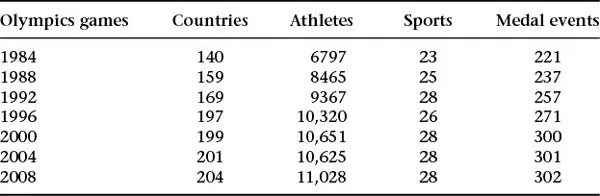
Source: Adapted from the IOC (2012).
A more recent factor that has influenced the size and scale of organizing and hosting the Games, as well as the increasing complexity of the task faced by Olympic host cities, is the responsibility for staging both the Olympic and Paralympic Games. Since 1988, the Olympic Games and the Paralympic Games have been staged alongside one another, with the Paralympics starting approximately two weeks after the Olympic Closing Ceremony. This dual mega-sport event organization has been strengthened in recent years, with the IOC and the International Paralympic Committee (IPC) signing an agreement to continue their strategic alliance and event cooperation (Cashman and Darcy, 2008).
As a consequence of staging the two events, Olympic organizers now provide facilities and venues that are designed to service both Games. The organizers are required to provide competition venues for 26 Olympic sports, while also ensuring that 20 Paralympic sports can be staged either in the venues built for the Olympics or in additional and specifically designed Paralympic facilities (IOC, 2012). Apart from the sport competition venues, a range of non-sport facilities need to be provided for both Games, including infrastructure like the Athletes Village, the Officials Village, the Media Village, the Main Press Centre and the International Broadcasting Centre (Toohey, 2001).
Another concomitant feature that highlights the growth of the Olympic Games and mega-sport events is media coverage. In recent years, this feature of the Games has been researched by the likes of Rowe (1999) and Whannel (2005). Evidence of the ‘mass’ global interest in an event like the Olympic Games is highlighted by the size of the international television audiences that consume the fortnight of sport competition. The Athens Olympic Games, for example, attracted a television audience of approximately 3.9 billion people, making it the largest sport or non-sport event watched anywhere in the world in 2004 (IOC, 2008). In addition to the Olympic Games, other mega-sport events that have attracted large media audiences include the Football World Cup, the Rugby Union World Cup, the Cricket World Cup, the World Championships of Athletics, the World Swimming Championships and larger regional competitions such as the Pan-American Games, the European Football Championships, the Asian Games and the Commonwealth Games (Horne and Manrenreiter, 2006).
With the increase in media interest in mega-sport events over the past 30 years, largely as a consequence of the development and availability of new broadcast technologies, the flow of ...
Table of contents
- Cover
- Title Page
- Copyright
- Contents
- List of Tables and Figures
- Acknowledgements
- Notes on the Contributors
- 1. The Olympic Games: Managerial and Strategic Dimensions
- 2. Olympic Games Stakeholder Governance and Management
- 3. Information, Knowledge and the Organization of the Olympic Games
- 4. Managing Legacy
- 5. Managing Sport Participation Legacy at the Olympic Games
- 6. Managing Sport at the Olympic Games
- 7. Managing Olympic Venues
- 8. Managing Transport during the Olympic Games
- 9. Broadcasting the Olympics
- 10. Investigating Olympic Sponsorship: A Contemporary Review of Selected Activation and Achievement
- 11. Olympic Ceremonial, Protocol and Symbolism
- 12. Managing the Games: Prospects for the Future
- Index
Trusted by 375,005 students
Access to over 1.5 million titles for a fair monthly price.
Study more efficiently using our study tools.
Frequently asked questions
Yes, you can cancel anytime from the Subscription tab in your account settings on the Perlego website. Your subscription will stay active until the end of your current billing period. Learn how to cancel your subscription
No, books cannot be downloaded as external files, such as PDFs, for use outside of Perlego. However, you can download books within the Perlego app for offline reading on mobile or tablet. Learn how to download books offline
Perlego offers two plans: Essential and Complete
- Essential is ideal for learners and professionals who enjoy exploring a wide range of subjects. Access the Essential Library with 800,000+ trusted titles and best-sellers across business, personal growth, and the humanities. Includes unlimited reading time and Standard Read Aloud voice.
- Complete: Perfect for advanced learners and researchers needing full, unrestricted access. Unlock 1.5M+ books across hundreds of subjects, including academic and specialized titles. The Complete Plan also includes advanced features like Premium Read Aloud and Research Assistant.
We are an online textbook subscription service, where you can get access to an entire online library for less than the price of a single book per month. With over 1.5 million books across 990+ topics, we’ve got you covered! Learn about our mission
Look out for the read-aloud symbol on your next book to see if you can listen to it. The read-aloud tool reads text aloud for you, highlighting the text as it is being read. You can pause it, speed it up and slow it down. Learn more about Read Aloud
Yes! You can use the Perlego app on both iOS and Android devices to read anytime, anywhere — even offline. Perfect for commutes or when you’re on the go.
Please note we cannot support devices running on iOS 13 and Android 7 or earlier. Learn more about using the app
Please note we cannot support devices running on iOS 13 and Android 7 or earlier. Learn more about using the app
Yes, you can access Managing the Olympics by S. Frawley, D. Adair, S. Frawley,D. Adair in PDF and/or ePUB format, as well as other popular books in Business & Business General. We have over 1.5 million books available in our catalogue for you to explore.