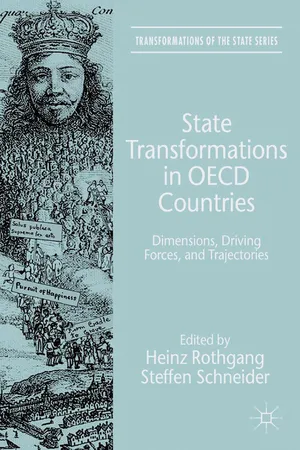
eBook - ePub
State Transformations in OECD Countries
Dimensions, Driving Forces, and Trajectories
- English
- ePUB (mobile friendly)
- Available on iOS & Android
eBook - ePub
State Transformations in OECD Countries
Dimensions, Driving Forces, and Trajectories
About this book
The democratic nation state of the post-war era has undergone major transformations since the 1970s, and political authority has been both internationalized and privatized. The thirteen chapters of this edited collection deal with major transformations of governance arrangements and state responsibilities in the countries of the OECD world. A unified conceptual and explanatory framework is used to describe trajectories of state change, to explain the internationalization or privatization of responsibilities in the resource, law, legitimacy and welfare dimensions of the democratic nation state, and to probe the state's role in the today's post-national constellation of political authority. As the contributions show, an unravelling of state authority has indeed occurred, but the state nevertheless continues to play a key role in emerging governance arrangements. Hence it is not merely a 'victim' of globalization and other driving forces of change.
Information
Topic
Ciencias socialesSubtopic
Política comparadaPart I
Introduction
1
Explaining State Transformations: A Framework
Steffen Schneider and Heinz Rothgang
The claim that the end of the Cold War not only brought about the ‘end of history’ – the global triumph of capitalism and liberal democracy (Fukuyama 1992) – but also, and perhaps ironically, the ‘end of the nation state’ was commonplace in the final years of the twentieth century. Today, such obituaries – whether couched in terms of regret (Guéhenno 1995) or of unconcealed joy about the presumptive withering away of the state (Ohmae 1996) – appear rather premature. ‘The reports of my death are greatly exaggerated’, a very lively Mark Twain (1835–1910) cabled from London to the United States in 1897 – and that also holds for reports on the ‘death of the state’. In the wake of the global financial market and economic crisis after 2008 (Kahler and Lake 2013), the state is now often seen as having experienced a spectacular revival, and its return is even hailed by some (Leibfried 2008; Heinze 2009).
This extreme swing of the analytical pendulum between obituaries in the ‘roaring nineties’ (Stiglitz 2004) and sudden resurrection in the new Great Recession of the 2000s is partly due to a lack of precision in the description of the state and its transformations. In this volume, we submit that an adequate conceptualization of state change requires, first of all, the concentration on a specific historical form of the state – as different state types may undergo different types of change – and, at the same time, a disaggregated view of state dimensions and related governance functions. Moreover, state transformations have to be distinguished from a mere change of government policies. Therefore we focus on the state model that developed in the OECD (Organisation for Economic Co-operation and Development) world during the first three decades after the Second World War – the ‘Golden Age’ of the democratic nation state (Hurrelmann et al. 2007) – and on the transformations experienced by this state type since the 1970s (Leibfried et al. 2015, Part III).
Using this benchmark, it is readily apparent that there have indeed been important transformations of the state and its individual dimensions. Thus we differ from authors who argue that the retreat of the state – the erosion of state autonomy and capacity – is a myth (Weiss 1998; Krasner 2003; Sørensen 2004). Undeniably, the scope and nature of the state and its activities have changed in the last decades. These transformations – as well as their varying scope and nature in different countries and state dimensions – need to be explained. The transformations may notably have been induced by economic globalization, demographic change or other secular trends (Held et al. 1999; Huber et al. 2015b). The popular conception of a globalization-induced erosion of state functions is, however, inadequate. It seems more accurate to carefully consider the overall picture of emerging ‘global governance’ arrangements in the ‘post-national constellation’ of today’s political world and the state’s role in them (Habermas 2001; Dingwerth and Pattberg 2010; Genschel and Zangl 2014; Leibfried et al. 2015, Part II). The shifts of political authority to international organizations and regimes or to private and transnational governance arrangements that are implied in the term ‘post-national constellation’ need to be viewed as a complex, multifaceted set of transformations rather than as a mere erosion of state capacity and an across-the-board retreat of the state (Evans 1997; Strange 2009), and by no means as the end of the state (on the internationalization and privatization of political authority, see Barnett and Finnemore 2004; Slaughter 2004; Milner and Moravcsik 2009; Cerny 2010).
In order to provide a framework for the explanation of state change, this chapter first describes what has to be explained, that is, the kinds of state transformations observed in the OECD world in the last decades. Once the question what it is that requires explanation is resolved, we discuss extant literature on the state and identify the major theoretical approaches that may be used to explain its transformations as well as diverging trajectories of stability and change. Based on these theories, we move on to develop an explanatory framework that underpins the remainder of the volume. Such a framework has to avoid the pitfalls of monocausal and deterministic explanations; rather, it has to take into account a number of distinct independent and intervening variables. The chapter finishes with an outline of the book.
What is to be explained?
In order to give an accurate picture of state transformations and to clarify the explananda of the following empirical chapters, we turn away from essayistic and overly general approaches to the state per se. Instead, we focus on one particular type of state, namely, the modern state form that developed in Western democracies after the Second World War and flourished until the early 1970s.1 In order to describe this Golden Age state and explain its transformations during the subsequent ‘Silver Age’ (Taylor-Gooby 2002), we first introduce a four-dimensional model of this state type – the ‘TRUDI’ model – which refers to separate dimensions of the modern state and to governance functions assumed, or public goods and services produced, in each of them; we then sketch the transformations of the TRUDI state.
The TRUDI model of the modern state
The modern state arguably has four core functions. First of all, as a sovereign territorial state (T) it enjoys what Max Weber (1978) famously called the monopoly on the legitimate use of coercion – using the military and the police, and ultimately relying on its largely unchallenged sovereignty (Biersteker 2002), to ensure foreign and domestic security and to extract revenue from its population (Tilly 1993). Second, as a constitutional state, it guarantees the rule of (an exclusively nationally embedded) law (RU). Third, as a democratic state, it ensures legitimacy through democratic (D) procedures and decision-making institutions. Finally, as a welfare state, it provides for the welfare of the nation through state intervention (I) into economic and social affairs, thus securing efficiency and social justice. Henceforth, we will refer to the resource, law, legitimacy and welfare dimensions of the state and use the TRUDI acronym to denote this particular state form (Leibfried and Zürn 2005, 3; Huber et al. 2015b; Levy et al. 2015).
The most striking characteristic of the TRUDI state in its Golden Age was that the production of goods and services in the outlined dimensions was concentrated at the nation state level; in the OECD world up until the early 1970s, the state therefore had all but a ‘monopoly’ on the production of foreign and domestic security, the rule of law, the legitimacy of political authority and welfare (Deitelhoff and Steffek 2009; Nullmeier 2009).
In the Golden Age, the state’s powerful position and the relative self-containedness of national economies also enabled it to choose among different pathways in assuming its functions. Gøsta Esping-Andersen’s (1990) already classic notion of ‘three worlds of welfare capitalism’ and the even more encompassing ‘varieties of capitalism’ perspective (Hall and Soskice 2001) both underline the variation of governance arrangements and policies that was possible in the TRUDI context. It is not necessary to modify the concept of TRUDI to acknowledge different types of welfare capitalism precisely because the differences correlate with the state’s prominent role in the post-war decades, which in turn was a prerequisite for the welfare regimes and functions that are a key dimension of the TRUDI model. Conversely, the persistence of varying welfare regimes may be interpreted as evidence for the continued strength of TRUDI and the freedom of state actors to choose a specific regime form, whereas a blurring of regimes and the convergence of policies would indicate a loss of state autonomy and capacity (see, for instance, van Kersbergen 2000; Schwartz 2001; Rothgang et al. 2006).
State transformations in the Silver Age
Since the mid-1970s, the TRUDI state has been under increasing pressure. Developments such as globalization and economic crises, rising public debt and the end of full employment, changing demographics, shifts in work and family patterns, and the emergence of ‘new social risks’ jeopardize the arrangements and government functions described above. The transformations fostered by these developments may occur in two distinct dimensions: organizational and territorial. On an organizational axis, we may observe shifts of the capacity to act ‘out’ to the private sector. Much of the literature in the 1990s and the early years of the twenty-first century focused on (the extent of) retrenchment, cuts in the welfare state and the privatization of state functions writ large (Huber and Stephens 2001; Pierson 2001; Gilbert 2002; Castles 2004; Hays et al. 2005; Swank 2005). On a territorial axis, competencies formerly entrusted to the nation state may move ‘up’ to the international level, for instance, to the European Union or the World Trade Organization (WTO; for an overview, see Zangl 2005). Moreover, even where political authority legally remains at the national level, its use may be effectively restrained by the competitive logic and the race-to-the-bottom mechanism of economic competition, leading to a hollowing out of the state.
So, what has happened to the TRUDI model in the age of globalization and ‘permanent austerity’ (Pierson 2001)? To what extent has this state form lost its competencies and overall leverage? Where has political authority shifted – ‘out’ to (national) private actors (privatization), ‘up’ to public international actors (internationalization) or, in a twofold move, to private international actors (transnationalization, see Dingwerth 2007; Abbott and Snidal 2009; Albert et al. 2009 as well as Chapters 4 and 7 in this volume)? What is the role of the state in the post-national constellation? Has the TRUDI model been replaced by a new state form? To what extent has the state been a ‘victim’ or an initiator and even ‘master’ of state transformations? Answers to these questions may be summarized under four headings:
- the extent of internationalization and privatization;
- transformations of the state versus policy change;
- the state as a producer or manager of goods and services;
- convergence of regimes.
The extent of internationalization and privatization
As described elsewhere in detail (Leibfried and Zürn 2005; Hurrelmann et al. 2007; Genschel and Zangl 2008, 2014), there has indeed been a fair amount of internationalization and privatization as well as transnationalization regarding competencies that used to be tightly bundled in the TRUDI state. The extent of these transformations, however, differs across policy fields and countries.
The law dimension is particularly characterized by internationalization and transnationalization (see, for instance, Zangl 2005, 2009 as well as the chapters in Part III of this volume). By contrast, and even though the legitimation requirements of international actors and regimes such as the EU and the WTO have arguably grown, there is little evidence, if any, for a shift of support and legitimacy from the nation state upwards (Nullmeier et al. 2010; Schneider et al. 2010).
With the notable exception of education (Martens et al. 2007), internationalization is also rather weak in the welfare dimension whose core elements – pensions, healthcare and labour market policies – are still a matter of national decisions, although some aspects of social regulation (for instance, in the field of environmental protection, health and safety, or consumer protection) have been internationalized, especially in the context of the EU. Although states have to some extent attempted to privatize social risks (Hacker 2004), a general race to the bottom and a comprehensive withdrawal from welfare production thus cannot be observed (Starke and Obinger 2009; Obinger et al. 2010 and in Chapter 10 of this volume). Particularly though not exclusively in the welfare dimension, we nevertheless observe considerable convergence, which may indicate a loss of state capacity to implement and uphold nation-specific governance arrangements.
In the resource dimension of the territorial state, there is a surprising amount of internationalization in the areas of taxation (Rixen 2008) and security policies (Friedrichs 2007; Jachtenfuchs and Genschel 2013). Altogether, these complex shifts on the territorial (internationalization) and organizational (privatization) axes have undone the quasi-monopolistic state authority in each of the TRUDI dimensions, di...
Table of contents
- Cover Page
- Title Page
- Copyright
- Contents
- List of Figures
- List of Tables
- Preface and Acknowledgements
- Notes on Contributors
- Part I: Introduction
- Part II: Resource Dimension: The Territorial State
- Part III: Legal Dimension: The Rule of Law
- Part IV: Legitimacy Dimension: Democracy
- Part V: Welfare Dimension: State Intervention
- Part VI Conclusion
- Bibliography
- Index
Trusted by 375,005 students
Access to over 1.5 million titles for a fair monthly price.
Study more efficiently using our study tools.
Frequently asked questions
Yes, you can cancel anytime from the Subscription tab in your account settings on the Perlego website. Your subscription will stay active until the end of your current billing period. Learn how to cancel your subscription
No, books cannot be downloaded as external files, such as PDFs, for use outside of Perlego. However, you can download books within the Perlego app for offline reading on mobile or tablet. Learn how to download books offline
Perlego offers two plans: Essential and Complete
- Essential is ideal for learners and professionals who enjoy exploring a wide range of subjects. Access the Essential Library with 800,000+ trusted titles and best-sellers across business, personal growth, and the humanities. Includes unlimited reading time and Standard Read Aloud voice.
- Complete: Perfect for advanced learners and researchers needing full, unrestricted access. Unlock 1.5M+ books across hundreds of subjects, including academic and specialized titles. The Complete Plan also includes advanced features like Premium Read Aloud and Research Assistant.
We are an online textbook subscription service, where you can get access to an entire online library for less than the price of a single book per month. With over 1.5 million books across 990+ topics, we’ve got you covered! Learn about our mission
Look out for the read-aloud symbol on your next book to see if you can listen to it. The read-aloud tool reads text aloud for you, highlighting the text as it is being read. You can pause it, speed it up and slow it down. Learn more about Read Aloud
Yes! You can use the Perlego app on both iOS and Android devices to read anytime, anywhere — even offline. Perfect for commutes or when you’re on the go.
Please note we cannot support devices running on iOS 13 and Android 7 or earlier. Learn more about using the app
Please note we cannot support devices running on iOS 13 and Android 7 or earlier. Learn more about using the app
Yes, you can access State Transformations in OECD Countries by H. Rothgang, Steffen Schneider, H. Rothgang,Steffen Schneider in PDF and/or ePUB format, as well as other popular books in Ciencias sociales & Política comparada. We have over 1.5 million books available in our catalogue for you to explore.