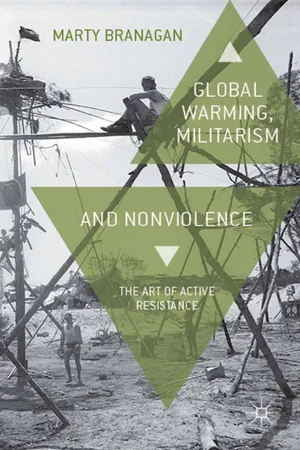
Militarism is the elephant in the room of global warming. Of all government sectors, 'Defence' has the highest carbon footprint and expenditure, yet has largely been exempt from international scrutiny and regulation. Marty Branagan uses Australian and international case studies to show that nonviolence is a viable alternative to militarism for national defence and regime change. 'Active resistance', initiated in Australian environmental blockades and now adopted globally, makes the song 'We Shall Not Be Moved' much more realistic, as activists erect tripod villages, bury, chain and cement themselves into the ground, and 'lock-on' to machinery and gates. Active resistance, 'artistic activism', and use of new information and communication technologies in movements such as the Arab Spring and 'Occupy' demonstrate that nonviolence is an effective, evolving praxis.
- English
- ePUB (mobile friendly)
- Available on iOS & Android
eBook - ePub
About this book
Information
1
Introduction: Global Warming and Militarism
Global warming1 is a huge and complex issue, and part of a wider environmental crisis, which includes an unprecedented loss of biodiversity. Linked to the carbon dioxide (CO2) created by burning fossil fuels – one of the main causes of global warming – is the issue of peak oil, where declining availability of oil will have major impacts on most nations. This chapter will give a brief overview of these issues. Its major focus, however, is on militarism’s enormous but rarely-discussed contribution to these environmental and resource depletion crises. It will examine how militarism is exempt from most environmental scrutiny, and diverts resources away from addressing environmental issues. We also take a look at the military-industrial complex, the interconnected web of industries and governments that profits from and promotes militarism.
Global Environmental Crisis
The consensus of the international scientific community is that the world is warming. Greenhouse gases, a natural constituent of the atmosphere, are essential for maintaining habitable conditions on earth. However, the levels of these gases need to be finely balanced; too little or too much and overall global temperature may be significantly affected.2 Global warming refers to the effects generated by rising levels of greenhouse gases (GHGs) in the Earth’s atmosphere (the ‘greenhouse effect’), trapping heat from solar radiation within the atmosphere and leading to increases in average global surface temperatures.3 The initiation of numerous feedback loops, difficult to predict, escalates the problem.4 Global warming is not, as is often stated, just a threat but a current reality; the decade from 2000–2009 was the warmest on record,5 and average global temperatures are likely to increase by 2–4 degrees over the next 100 years, although significantly greater increases are a possibility.6
The evidence for global warming is overwhelming. In fact, the Intergovernmental Panel on Climate Change (IPCC), the international body appointed to investigate the phenomenon, has been overly cautious, probably because of a barrage of pressure from vested interests and political conservatives. It has significantly underestimated, for example, the likely extent of sea level rise in the 21st century. Despite controversy over the rate of glacial melting,7 the best evidence is that the rate is accelerating.8 The East Antarctic ice sheet, previously believed to be stable, has now begun to melt on its coastal fringes. The West Antarctic ice sheet continues to melt rapidly.9 Over the last seven years, sharply rising temperatures in the Arctic have caused a rapid increase in the amount of methane being emitted from melting permafrost, adding further to global warming.10 In Canada’s James Bay region, the limit of the Arctic permafrost has retreated northwards by 130 kilometres over the last 50 years.11
Consequences of Global Warming
Global warming has the potential to significantly impact on life on earth by altering weather patterns and events, environments, sea levels, and the ability of our planet to sustain both plant and animal life.12 Climate scientists predict severe impacts on humans from even the most conservative of climate change estimates, with the costs of inadequate action growing exponentially.13
Global warming of only 1°C may have dangerous consequences (this threshold was previously thought to be 2°C). One study concludes that an average warming of 3–4°C (which means 6–12°C on land), previously thought to be associated with CO2 concentrations of 500–600 parts per million by volume (ppmv), is now possible with concentrations of only 360–420 ppmv,14 a range that the February 2012 concentration of 393.53 ppmv15 is already in, and this is rising at 2 ppmv per annum. A 4°C future would lead to a 40 per cent reduction in rice and maize production, the collapse of many ecosystems and is probably incompatible with an organized global community.16 This is extremely alarming, not ‘alarmist’.
Climate change is recognised by major scientific institutions and world leaders as the ‘single most pressing issue facing society on a global basis’.17 Although some groups choose not to acknowledge this, even the ones who do, see it as something in the future. However, the World Health Organization has estimated that already some 150,000 people die each year from the effects of climate change.18
Former UN Secretary-General Kofi Annan’s Global Humanitarian Forum estimates 300,000 deaths per year and a cost to the global community of over $125 billion annually. It claims that climate change’s ‘silent crisis’ is seriously affecting hundreds of millions more, and that the effects are growing in such a way that they will have a serious impact on 600 million people, almost 10 per cent of the world’s population, within 20 years. Almost all of these will be in developing countries: ‘Climate change is the greatest emerging humanitarian challenge of our time... [T]he first hit and worst affected are the world’s poorest groups, and yet they have done least to cause the problem.’19
If global warming continues at the current rate, it is likely to drastically impact on human health and survival on a global scale within the next 50–100 years and alter global conditions and weather dramatically.20 Global warming threatens ecosystems and the communities they support. Death, disease, and the mass displacement of people are consequences of melting ice, rising sea levels and wilder oceans, more acid oceans, temperature extremes and severe storms associated with a warming atmosphere. Heavier rainfall and floods, intensifying droughts, more frequent bushfires and the damage they cause are other outcomes which threaten water supplies, agricultural production, and industries21 and are already leading to increased political instability and conflict.22
Global warming also has geological effects – the melting of ice and snow removes considerable weight from the land, and allows faults contained therein to slide more easily. This appears to be already leading to more frequent earthquakes, such as in Alaska, where some glaciers have lost a kilometre of thickness in the last 100 years. A dramatic increase in landslide activity23 and volcanic eruptions is also expected, with major consequences. The Eyjafjallajokull volcanic eruption in Iceland brought much of the globe’s air traffic to a halt in April 2010, while the megaquake and tsunami which hit Japan and one of its nuclear facilities in 2011 resulted in 15,854 deaths, widespread radioactive contamination and, at around a quarter of a trillion dollars, the biggest natural catastrophe bill ever.24
Most national and international plans for emissions reductions are long-term, past the terms of current politicians, and reliant on technological innovation which may never eventuate. Although some important reforms are occurring, these are outweighed by continuing growth of human society. Despite all the political hot air about reductions, global carbon emissions are still rising exponentially, from increases of 2.7 per cent p.a. over the last 100 years, to 3.5 per cent between 2000 and 2007, to 5.6 per cent between 2009 and 2010.25
Biodiversity Crisis and Peak Oil
Global warming is just part of a wider global environmental crisis, which involves over-fished oceans, and rivers polluted by toxins such as mercury, radioactive materials and plastics; lands that are affected by salinity, erosion, over-grazing and deforestation;...
Table of contents
- Cover
- Title
- Copyright
- Dedication
- Contents
- List of Figures
- Foreword
- Preface
- Acknowledgements
- List of Acronyms
- 1 Introduction: Global Warming and Militarism
- 2 Fighting Fire with Water: Nonviolent Alternatives to Militarism
- 3 Australian Eco-Pax Activism
- 4 Active Resistance: We Shall Never Be Moved
- 5 Internetworking
- 6 Artistic Activism
- 7 Creating Campaigns and Constructive Programmes
- Index
Trusted by 375,005 students
Access to over 1.5 million titles for a fair monthly price.
Study more efficiently using our study tools.
Frequently asked questions
Yes, you can cancel anytime from the Subscription tab in your account settings on the Perlego website. Your subscription will stay active until the end of your current billing period. Learn how to cancel your subscription
No, books cannot be downloaded as external files, such as PDFs, for use outside of Perlego. However, you can download books within the Perlego app for offline reading on mobile or tablet. Learn how to download books offline
Perlego offers two plans: Essential and Complete
- Essential is ideal for learners and professionals who enjoy exploring a wide range of subjects. Access the Essential Library with 800,000+ trusted titles and best-sellers across business, personal growth, and the humanities. Includes unlimited reading time and Standard Read Aloud voice.
- Complete: Perfect for advanced learners and researchers needing full, unrestricted access. Unlock 1.5M+ books across hundreds of subjects, including academic and specialized titles. The Complete Plan also includes advanced features like Premium Read Aloud and Research Assistant.
We are an online textbook subscription service, where you can get access to an entire online library for less than the price of a single book per month. With over 1.5 million books across 990+ topics, we’ve got you covered! Learn about our mission
Look out for the read-aloud symbol on your next book to see if you can listen to it. The read-aloud tool reads text aloud for you, highlighting the text as it is being read. You can pause it, speed it up and slow it down. Learn more about Read Aloud
Yes! You can use the Perlego app on both iOS and Android devices to read anytime, anywhere — even offline. Perfect for commutes or when you’re on the go.
Please note we cannot support devices running on iOS 13 and Android 7 or earlier. Learn more about using the app
Please note we cannot support devices running on iOS 13 and Android 7 or earlier. Learn more about using the app
Yes, you can access Global Warming, Militarism and Nonviolence by M. Branagan in PDF and/or ePUB format, as well as other popular books in Politics & International Relations & Environment & Energy Policy. We have over 1.5 million books available in our catalogue for you to explore.