eBook - ePub
The Theatre of Naomi Wallace
Embodied Dialogues
- English
- ePUB (mobile friendly)
- Available on iOS & Android
eBook - ePub
The Theatre of Naomi Wallace
Embodied Dialogues
About this book
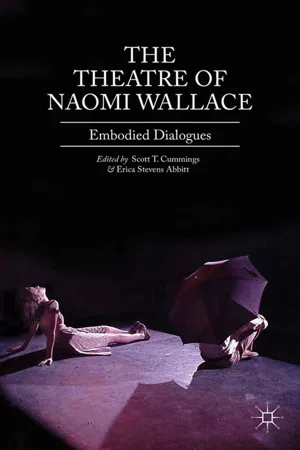
Naomi Wallace, an American playwright based in Britain, is one of the more original and provocative voices in contemporary theatre. Her poetic, erotically-charged, and politically engaged plays have been seen in London's West End, off-Broadway, at the Comédie-Française, in regional and provincial theaters, and on college campuses around the world. Known for their intimate, sensual encounters examining the relationship between identity and power, Wallace's works have attracted a wide range of theatre practitioners, including such important directors as Dominic Dromgoole, Ron Daniels, Jo Bonney, and Kwame Kwei-Armah. Drawing on scholars, activists, historians, and theatre artists in the United States, Canada, Britain, and the Middle East, this anthology of essays presents a comprehensive overview of Wallace's body of work that will be of use to theatre practitioners, students, scholars, and educators alike.
Information
Part I
Writings on Wallace
1
Death and Desire, Apocalypse, and Utopia: Feminist Gestus and the Utopian Performative in the Plays of Naomi Wallace
Shannon Baley
Capitalism plunders the sensuality of the body.
—Terry Eagleton (qtd. in Gornick 1997, 31)
Some labor destroys the body . . . If your hands are damaged, it doesn’t just mean you can no longer work and earn a living, it also means that you will no longer be able to touch someone you love. If your body is destroyed and exhausted, then how can you desire?
—Naomi Wallace (qtd. in Gardner 1996b, 5)
I could touch myself at night and I didn’t know if it was her hand or mine. I could touch myself. I could put my hand. I could. Maybe I was asleep. I don’t know but sometimes I put my hand. Inside myself.
—Dalton Chance (Wallace 2001, 310)
In the final scene of Naomi Wallace’s Depression-era play The Trestle at Pope Lick Creek, the two youngest characters—Dalton Chance, the 15-year-old protagonist, and Pace Creagan, the 17-year-old young woman whose presence literally and figuratively haunts the play—engage in a highly erotic sex scene without touching. This scene, like the prologue, book-ends the play in a kind of ‘no-space,’ which is neither the place of memory (the ‘when’ of the majority of Trestle) nor the present moment, as indicated by Wallace’s opaque stage direction: “[Dalton] is in a place that is both the past and the present at the same time” (2001, 340). During the course of the scene, Pace completes her arm’s-length seduction of Dalton from beyond the grave, commanding him to lie down upon her dress (a material presence that complements—and complicates—her own ghostly presence), and to “touch” her by touching himself. Dalton complies, and audience members watch both characters climax, a charged and complicated “looking” that, for audience and actors alike, balances on the thin edge between radicalism and voyeurism. Pace’s last line, and the last line of the play, is particularly lyrical and complicated, apropos of Wallace’s writing throughout Trestle. After a few “quiet moments,” she observes: “There. We’re something else now. You see? We’re in another place” (342). What they have been transformed into, and what or where that other place exactly is—whether it is apocalyptic or utopian, a place of redemption or a place of loss—are the open questions of the play.
A similar scene takes place in Wallace’s One Flea Spare, set in plague-ridden seventeenth-century London. Trapped in a quarantined home, Morse, a mad servant girl; Bunce, an escaped conscripted sailor; and William and Darcy Snelgrave, the elderly, wealthy lord and lady of the house, wipe the walls with vinegar and mercilessly enact physical and emotional torture on each other while waiting out the disease. Near the climax of the play, Darcy, who had been horribly scarred in a fire when she was much younger, asks to see Bunce’s wound, an unhealed hole in his side. Obliging, he takes her hand and guides her finger into the hole; her reaction echoes Dalton’s experience with Pace in Trestle as she comments with wonder, “My finger. I’ve put my finger. Inside. It’s warm. (Beat) It feels like I’m inside you” (53). Afterwards Wallace’s stage direction dictates she, “looks at her hand as though it might have changed” (54). The much younger Bunce then begins slowly, almost scientifically, to explore Darcy’s body while relating the horrific details of life as a conscript in the Royal Navy, searching for places where she can feel through the layers of scar tissue. Wallace juxtaposes Darcy’s slow sexual reawakening and Bunce’s own digital penetration of her with his bleak, jarring narrative of a young man vomiting his “stomach into [his] hands” and gulls whose wings “caught fire, so close did they circle the sinking masts” during a sea battle (55–6). Darcy’s sexual climax, like Dalton’s, occurs in an odd, liminal “someplace else,” a space in which intimacy and physical desire can subsist with war, immolated birds, and bodies literally unmaking themselves, whether it be throwing themselves from a railroad trestle or throwing their internal organs out into the light of day.
These scenes open up fascinating questions about sensuality and trauma, presence and absence, materiality, and the limits of representation in Wallace’s work. In both Trestle and One Flea Spare, Wallace combines an unflinching, distinctly feminist attention to gender and sexuality with unabashed socialist politics.1 The real tragedy of these plays, Wallace implies, is not only the ravages of the Black Death or of the American Depression, but also of the crushing economic forces and class-based hierarchies attendant to laissez-faire capitalism that not only denies Pace and Dalton, Bunce and Darcy access to material ease, but also cuts them off from themselves and, to paraphrase Terry Eagleton, from their “sensual” capacities (qtd. in Gornick 1997, 31). Each of these plays gestures to apocalypse, whether it be unleashed by the bubonic plague or by junk bonds; however, these apocalypses exist on the edge of utopia, a place where death and desire co-exist, where bodies can be expanded, become fluid, and new horizons can be seen from what is possible, both in the world of the play and on stage in production. Though the men and women, boys and girls of One Flea Spare and The Trestle at Pope Lick Creek scramble to survive in the most horrendous conditions, through these plays we can glimpse the possibilities of a better world, a radical feminist utopia in which the conundrums, pleasures, and dangers of gender, class, and sexuality are made palpable for audience and artists alike.
In “Performance, Utopia, and the Utopian Performative,” Jill Dolan proposes that theatre is an ideal place to glimpse utopia, a place to “enact an ideal future” by moving away from the real and into the realm of the “performative,” a doing made communal by the presence of the audience that gestures to “better ways to be together as human beings” (2001, 457). The utopian performative, as defined by Dolan, is not only something that happens on stage, propelled forcefully into being by the virtuosity of actors and directors, playwrights and dramaturgs, designers, and technicians, but a collaborative “intersubjective” and affective event occurring among all present at a performance. This co-creation of the utopian performative is a distinctly social, public process that models democracy as a “participatory forum” as much as it models what a more just, equitable world “might feel like” (456, my emphasis).2 Dolan notes that, contained in the collective effort of the utopian performative is a sense of “relief,” a respite shared between performer and audience, during which “gestic moments of clarity” can occur (475). I wish to explore this small thread of Dolan’s observation further, looking at how gestus itself can serve as the point of origin for utopian performatives and, more particularly, how an explicitly feminist gestus can help draw the counterpublics of theatrical audiences into a momentary construction of a world in which desires, bodies, and identities are fluid, escapable, anything but fixed.3 In addition, I am interested in exploring how the utopian potential of gestus can help us understand—and perhaps better harness—the staggering but often elusive, affective power of gestus, its ability to make us feel, even just for a moment, part of something larger than ourselves. Naomi Wallace’s plays, her ongoing engagement with issues of representation, class inequities, and desire are an ideal site to trace this kind of feminist gestus and its resulting glimpses of utopian performatives; to that end, I will more closely explore several of the gestic feminist moments that pervade One Flea Spare and Trestle, looking for clues to how they gesture towards both apocalypse and utopia.
I draw my understanding of gestus and its affective power not only from Brecht but also from Elin Diamond’s Unmaking Mimesis, and her insightful interpretation of how the strangely apt relationship between feminism and Brechtian theory and theatre—more a “fellow-traveling” than a wholesale endorsement—emerged through a shared desire to explode realism’s stranglehold on theatre and its subsequent “recontainment of difference”, whether those differences be class-based (Brecht’s favored critical lens) or gender-based (feminist critics’ forte) (1997, 54, 44). Diamond defines Brechtian gestus as a “gesture, a word, an action, a tableau, by which, separately or in a series, the social attitudes encoded in the playtext become visible to the spectator”; it is a moment that “explains” the play, but also “exceeds” the play (52–3). Like the utopian performative, gestus is elusive, latent in the words of the text but only fully realized when it is embodied by an actor and received by the spectator. Gestus becomes feminist when its power to comment upon class or economic inequities is harnessed and expanded to condemn gender and sexual inequities ever-present in patriarchal power structures; it reveals gender as ideology and performative, a “system of beliefs and behavior mapped across the bodies of women and men which reinforces the social status quo” rather than as something fixed or irrevocable (47). Feminist gestus and feminist gestic criticism thus assist in the project of “ruin[ing] the scopic regime of the perspectival realist stage,” and opening up a “provisional, indeterminate, nonauthorative” space for a distanced, distinctly alive and empowered spectator, and, even more importantly, an actor who is “free” to gaze back at her audience (53–4). Gestic feminist criticism, to paraphrase Diamond, thus allows the reader/spectator to engage dialectically rather than masterfully with the playtext before her, to “see” as a “transformative act of cognition,” to witness the, “possibilities emerging of another reality, what is not there, but could be”—to enact, in other words, the utopian performative (145).
For Wallace, this longing to witness, to see possibilities of another reality, a utopia in the midst of chaos and death appears in her writing as just that—a desire: “Desire—that’s really what I’m talking about . . . I don’t mean love. I’m not sure I know what that means. Desire serves the need to end one’s singular state. It creates the space in which to reimagine oneself. That alone ends loneliness” (Wallace qtd. in Gornick 1997, 31). Desire imbues Wallace’s work, an ever-fluctuating configuration upon which the need for communion overlies the unruly sexual desires of her characters whose hunger for each other is equally paced by their hunger for community. Feminist gestus like Dalton’s unnerving dis-substantiation of himself and Darcy’s penetration of Bunce’s open wound demonstrate the points where the two axes of physical and communal desire intersect, points at which the body—and all its attendant identity markers—blazes into being with a startling intensity for character, actor, and spectator. Ron Daniels, director of One Flea Spare for the Joseph Papp Public Theater in 1997 and Wallace’s Slaughter City at the Royal Shakespeare Company, notes Wallace’s particular gift for hailing, and implicating, bodies into being in her plays:
In Naomi’s work something is always being done to the body . . . It is always being touched, caressed, burned, perforated, poured on and spat on. It’s standing in a river of life-and-death fluids: alive to blood, sweat, snot, running sores and oozing wounds. For Naomi, it has to do with making the body—for which read “class”—burst its bounds. Now here’s the catch: it’s all in the name of change, hope, possibility (Daniels qtd. in Gornick 1997, 31).
Daniels’s connection between the effluence of the live body and “hope” is useful in illuminating how Wallace uses her textual bodies—as well as the physical bodies of the actors who take up the roles of her characters—to dramatize the ongoing history of class struggles. Like Dolan’s utopian performative, Wallace’s bodies are anything but static: the body, a site of unmaking or remaking, is a place where, Wallace observes, “it’s possible to make a new vision” of oneself as well as a “new vision of desire” (Greene 2001, 466).
It is this new vision of desire that is the hope and the heartbeat of One Flea Spare. Drawing its title from John Donne’s tongue-in-cheek carpe diem poem, in which a man asks his lover to “spare” the life of a flea in which his blood comingles with hers (“Where wee almost, yea more than maryed are”), One Flea Spare investigates the power of desire under the most extreme circumstances. When two vagabonds—Bunce, the escaped sailor, and Morse, a servant girl masquerading as her dead mistress—sneak into the Snelgrave house looking for shelter, they breach the house’s nearly completed quarantine cycle of 28 days, imposed by Kabe, a “guard” hired to keep the quarantine enforced. When confronted, Kabe, a shrewd capitalist, observes merrily that it’s not his job to keep people from breaking and entering the Snelgrave home, but to “make sure no one gets out,” the prospect of further profit for “guarding” the Snelgrave residence making him positively gleeful. Like Helene Weigel’s much-cited purse-snap gestus in the Berliner Ensemble’s staging of Brecht’s Mother Courage, Kabe’s periodic carnivalesque appearance—only at the window and no further—serves as a reminder of the profits to be made from great suffering caused by war or plague (Wallace 2001, 12).
Under the pressure of enforced quarantine, the Snelgraves initially attempt to maintain the rigid class hierarchies of 1665 London, forcing Bunce to swab down the kitchen repeatedly and attempting to force the amoral, often cryptic Morse to behave like a “Christian” (13). These class distinctions, however, quickly break down under the pressure of impending apocalypse, and desire, both physical and imaginative, erodes the line between master and servant. In one particularly vivid scene, William Snelgrave, whose wealth, Wallace implies, is a result of his work with the Royal Navy, tries to push Bunce into revealing what he did at sea when his “baser instincts” took over (47). William’s interest in Bunce’s imagined homoerotic activities is salacious and romanticized; his use of multiple euphemisms for how Bunce might have used his “foul and fleshful instrument” is interrupted only by Bunce’s blunt observation, “You mean my prick, sir?” (48). Frustrated (one suspects sexually), William commands Bunce to speak; in a stunning display of gestus, Bunce instead chooses to act:
Bunce nears Snelgrave, close, too close. He takes Snelgrave’s finger, examines it a moment, then forces it through the rind of the orange. Bunce turns the orange on Snelgrave’s finger, slowly, sensually. Then he pulls the orange off of Snelgrave’s finger. Involuntarily, Snelgrave looks at his wet finger. Bunce raises the orange over his head, squeezes it and drinks from the hole in the rind (48).

Figure 1.1 Richard Thompson (Bunce) and William McNulty (Snelgrave) in the 1996 Actors Th...
Table of contents
- Cover
- Title
- Introduction: The Discourse of the Body
- Part I Writings on Wallace
- Part II Collaborators
- Part III Wallace in Her Own Words
- Appendix A: Naomi Wallace Selected Production History
- Appendix B: Naomi Wallace Play Titles and Their Sources
- Bibliography
- List of Contributors
- Index
Trusted by 375,005 students
Access to over 1.5 million titles for a fair monthly price.
Study more efficiently using our study tools.
Frequently asked questions
Yes, you can cancel anytime from the Subscription tab in your account settings on the Perlego website. Your subscription will stay active until the end of your current billing period. Learn how to cancel your subscription
No, books cannot be downloaded as external files, such as PDFs, for use outside of Perlego. However, you can download books within the Perlego app for offline reading on mobile or tablet. Learn how to download books offline
Perlego offers two plans: Essential and Complete
- Essential is ideal for learners and professionals who enjoy exploring a wide range of subjects. Access the Essential Library with 800,000+ trusted titles and best-sellers across business, personal growth, and the humanities. Includes unlimited reading time and Standard Read Aloud voice.
- Complete: Perfect for advanced learners and researchers needing full, unrestricted access. Unlock 1.5M+ books across hundreds of subjects, including academic and specialized titles. The Complete Plan also includes advanced features like Premium Read Aloud and Research Assistant.
We are an online textbook subscription service, where you can get access to an entire online library for less than the price of a single book per month. With over 1.5 million books across 990+ topics, we’ve got you covered! Learn about our mission
Look out for the read-aloud symbol on your next book to see if you can listen to it. The read-aloud tool reads text aloud for you, highlighting the text as it is being read. You can pause it, speed it up and slow it down. Learn more about Read Aloud
Yes! You can use the Perlego app on both iOS and Android devices to read anytime, anywhere — even offline. Perfect for commutes or when you’re on the go.
Please note we cannot support devices running on iOS 13 and Android 7 or earlier. Learn more about using the app
Please note we cannot support devices running on iOS 13 and Android 7 or earlier. Learn more about using the app
Yes, you can access The Theatre of Naomi Wallace by Scott T. Cummings,Erica Stevens Abbitt, E. Stevens Abbitt in PDF and/or ePUB format, as well as other popular books in Literature & Art General. We have over 1.5 million books available in our catalogue for you to explore.