Chapter 4 of this book is open access under a CC BY 4.0 license via link.springer.com.
eBook - ePub
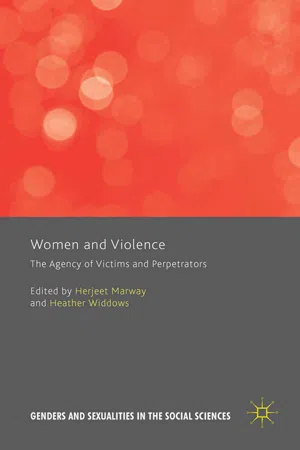
Women and Violence
The Agency of Victims and Perpetrators
- English
- ePUB (mobile friendly)
- Available on iOS & Android
eBook - ePub
Women and Violence
The Agency of Victims and Perpetrators
About this book
Information
Topic
PhilosophySubtopic
Ethics & Moral PhilosophyPart I
Women as Victims of Violence
1
Rape, Women’s Autonomy and Male Complicity
Sarah Sorial and Jacqui Poltera
Introduction
Rape is a ubiquitous, gendered crime overwhelmingly committed by men against women.1 Being raped can severely damage a woman’s capacity for autonomy and change the structure of her will. However, women need not experience the horror of being raped to find their autonomy threatened by fear thereof. The threat of being raped is a persistent reality in the lives of most women, and is one that constrains women’s actions and their motility, at least some of the time (Brownmiller 1975; Card 1991). The prevalence of rape or sexual assault stems from a lack of recognition and respect for women as equal moral agents. Our view is that, despite significant advances in law reform2 and in education programs,3 rape and the fear of rape persists in many societies, and its prevalence threatens and can diminish women’s autonomy.
We understand autonomy in relational terms as something that is achieved in relation to existing social and cultural institutions and supportive relationships. On our account, autonomy is not a given, although we are in one sense ‘autonomous beings’ just in virtue of being persons. The sense in which we are autonomous is that we each have the capacity for autonomous agency, but the extent to which we can be autonomous or exercise autonomy is not only up to us: it is framed by the nature of our relations with others and the context in which we find ourselves. Not all situations or cultural norms will be conducive to achieving/exercising ‘full’ autonomy, even though we may be able to exercise/achieve a degree of autonomy despite being in an oppressive social environment. The prevalence of rape in our culture is one of the ways in which the autonomy of women is threatened relative to men. The fact that rape threatens autonomy is relatively uncontested in the philosophical literature on rape. The more difficult question is how women are to achieve autonomy despite the persistence and prevalence of rape. It is this question that we seek to address in this chapter. While it is the case that women are commonly presented as lacking agency because of male aggression, we do not think that the achievement of autonomy is impossible for women. But nor do we think that promoting women’s autonomy is something that women, as either individuals or as a group, are primarily responsible for.
We will argue that, because exercising full autonomy requires socially supportive relations, including relations of mutual recognition, promoting women’s autonomy is as much the responsibility of men as it is of women. That is, in the same way women and women’s groups have been demanding recognition of women as equal moral agents, and have been resisting male dominance and aggression in various ways, including by agitating for law reform, men also have various responsibilities to alleviate and eventually eradicate the prevalence of rape within our culture. There are several reasons for focusing on men’s complicity in, and responsibility for, alleviating the incidence of rape or sexual assault.
First, there seems to be an asymmetry in how responsibility for avoiding and preventing sexual assault is understood and distributed within the existing philosophical literature on sexual assault and within our culture more generally. For example, one of the foremost recommendations for increasing women’s autonomy in the philosophical literature is for women to learn self-defence. Although this is by no means the only avenue for promoting women’s autonomy and reducing instances of rape, we are interested in this strategy since it is arguably one of the most common. As an avenue for promoting women’s autonomy, we argue that self-defence explicitly places the onus on individual women to address the prevalence of rape and to take responsibility for cases in which their autonomy is threatened by (some) men. The more pressing issue here is that women would not have to find ways to defend themselves from would-be rapists if rape were not a persistent social crime. To this end, we argue that philosophers working on rape and women’s autonomy need to increase their focus on how men can and should take responsibility for addressing rape, rather than on educating women to resist rape through learning self-defence, given that men are on average more complicit (to varying degrees) in the prevalence of rape and given that it is primarily men who fail or refuse to recognize and respect women as equal moral agents.
Second, while men are more complicit in sexual violence against women, as a collective, they do not take equal responsibility for it. This is attributable to a variety of reasons, including the fact that many men benefit from existing (unequal) gender relations or are ignorant about the extent to which their actions threaten women’s autonomy. Third, because male violence is a specifically male issue, men are better placed to understand it and to find ways of addressing it. Although rape theorists like Susan Brison (2002), Anne J. Cahill (2001), Claudia Card (1991) and Keith Burgess-Jackson (1996) may be sympathetic to this approach, focusing on ways in which men can take responsibility to promote relations of mutual recognition, and by implication, women’s autonomy, has yet to be explicitly introduced in the debate on rape and women’s autonomy.4 Because rape threatens women’s autonomy, and because autonomy is relational, it follows that women should not be solely responsible for challenging male violence. We start by sketching an account of autonomy in order to explain how rape and fear thereof can threaten women’s autonomy. The purpose of this section is to lay the foundation for our claim that the prevalence of rape exemplifies the ways in which an ‘individual’s autonomy can be diminished or impaired through damage to the social relations that support autonomy’ (Anderson and Honneth 2005, 127). In next section, we explain why it is problematic to overemphasize women’s taking self-defence courses to increase their overall autonomy and resist rape. We also provide a preliminary account of the ways in which men are complicit in rape culture. In next section we develop our claims about social recognition and provide the foundations for a positive account of how women can achieve/exercise autonomy.
How rape and fear thereof threaten autonomy
Minimally specified, to exercise autonomy, an agent needs the capacity for reflexive self-awareness; to identify and choose to act on the basis of her defining motivations; and to exercise ownership with respect to her actions and decisions. These broad agentic skills require that she sustain certain attitudes of self-trust, self-respect and self-esteem (Anderson and Honneth 2005, 130). For example, an agent needs to trust that she knows what her defining motivations are; she needs to respect her deliberative processes and reasons for acting on the basis of those; and she needs a sense of self-worth and confidence that her life, actions and decisions are meaningful in order to be autonomous. Each of these agentic skills is socially supported: an agent’s capacity for self-trust, self-esteem and self-worth can be enhanced or threatened by the actions, decisions and treatment of other agents. Further, insofar as the body is the locus of agency, and an agent’s autonomy can be damaged when others violate her body, embodiment is also a feature of agency. We understand autonomy in relational terms since agents are social beings whose actions and decisions take place within a social milieu.5 It is precisely because autonomy is ‘shaped by complex, intersecting social determinants and constituted in the context of interpersonal relationships’ (Mackenzie and Poltera 2010, 48) that being autonomous depends on socially supportive ‘relations of recognition’ (Anderson and Honneth 2005, 144).
The act of rape, by its very nature, damages the victim’s autonomy since it violates her bodily integrity and disrupts her sense of ownership over her actions and decisions. Being raped can also dramatically alter the agent’s psychological life, interpersonal relationships and identity.6 Rape shatters the victim’s assumptions about her safety in the world and trust in others. It can change the very structure of the agent’s will, and it can take years before the victim is able to restore a sense of ownership over her psychological life, actions and decisions. Representative here is Susan Brison’s account of how being raped and left for dead profoundly changed her life. Brison experienced post-traumatic stress disorder (PTSD) in the aftermath of the assault. She describes the symptoms of PTSD as follows:
The immediate psychological responses to such trauma include, terror, loss of control, and intense fear of annihilation. Long-term effects include the physiological responses of hypervigilance, heightened startle response, sleep disorders, and the more psychological, yet still involuntary, responses of depression, inability to concentrate, lack of interest in activities that used to give life meaning, and a sense of a foreshortened future. (Brison 2002, 39–40)
Setting goals and making life plans – some of the very foundations of a meaningful life – are not things Brison feels able to do because she feels overwhelmed by anxiety. Brison’s experience illustrates how rape can destroy an agent’s capacity for autonomy, even if only temporarily. In Brison’s case, she was initially only able to exercise local autonomy with respect to actions like taking her medication each day, or getting out of bed.7 Over time, and with the help of others, she was able to exercise autonomy with respect to other aspects of her life. For example, she enrolled in a self-defence course. Brison was able to piece her life back together and restore her capacity for autonomy in many ways. Yet, she likens being raped to the death of her, saying she is no longer the same person as she was before the assault (Brison 2002, 21).8
While victims of rape will experience a higher level of fear and anxiety, women need not be raped to fear the threat thereof or to feel vulnerable to harm.9 An upshot of rape culture is that women’s fear of rape can result in a loss of ‘self-confidence, self-respect, and self-esteem; nightmares and other sleep disorders; distrust and suspicion of strangers and acquaintances; chronic anxiety, stress, and depression; inability to live alone (where that is desired); and increased dependence on men for protections, which in turns undermines self-respect and self-confidence’ (Burgess-Jackson 1996, 186–187).10 Although there are exceptions, many, if not most women whether consciously or not, exercise a level of hyper-vigilance in these kinds of ways on a regular basis. It may well be that many of these fears about random attacks are unfounded, given that most rapes or sexual assaults are by someone who is known to the victim. The fear may simply be a part of female socialization, but whether women’s fears of rape by a stranger are unfounded, the fact remains that at the descriptive level, most women do exercise a level of hyper-vigilance with respect to their safety in ways that men do not.11 This is not to say that all women will have their autonomy compromised in the same way. Autonomy admits of degrees, and the woman who has been a victim of rape will find it more difficult to achieve autonomy than a woman who has not, but whose actions are still somewhat constrained by fear thereof. Our point is that where rape culture exists, women’s autonomy will be more difficult to achieve relative to men’s.
There can be considerable social pressure on women to maintain constant vigilance over their safety. Representative here is a recent case in Sydney, Australia, where women were being sexually attacked in their bedrooms. Police advised women to exercise additional cautions like ensuring their windows were shut and locked, despite the stifling summer humidity; ensuring their doors were locked; and varying their daily routines.12 Such pragmatic, fairly routine advice illustrates how women are socialized to perceive their own safety and mobility as diminished relative to men’s. It also implies (although unintentionally in this case) that the responsibility for avoiding sexual assault falls largely to women qua potential victims, a point we revisit shortly. Such socialization plays an important role in the construction of feminine bodily comportment (Cahill 2001) and can reinforce feelings of defencelessness, fragility and powerlessness on the part of some women.13
Rape culture is an acute and violent form of gender inequity and male dominance. Like gender inequity, rape culture is pervasive and exists in a variety of forms in most societies (May and Strikwerda 1994; Burgess-Jackson 1996; Cahill 2001). It is also manifest at the private and public level. Rape culture is in part made possible because many of the social conditions that support women’s autonomy are diminished. Just as pervasive male dominance fosters the conditions for rape culture to be sustained and legitimated, so rape culture can also beget gender inequity when it functions as a form of social control by which men keep women in a state of fear and subservience (Card 1991, 299). At the private level, rape victims can be silenced and rapes underreported, which contributes to sustaining and overlooking the prevalence of rape. At the public level, the harmful effects of rape can be diminished and the act of rape tacitly condoned when, for example, public sporting figures or celebrities escape harsh penalties for rape. This can normalize and legitimate rape.
Rape culture is a pressing social and moral problem that profoundly threatens many women’s autonomy. While we agree that male dominance in general, and rape culture in particular, threaten women’s autonomy relative to men, we do not think that male dominance is intractable. Nor do we think that women are primarily responsible for achieving a degree of autonomy, as some of the literature on rape seems to suggest. For example, within the literature on rape and women’s autonomy, self-defence is cited both as a way of enhancing women’s autonomy and as a way of addressing rape culture. In what follows, we explain the motivations for this approach and why we think it is problematic.
Self-defence and rethinking men’s complicity
Rape theorists argue that learning self-defence can increase women’s autonomy by decreasing their fear and sense of vulnerability to men.14 Representative here is Burgess-Jackson’s argument that learning self-defence is one way to reduce women’s sense of vulnerability to, and thus their fear of men. Drawing on empirical evidence, he argues that women who have been trained in self-defence ‘reported feeling stronger, braver, more active, more in control, bigger, more efficacious in a variety of arenas – and less afraid’ (Burgess-Jackson 1996, 190). Further, he stresses the importance of modifying conventional femininity and teaching women physical skills like fending off attacks, striking targets and so on. The underlying idea here is that women need to be socialized and educated differently to better equip them to resist rape. Burgess-Jackson even suggests that state-subsidized self-defence courses could significantly decrease women’s fear of crime by breaking ‘the cycle of [women’s] socialized v...
Table of contents
- Cover
- Title
- Introduction
- Part I Women as Victims of Violence
- Part II Women as Perpetrators of Violence
- Part III Governance, Violence and Agency
- Part IV Theorizing Violence and Agency
- Index
Trusted by 375,005 students
Access to over 1.5 million titles for a fair monthly price.
Study more efficiently using our study tools.
Frequently asked questions
Yes, you can cancel anytime from the Subscription tab in your account settings on the Perlego website. Your subscription will stay active until the end of your current billing period. Learn how to cancel your subscription
No, books cannot be downloaded as external files, such as PDFs, for use outside of Perlego. However, you can download books within the Perlego app for offline reading on mobile or tablet. Learn how to download books offline
Perlego offers two plans: Essential and Complete
- Essential is ideal for learners and professionals who enjoy exploring a wide range of subjects. Access the Essential Library with 800,000+ trusted titles and best-sellers across business, personal growth, and the humanities. Includes unlimited reading time and Standard Read Aloud voice.
- Complete: Perfect for advanced learners and researchers needing full, unrestricted access. Unlock 1.5M+ books across hundreds of subjects, including academic and specialized titles. The Complete Plan also includes advanced features like Premium Read Aloud and Research Assistant.
We are an online textbook subscription service, where you can get access to an entire online library for less than the price of a single book per month. With over 1.5 million books across 990+ topics, we’ve got you covered! Learn about our mission
Look out for the read-aloud symbol on your next book to see if you can listen to it. The read-aloud tool reads text aloud for you, highlighting the text as it is being read. You can pause it, speed it up and slow it down. Learn more about Read Aloud
Yes! You can use the Perlego app on both iOS and Android devices to read anytime, anywhere — even offline. Perfect for commutes or when you’re on the go.
Please note we cannot support devices running on iOS 13 and Android 7 or earlier. Learn more about using the app
Please note we cannot support devices running on iOS 13 and Android 7 or earlier. Learn more about using the app
Yes, you can access Women and Violence by Heather Widdows, Herjeet Marway, Heather Widdows,Herjeet Marway in PDF and/or ePUB format, as well as other popular books in Philosophy & Ethics & Moral Philosophy. We have over 1.5 million books available in our catalogue for you to explore.