eBook - ePub
Rwanda 1994
The Myth of the Akazu Genocide Conspiracy and its Consequences
- English
- ePUB (mobile friendly)
- Available on iOS & Android
eBook - ePub
About this book
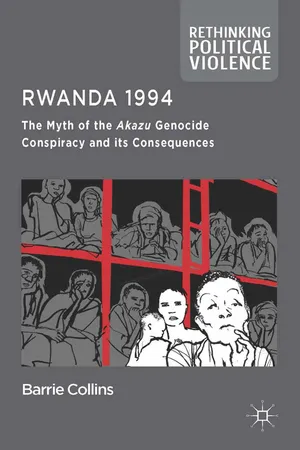
Through a rigorous critique of the dominant narrative of the Rwandan genocide, Collins provides an alternative argument to the debate situating the killings within a historically-specific context and drawing out a dynamic interplay between national and international actors.
Information
1
The Tipping Point
When the plane carrying President Juvénal Habyarimana was blown out of the sky as it approached Kigali airport on the evening of 6 April 1994, a marker in Rwanda’s history was laid down. This was a tipping point for this small central African state. The four-year-old war that had officially ended with the signing of the Arusha Accords on 3 August 1993 was reignited. It turned into a showdown of apocalyptic dimensions. Hundreds of thousands were slaughtered as a power struggle reached its climax and resulted in regime change. Within days of the President’s assassination the government had fled the capital, and while the national army was pinned down by the rebel army of the Rwandan Patriotic Front (RPF), roving gangs of militia were free to go after (mostly) ethnic Tutsi civilians for murder, rape and pillage. As it gained territory, the RPF also engaged in wholesale civilian slaughter. The numbers killed, and the relative numbers of Tutsi and Hutu dead, remain disputed and differ in accordance with the political affiliations of analysts. Tutsi civilians were hunted down by militia forces, along with Hutus whom they regarded as RPF sympathisers. The RPF killed indiscriminately in a land that was overwhelmingly Hutu. One can safely say that at least half a million died in the period between the President’s assassination and the RPF’s assumption of power just over three months later. The death toll could possibly have been as much as one million.
The missiles that brought down the President’s plane did not only create a crisis in Rwanda. As fate would have it, Burundi’s President Cyprien Ntaryamira had asked for a lift in the Falcon 50 jet from Dar es Salaam, where they had attended a regional summit. The death of Burundi’s second democratically elected president did not catalyse mass violence in Burundi, despite this state having a remarkably similar Hutu/Tutsi cleavage, but it did weaken that country’s nascent democratic initiative. A military coup brought Burundi’s Tutsi-dominated army back at the helm two years later.
Briefing the media
The aerial assassination of two central African presidents caught the international media completely unprepared. The big Africa story at the time was South Africa, where Nelson Mandela was being inaugurated as president and apartheid was being consigned to the dustbin of history. Journalists left South Africa for Rwanda frantically fact-finding about a country most knew little about. The only practical entry point to Rwanda for them was from Uganda. But Uganda was a participant in the Rwandan war, supporting the RPF rebels who had been part of the Ugandan army. The RPF was overwhelmingly comprised of Rwandan Tutsi exiles who had played a key role in Yoweri Museveni’s military takeover in Uganda in 1986. Now the rebels were fighting for a bigger prize: power in their homeland. Museveni was giving discreet support to his Rwandan comrades,1 and this included backing up an elaborate fiction of who the RPF were and why they had resorted to arms against their fellow citizens in Rwanda. It was this story that the journalists received upon their arrival in Uganda and along their travels inside Rwanda with the RPF. Ugandan and RPF officials came across as sophisticated, disciplined and, crucially, articulate in English.
The message the journalists received was that the RPF was engaged in a war against a corrupt dictatorship that rested upon ‘majoritarianism’ – a claim to democratic representation made by the rulers of Rwanda that was based solely upon the fact that they acted in the interests of the Hutus, who were the majority ethnic group by around 85% (Tutsis and Twa made up the other 14% and 1% respectively). ‘Majoritarianism’ was no more than Hutu supremacy and Tutsi oppression, went the line. Furthermore, the dictator-president Habyarimana was also intransigent on another almost three-decade-old injustice: the refusal to allow the return of Tutsi refugees exiled in neighbouring countries and around the world. The RPF presented itself as a Rwandan liberation movement that was above ethnicity, fighting for good governance and for the return of all Rwandans. It had emerged as a defection from the Ugandan army and was now acting alone to bring down an ethnic dictatorship. The crisis, the journalists were told, was no less than genocide. And this is the widely accepted version of how the genocide came about:
The génocidaires were Hutu extremists who had had enough of Habyarimana after he had conceded so much to the RPF in the recent peace talks in Arusha, Tanzania. The Arusha Accords were going to bring about power-sharing in Rwanda and thereby an end to Hutu domination. This was anathema to a clique centred on Habyarimana referred to as the Akazu. The Akazu conspired to assassinate Habyarimana in order to destroy the peace process and teach the Tutsis once and for all who their masters were. And the way they planned to do this was through exterminating the entire local Rwandan Tutsis population.2 The plane shooting was the signal for the genocide to commence.3 Immediately upon learning that their aerial assassination of the President had succeeded, the genocidaires engineered a coup that brought in an ‘interim government’ of Hutu extremists. They used the instruments of state power to execute the genocide. By the time the genocide was ended by the RPF seizing power in July 1994, around a million had perished – a killing rate faster than the Nazi Holocaust.
The journalists were invited to travel around Rwanda behind the RPF’s lines and tell the world about the genocide being committed before their own eyes. The RPF’s genocide thesis was a more sophisticated and credible analysis than the somewhat racist depiction of the slaughter of civilians being an eruption of primordial tribal hatred that earlier reports had suggested. The RPF line resonated well with the journalists. Carefully chaperoned across the country, they were unaware of the tens of thousands of civilians that were also being slaughtered by their erudite hosts. They were shown the work of Hutu militias, collectively known as Interahamwe: scenes of depravity that were overwhelming even to the most seasoned of war reporters.
The appearance of genocide
The fact that Tutsi men women and children of all ages were targeted by Hutu militia forces for murder on a horrifying scale made the claim of an organised genocide seem credible. The protestations of representatives of the interim government, who were fluent in French but somewhat less articulate in English, that the killings were in the main expressions of a spontaneous eruption of rage against a Tutsi organisation that had murdered their beloved president, sounded to them more like guilty evasiveness.
No wonder then that international journalism increasingly depicted the RPF as the victims’ champion. From this perspective, the RPF’s seizure of power was a vital step towards ending genocide. And ending genocide also seemed to be nowhere on the priority list of Western governments. In fact, Washington was at that time engaging in all kinds of verbal gymnastics in order to avoid using the word ‘genocide’ – for that would have compelled the United States to honour the United Nations convention on genocide that made intervention a legal as well as a moral imperative. In this way the RPF’s victory in July 1994 and transformation into the new government was widely celebrated in Western capitals. Having won the fight, the RPF also won the argument. The story of the Akazu-led genocide was universally adopted as a penetrating analysis of the tragic events that unfolded upon the assassination of President Habyarimana. So powerful was this consensus that President Clinton apparently had no choice but to humbly apologise for not recognising the genocide it was, and to commit his government to assisting the new government of all the help it needed so that the forces of genocide would be completely and permanently extinguished.
Consequences
And so Africa’s first morally constituted tyranny was inaugurated.
With ‘genocide credit’ overflowing, the new masters of Rwanda under Paul Kagame set about dominating all aspects of Rwandan society with fists of iron.4 Officially, Rwanda was rehabilitating itself from the dark days of genocide and building a new state that would transcend narrow and exclusive preoccupations with ethnicity. Expressions of ethnic identity, including the actual use of the terms ‘Hutu’, ‘Tutsi’ or ‘Twa’ were forbidden as expressions of ‘divisionism’. Ethnic identity, so the new line went, was a racist colonial construct that had been manipulated by the ideologues of genocide. To deal with the demon of genocide ideology, all references to ethnicity were to be expunged from social discourse. Yet, while disavowing ethnicity in public and censoring expressions of ethnic identity, the new regime quietly set about establishing an exclusively Tutsi power structure. The new elite were Kagame’s comrades, the exiled ‘Ugandan’ generation of Tutsis at the core of the RPF at the time of its constitution. An elaborate façade was established whereby all cabinet ministers were Hutu. But they were merely figureheads, and behind each of them was a second in command who was the real decision-maker who had the ear of Kagame and just happened to be a ‘Ugandan generation’ Tutsi. This façade included the Hutu President, Pasteur Bizimungu – who was shadowed by ‘vice-President’ Paul Kagame.5 Kagame called the shots in every state institution: the army, the cabinet and the intelligence services. Anyone brave enough to expose the deception of these Hutu figureheads faced the threat of being charged with promoting ‘divisionism’ – a serious criminal offence.
The Rwanda that was shown to the outside world was one that fostered ethnic harmony and reconciliation as it struggled to bring the perpetrators of the genocide to justice. The true Rwanda that its inhabitants experienced was a ‘Ugandan’ Tutsi dictatorship that criminalised the Hutu majority for having been either active or passive genocide participants. Surviving Hutu men were treated as guilty until proven innocent.6 They included former members, or those accused of being former members, of the militia and those who had served in the army of the former regime, the Forces Armées Rwandaises (FAR). Rwanda’s prisons, which had been built to accommodate around thirty thousand, were crammed with over a hundred thousand. Conditions were, and remain to this day, indescribable. The death rate among Rwandan prisoners became one of the highest, if not the highest, of any prison population in the world. The press no longer enjoyed the freedom it had become used to during the last years of Habyarimana’s leadership. Critical journalists were killed in mysterious circumstances.7 The political space that had also been opened under Habyarimana was closed, with opposition figures murdered, thrown into prison or driven into exile. Internationally, the consensus on the Rwandan genocide muted all criticism from those who had hitherto loudly championed the cause of human rights and civil liberties in Rwanda. Perhaps it was felt that, since there appeared to have been a high level of participation of ordinary civilians in the genocide, a suspension of the democratic process was not an unreasonable measure for the new government to take. As the British Economist put it, ‘[n]or do they [Rwanda’s Western backers] insist on elections – which, in the absence of a Hutu–Tutsi alliance, would put Hutus back in power. For Tutsis, democracy means death.’8
A false claim
As powerful as it is, the consensus on the Rwandan genocide is highly problematic, to say the least. It is centred upon a totally false claim: that the Hutu-extremist Akazu planned and then implemented a genocide. Akazu was no more than a term of abuse for the politically well connected; it was not an organisation, least of all an organisation that conspired to implement genocide. The aerial assassination of President Habyarimana and the rapid resumption of the RPF’s war took the government and the army completely by surprise. Fears for their own and their family’s security were uppermost in the minds of the political leadership, with a significant number of them making a dash for sanctuary in Western embassies. The effort to assemble surviving members of the recently constituted transitional government into an ‘interim’ government went as far as possible according to established constitutional procedures that the prevailing conditions allowed. In no way could the formation of the interim government be described as a coup.
From the outset, the Rwandan army was on the back foot against a well-prepared assault from the RPF. The RPF had already demonstrated its military superiority with its last major offensive in February 1993, and now had the Rwandan armed forces pinned down in one losing encounter after another, resulting in escalating desertions. Members of the new interim government were not able to take office in the main ministerial buildings after 6 April, since they were situated on hilltops that had already fallen to the RPF. After only six days, all government members fled the capital, leaving the residents of Kigali completely defenceless. It is in this atmosphere that the murderous phenomenon of militia killings took on a life of its own. There was no one in authority to restrain them or to come to the defence of the targeted civilians because Rwanda by this time had no government or effective administration. The killings had erupted without prior organisation or planning. They were uncontrolled, opportunistic and unsupervised. If the killers’ behaviour can be analysed in order to discern their motives, it is clear that there was a targeting of Tutsis in general, of Tutsi families whose sons and daughters who were known to have attended RPF functions, and of others who may not have been Tutsi but were assumed ‘accomplices’ of the RPF. These were ‘revenge killings’ of defenceless non-combatant civilians, a terrible displacement of the fear and loathing born of the misery of wartime conditions that had been generated by an almost exclusively Tutsi army. There was large-scale rape and mutilation. In other instances, killing stopped in favour of looting and property seizure.
Having won the war, the RPF also won the argument. The widely accepted narrative of the Akazu genocide is simply an endorsement of RPF war propaganda. It rests upon three completely false propositions: that the killings were the product of an Akazu-planned and -implemented programme of genocide; that the scale of the ensuing slaughter reflected the Akazu’s ability to have its ‘genocide orders’ followed by ordinary Rwandans owing to its ability to key into their culturally conditioned obedience towards figures in authority, and culturally conditioned expectations that Tutsis could be killed with impunity; and that the RPF’s return to the battlefield arose from a sense of moral obligation in the face of civilian slaughter.
Contradictory evidence
Over the succeeding years, highly credible evidence has emerged that shows that Kagame is responsible for ordering the missile attack upon President Habyarimana’s plane9 and for resuming the war immediately upon receiving confirmation of the President’s death.10 The reason for assassinating the president was obvious. The RPF needed an excuse to tear up the Arusha Accords and restart the war. If the peace agreement had followed its agreed schedule of events, Rwanda would have had elections within a matter of months. It is no secret that the RPF was so unpopular across the country that these elections would have exposed them as no more than a small minority party. They obviously wanted to avoid this at all costs. Killing the most popular political figure in the land at the time would be certain to spark off mass killings, and mass killings would justify a return to the battlefield. With strong support from the United States, and the sympathy of America’s most influential human rights organisation, the RPF could count on the aerial assassination and the return to war being blamed on their opponents.
Non-intervention?
The fact that Washington prevented the UN from sending in a rescue force to Rwanda11 to save civilians gave the impression that it had little to do with what took place in Rwanda. The opposite is in fact the case. America vetoed an intervention force because it had no wish to obstruct the RPF’s military takeover, and because it did not want to risk the lives of its own forces in doing so. From the onset of the war, America gave diplomatic support to the lie that the Ugandan government of President Yoweri Museveni had been taken by surprise when a large number of Rwandans serving in his army suddenly ‘defected’ and invaded Rwanda. They knew that Museveni had been in on the act.12 Instead of arr...
Table of contents
- Cover
- Title
- Copyright
- Contents
- Foreword
- Acknowledgements
- Glossary
- 1 The Tipping Point
- 2 Apocalypse 1994
- 3 The Kingdom, the Colony and the Republics: Ethnicity in Perspective 37
- 4 The RPF’s War
- 5 The Myth of the Akazu Genocide Conspiracy
- 6 Hate Speech, the Audience and Mass Killings 160
- 7 Genocide and Humanitarian Intervention in the Twentieth Century 180
- 8 Consequences
- Notes
- Bibliography
- Index
Trusted by 375,005 students
Access to over 1.5 million titles for a fair monthly price.
Study more efficiently using our study tools.
Frequently asked questions
Yes, you can cancel anytime from the Subscription tab in your account settings on the Perlego website. Your subscription will stay active until the end of your current billing period. Learn how to cancel your subscription
No, books cannot be downloaded as external files, such as PDFs, for use outside of Perlego. However, you can download books within the Perlego app for offline reading on mobile or tablet. Learn how to download books offline
Perlego offers two plans: Essential and Complete
- Essential is ideal for learners and professionals who enjoy exploring a wide range of subjects. Access the Essential Library with 800,000+ trusted titles and best-sellers across business, personal growth, and the humanities. Includes unlimited reading time and Standard Read Aloud voice.
- Complete: Perfect for advanced learners and researchers needing full, unrestricted access. Unlock 1.5M+ books across hundreds of subjects, including academic and specialized titles. The Complete Plan also includes advanced features like Premium Read Aloud and Research Assistant.
We are an online textbook subscription service, where you can get access to an entire online library for less than the price of a single book per month. With over 1.5 million books across 990+ topics, we’ve got you covered! Learn about our mission
Look out for the read-aloud symbol on your next book to see if you can listen to it. The read-aloud tool reads text aloud for you, highlighting the text as it is being read. You can pause it, speed it up and slow it down. Learn more about Read Aloud
Yes! You can use the Perlego app on both iOS and Android devices to read anytime, anywhere — even offline. Perfect for commutes or when you’re on the go.
Please note we cannot support devices running on iOS 13 and Android 7 or earlier. Learn more about using the app
Please note we cannot support devices running on iOS 13 and Android 7 or earlier. Learn more about using the app
Yes, you can access Rwanda 1994 by Barrie Collins in PDF and/or ePUB format, as well as other popular books in Política y relaciones internacionales & Derechos civiles en la legislación. We have over 1.5 million books available in our catalogue for you to explore.