eBook - ePub
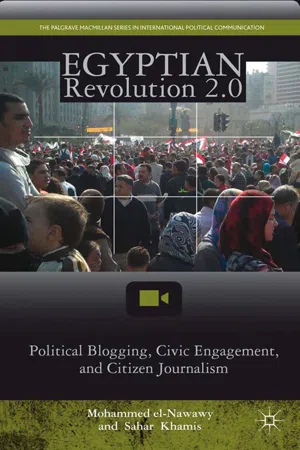
Egyptian Revolution 2.0
Political Blogging, Civic Engagement, and Citizen Journalism
- English
- ePUB (mobile friendly)
- Available on iOS & Android
eBook - ePub
Egyptian Revolution 2.0
Political Blogging, Civic Engagement, and Citizen Journalism
About this book
This book sheds light on the growing phenomenon of cyberactivism in the Arab world, with a special focus on the Egyptian political blogosphere and its role in paving the way to democratization and socio-political change in Egypt, which culminated in Egypt's historical popular revolution.
Information
Print ISBN
9781137020918
Subtopic
Middle Eastern HistoryC H A P T E R 1
Blogging as Cyberactivism: Introductory Themes
Who would have expected that a group of young digital activists, blogging, tweeting, chatting, and texting, could have sparked the massive wave of political change that swept the Arab world, and came to be known as the “The Arab Spring” or “The Arab Awakening”? The answer could very well be “no one”! That’s mainly because for a number of years the Arab world has been witnessing a perplexing paradox, namely, the gap between the vibrant and active media landscape, where many resistant and oppositional voices could be heard, on the one hand, and the dormant and stagnant political landscape, which did not exhibit any serious signs of active change, popular participation, or true democratization, on the other hand. One explanation that some Arab media scholars (Seib, 2007; Khamis, 2007, 2008) used to account for this puzzling gap was the notion of “safety valves,” that is, that Arab media, especially the opposition press, were being exploited by the autocratic ruling regimes as a platform for people to vent their angry feelings and resentment toward their authoritarian governments, instead of taking decisive steps in the direction of radical reform and transformation, thus substituting words for action (Seib, 2007).
It was not until the latest wave of political upheaval swept the Arab region that Arab media, or more precisely new media in the Arab world, started to become effective tools for “public will mobilization,” which usually “crystallizes around a social condition that is recognized as problematic; it coalesces into a collective consensus about how the problem can and should be ameliorated; and it can erupt, through coordination of resources and collective resolve, into social action” (Salmon et al., 2010, p. 159).
This book contributes to understanding how new media in the Arab world, especially political blogs, changed from being just safety valves to becoming effective “mobilization tools,” through analyzing the role played by the Egyptian political blogosphere in paving the road for the Egyptian popular revolution of 2011, as well as its multiple roles during and after the revolution.
The Egyptian revolution was characterized by the instrumental use of social media, especially Facebook, Twitter, YouTube, and text messaging by protesters, to achieve a number of pragmatic goals, such as group networking, on-the-ground organizing, and offering practical advice on how to confront police brutality or how to avoid arrest.
Each type of social media played a different role that is closely related to its own nature and functions. For example, the social network best suited for the task of organizing the protesters was Facebook, “where information could be spread to thousands of people in an instant and then shared between friends,” and this “dissemination was far faster than leaflets, with the added benefit that those receiving the messages were already interested and trusted the source” (Idle & Nunns, 2011, p. 20). This highlights the value of social media in terms of creating networks that enable peer-to-peer communication between users, especially since networks are multifaceted communication systems comprising relations that allow for “dynamic, emergent, adaptive, and flexible associations” (Howard, 2011).
Different social media tools lend themselves to different types of networks. Facebook, for example, is built on linkages between “friends,” whereas Google Moderator and Twitter allow anyone to comment on a subject. Google Moderator allows for commentary and voting on subjects by all users. Twitter allows users to create a subject for discussion and post a comment, or “tweet,” about that subject (which could include a link to other content), which can then be picked up by other users and “retweeted” multiple times, until it becomes widespread. Thus, tools like Twitter lead to an environment where the best ideas and content, regardless of who posted it, can spread and gain great influence in a type of “meritocracy” of ideas and information (Maher, 2011). By combining these multiple functions of different types of online media together in one effective communication network during the 2011 revolution, it is easy to understand how Egyptian political activists won their battle against the regime both online and, most importantly, offline.
However, we argue that while these types of social media were crucial for the actual execution of instrumental, organizational roles during the revolution, political blogs have played a different, but equally valuable, role through providing important venues for the exchange of ideas and the formulation of collective public opinion. Over the past seven years, blogs paved the way for the eruption of the revolution by widely sharing an antigovernmental discourse that revealed the former Egyptian regime’s dysfunctions and malpractices, such as corruption, violations of human rights, and limitations on freedom and democratic practice.
Through analyzing the discourses in five of the most popular Egyptian political blogs, we highlight the role played by political blogs in encouraging civic engagement and public participation through (1) acting as effective tools for supporting the capabilities of the democratic activists by allowing forums for free speech and political networking opportunities and (2) providing a virtual space for assembly, which allows for the exchange of civic discourse, deliberation, and articulation that goes beyond simply supporting the capability of the protestors to plan, organize, and execute peaceful protests on the ground.
Additionally, the book explores how political blogs, as new media avenues, can provide forums for citizen journalism through enabling ordinary citizens to document not only the protests, but, most importantly, the underlying causes that led to the eruption of these protests in the first place, such as governmental brutality, limitations on freedom of expression, flaws in the political system, official corruption, and violations of human rights, as well as allowing them to disseminate these words and images to each other, and, most importantly, to the outside world.
Moreover, we argue that the discourses and deliberations in the Egyptian political blogosphere also highlighted and optimized the communication struggle that erupted between the people, on the one hand, and their repressive government, on the other hand, which was as fierce as the political struggle on the ground. Through analyzing the postings on these political blogs, the book reveals how the Egyptian people engaged in a political struggle to impose their own agenda and ensure the fulfillment of their demands, while at the same time engaging in a communication struggle to make their authentic voices heard and tell their side of the story. While the dictatorial Egyptian regime took many measures to block the flow of information and inhibit mobilization efforts, thus combining the repression of protestors on the streets with the suppression of the truth in the media arena, the Egyptian people resisted these persistent efforts to both silence the peoples’ voices and present the state’s fabricated versions of the story, through asserting their own will and protecting their political rights. We argue that political blogs provided a venue through which such acts of resistance and empowerment were exercised and exemplified.
To better understand these points, however, it is essential to provide a brief overview of the changing communication landscape in the Arab world, especially before and after 1990, in order to assess the implications of new media venues, such as blogs, on transforming the political and communication landscapes in the Arab world. This provides the necessary context for analyzing the role played by political blogs before, during, and after the Egyptian revolution.
THE SHIFTING COMMUNICATION LANDSCAPE IN THE ARAB WORLD: THE IMPACT OF NEW MEDIA
Prior to 1990, most media ownership in the Arab world lay largely with governments, and most media functioned under strict governmental supervision and control. A number of authors (Rugh, 2004; Boyd, 1999; Mellor, 2007; Abdel-Rahman, 1985, 2002) argued that in this era, Arab media were mostly controlled by governments mainly to keep laypeople largely uninformed and thus incapable of effectively participating in ongoing political controversies and rational debates.
A new media revolution erupted in the Arab world after 1990, inspired by the introduction of both satellite television channels and the Internet (Khamis & Sisler, 2010). In the 1990s, Internet penetration started to spread throughout the Arab world. Although the region has generally suffered from being on the low end of the digital divide (Abdulla, 2007, p. 35), facing many challenges, including the lack of human and economic information technology (IT) resources, illiteracy and computer illiteracy, the lack of funds for IT research and development, and the lack of solid telecommunication infrastructures (Abdulla, 2007, p. 35), this situation is rapidly changing, since many Arab countries are currently striving hard to increase Internet penetration rates.
Ironically, although many Internet websites and blogs are used to defy and resist autocratic governments and dictatorial regimes in the Arab world, a number of these governments took steps to encourage Internet proliferation and accessibility, mainly in order to boost economic development, as in the case of the Egyptian government (Abdulla, 2006, p. 94). This provides more evidence of the highly ambivalent and complex relationship between media and governments in the Arab world (Khamis & Sisler, 2010).
Overall, it could be said that the introduction of satellite television channels and the Internet represented an important shift from the monolithic, state-controlled, and government-owned media pattern to a much more pluralistic and diverse media scene, where many varied and competing voices representing different political positions and orientations could be heard at the same time, adding to the richness of ongoing political debates and the formation of a wide array of public opinion trends (Khamis, 2007, 2008; Atia, 2006).
The rise in social media usage in the Arab world followed a rise in overall Internet and mobile phone penetration in the region. A study by Philip Howard (2011, pp. 19–20), encompassing predominantly Muslim countries throughout the world, shows that mobile phones and Internet penetration has increased dramatically over the last ten years, with technology adoption rates in these countries among the highest of all developing nations. The same study indicated that since 2001, the increase in Internet users has outstripped the increase in computers per household, likely reflecting the use of Internet cafés (which can be found in both urban and rural areas) and libraries, as well as the collective use of computers among family members and circles of friends.
The Internet allows for the dissemination of cultural content in the Arab world (Howard, 2011, p. 163). Much of the user-generated content is transmitted using social media, such as Facebook, blogs, the video-sharing portal YouTube, Twitter, and short message service (SMS) or text messaging. These media enable peer-to-peer communication between users and can be linked to each other, allowing users to transmit their ideas and images to large numbers of people. Therefore, it is safe to say that the Internet is one of the most important avenues through which public opinion trends and public spheres are both shaped, as well as reflected, in modern Arab societies (Zelaky et al., 2006, p. 5). The significance of the introduction of the Internet stems from the fact that it defies boundaries, challenges governmental media censorship, and provides an alternative voice to traditional media outlets that echo official, governmental policies and views. In other words, it enables the inflow and outflow of information simultaneously through a “virtually defined . . . emerging cyberworld that knows no physical boundaries” (Salmon et al., p. 159). Thus, it provides invaluable opportunities for public will mobilization across borders.
The Internet is also a rapidly growing and expanding medium, especially among youth. Recent research studies indicate that Internet use is increasingly more prevalent among younger age groups within the Arab world, especially the 20- to 30-year-old age group, which uses the net more avidly compared to the rest of the population, and those younger than 20 years old are the group growing most rapidly in the Arab world (Abdulla, 2007, p. 50). This can very well explain why and how new media were effectively deployed by young people in the Arab world to trigger political reform and pave the way for democratization.
Howard (2011, p. 182) notes that through social media, citizen journalists who are dissatisfied with traditional media’s version of events are telling their own stories, and that “these patterns of political expression and learning are key to developing democratic discourses.” He observed that social media not only help start democracies but also help entrench existing ones, and that the “networked design” of social media is the key factor threatening authoritarian regimes since “these are the communication tools for the wealthy, urban, educated elites whose loyalties or defection will make or break authoritarian rule” (Howard, 2011, p. 11).
Social media can also serve as channels for expressing collective consciousness and national solidarity. Freeland (2011) argues that opponents of a dictator need to feel that their views are widely shared and that enough of their fellow citizens are willing to join them. He indicates that “what really stops people who are oppressed by a regime from protesting is the fear that they will be part of an unsuccessful protest. When you are living in these regimes, you have to be extremely afraid of what happens if you participate and the regime doesn’t change.” Therefore, he contends that satellite television and social networking have made it easier to let each individual know that his/her views are shared by enough people to make protesting worthwhile and safe (Freeland, 2011). This was, indeed, applicable in the case of the Egyptian revolution.
After providing this overview of the dynamically shifting Arab communication landscape, which provided the needed environment for an equally transformative Arab political scene, we can now focus our attention on how blogs, in particular, can play an effective part in this vibrant and transitory moment of contemporary Arab history, through their multiple roles.
BLOGGING: DEFINITIONS, TYPES, AND FUNCTIONS
A blog can be defined as “a Web page that is updated frequently, with the most recent entry displayed at the top of the page” (Rheingold, 2008, p. 103). It can also be defined as virtual spaces “with minimal to no external editing, providing on-line commentary, periodically updated and presented in reverse chronological order, with hyperlinks to other online sources” (Drezner & Farrell, 2004, p. 5). By definition, “a blog . . . [or] ‘weblog’ is a form of online diary where anyone with access to the Internet can create a platform from which they may reveal to the world whatever is on their minds” (Seymour, 2008, p. 62). One of the main distinguishing features of blogs has been their autonomy and independence from authoritarian and governmental control and domination, and blogs have been described as “a new form of communication that shifts mainstream control of information to the audience. Emergent technology allows bloggers to express views and blog readers to engage in meaningful conversation, thus empowering news audiences to become information providers” (Chung et al., 2007, p. 305). Additionally, besides providing the opportunity for the author to express himself or herself, blogs allow other Internet users to comment on the online stories referred to as blog posts (Drezner & Farrell, 2004), thus widening the scope of public participation in online discussions and opinion exchange.
This activity has been made possible through some of the characteristics of blogging, such as the fact that it is free of charge and easily accessible. In just a couple of minutes, a person can create an account with Blogger, or WordPress, or some other blog hosting service, and start blogging. If we compare this to the process of television, newspaper, or magazine production, we can easily tell that blogging requires no special resources, whether economic, in terms of budget, or human, in term of training or skills. Therefore, it has fewer barriers, compared to mainstream media, in terms of who can participate and who can become a “sender” and/or a “receiver.” It is this openness and accessibility of blogging that provides it with the potential to be such a powerful tool for participatory democracy, and to possibly bring about change in the public sphere. These possibilities will be questioned and debated in the rest of this chapter. However, the fact remains that today any Internet user can maintain a blog without additional training (Ward & Cahill, 2007), and blogs are easily available to anyone, provided they have Internet access. Blogging also allows building relationships online, since the structure of blogs allows readers to reach posts, read others’ comments, and post multiple comments, thus providing for a meaningful conversation (Kline & Burstein, 2005). Additionally, the Internet provides a certain degree of anonymity; therefore, bloggers can express their views without identifying their names, localities, or any other personal information. This could, in turn, make them feel less threatened when they expose their views and ideas to an online community. Some scholars, such as McCullagh (2008), found that the anonymous nature of blogging encouraged Internet users to post personal information that may have been threatening and/or private. Along the same lines, Muhtaseb and Frey (2008) suggested that anonymity might encourage Internet users to freely express their opinions online, thus allowing bloggers to post their views with less restrictions and constraints.
Another feature of the growing blogging process has been “linking conversations and other existing blogs, increasing the ebb and flow of information. This forms hubs or nodes within networks, where bloggers aggregate information, and give orientation and relevance—and also become effective filters of information. They act like fishers, who pick the most relevant pieces of information out of the net” (Kreutz, 2009, p. 30). This interconnected and closely networked web of blogs leads to the creation of a “blogosphere.” This is another distinguishing characteristic between blogs and mainstream media. Newspapers and...
Table of contents
- Cover
- Title Page
- 1 Blogging as Cyberactivism: Introductory Themes
- 2 Political Blogging: (Re)Envisioning Civic Engagement and Citizen Journalism
- 3 The Arab Political Blogosphere: The Case of Egypt
- 4 Blogging on Violations of Human Rights and Limitations on Freedom
- 5 Blogging on Governmental Corruption
- 6 The Future of Political Blogging in Egypt: Looking Ahead
- References
- Index
Trusted by 375,005 students
Access to over 1.5 million titles for a fair monthly price.
Study more efficiently using our study tools.
Frequently asked questions
Yes, you can cancel anytime from the Subscription tab in your account settings on the Perlego website. Your subscription will stay active until the end of your current billing period. Learn how to cancel your subscription
No, books cannot be downloaded as external files, such as PDFs, for use outside of Perlego. However, you can download books within the Perlego app for offline reading on mobile or tablet. Learn how to download books offline
Perlego offers two plans: Essential and Complete
- Essential is ideal for learners and professionals who enjoy exploring a wide range of subjects. Access the Essential Library with 800,000+ trusted titles and best-sellers across business, personal growth, and the humanities. Includes unlimited reading time and Standard Read Aloud voice.
- Complete: Perfect for advanced learners and researchers needing full, unrestricted access. Unlock 1.5M+ books across hundreds of subjects, including academic and specialized titles. The Complete Plan also includes advanced features like Premium Read Aloud and Research Assistant.
We are an online textbook subscription service, where you can get access to an entire online library for less than the price of a single book per month. With over 1.5 million books across 990+ topics, we’ve got you covered! Learn about our mission
Look out for the read-aloud symbol on your next book to see if you can listen to it. The read-aloud tool reads text aloud for you, highlighting the text as it is being read. You can pause it, speed it up and slow it down. Learn more about Read Aloud
Yes! You can use the Perlego app on both iOS and Android devices to read anytime, anywhere — even offline. Perfect for commutes or when you’re on the go.
Please note we cannot support devices running on iOS 13 and Android 7 or earlier. Learn more about using the app
Please note we cannot support devices running on iOS 13 and Android 7 or earlier. Learn more about using the app
Yes, you can access Egyptian Revolution 2.0 by M. el-Nawawy,S. Khamis in PDF and/or ePUB format. We have over 1.5 million books available in our catalogue for you to explore.