eBook - ePub
The Political Role of Corporate Citizens
An Interdisciplinary Approach
- English
- ePUB (mobile friendly)
- Available on iOS & Android
eBook - ePub
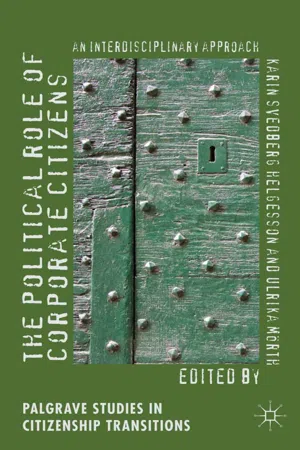
The Political Role of Corporate Citizens
An Interdisciplinary Approach
About this book
This volume provides an interdisciplinary analysis on the political role of corporations in society by using the analytical device of corporate citizenship. It questions what ideas on corporate citizenship may say about the ongoing publicization of the corporation and the implications of these developments for the public domain and welfare state.
Information
1
Introduction: Corporate Citizenship and the Political Role of the Corporation
Introduction
The role of corporations in modern society is in flux, and the state is not what it used to be. During recent years the scholarly debate on the borders between the public and private domains has focused on how large transnational companies have gained authority in areas of global governance and regulation that traditionally belonged to the state, intergovernmental organizations and the public sector (Jordana and Levi-Faur, 2004; Djelic and Sahlin, 2006; Kobrin, 2009). This trend comes in many shapes and forms. Increased co-operation and boundary-blurring are conceptualized as network governance (Bäckstrand, 2008), multi-sectoral or global policy networks (Benner et al., 2005), forms of neo-liberal governmentality (Lipschutz, 2005), a manifestation of an emerging global public domain (Ruggie, 2004; Helgesson and Mörth, 2012), private international authority (Cutler, 2003; Hall and Biersteker, 2002), private government (Crane et al., 2008), and public-private partnerships (Dingwerth, 2007; Schäferhoff et al., 2009; Bexell and Mörth, 2010). A common theme in the literature is that the state and the public sector have become more dependent on business norms and resources, to what is in national and European contexts referred to as New Public Management (Lane, 2000; Mörth, 2008), and in the global context discussed in terms of market multilateralism (Bull and McNeill, 2007).
Of course, the scholarly debate on the role of business in society has long roots. The concept of private government was contemplated by Merriam (1944), and others. Around two decades later, Peter Bachrach (1967) argued that there were important similarities between General Motors and the United States government. Bachrach (1967: 102, in Vogel, 1975: 15) proposed that these entities ‘both authoritatively allocate values for the society. It is on the basis of this resemblance that General Motors and other giant private governments should be considered a part of the political sector in which democratic norms apply’. In a similar vein, James March observed that the business firm is a political coalition (March, 1962). A large corporation was thus not only to be thought of as a social enterprise but as a political system as well (Dahl, 1972). Although the political system of the state in principle had the legitimate authority to its citizens, an authority that the large corporations lacked, the distinction between the systems was blurred in practice (Dahl, 1972). Dahl argued that large corporations may cause death and injuries by decisions on pollution, working conditions, impose severe deprivations of income by making decisions on plant location, and ‘exercise influence, power, control, and even coercion over employees, customers, suppliers … by advertising, propaganda, promotions, and demotions, not to mention possible illegal practices’ (Dahl, 1972: 18). For Dahl, the implication of this similarity between the political system of the state and the enterprise was the obligation to examine the corporations. They were a public matter.
The quote from Dahl (Dahl, 1972: 18) illustrates the wave of the publicization of the corporation that was so strongly advocated in the 1960s and 1970s (Vogel, 1975). The aim was not only to raise questions on the internal legitimacy of management, but to challenge, and expand ‘the accountability of the corporation as a whole to the society’ (Vogel, 1975: 16). The collapse of the distinction between government and business, expressed in the buzzwords at the time – the military-industrial complex and the corporate state – made it necessary to analyse the corporation as a form of governmental authority and public institution.
Currently, we still grapple with questions on the borders between the public and private, and the role of corporations in society. In the early 2000s they appear perhaps more pressing than ever. The classic Friedman approach towards business – that businesses should ‘stick to the knitting and attend exclusively to their interests of their shareholders’ (Néron and Norman, 2008: 1) – is challenged, though advocates are also around (Pies et al., 2010). New demands on legitimacy standards are being raised for governance beyond the state and by the for-profit sector (Dingwerth and Hanrieder, 2010; Dingwerth, 2007). These demands are often about democratic legitimacy and accountability, as the power to act on public matters is not always grounded in a legitimate authority to do so (Kobrin, 2009). Far from it, irrespective of whether transnational corporations are deemed democratically legitimate or not, they do ‘operate directly as powerful autonomous actors in international politics’ (Kobrin, 2009: 354), and capital markets are intertwined with national politics:
The formation of a global capital market represents a concentration of power capable of influencing national government economic policy, and, by extension, other policies as well. These markets now exercise the accountability functions associated with citizenship: they can vote governments’ economic policies down or in; they can force governments to take certain measures and not others. (Sassen, 1996: 42, see also Lindblom, 2001)
The political dimension is not necessarily about party politics but on how political values and norms are involved when corporations provide welfare services, or protect citizens from terrorist attacks (den Boer and van Buuren, 2012). We are witnessing an increased politicization of corporations when they increasingly populate the public domain. Studies by Drache, Ruggie and Dryzek deal with how states and non-state actors are embedded in a broader institutionalized arena concerned with the production of global goods and services (Drache 2001; Ruggie 2004; Dryzek 2000). Their works deal with how different values and norms from the public and private are intertwined, and re-mixed, and the normative implications of this embeddedness. One implication is a state of confusion of what norms and values are applicable in politics as argued by Sennett (1974). We believe that the stronger presence of corporations in the public domain may depoliticize this domain also in the sense that the democratic system, the elected politicians and citizens, will have less influence over welfare and other core policy areas.
The implications of an increasing publicization of corporations – that they take on important roles in societies – and how it affects the public domain, the welfare state and democracy is multifaceted. In this volume we analyse the current state of the role of corporations in societies with a view to the political role of corporations. Drawing on a range of disciplines, including political science, organization and management, sociology, and accounting, we make use of the notion of a citizenship for corporations as a device for delineating and analysing the political role of the corporation in the public domain. The political role of corporations is understood here as a role that goes beyond the traditional understanding of corporations and politics. Traditionally, corporations are perceived to act and react towards the political system by lobbying and other activities in order to influence public policy. This volume is about boundary blurring between the world of corporations and politics. Corporations are not outside the political process. They are influencing the playing field of politics by enacting different societal roles. We ask what ideas on corporate citizenship may be voiced about this ongoing publicization of the corporation. What are the roles of the corporate citizen in the public domain and how do these new roles transgress traditional notions of what corporations are and ought to be?
Frame of reference
The volume addresses the complex and classic questions on the roles of states and markets by analysing how this longstanding debate is manifested in corporate citizenship. Corporations may not be citizens, but ‘corporations could reasonably claim to act “as if” they were metaphorically citizens in that their engagement in society resembles that of citizens’ (Moon et al., 2005: 448).
What then is it that such an ‘as if’ position of citizen may entail for corporations? How is corporate citizenship to be defined? One influential template in the literature on corporate responsibility and citizenship is that of Carroll (1991, 1997, 2003). He proposes that corporate citizenship has four facets, or levels, to do with being profitable, obeying the law, behaving ethically and engaging in philanthropy. Here, we have opted for using a template that draws more explicitly on traditional notions of individual citizenship. One important reason for this, we argue, is that for the concept of corporate citizenship to serve as a device for understanding the political role of corporations in the public domain, one needs to acknowledge that ‘citizen’ and ‘citizenship’ are powerful and multifaceted concepts. They are powerful because they speak of rights, duties/responsibilities, participation/deliberation and identities. They are multifaceted because these values can be categorized into different types of rights, duties, participation and identity (Delanty, 2000). Citizenship can further be regarded as an individual membership or as a social citizenship in the welfare state alleviating socio-economic inequality (Delanty, 2000).
Importantly, there exist various theoretical traditions in modern social and political thought on how to interpret citizenship, that have different implications for the conceptualization of corporate citizenship. Put simply, the liberal tradition emphasizes rights, the conservative tradition stresses duties, and the republican and communitarian tradition focuses on participation and identity as being linked to the nation-state project (Delanty, 2000). This implies that what corporate citizenship is and can be varies depending on what tradition is placed at the fore, and which constituent parts and sub-categories are emphasized. In this volume, we will make use of Delanty’s categorizations and discuss the realm of corporate citizenship in terms of rights, duties, participation and identity (cf. Crane et al., 2008).
The idea of a citizenship for corporations can be seen as provocative in that it implies that corporate actors could be similar to individuals in important matters of citizenship. To be sure, neither the concept nor the phenomenon of corporate citizenship exists in the classical literature on citizenship, and the notion of a citizenship for corporations tends to be regarded as an oxymoron (Delanty, 2000). Here we do not attempt to claim that corporations can be equals among other citizens. However, we do believe that the friction and resistance the concept of corporate citizenship encounters are useful for analytical purposes, and make the notion of citizenship more challenging than related concepts like corporate social responsibility and corporate accountability (see the comparative analysis of these concepts in Waddock, 2004). It is precisely because the fit is not perfect that the idea of a citizenship for corporations can serve as a device for delineating the political role of corporations that spans the public-private divide, we suggest.
Two recurrent themes
Our analyses of the following are grounded in two recurrent themes from discussions of the role of corporations in the general literature on politics and business. The first theme is how the state has retreated or transformed and opened up for business to take on societal responsibility. The second theme is that this development, in turn, requires a new understanding of the political role of business that goes beyond ‘mere compliance with legal standards and conformity with moral rules’ (Scherer and Palazzo, 2008). In summary, there is a call for a political theory of the firm (Néron, 2010).
The first theme – the retreat or transformation of the state – is an important premise in the literature for the very notion of bringing in citizenship into the world of business that goes beyond the traditional legal-rationalistic perspective on corporations (Scherer and Palazzo, 2011). The marketization of the public and/or the privatization of the state create spaces that may be filled by (more engaged) corporate citizens. Globalization and the post-Westphalian order or the post-national constellation has created new challenges for business. The erosion of the division of labour between business and government accentuates and emphasizes the need for the business to take on societal responsibility (Crane et al., 2008; Scherer and Palazzo, 2011).
Thus, the theme in the literature on the retreat or the transformation of the state has to do with the complex issue of whether the emergence of corporate citizenship is a function of a changed or a weak state. The question is seldom the object of empirical scrutiny in the literature on corporate citizenship. We believe that this volume contributes to the theorization of the relationship between states and corporations. The ‘commodification’ or the ‘choice revolution’ (Blomqvist, 2004 and Blomqvist, this volume) in the welfare states in the western world have created new rights and obligations for corporations, whether they want to take on such a role or not. What is less problematized is that in some cases there was no prior state, only failed state-building efforts, in need of responsible actors, private or public (Matten and Crane, 2005; Idemudia, 2010). We have limited knowledge on if, and how, governments or local authorities respond to a societal role by corporations in cases of weak states. Furthermore, we have limited empirical studies on the various manifestations an increased publicization may take in the western world. The advent of new existential threats raises demands for a more proactive engagement on behalf of corporate actors as agents in process of securitization with associated conflicts of interests and values (Helgesson and Mörth, 2012).
The second theme from the literature is that corporate citizenship helps bring politics into the world of business and business into the world of politics (Moon et al., 2005; Edward and Willmott, 2008a, 2008b). The concept of citizenship may thus open up for a more explicit analysis of the firm as a political actor in contrast to the traditional view of corporations in societies (Néron, 2010). As Néron and Norman (2008), who are critical to many aspects of corporate citizenship, acknowledge: ‘if we take seriously the conceptual resources of citizenship, it will focus our attention back on a number of important virtues that are surprisingly neglected in discussions framed under the rubrics of business ethics, CSR and sustainability’ (Néron and Norman, 2008: 18). Or as Edward and Willmot (2008b: 772) put it: ‘An alternative to dropping the corporate citizenship term is to advance a more powerful case for its retention in order to promote greater politicization of the corporation as a means towards social and corporate transformat...
Table of contents
- Cover
- Title
- Copyright
- Contents
- List of Tables
- List of Figures
- Series Editors’ Preface
- Preface and Acknowledgements
- Notes on Contributors
- List of Abbreviations
- 1 Introduction: Corporate Citizenship and the Political Role of the Corporation
- 2 Corporations and Clientelism: The Problem of Democratic Accountability for Corporate Citizenship
- 3 Citizenship, Identity and the Corporation: Exploring New Avenues of Political Mediation
- 4 Inadvertent Citizens: Corporate Citizenship and Moral Actorhood
- 5 Standards, Triple Bottom Lines and Balanced Scorecards: Shaping the Metaphor of Corporate Citizenship with Calculative Infrastructures
- 6 Revisiting Corporate Citizenship Theory and Practice from the Perspective of Local Communities in Africa: Lessons from Nigeria
- 7 Various Corporate Citizenships in BoP Markets
- 8 Citizenship, Choice and Social Equality in Welfare Services
- 9 Corporate Citizens and ‘The War on Terror’
- 10 Conclusions: The Political Role of Corporations
- Index
Trusted by 375,005 students
Access to over 1.5 million titles for a fair monthly price.
Study more efficiently using our study tools.
Frequently asked questions
Yes, you can cancel anytime from the Subscription tab in your account settings on the Perlego website. Your subscription will stay active until the end of your current billing period. Learn how to cancel your subscription
No, books cannot be downloaded as external files, such as PDFs, for use outside of Perlego. However, you can download books within the Perlego app for offline reading on mobile or tablet. Learn how to download books offline
Perlego offers two plans: Essential and Complete
- Essential is ideal for learners and professionals who enjoy exploring a wide range of subjects. Access the Essential Library with 800,000+ trusted titles and best-sellers across business, personal growth, and the humanities. Includes unlimited reading time and Standard Read Aloud voice.
- Complete: Perfect for advanced learners and researchers needing full, unrestricted access. Unlock 1.5M+ books across hundreds of subjects, including academic and specialized titles. The Complete Plan also includes advanced features like Premium Read Aloud and Research Assistant.
We are an online textbook subscription service, where you can get access to an entire online library for less than the price of a single book per month. With over 1.5 million books across 990+ topics, we’ve got you covered! Learn about our mission
Look out for the read-aloud symbol on your next book to see if you can listen to it. The read-aloud tool reads text aloud for you, highlighting the text as it is being read. You can pause it, speed it up and slow it down. Learn more about Read Aloud
Yes! You can use the Perlego app on both iOS and Android devices to read anytime, anywhere — even offline. Perfect for commutes or when you’re on the go.
Please note we cannot support devices running on iOS 13 and Android 7 or earlier. Learn more about using the app
Please note we cannot support devices running on iOS 13 and Android 7 or earlier. Learn more about using the app
Yes, you can access The Political Role of Corporate Citizens by Karin Svedberg Helgesson, U. Mörth in PDF and/or ePUB format, as well as other popular books in Social Sciences & Business General. We have over 1.5 million books available in our catalogue for you to explore.