- English
- ePUB (mobile friendly)
- Available on iOS & Android
eBook - ePub
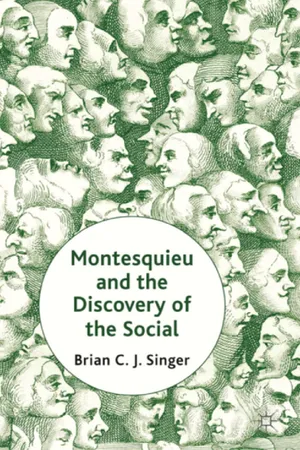
Montesquieu and the Discovery of the Social
About this book
Montesquieu is often considered the first social thinker. Today, when 'the end of the social' has been proclaimed, it is time to reconsider its beginnings. In a wide-ranging, original interpretation of The Spirit of the Laws, this book explores what did it mean to 'discover the social', and what can it mean to recover the social today?
Information
1
The Question Concerning Laws
When I recollect what the President Montesquieu has written, I am at a loss to tell why I should treat of human affairs …1
Durkheim on Montesquieu: social vs. political laws
Auguste Comte, Émile Durkheim, Raymond Aron and Louis Althusser, among others, all claimed Montesquieu to be the first to discover the social.2 Such a claim, despite or because of the diversity of the claimants, is entirely conventional, at least among French authors. By revisiting this convention, I am defending the claim—although I admit to more than one discovery. Moreover, these authors all claim that social analysis arose in opposition to the formerly dominant political (and implicitly, metaphysical) schemas. But this latter claim begs a number of questions, and it is in the response to these questions that my analysis seeks to cut its own path. How is the separation of the social from the political made possible? What is this ‘social’ that by being separated appears for the first time? What kind of ‘object’ is it? What does its emergence mean for the comprehension of—and by implication, action on—collective life? And what are the implications of this separation as it rebounds onto the political? To highlight my difference from the more common responses, I want to begin with a brief examination of Émile Durkheim’s writings on Montesquieu. I choose Durkheim’s writings because they are far more extensive than those of Comte, more emphatic than those of Aron, and in crucial respects similar to those of Althusser.3 Besides, Durkheim is a perennial favourite in classical sociology courses.
Durkheim’s essay on Montesquieu is, arguably, his first properly sociological work. It is, in fact, his thesis, written in Latin, published in 1892, and translated into English as ‘Montesquieu’s Contribution to the Rise of Social Science’.4 The thesis speaks, in a sense, of a double discovery of the social: a first, incomplete discovery (Montesquieu’s) and a second, more conclusive discovery (Durkheim’s). Durkheim, in effect, claims to recover in Montesquieu the sociological principles that he himself failed to fully uncover. These principles become the basis for Durkheim’s own scientific study of society, as demonstrated in his first major work, The Division of Labour in Society, which he was writing concurrently.5
Montesquieu, according to Durkheim, lays the basis for the ‘epistemological break’ that founds the social sciences by substituting social laws for political or juridical laws. In contrast to juridico-political laws, social laws are scientific laws, not unlike those uncovered in the sciences of nature. Like the latter, social laws are concerned with the discovery of ‘efficient causes’; juridico-political laws, by contrast, are burdened by teleological thinking. Prior to Montesquieu, collective existence was seen as an essentially political construct established and maintained by a will (either divine or human, individual or collective). This will makes and enforces the laws that give the collective its order and purpose. To establish a good order, the will not only has to establish good laws, but the will itself has to be good, that is, guided by proper principles. Without the laws established by a political will, there can be no collective order; and without good laws, disorder and corruption will result. This political understanding of collective order, according to Durkheim, is fundamentally ‘idealist’; it would constitute the collective in accord with its ‘idea’ of the law. Because it is based in ideas, the political is closely related to, and borrows heavily from, theology, philosophy and morality, as well as jurisprudence. The political understanding of society, in short, represents the last flower of Auguste Comte’s metaphysical age; Durkheim understands the new social understanding as marking the entry into a new ‘positive age’. Where the old political metaphysics’ primary concern was with the proper juridico-political norms, the new social science, in Durkheim’s view, addresses factual reality.6 As there are elements of the Durkheimian argument that I wish to retain, let me fill in for Durkheim and examine this failure to consider this reality.
In truth, the juridico-political discourse does not ignore the facts (something that, in the last analysis, is impossible); but for this discourse the significance of the facts can only be determined in terms of their accord with the juridico-political norm. As the latter alone constitutes order (and the value and sense conveyed by order), to the extent that the facts do not accord, they appear literally disordered and senseless. It is of secondary importance whether this senseless disorder is attributed to either a shortfall of the law or its enforcement, or to some active, negative principle, which is theological (evil), natural (corruption) or historical (the legacy of a dark and barbarous age). Society is made not only orderly but intelligible through the imposition of the proper juridico-political norm—which is to say that society appears intelligible only to the degree that its legal norm is re-presented, that is, rendered present. This norm, then, entails both the instrument necessary for the constitution of orderly collective existence and the knowledge necessary for its comprehension. As such, knowledge is knowledge of the norm, and of the law that re-presents the norm; and such knowledge belongs to the power that pronounces and enforces the law. For knowledge does not simply describe, explain or justify the norm; it translates the norm into laws, and establishes the order and sense that the law makes possible. In this sense the norms must be re-presented twice over: rendered present in discourse as law; and rendered present in the facts. These are facts that not only accord with the norm, but would not be present without the norm. These are orderly, sensible facts—the demonstration of the norm’s purchase on reality. In a perfect world all facts would be of this type. In such a world, the doubling of re-presentation would occur through a single act, whereby legislation in discourse suffices for its execution in the facts. Here those distinctions that we take for granted would be elided—those between the ideal and the real, the word and the thing, speaking and doing, the invisible and the visible. For this conception of re-presentation supposes the ideal to be present in the real, the word in the thing, the invisible within the visible. Of course, we do not live in a perfect world: the facts belong to a material world that often proves recalcitrant, and the institutions that re-present the law must be doubled by those that enforce it. Moreover, some facts resist the law’s enforcement; these are the disordered, senseless facts that attest to ‘the real’. The norm, however, is based in an ideal world, and it is the latter that models the understanding of law, knowledge and power.
Durkheim has little patience with the circular logic implied by this understanding. He criticizes juridico-political laws for wanting to identify collective order with their own discursive enunciation, as if these laws could constitute an order simply by speaking it. They would produce a metaphysical dream world, where political reason required only its imposition by an effective political will. In turning to the facts, Montesquieu sought to shake intellectual life out of its sempiternal reverie. But he could not turn to the facts unless they were seen to bear an order and sense of their own, independent of the norm. This, precisely, is what social laws do: they arrange the facts into regular patterns of cause-and-effect relations, and thereby reveal that collective existence possesses a modicum of order without having to refer to juridico-political representation of ideas and wills. Indeed, in Durkheim’s starkly binary conception of social science, social laws almost completely replace juridico-political laws, the existence of the latter being largely redundant to either the collective order’s constitution or comprehension. The social exists in the facts, and juridico-political laws are not proper facts, for being based in an ideal world, they are without genuine causal purchase. One must penetrate beneath the discursive surface of positive laws to the underlying reality presented by social laws, and inscribed in the facts. Where formerly the distance between facts and norms signalled a deficient, disorderly reality, this distance now signals a failure to properly appreciate the underlying social order. From the perspective of the norm, reality can appear disorderly and senseless, but from a properly scientific perspective, disorder must be seen as reflecting a deeper order. The facts may not live up to the juridical norm, but for social science there can be no division between facts and social laws. Social science can, in principle, explain all the social facts, which, however subjectively distressing, must be considered objectively lawful and, therefore, orderly. ‘The real’ dissolves into reality, even as reality becomes complete in itself. The discovery of social laws, and their enunciation by the social scientist, adds nothing to the reality they describe. Knowledge of these laws remains mere words—at least until inscribed in a techne or praxis. The truth value of knowledge is without symbolic value; unlike juridico-political laws, scientific knowledge supposes a reality separate from its representation. Reality is no longer tied to transcendent ideas (of which this world is but a pale copy); reality is now seen as immanent, and lies below rather than above.
With the displacement of reality from the norms to the facts, the polity, equated with positive laws and powers, is replaced by society, equated with the facts and the social laws that ‘govern’ them. In truth, the polity is not so much replaced as absorbed within society. Durkheim cannot deny the reality of juridico-political institutions, but theirs is a lesser reality, a tributary to the underlying social reality. The political, in short, is now seen as determined rather than determining. Though to be fair, Durkheim hesitates before the enormity of his own claims:
[T]he lawgiver produces nothing—or next to nothing—that is new. Even if he did not exist, there would have to be laws, though they would be less sharply defined. However, he alone can frame them. Granted. But he is only the instrument of their promulgation, not their generating cause.7
In the distinction between framing the laws and the generating cause, one detects the emergence of a gap that must be quickly closed. It is the social laws that rule; political laws provide only a semblance of rule, a semblance that, being ‘next to nothing’, makes little or no difference. The real power behind the political throne lies with the social laws, which alone create order and value. Such is Durkheim’s ‘socio-centrism’ here that there is almost no room for the political. Without any real weight of its own, the political appears, at best, an extension of the social and, at worst, a distorting mirror. As a result, there can be no genuine articulation between the two terms.
This socio-centrism leads Durkheim to fault Montesquieu. Durkheim praises his discussion of the influence of ‘size of population, topography, climate and soil’,8 as well as his examination of monarchic regimes as complex, self-regulating systems. However, he judges Montesquieu’s epistemological break to be incomplete, for Montesquieu remains too enamoured of the political. Not only does he use political categories to distinguish different societal types (republic, monarchy and despotism),9 but he places too much emphasis on individual lawgivers (Romulus, Numa, Solon and Lycurgus), and too much importance on the ‘art’ of legislation. ‘Laws’, Durkheim insists, ‘are not devices that the lawgiver thinks up because they seem to be in harmony with the nature of society. They spring most often from causes which engender them by a kind of physical necessity.’10 It is not just Montesquieu’s reliance on political categories that is problematic; his discussion of social laws is itself deficient. In truth, he never uses the term ‘social laws’, but distinguishes between positive juridical laws from ‘laws in general’, which could be considered social laws if not for the unwarranted intrusion of metaphysics (‘natural law’) and psychology (the laws of ‘human nature’). Moreover, many of these ‘general’ laws are particular to the functioning of a given regime type. True social laws are truly general, and apply to all societies irrespective of their differences. Montesquieu, moreover, appears less interested in uncovering scientific truths than in developing an ‘ideal logic’ for the construction of regime types.11 But the latter can only proceed deductively, in view of a definitional and logical consistency. The result is a hierarchization of the facts, with those that confirm the type being stressed, and those that do not being ignored. Although Montesquieu examined a huge range of social phenomena, he was not, in Durkheim’s estimation, a consistent empiricist. A genuine social science supposes an inductive method, and treats all the facts in a given domain as equally relevant. Only then can one be assured that the social laws reflect external reality, and not the ideas, ideals or desires of the thinker.12 One last criticism: in establishing regime types, Montesquieu sought to establish a set of ideational relations that both explained a regime’s moral character and rendered moral judgement on that character. Behind the ‘ideal logic’, Durkheim detects a hidden teleology, borne by the demand for rational coherence that would be both logical and normative.13
Again Durkheim’s binaries are stark. The distinction between social and political laws corresponds to the oppositions between facts and values, induction and deduction, material and ideal causality, determinacy and contingency. The former terms are embraced—they alone belong to reality— and the latter are abandoned as the idle spinning of a hubristic reason. No doubt, at the root of these binaries lies the importation of a notion of scientific law drawn from the natural sciences. Whether the natural sciences actually conform to this portrait is not at issue here; nor is whether Durkheim applies such strictures, in all their rigour, to his own work. What is at issue is the claim, oft repeated since Durkheim, that Montesquieu discovered the social by introducing scientific law and scientific method into areas considered the exclusive preserve of more ‘humanist’ branches of knowledge—history, political theory, jurisprudence, with philosophy and, possibly, theology playing supporting roles. Sometimes this claim is made to praise Montesquieu, as is the case here. At other times, the claim is made critically, the scientistic moment being ‘the original handicap’ of ‘the sociological viewpoint’, which asserts ‘the necessity of necessity’ at the expense of human agency.14 Among political theorists in particular, once the sociological moment is equated with science, it becomes necessary to condemn, reduce or isolate its presence.15
However common the identification of the social with scientific laws, it entails two problems: it does not do justice to Montesquieu; and it does not do justice to sociology or social science, let alone social theory. The latter have undergone far too much epistemological variation to be reducible to a single, scientistic strand. Wouldn’t it be better, then, to associate the discovery of the social with a method that is potentially inclusive of a variety of tendencies? Moreover, if one must equate the social sciences with the ideas and methods of the natural sciences, there are far better candidates for the discovery. Physiocracy literally means ‘rule by natural law’, the latter understood as bringing to bear, precisely, the ‘kind of physical necessity’ that Durkheim would approve of.16 And if one considers the physiocrats’ understanding of natural law as insufficiently empirical, there were the ‘sciences morales et politiques’ of the idéologues, whose ‘analytic method’ was drawn from Locke and Condillac.17 The fact that these schools rarely rate a mention in the standard histories of sociology or the social sciences suggests that the importation of scientific law and method was hardly as decisive as often claimed.
Durkheim acknowledges, if only negatively, that Montesquieu is not an ideal exponent of the scientific method. Montesquieu was too enmeshed in an older episteme to follow through his scientific insights to their proper conclusions. But what appears inconsistent to Durkheim is better understood as the inadequacy of his interpretation. Montesquieu is entirely consistent, and a close reading of De l’Esprit des lois reveals a very coherent text. This is not to deny the existence of a scient...
Table of contents
- Cover
- Title Page
- Copyright
- Contents
- Preface and Acknowledgements
- 1. The Question Concerning Laws
- 2. Power, Law and the Three Regimes: Political Bonds
- 3. The Spirit of the Three Regimes: Social Bonds
- 4. The General Spirit, Moeurs, Manners and the English Regime
- 5. Conclusion: Speaking of the Social
- Bibliography
- Index
Trusted by 375,005 students
Access to over 1.5 million titles for a fair monthly price.
Study more efficiently using our study tools.
Frequently asked questions
Yes, you can cancel anytime from the Subscription tab in your account settings on the Perlego website. Your subscription will stay active until the end of your current billing period. Learn how to cancel your subscription
No, books cannot be downloaded as external files, such as PDFs, for use outside of Perlego. However, you can download books within the Perlego app for offline reading on mobile or tablet. Learn how to download books offline
Perlego offers two plans: Essential and Complete
- Essential is ideal for learners and professionals who enjoy exploring a wide range of subjects. Access the Essential Library with 800,000+ trusted titles and best-sellers across business, personal growth, and the humanities. Includes unlimited reading time and Standard Read Aloud voice.
- Complete: Perfect for advanced learners and researchers needing full, unrestricted access. Unlock 1.5M+ books across hundreds of subjects, including academic and specialized titles. The Complete Plan also includes advanced features like Premium Read Aloud and Research Assistant.
We are an online textbook subscription service, where you can get access to an entire online library for less than the price of a single book per month. With over 1.5 million books across 990+ topics, we’ve got you covered! Learn about our mission
Look out for the read-aloud symbol on your next book to see if you can listen to it. The read-aloud tool reads text aloud for you, highlighting the text as it is being read. You can pause it, speed it up and slow it down. Learn more about Read Aloud
Yes! You can use the Perlego app on both iOS and Android devices to read anytime, anywhere — even offline. Perfect for commutes or when you’re on the go.
Please note we cannot support devices running on iOS 13 and Android 7 or earlier. Learn more about using the app
Please note we cannot support devices running on iOS 13 and Android 7 or earlier. Learn more about using the app
Yes, you can access Montesquieu and the Discovery of the Social by Brian Singer in PDF and/or ePUB format, as well as other popular books in Social Sciences & Political Philosophy. We have over 1.5 million books available in our catalogue for you to explore.