- English
- ePUB (mobile friendly)
- Available on iOS & Android
eBook - ePub
About this book
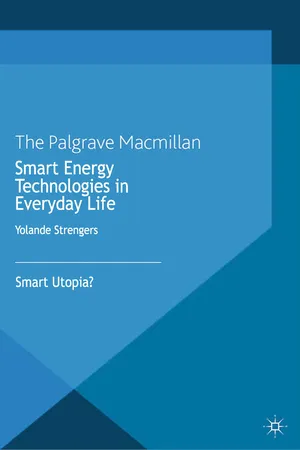
This book interrogates the global utopian vision for smart energy technologies and the new energy consumer intended to realise it. It enriches and extends the possibilities of four residential smart strategies: energy feedback, dynamic pricing, home automation and micro-generation, focusing on how they are being integrated into everyday practice.
Information
1
Introducing the Smart Utopia
Smart stuff has captured the imaginations of governments and industries around the world. In many developed and developing countries, the ‘smart’ tag is attached to all manner of things, including meters, grids, homes, phones, cars, communities, cities and even nations, where it confusingly characterises both the proliferation of new information communication technologies (ICTs) and the rise of resource-efficient technological features (Berry et al. 2007). In its broadest sense, ‘smart’ represents an ultimate desired state across all aspects of contemporary life. It encapsulates ideals of efficiency, security and utilitarian control in a technologically mediated and enabled environment. Further, it is employed by its proponents as a means of imagining and realising social and technological progress, while simultaneously solving a range of social and environmental problems.
The ‘smart’ label extends to people who become smart consumers, citizens or users when they come into contact with smart technologies. Smart people not only use smart stuff and live in smart places; their reality is constituted by and through these technologies. More specifically, it is through the provision and use of information and technology that people are thought to become smart. This is underpinned by an understanding of human action where people act in rational ways and technologies determine particular courses of action. The technocratic, functional and efficient ideals of the smart tag extend to people who use data and technology to mediate and moderate their behaviour. In these ways, the word ‘smart’ is not only used to describe ICT-enabled things, cities and countries; it also constitutes a distinctive ontology in which smart technologies perform and establish a highly rational and rationalising form of social order.
In the residential energy sector, where this book is situated, the smart rhetoric has taken hold. There is a proliferation of smart metering and grid ‘roll-outs’ and trials in most developed and some developing countries, along with a growing smart home and smart automation industry. A smart ontology now underpins an international aspiration for smart grids, meters, homes and their associated technologies to revolutionise the ways in which electricity is provided and consumed. Smart meters and grids are the lynchpins of this vision, enabling an extensive range of smart energy tools and technologies that energy consumers are destined to take advantage of. Most simply, smart meters and grids are intelligent or ICT-enabled versions of their ‘dumb’ predecessors (mechanical electricity meters and grids). They are intended to improve the operating efficiency and security of the electricity industry through capabilities such as remote billing and real-time resource management.
The task intended for these technologies – and for those intended to use them – is nothing short of transformational. Smart meters and grids are expected to address a number of significant challenges facing the electricity sector, such as peak electricity demand,1 distribution and transmission losses, fuel security, rising greenhouse gas emissions, fraud, and inaccurate billing (Darby 2010). They will do this by increasing energy efficiency, shifting demand to off-peak times of the day, and enabling the increased integration of renewable energy into electricity grids (Ngar-yin Mah et al. 2012). In some cases they are expected to allow for a complete decarbonisation of the electricity sector (Fox-Penner 2010). These are no small tasks.
In this book I argue that this global and ubiquitous vision for smart energy technologies constitutes a Smart Utopia, which resonates with and repackages technological utopian ideals from the past. Further, it imagines and performs a ‘new’ energy consumer who is intended to both realise and significantly benefit from this vision. Cast in the male-dominated industries of engineering, economics and computer science – and imagined in highly functional and masculine ways – I name this efficient, technologically enabled and rational consumer Resource Man.
Given the scale and scope of change intended for smart energy technologies and their consumers, the lack of interrogation of this vision is alarming. My first ambition for this book is therefore to critically document and analyse the emergence and rise of the smart ontology underpinning the Smart Utopia and the ideal consumer, Resource Man. My second ambition is to understand how this vision is encountering everyday life, and what this means for the Smart Utopia’s aims of reducing and shifting energy demand. I do this by analysing the problems and potentialities of smart utopian strategies as they intersect with an alternative ontology of everyday practice, in which smart energy technologies, and energy itself, are entangled in everyday activities. In doing so, I reject the implication that all non-smart activity is ‘dumb’ or without order and intelligibility. Drawing on theories of social practice, I conceptualise energies and smart technologies as participants in the everyday practices that householders perform, where these ‘materials’ disrupt and potentially reorder everyday routines (Reckwitz 2002a; Shove et al. 2012; Warde 2005).
There are many reasons to pursue this agenda, not the least of which is because relying on any one ontology sets limits on what is real and what can be known to be real (Law 2009). In relying entirely on the smart ontology, the Smart Utopia will remain trapped in a self-reproducing performance. Resource Man will form the boundaries around who or what an energy consumer can and should be, and commitment to this characterisation will reinforce and naturalise an idealised vision of rational and efficient consumption, even if it does not eventuate as planned. More problematically, ongoing commitment to the smart ontology is likely to reproduce a series of problems that undermine the aims of the Smart Utopia, such as the emergence of energy-intensive ‘smart’ lifestyles featuring unprecedented levels of electrically-enabled ‘pleasance’, or rather new energy-intensive experiences and expectations of pleasure.
My reason for envisioning another possible future for smart energy technologies is therefore not only to highlight the gaps and holes in the smart ontology and what it potentially excludes, but to demonstrate that there are other realities which perform quite divergent possibilities for achieving – and undermining – the aims of the Smart Utopia. In the remainder of this chapter I introduce the disciplinary traditions and resources I draw on to conceptualise the role of smart energy technologies in everyday life. I conclude by briefly outlining the smart questions this book seeks to answer, and the structure and scope of my argument.
Everyday practice: conceptual tools
Interrogating the smart agenda requires an explicit acknowledgement of and departure from the theories and concepts that underpin it, particularly rational choice theory, behavioural and informational-deficit models, and an underlying commitment to linear technological transfer and substitution. Instead, it requires conceptual resources and tools that provide a nuanced understanding of the interconnected role of technology and consumption in everyday life. Here I outline four interwoven theoretical and conceptual strands this book draws on to depict an ontology of everyday practice in which all human action and social change takes place through participation in social practices.
The most important of these conceptual resources are theories of social practice. Recent iterations have revived this body of theory’s relevance in studies of consumption (Røpke 2009; Shove et al. 2012; Warde 2005), where they have been put forward as an alternative to dominant paradigms that prioritise individuality or social totality. The first of these paradigms proposes that individuals and their attitudes, behaviours and choices form the basis of action, while the second contends that social structures, norms and forces act upon and control action. In studies of energy consumption, these two philosophical traditions remain the dominant means of understanding the world, and in the Smart Utopia it is the first of these that dominates understandings of social action and change.
In response – and in some ways in reaction – to this methodological individualism and social normativity, social practice theory has captured the interest of a small but growing group of enthusiasts (Gram-Hanssen 2008; Halkier et al. 2011; Røpke 2009; Shove et al. 2012; Spaargaren 2011; Strengers & Maller 2011; Warde 2005). This resurgence has been paralleled by a similar interest in social practice theory in other disciplines and domains, such as media studies (Couldry 2012; Postill 2010), geography (Everts et al. 2011), and human–computer interaction (HCI) and user-centred design (Kuijer & De Jong 2011, 2012; Pierce et al. 2011; Scott et al. 2012). Recent interpretations have attempted to make this body of theory directly relevant to studies of energy demand and smart technologies (Gram-Hanssen 2009, 2010, 2011; Røpke & Christensen 2012; Røpke et al. 2010; Shove 2004, 2010a).
While there are significant differences between them, social practice theories are united in their view that practices, rather than individuals or their normative subjectivities, constitute and mediate social reality. What constitutes a practice is also the subject of debate, but there are a few points of agreement. For example, most agree that ‘shared embodied know-how’ is the foundation of practice (Schatzki 2001: 3). There is also significant agreement that objects, technologies or ‘things’ mediate or constitute social practices in some way (Schatzki 2001). There is much more that could be said here. However, for now I wish to put these debates and distinctions to one side, and simply say that I follow recent definitions of practice as being constellations of elements (the practice entity) that are routinely performed or enacted (practice performances) (Schatzki 1996; Shove et al. 2012). Leaving aside another bone of contention regarding the elements that constitute the practice entity (Schatzki et al. 2001), I follow Shove and colleagues’ (2012) simple articulation of the elements of practice as being meanings, skills and materials.
The second conceptual strand I draw on is focused on the study of the everyday – a body of research which is strikingly absent from the Smart Utopia. Indeed, in many ‘smart’ studies, people are entirely absent. The field of the everyday is closely connected to, but does not necessarily follow, the theoretical traditions of social practice. De Certeau’s (1984) book The Practice of Everyday Life, for example, is sometimes considered a key work in social practice theory, but in many ways his orientation bears very little connection to modern-day theorists such as Schatzki (1996, 2002) or Shove and colleagues (2012). Similarly, the philosophy of Lefebvre (2004), and his book Rhythmanalysis: Space, Time and Everyday Life, offer insights to social practice scholars seeking to understand the ordering of rhythmic routines (Shove et al. 2009), but arguably does not offer a distinctive theory of practice. Other scholars have studied the everyday as a site of social (and technical) reproduction and change (Macnaghten 2003; Michael 2006; Pink 2004, 2012b; Sofoulis 2005; Trentmann 2009; Wilhite 2008a). Here the term ‘everyday’ is broadly used to describe a suite of activities routinely enacted in the course of everyday life, but it is not only the domain of those working with theories of practice.
More specifically, the term ‘everyday practice’ is commonly used in relation to the domestic setting. It is often used colloquially, or outside theories of social practice. However, everyday practices have also become a site of growing social enquiry by consumption scholars seeking to understand the dynamics of practices that use energy and water, such as heating (Gram-Hanssen 2010), cooling (Strengers & Maller 2011), showering (Hand et al. 2005), freezing (Hand & Shove 2007) or emerging ICT-enabled practices (Røpke & Christensen 2012; Røpke et al. 2010). Following this tradition, I use the term ‘everyday’ as a way to loosely qualify the site or suite of practices on which I focus my enquiry – namely those that are performed routinely in and around the home.
The third set of conceptual resources I am interested in are the understandings of materiality drawn primarily from science and technology studies (STS), which have more recently intersected with social practice theories. More specifically, STS-inspired conceptualisations of materiality take material things beyond their largely passive role in theories of material culture, where culture is often thought to be inscribed into and simply ‘do its work’ on society. Materiality has long been (and still is) the subject of well-documented debate in STS, and I do not wish to spend too much time here tracing these theoretical developments. Nonetheless, notable STS scholars, such as Latour, Law and Haraway, have made considerable progress in developing concepts of materiality that give non-humans agency (Latour 1987b, 2000, 2005), seek to understand the performative and provisional nature of seemingly ‘hard’ material objects (Law 1993, 2004) and blur the boundaries between technologies and humans (Haraway 1991).
Social practice scholars, particularly Shove and colleagues (2012; 2007), have built on these theoretical traditions to position material entities as elements of practice which are integrated into and actively constitute practices as they are performed. Rather than materials being what humans tame or domesticate and appropriate through usage, Shove et al. (2012: 73) emphasise that the role of materials in practice is provisional and transforming: practices and their materials are always ‘on the move’ in a co-dependent relationship.
Despite significant intellectual resources being devoted to the role of materials in practice, little attention has been paid to the role of ‘immaterial materials’ such as energy (Pierce & Paulos 2010), or to big systems and infrastructures, such as smart grids, meters and micro-generation systems (Strengers & Maller 2012). Important questions remain here, such as: what role does an electricity grid play in practice? How do systems of energy provision shape the ways we cool our homes and do the laundry? Can energy itself make ‘demands’ on or co-shape our everyday actions? This book develops this conceptual terrain, positioning smart energy technologies and energy itself as material elements of practice. In this way I am able to consider the role smart devices and the different energies they manifest play in everyday practices, and how the realities intended for smart technologies encounter, transform and are sometimes rejected from everyday life.
A final conceptual orientation to note is the two related understandings of performativity I adopt. The first of these follows social practice theorists’ understandings of practices as performances enacted by those who carry them out (Reckwitz 2002b; Schatzki 1996; Shove et al. 2012). We do not find a smart energy consumer making rational choices or automating their appliances in this conceptualisation; instead, householders perform practices of which smart energy technologies – and energy itself – are, or are not, a part. By implication, the ‘carriers’ of practice – which in this case are householders – are involved in enacting and constituting their reality (or realities) through the practices they participate in.
The second understanding of performativity follows the ‘performative turn’ in the social sciences, particularly in STS, which positions different ontologies and epistemologies as performative, that is, as performing divergent and sometimes multiple realities (Licoppe 2010). I adopt this understanding to explore the performative potentialities of smart energy technologies. This also allows me to ‘counter culturally constructed categories’ such as the consumer construction of Resource Man, and describe a set of practices which are intended to bring his reality and social consequences into being (Butler 2010: 147; Law 2004, 2009). These two related understandings, of practice-as-performance and practice-as-performative, are intertwined throughout this book to interrogate the realities that the Smart Utopia both seeks to perform and is performing through practice.
Smart questions
Despite forming the basis for international policy reform, the Smart Utopia, as a vision of the future, has so far failed to receive significant critical attention. An explosion of international research has evaluated and predicted the costs and benefits of smart metering and smart grids, and outlined in significant detail the anticipated role of and for the n...
Table of contents
- Cover
- Title
- 1 Introducing the Smart Utopia
- Part I
- Part II
- Glossary
- Notes
- Bibliography
- Index
Trusted by 375,005 students
Access to over 1.5 million titles for a fair monthly price.
Study more efficiently using our study tools.
Frequently asked questions
Yes, you can cancel anytime from the Subscription tab in your account settings on the Perlego website. Your subscription will stay active until the end of your current billing period. Learn how to cancel your subscription
No, books cannot be downloaded as external files, such as PDFs, for use outside of Perlego. However, you can download books within the Perlego app for offline reading on mobile or tablet. Learn how to download books offline
Perlego offers two plans: Essential and Complete
- Essential is ideal for learners and professionals who enjoy exploring a wide range of subjects. Access the Essential Library with 800,000+ trusted titles and best-sellers across business, personal growth, and the humanities. Includes unlimited reading time and Standard Read Aloud voice.
- Complete: Perfect for advanced learners and researchers needing full, unrestricted access. Unlock 1.5M+ books across hundreds of subjects, including academic and specialized titles. The Complete Plan also includes advanced features like Premium Read Aloud and Research Assistant.
We are an online textbook subscription service, where you can get access to an entire online library for less than the price of a single book per month. With over 1.5 million books across 990+ topics, we’ve got you covered! Learn about our mission
Look out for the read-aloud symbol on your next book to see if you can listen to it. The read-aloud tool reads text aloud for you, highlighting the text as it is being read. You can pause it, speed it up and slow it down. Learn more about Read Aloud
Yes! You can use the Perlego app on both iOS and Android devices to read anytime, anywhere — even offline. Perfect for commutes or when you’re on the go.
Please note we cannot support devices running on iOS 13 and Android 7 or earlier. Learn more about using the app
Please note we cannot support devices running on iOS 13 and Android 7 or earlier. Learn more about using the app
Yes, you can access Smart Energy Technologies in Everyday Life by Y. Strengers in PDF and/or ePUB format, as well as other popular books in Social Sciences & Environmental Science. We have over 1.5 million books available in our catalogue for you to explore.