- English
- ePUB (mobile friendly)
- Available on iOS & Android
eBook - ePub
About this book
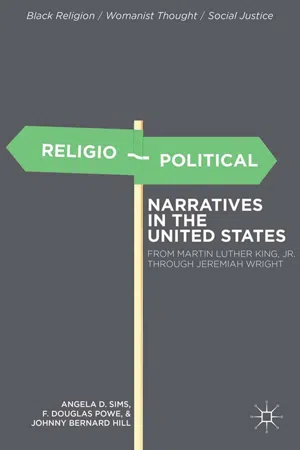
The authors select sermons by Martin Luther King Jr. and Jeremiah Wright to as a framework to examine the meaning of God in America as part of the formational religio-political narrative of the country.
Information
1
Not God Bless America, God Damn America: Black Rhetorical Performance and Patriotic Idealism
In April 2008, Angela D. Sims, then an instructor of Christian Ethics and Black Church Studies at Saint Paul School of Theology in Kansas City, Missouri, received a handwritten note from one of the seminary’s donors asking Sims to elaborate on her comments in Helen T. Gray’s Kansas City Star article “A Prophet in His Own Land.”1 In particular, the self-described “Methodist layman” wanted to know whether Sims’ “apologist role is for the style of Wright’s preaching only and not for the sulfuric anti-American content.” Of particular concern for the writer was Sims’ “analysis of Wright’s statement [that]: The U. S. created the aids virus to infect Black Americans.” He wanted to understand by “what standard could this outrageous statement be considered speaking truth to power as in prophetic preaching.”
In her July reply, Sims stated that her comments were not an apology or defense of the Reverend Dr. Jeremiah A. Wright Jr.’s April 13, 2003, sermon “Confusing God and Government.” Sims explained that Wright did not, as the sound bites might lead some to conclude, “damn America.” What he did say, however, was
The government gives them the drugs, builds bigger prisons, passes a three-strike law, and then wants us to sing “God Bless America.” No, no, no. Not “God Bless America;” God Damn America! That’s in the Bible, for killing innocent people. God Damn America for treating her citizens as less than human. God Damn America as long as she keeps trying to act like she is God and she is supreme! . . . Turn back and say “Forgive him for the ‘God Damn,’ that’s in the Bible Lord.” Blessings and cursing is in the Bible, it’s in the Bible. But I’m fitting to help you one last time. Let me tell you something. Where governments fail, God never fails. (Jeremiah Wright, “Confusing God and Government,” 2003)
At issue it appears, is who determines whether a country’s actions are classified as homeland security or terrorism.
In her reply, Sims posited that though the writer defined the rhetoric of Wright as “angry vitriol [that is] . . . reprehensible and totally objectionable,” perhaps we should, in a post 9/11 society, question the tendency to categorize counter perspectives as unpatriotic. After all, Wright is not the only preacher to voice concerns about governmental actions. Consider, for example, the following statements made by Reverends Jerry Falwell and Pat Robertson.
And I agree totally with you that the Lord has protected us so wonderfully these 225 years. And since 1812, this is the first time that we’ve been attacked on our soil and by far the worst results. And I fear, as Donald Rumsfeld, the Secretary of Defense, said yesterday, that this is only the beginning. And with biological warfare available to these monsters—the Husseins, the Bin Ladens, the Arafats—what we saw on Tuesday, as terrible as it is, could be miniscule, if, in fact—if, in fact—God continues to lift the curtain and allow the enemies of America to give us probably what we deserve. (Jerry Falwell, September 13, 2001 telecast of the 700 Club)
Don’t ask why did it happen. It happened because people are evil. It also happened because God is lifting His protection from this nation and we must pray and ask Him for revival so that once again we will be His people, the planting of His righteousness, so that He will come to our defense and protect us as a nation. That is what I want to see and why we say we must have revival. (Pat Robertson, Press Release regarding terrorist attack on the United States of America)
Even a cursory read of Falwell and Robertson’s assessment of that fateful event in 2001 suggests that the media should have subjected their remarks to the same level of media scrutiny as that given to Wright’s. Since there is no monolithic representation of life in the United States of America, Sims questioned whether the tone of delivery was equally important as the substance of Wright’s message when one attempts to decide what is and what is not an acceptable representation of patriotism.
Shaping Public Opinion
Pride in one’s nation, a zealous devotion to its welfare, and a fervent loyalty to its government are the traditional markers of patriotism.2 The handling of Wright, whose name was not nationally recognized by his critics before the 2008 presidential campaign, illustrates a manner in which reporters and broadcasters can and do shape public opinion. Broadcasters did not play Wright’s recorded sermon in its entirety, thereby making it almost impossible for listeners to draw their own conclusions. Instead, character depictions accompanied most replays of the excerpts along with several reporters, anchors, and other public figures who described Wright’s sermons as “animated,” “ranting,” “eardrum-assaulting,” “offending,” “divisive,” “destructive,” “racially charged,” “black chauvinist rhetoric.” They characterized his theological positions as “bad,” “radical,” “extreme separatist views,” “stuck in a late-Sixties time warp,” that “denigrate both the greatness and the goodness of our nation.”3
These pejorative adjectives are clear examples of how language functions to elicit a desired response. An interdisciplinary approach to the study of “text in context” known as discourse analysis sheds light on how language functions in context through a critical evaluation of the properties of language. Utilizing this method often contributes to understanding some of the ways in which modes of communication can maintain privilege at the expense of denigrating others.4
More than five years after the 2008 airing of excerpts from Wright’s sermon, an unquestioned depiction of Wright and a near-deafening silence on similar comments offered by Falwell, Robertson, and other self-identified evangelical pastors emphasizes that there is a mingling of the secular and the sacred in the sentiments of patriotism.5 Yet, as Edward S. Herman and David Peterson posit, this episode provides an outstanding illustration of this country’s racism, chauvinism, and political biases6. With virtually 24-hour news coverage, sound bites, and character depictions function subliminally, according to Alan Geyer, as patriotic rhetoric to sanctify racism, sexism, antiunionism, excess profits, witch hunts, religious bigotry, and environmental plunder.7 At issue for us, though, is not an examination of this country’s cloaked racist ideology but rather what presented during the 2008 presidential campaign as nonawareness, not of black prophetic preaching, but, of the tradition of the American jeremiad in which Wright’s sermon, “Confusing God and Government,” must be understood.
American Rhetorical Theory and Practice
In the history of this republic, enslaved persons of African descent, classified as chattel for economic- and 3/5 human for political- purposes, were the only people legally forbidden to learn to read and write. From their arrival in what is now the United States, Africans and their descendants were viewed as pagan. Yet, as sociologist W. E. B. Du Bois documented in The Negro Church,8 the first full-length treatment of the Black Church in the United States, in the seventeenth century there was a positive refusal to let slaves be converted, and this refusal was one incentive to explicit statements of the doctrine of perpetual slavery for Negroes.9 Evidence does suggest, however, that there was some effort to convert slaves as early as 1624, blacks’ baptisms were recorded in church registers.10 Though the bible was used by many slave holders and their sympathizers as a tool of subjugation and control, historians provide numerous accounts of enslaved, freed, and free persons of color’s ability to engage in a process of scriptural interpretation that reflected their existential reality. From this emerged a faith that bore witness not to a God that condoned slavery but rather a testimony about a God who “set captives free.” From this biblically informed understanding of liberation emerged the “Invisible Institution.”11 In designated spaces that allowed for freedom of expression, blacks exercised moral agency.
Cognizant of risks associated with unauthorized public gatherings, enslaved persons gathered in “hush harbors,” and other locales where they were not subjected to oversight by slave owners or their representatives. With what Walter Brueggemann might describe as “faithful imagination”12 the ability to read printed words was not a prerequisite to either a personal relationship with God or a call to preach. Some scholars draw correlations between this emphasis on personal conversion, coupled with freedom of expression in worship, to revival movements dating back to the early 18th century, from which blacks drew on and adapted their cultural memories13 to negotiate public and private spaces. Of utmost significance is the importance of the preached word as a major aspect of the United States’ jeremiad, albeit with particular reference to what is now the United States. To this end, we posit that what we learn about views on preaching, theology, rhetorical styles, social customs, and understanding of preacher as pastor-citizen from preachers from varied historical epochs and perspectives is essential to understanding the ways in which media interpretations of rhetorical performance influences idealistic perceptions of patriotism.
Clergy’s Most Important Duty
Described as a leading figure of the Great Awakening in the Middle Colonies, Gilbert Tennent14 was, according to some, one who questioned the traditional authoritarian system and the hierarchical structure of society and asserted that social position does not determine a person’s true character. Born in Ireland in 1703, Tennent was 14 years old when his family came to America. With an MA from Yale, Tennent, as Janet F. Fishburn points out, “distinguished himself from his peers in his ability to adapt old world theology, ministry practices, and policy selectively to a very different set of circumstances in a new world.”15 It is this ability to contextualize ministry that informed both Martin Luther King Jr.’s and Jeremiah Wright’s sermonic structure and delivery.
Intimately acquainted with race, particularly a sociocultural construction of a black/white dichotomy in the United States, both preachers’ engagement with the biblical text was informed by a historical analysis with which their faith resonated. Refusing to ignore the crucible of Jim Crow that symbolized neo-slavery and to romanticize West Africa as a place of genealogical-spiritual connectivity, King and Wright developed an amazing ability to theologically interpret political decisions. Yet, for many, King’s public delivery of his dream is all too often presented as a parody to counter Wright’s public proclamation of national accountability. In its depiction of Wright as an anathema to King, a shift from focusing on preaching as performance to a substantive assessment of the sermon itself can function as a framework to mediate conversations on race, rather than a media demand that a presidential candidate denounce pastor and church publicly, in the United States of America.
Convinced that the sermon wa...
Table of contents
- Cover
- Title
- 1 Not God Bless America, God Damn America: Black Rhetorical Performance and Patriotic Idealism
- 2 Disturbing the Peace: Theological Mandate to Construct an Inclusive Vision of Humanity
- 3 Liberation for All
- 4 The World House: Reclaiming the Dream of Dr. King in the Age of Obama
- 5 When Black Is Not Black Enough
- 6 Reclaiming the Prophetic: Toward a Theology of Hope and Justice in a Fragmented World
- 7 The World House: The Beloved Community as a New Global Vision for Peace and Justice
- 8 Unlocking Doors of Hope: A Quest for Enduring Peace and Justice
- Conclusion
- Notes
- Bibliography
- Index
Trusted by 375,005 students
Access to over 1.5 million titles for a fair monthly price.
Study more efficiently using our study tools.
Frequently asked questions
Yes, you can cancel anytime from the Subscription tab in your account settings on the Perlego website. Your subscription will stay active until the end of your current billing period. Learn how to cancel your subscription
No, books cannot be downloaded as external files, such as PDFs, for use outside of Perlego. However, you can download books within the Perlego app for offline reading on mobile or tablet. Learn how to download books offline
Perlego offers two plans: Essential and Complete
- Essential is ideal for learners and professionals who enjoy exploring a wide range of subjects. Access the Essential Library with 800,000+ trusted titles and best-sellers across business, personal growth, and the humanities. Includes unlimited reading time and Standard Read Aloud voice.
- Complete: Perfect for advanced learners and researchers needing full, unrestricted access. Unlock 1.5M+ books across hundreds of subjects, including academic and specialized titles. The Complete Plan also includes advanced features like Premium Read Aloud and Research Assistant.
We are an online textbook subscription service, where you can get access to an entire online library for less than the price of a single book per month. With over 1.5 million books across 990+ topics, we’ve got you covered! Learn about our mission
Look out for the read-aloud symbol on your next book to see if you can listen to it. The read-aloud tool reads text aloud for you, highlighting the text as it is being read. You can pause it, speed it up and slow it down. Learn more about Read Aloud
Yes! You can use the Perlego app on both iOS and Android devices to read anytime, anywhere — even offline. Perfect for commutes or when you’re on the go.
Please note we cannot support devices running on iOS 13 and Android 7 or earlier. Learn more about using the app
Please note we cannot support devices running on iOS 13 and Android 7 or earlier. Learn more about using the app
Yes, you can access Religio-Political Narratives in the United States by A. Sims,F. Powe,J. Hill in PDF and/or ePUB format, as well as other popular books in Social Sciences & Politics. We have over 1.5 million books available in our catalogue for you to explore.