- English
- ePUB (mobile friendly)
- Available on iOS & Android
eBook - ePub
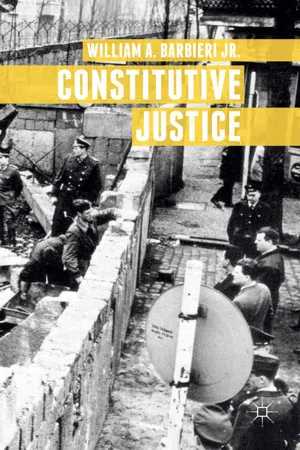
Constitutive Justice
About this book
Both classical and modern accounts of justice largely overlook the question of how the communities within which justice applies are constituted in the first place. This book addresses that problem, arguing that we need to accord a place to the theory of 'constitutive justice' alongside traditional categories of distributive and commutative justice.
Information
1
The Scope and Scale of Justice
“Justice is the first virtue of social institutions,” declared John Rawls at the outset of his Theory of Justice, before adding, “as truth is of systems of thought.”1 Justice, in other words, is the most important evaluative feature of a society in much the same way that truth is the fundamental evaluative feature of a science or tradition.
This is a powerful way of locating a powerful ideal, and it reflects a strong tendency in contemporary ethical thought and philosophizing to link talk of justice to the social and political realm. Rawls was right to suggest that in modern parlance justice is first and foremost a master category for characterizing our evaluations of how social entities are structured and administered. But of course historically, justice has also had numerous usages beyond the sociopolitical sphere, denoting righteousness in relation to God, or fidelity in translation of texts, or fairness in dealings with neighbors, or right conduct in relation to property, or even, at times, human virtue in toto. It is likely for this reason that Rawls quickly specified that the type of justice with which he was concerned was “social justice.” By this, he meant a type of justice relevant to and located in a society: “a more or less self-sufficient association of persons who in their relations to one another recognize certain rules of conduct as binding and who for the most part act in accordance with them.”2
It is in reflecting on the proposition that justice in its preeminent modern sense is an attribute of societies that we encounter the question that animates this book. If social justice is a property of relations within particular human associations, then what sort of justice can be said to bear on the moral features of how those associations are shaped in the first place?
Indeed, when we raise the question of who ought to be included or who might justifiably be excluded – or who ought to make such designations – in the human association presumed by Rawls’s maxim, it is not clear that social justice is the sort of concept that might cover a response. It seems, rather, that questions of social justice implicitly assume that the question of how the membership or bounds of a society are defined has already been in essence settled.
A close look at how Rawls framed his theory enables us to see that he butted up against the same problem encountered by Walzer regarding membership. Rawls set out to root his argument concerning “justice as fairness” in an account of the choices that rational actors would make in a hypothetical, generalized situation of founding modeled on the classical notion of social contract. As Rawls posits,
we are to imagine that those who engage in social cooperation choose together, in one joint act, the principles which are to assign basic rights and duties and to determine the division of social benefits. Men are to decide in advance how they are to regulate their claims against one another and what is to be the foundation charter of their society. Just as each person must decide by rational reflection what constitutes his good, ... so a group of persons must decide once and for all what is to count among them as just and unjust.3
Now, leaving aside the reference to the “men”4 who do the deciding in this “original position,” we may still ask who might be qualified to “engage in social cooperation” in advance of the adoption of any collective charter or constitution, and, more pointedly, how any disagreements about who belongs to the “group of persons” doing the deciding might be adjudicated prior to their adoption of principles of justice. For his part, Rawls stipulates that his doctrine of “justice as fairness” is premised on the agreement of “free and equal citizens who are born into the society in which they lead their lives.”5 We will have an opportunity to examine the implications of this proviso below.
It is true that Rawls is careful to say his thought experiment does not represent any actual society but corresponds, rather, to the state of nature theorized in classic accounts of social contract. Its actors, moreover, are generalized persons who operate behind a “veil of ignorance” and hence know nothing about their particular attributes, place in society, or conception of the good. These caveats, however, do not obviate the problem of criteria of inclusion for Rawls, since the notions he employs of “society” and “group” necessarily imply boundedness and cannot simply be universal or open.6
If this problem persists in Rawls’s ideal theory, it is all the more unavoidable in theories of social justice that refer to actual historical conditions. One can readily imagine, indeed, circumstances in which the way that the association of persons constituting the object of social justice is defined might be contested. Should all persons – including women, slaves, residents of occupied areas, long-term visitors, pariahs, and members of minority religious or national groups – be acknowledged as having equal status and standing in a society? How broadly should membership be extended among contiguous populations? How should a society be demarcated in a territorial sense? One might simply respond that all such questions aside, societies, regardless of how they came into being, undeniably exist in a manner that supports the sort of analysis of justice that Rawls and others undertake and that as a result, questions regarding the justness of their constitution are moot. I will discuss this response more fully in Chapter 2, but suffice it to say here that it would be difficult to identify an actual large-scale society or polity that has developed without any ethical controversy or putative injustices in determining its boundaries and membership. For this reason, it would seem reasonable to expect that theories of justice should take on the matter of the conditions under which social entities are constituted.7
Justice and its types
If, as I have suggested, the idea of social justice does not squarely address this matter, then what conception of justice might? To approach this question, it will be useful to give some basic consideration to the idea of justice and some of the received wisdom or conventional theories regarding its different facets or types. In what follows, I will set about, first, distilling a working general concept of justice. Second, I will then turn to a brief survey of some different typologies of justice.
To begin with, then, as I just proposed, justice relates to social life and hence concerns relations with, or to, others.8 It is essential to justice that it is a relational term, implying links or exchanges between or among multiple subjects, in addition to further components such as objects (e.g., goods or harms), evaluative criteria, and horizons of social meaning. It is only because of its reliance on shared meanings, however, that justice can be said necessarily to presuppose a community; otherwise, it merely posits some relations among persons.9 Justice involves determining how those relations ought to be, and it assumes that there are objective, ordered, and in some sense pre-ordained ways to which they should conform – or, put negatively, it assumes that how these relations take shape should not be merely arbitrary. As the reference here to should or ought denotes, justice has a prescriptive or normative character, in a manner that encompasses two broad contexts with which justice is often associated – namely, ethics and law.
Additionally, we can say that justice is directive, in two discrete senses. First, the term is inscribed with an energetic quality: justice is insistent and demanding; it compels a response. Second, it has a vectoral quality, directing us to act along certain trajectories. Justice, that is to say, recommends, impels, requires, or otherwise guides action in some ways and not others.10 And if justice is not arbitrary, then we can further say it is characterized by regularity, consistency, or impartiality.11 My point here does not go so far as to imply that justice necessarily assumes the equality of all persons, as some have claimed, although there is something to this view. Of course, for the ancients, in certain contexts justice required treating people differently on the assumption that people inherently differ with respect to their merit or worth: what was important was treating them in equal proportion to their desert. My point is perhaps better formulated negatively: justice forbids treating similar cases differently, or applying varying standards to a single group of persons, or giving preferential treatment to the few.
Beyond these very generic features, we can go a bit further to adopt the classic formulation of suum cuique and state that justice is about what people are due. Even if what people are due varies from case to case and person to person, we can add that justice involves proportion. A related dimension of justice that has recently received attention from philosophers is the degree to which there is a comparative element to justice. Even though some have emphasized that there is a distinction between judgments of justice focused on how goods are distributed among persons vis-à-vis one another and judgments of justice related to non-comparative factors bearing on individual persons – such as their desert or merit or contractual acts in which they have engaged – on examination it is apparent that there is frequently a comparative aspect as well to even the latter type of judgment.12 The implication of this, for my purposes, is that at one level or another justice can always be related to a holistic, social, or interpersonal context.
To sum up the sketch so far, justice is an idea involving norms or prescriptions that, in peremptory fashion, lead us to assess comparatively and to provide what is due to others, on a consistent and disinterested basis. In this account, what we might call “dueness” is the most distinctive feature. To give people their due is to render to them what is their own, what they deserve, what they have coming to them; and dueness thus encompasses a set of interlocking meanings concerning desert, debts or owing, and ownership. How to construe and judge dueness becomes the central preoccupation and challenge for theories of justice.
Having identified some generic features of justice, we now have a basis from which we can turn to the issue of varieties of justice. It is a staple of the history of theorizing about justice that justice has different faces: differing types of justice are engaged or arise in response to different kinds of relationships, situations, or problems. Here again, though, consensus does not reign on what the basic kinds of justice are or how many types there are. For example, a debate continues to simmer on whether retributive justice – the justice of punishments – is a...
Table of contents
- Cover
- Title
- Introduction: What If We Held a Constitutional Convention and Everybody Came?
- 1 The Scope and Scale of Justice
- 2 Reservations about Constitutive Justice
- 3 Constitutive Justice– A Paradox?
- 4 Justice between Communitarianism and Cosmopolitanism
- 5 Four Transcommunal Approaches
- 6 Constituents of a Theory
- 7 Toward a Theory of Constitutive Justice
- Bibliography
- Index
Trusted by 375,005 students
Access to over 1.5 million titles for a fair monthly price.
Study more efficiently using our study tools.
Frequently asked questions
Yes, you can cancel anytime from the Subscription tab in your account settings on the Perlego website. Your subscription will stay active until the end of your current billing period. Learn how to cancel your subscription
No, books cannot be downloaded as external files, such as PDFs, for use outside of Perlego. However, you can download books within the Perlego app for offline reading on mobile or tablet. Learn how to download books offline
Perlego offers two plans: Essential and Complete
- Essential is ideal for learners and professionals who enjoy exploring a wide range of subjects. Access the Essential Library with 800,000+ trusted titles and best-sellers across business, personal growth, and the humanities. Includes unlimited reading time and Standard Read Aloud voice.
- Complete: Perfect for advanced learners and researchers needing full, unrestricted access. Unlock 1.5M+ books across hundreds of subjects, including academic and specialized titles. The Complete Plan also includes advanced features like Premium Read Aloud and Research Assistant.
We are an online textbook subscription service, where you can get access to an entire online library for less than the price of a single book per month. With over 1.5 million books across 990+ topics, we’ve got you covered! Learn about our mission
Look out for the read-aloud symbol on your next book to see if you can listen to it. The read-aloud tool reads text aloud for you, highlighting the text as it is being read. You can pause it, speed it up and slow it down. Learn more about Read Aloud
Yes! You can use the Perlego app on both iOS and Android devices to read anytime, anywhere — even offline. Perfect for commutes or when you’re on the go.
Please note we cannot support devices running on iOS 13 and Android 7 or earlier. Learn more about using the app
Please note we cannot support devices running on iOS 13 and Android 7 or earlier. Learn more about using the app
Yes, you can access Constitutive Justice by William A. Barbieri in PDF and/or ePUB format, as well as other popular books in Politics & International Relations & Political Philosophy. We have over 1.5 million books available in our catalogue for you to explore.