- English
- ePUB (mobile friendly)
- Available on iOS & Android
eBook - ePub
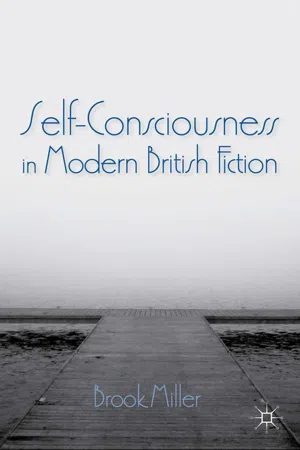
Self-Consciousness in Modern British Fiction
About this book
Using a cognitive approach to literature, this book uncovers representations of self-consciousness in selected modern British novels, exposing it as complicating character development. Miller provides new readings of works by Conrad, Joyce, and D.H. Lawrence to demonstrate the emergence of a self who feels split from the world.
Information
Chapter 1
Self-Consciousness, Embodiment, and the Narrativizing Self
Fueled by the ascendancy of psychology and psychoanalysis, the modernist period featured frequent, highly visible discussions of consciousness. The appearance of free indirect discourse and Bakhtinian dialogism in experimental novels testifies to a well-known displacement of realist mimesis by an inward turn into consciousness.
The premise of this chapter is that the psychological novel offered models of consciousness that reflected the philosophical and psychological thought in Britain during this period. Self-consciousness played an underappreciated role in conversations that provided an intellectual context for modernism. While the influence of Freudian psychoanalysis and some of its variants has been subject to numerous treatments, the ideas explored here have been less prominent. Self-consciousness was central to changes in approaches to the mind-brain problem, to new ontological positions, and to formulations of self and identity. By exhuming some significant ideas from these conversations, and by situating self-consciousness in contemporary theoretical frameworks, this chapter will introduce the ideas that govern the readings of individual experimental novels in the chapters that follow.
Specifically, a review of key ideas from conversations about consciousness and self-consciousness will highlight the heretofore underemphasized influence of neutral monism and process dynamics. After this survey, these ideas will be contextualized within recent theoretical approaches to embodied cognition and self-consciousness. Finally, this chapter will draw upon narrative identity theory to describe “narrativizing,” a process that links self-oriented consciousness and abstract, reflective self-consciousness. In the subsequent analytical chapters this process holds the key to the arcs of character development and identification at the heart of each novel.
Debates about Consciousness in MIND
In the British tradition, late nineteenth and early twentieth-century psychology favored empiricism, taking the data of the senses to be supreme. In The Vanishing Subject (1991), Judith Ryan claims that William James, Ernst Mach, and other empiricists had a significant impact upon Joyce, Woolf, and a variety of canonical European authors. Empiricism offered a phenomenological perspective, rendering consciousness as a flat field and promoting a “psychology without self,” in contrast to the Freudian model (22). This approach viewed the self as an evanescent phenomenon inseparable from the organism’s interface with the world. Ryan notes that, for literary writers, the evanescent self could still be effectual (226). In this manner, her book lays a foundation for notions of the self as a “functional illusion,” a concept that will be developed in this study.
Ontological influences were accompanied by extensive theorizations of the nature of the self. George Johnson’s Dynamic Psychology in Modern British Fiction (2005) explains the contributions of William James, Henri Bergson, and William McDougall in leading an “energetic debate on the dynamics of selfhood” in the historical moment before Freud’s publication of The Interpretation of Dreams (44). Together, these thinkers “acknowledged the flux of experience[,] . . . continued to consider the soul or spirit as an important dimension of selfhood . . . [and] embraced an eclectic garnering of insights” (44). The debates, in other words, were prolific, experience-centered, and conflicted over the nature of selfhood.
These developments occurred at the time of the “inward turn” of the novel—conventionally beginning with Flaubert’s use of free indirect style and continuing up to the high modernism of the 1920s. The emergence of psychology as a distinctive field of inquiry was accompanied by a new range of methodological and disciplinary questions, including an emphasis on the value of introspection. In An Essay on the Philosophy of Self-Consciousness: Containing an Analysis of Reason and the Rationale of Love (1882),1 P. F. Fitzgerald identifies the central concerns addressed through the study of self-consciousness:
Psychology is the ground or source of metaphysics, and . . . physiology plays a part in psychology; logical conceptions [are] correlated by neural representations of the presentations of psychological activity through the processes of the nervous system. We reason from similarity of effects produced by our own causal forces to similar causes to account for the production of these effects, and when we have the presence of a being similar to ourselves revealed to us, we cannot help inferring, i.e., arguing or supposing, that his feelings, thoughts, and motives in action will be similar to our own. Thus all reasoning is from the known Ego to the unknown but inferred Non-Ego or object. (9–10)
Fitzgerald demonstrates a concern with the relations of psychology to philosophy, the origins of thought in neural activity, and the emergence of higher order cognition, such as theory of mind (i.e., our perception of others as sentient, reasoning beings). For Fitzgerald, introspection
is the one act that embraces all the other acts of the reasoning process. Like the mirror of memory, it gathers up the scattered rays of consciousness, and gives back the perfect image of the Ego, so that in it we stand revealed to ourselves. This culminating act of the reasoning process has its own peculiar science, that on which all the other sciences depend, namely, logic, the science of the idea, i.e., of the relation between the facts of Being and thought. (17)
Thus, introspection held the key for bridging psychological and philosophical inquiry into consciousness.
At the risk of oversimplifying and leaving out key contributions to these conversations, but in the interest of providing a more developed sense of the ideas that animated discussions of issues close to the themes of modernist visions of consciousness, I will draw upon material from the British journal MIND, founded in 1876, to develop some of the key ideas. MIND holds a central place in the debates about consciousness during this period. According to editor William Sorley (writing in 1926), “during the whole of its fifty years, Mind has reflected faithfully or else contained the main currents of English philosophical thought” (413).
As British psychology emerged as distinct from philosophy, it was dominated by associationism and empiricism, which emphasized contrasting methods of discovering the operations of consciousness. William Monck notes that the empiricist approach “proceed[s] upon introspection of the actual contents of our consciousness, and the [associationist approach] . . . commenc[es] with an inquiry into the origin of our acquired ideas, the original or inexplicable facts of consciousness being on this theory only capable of detection as residual phenomena after all attempts to explain them otherwise have failed” (427). The development of psychology as an independent discipline raised questions about its proper practice. A variety of experimental methodologies proliferated alongside considerable debate on the merits of introspection as a scientific practice. Alexander Bain, founder of MIND, asserts that introspection must remain “at the head” of methods used to impart a “scientific character” to psychology (42).2
Key figures, meanwhile, argued that psychology should maintain a deep linkage to philosophy. John Dewey, for example, argued that psychology is a philosophic method (1886, 11). At the turn of the century, Hugo Münsterberg promoted a “scientific synthesis of ethical idealism with the physiological psychology of our days” (Schiller 1899). George Trumbull Ladd viewed psychological inquiries as “propaedeutic to the philosophy” of mind (Ladd, qtd. in Titchener 1895, 397).
One dominant model of thinking in the late nineteenth century was associationism, which began as a theory of learning through an association of sensory experiences and thoughts (and ultimately led to behaviorism). According to Bain, associationism reflected a diversity of perspectives grounded in the idea that thoughts involved presentations in the mind called upon by other presentations. These associations were initiated by sense impressions, but often associationists presented associations in a serial causal chain which, in keeping with psycho-physical parallelism, was analogous to the causal chains in the physical world. Associationism provided an unsatisfactory account of the self-concept and privileged chains of mental signification over embodied circuits of feeling and thought as the basis of self-consciousness.3 As associationism waned, it was supplanted by a proliferation of materialist and idealist models of consciousness with varying degrees of emphasis upon self-consciousness. Nicholas Dames notes that “by the 1850s physiology provided British and Continental psychology with the first serious alternative to associationist psychology, and with a grounding in the physical sciences that was increasingly persuasive; in the body’s reflex actions, and in the spinal cord’s relation to the cerebellum, psychologists found a basis for the study of more complex cognitions” (208).4
The emergence of “physiological psychology,” which emphasized empirical experimentation and was promoted by figures such as Wilhelm Wundt and Ladd,5 led to innovative theorizations of the interactions of body and psychological phenomena, including theories such as the reflex action hypothesis, which attempted to describe a fully neural pattern of stimulus and response, and the James-Lange theory, which suggested that emotions were co-implicated with physiological responses to experience. The era featured theories of psycho-physical parallelism, a concept associated with Wundt, the progenitor of experimental psychology. This doctrine, for Wundt, described the mental and physical as different perspectives upon phenomena. However, other early psychologists (and philosophers) interpreted the doctrine metaphysically—the physical and mental were separate but parallel phenomena. This confusion may have been caused by Wundt’s advocacy of viewing mental and physical phenomena in terms of separate, but parallel, causal chains.
The parallelist emphasis of this period provided one of the key thematics in debates between monist, dualist, and pluralist perspectives as well as debates between idealists and materialists. A. E. Taylor commented that it seemed a “characteristically British view that any philosophy which means to account for living experience as it is must start from the standpoint of Pluralism” (1912). While materialist perspectives were dominant, the journal witnessed a revived interest in idealism (especially Hegelianism), particularly via the influence of F. H. Bradley and T. H. Green. R. G. Collingwood describes British idealism as dominated by “the doctrine that what the mind knows is something other than itself, and the mind in itself, the activity of knowing, is immediate experience and therefore unknowable” (142).
The quest for a reasonable and verifiable metaphysics resulted in a number of theories positing a substance prior to and invisible to what we experience. Some theorizations, such as W. K. Clifford’s notion of “mind-stuff,” argued from a material starting point. Others posited mind as an epiphenomenon of the body.
Within the context of all of these themes and concerns, pragmatism and the new realism emerged as “the two theories which have attracted the greatest amount of interest in the present century” in MIND (Sorley 1926, 414). Led by William James and John Dewey, pragmatism aimed to find ways to reconcile varied approaches, including scientific empiricism with the way reality seemed to individuals, by identifying the practical consequences of an object with the object. This led to expanded definitions of “experience” that grouped together phenomena earlier excluded from normative empirical inquiry, and also excluded from mutual consideration in philosophical speculation. Some of James’s most significant essays first appeared in MIND, such as “Does ‘Consciousness’ Exist?,” “The Psychology of Belief,” and “What is an Emotion?” Working between philosophical and psychological traditions, James’s contributions were varied, but they featured his resolute simplifying of consciousness into a field of pure experience, into which objects, relations, and thoughts shared a common basis rather than being made up of different substances. According to Louise Roska-Hardy,
James proposes an influential account of the self . . . he distinguishes between two aspects of the self, the “I” or self as subject or knower, which he construes as a self-conscious first person perspective—a stream of consciousness, and the “Me,” the self as object or as known, which comprises the “material me,” the “social me” and the “spiritual me”. James maintains that the “I” knows the various “Me’s” through direct observation, whereas the “I” is unable to observe itself. Regarding the “I,” James maintains that there is no need to posit a Cartesian subject of experience, a metaphysical “I” that is something other than the biological being who does the thinking. As he remarks: “[the] passing thought [ . . . ] is itself the thinker” . . . In this view, the self features in experience and thought as a subject as well as an object. (37)
James believed self was a social phenomenon, and thus was iterative and situational. He believed there were potentially as many selves as roles that the individual had to play. Yet James also noted a continuity of identity through the experience of multiple selves, which Knowles and Sibicky (1990) have described as the “one-in-many selves” paradox (Humphreys and Kashima 45). The persistence of self-consciousness even in normative thought provides a sense of continuity: “Whatever I may be thinking of, I am always at the same time more or less aware of myself, of my personal existence” (James, Psychology, 43). James’s views on these matters were hotly debated, as were those of his counterparts Dewey and Charles Saunders Pierce. A number of famous thinkers, including F. C. S. Schiller and G. E. Moore, placed James within the framework of earlier philosophies. Knox situated James as a descendant of Charles Renouvier, who foreshadowed James’s notion that purposive selection was a primary function of mind.
Pragmatism was succeeded by Bergsonian vitalism and neutral monism. Edward Douglas Fawcett linked James and Henri Bergson through a lineage that extended back to Schopenhauer. James himself introduced Bergson as a pluralist in his 1909 treatise The Pluralistic Universe.6 Bergson’s theories of time, pure perception, and creative evolution were subject to intensive discussion. One of Bergson’s notable aims was to critique the authority of intellection as a “primary adaptive response to pure duration [which] . . . evolved in order to limit, with a view to action, the life of the spirit” (Matter and Memory 233 qtd. in Douglass and Burwick 4).7
Bergson’s polemics against intellection find analogues in some of the works examined here, particularly Lady Chatterley’s Lover and The Golden Notebook. Yet the status of “action-orientation” manifests quite differently in other texts. As a result, I am uncertain about Richard Lehan’s claim that Bergson’s philosophy helped modernists “undo . . . the influence of literary naturalism, which rested in turn heavily upon the dictates of Darwinian theory” (306). The circuit of Darwinian influence described in these perspectives implies that a facility for abstraction reflects the legacy of natural selection in a way that might deny “action-orientation” as a basis for selection in precursors to human intellection. Many modernists recognize that thought is prima facie derived from circuits of organism-world exchange (related to conation and feeling).
The second major thematic to arise in MIND, according to Sorley, was the “new realism.” New realists mounted a “protest against any form of psychological philosophy” (Sorley 1926, 416). These thinkers were led by six American philosophers, including Ralph Barton Perry (who wrote the preface to James’s Essays in Radical Empiricism). New realism disputed idealist claims that reality was dependent upon consciousness of it. Knowledge had no intrinsic relationship to the objects of knowledge. The “new” in their realism referred to the affinity with Jamesian empiricism, and a rejection of the dualism embedded in older realisms. That is, the new realists’ objects and our knowledge of them are indistinguishable. Thus the reality we experience is populated with epistemic elements that are inseparable from our consciousness; in extreme versions, consciousness is what we experience of reality. This concept has a direct link to models of the mind suggested in the modernist novel, insofar as consciousness is a (subtractive) selecting process that the individual doesn’t distinguish from reality itself. This position is not subjectivist—in fact, it is a repudiation of subjectivism. For the new realists, “things when consciousness is had of them become themselves contents of consciousness, and the same things thus figure both in the so-called external world and in the manifold which introspection reveals” (New Realism: Cooperative Studies in Philosophy 35). Knowledge, then, is a process by which the object is brought into...
Table of contents
- Cover
- Title
- Introduction: Functional Illusions and Modernist Self-Consciousness
- 1 Self-Consciousness, Embodiment, and the Narrativizing Self
- 2 Minding the Gap: Embodiment, Narrativity, and Identification in Under Western Eyes
- 3 Selfhood and the Sensorium in A Portrait of the Artist as a Young Man
- 4 Removing the Serpent’s Tail from Its Mouth: D. H. Lawrence’s Vision of Embodied Consciousness
- 5 Narrative Identity, Embodied Consciousness, and The Waves
- 6 Scriptive Consciousness and Embodied Empathy in The Golden Notebook
- Conclusion
- Notes
- Works Cited and Consulted
- Index
Trusted by 375,005 students
Access to over 1.5 million titles for a fair monthly price.
Study more efficiently using our study tools.
Frequently asked questions
Yes, you can cancel anytime from the Subscription tab in your account settings on the Perlego website. Your subscription will stay active until the end of your current billing period. Learn how to cancel your subscription
No, books cannot be downloaded as external files, such as PDFs, for use outside of Perlego. However, you can download books within the Perlego app for offline reading on mobile or tablet. Learn how to download books offline
Perlego offers two plans: Essential and Complete
- Essential is ideal for learners and professionals who enjoy exploring a wide range of subjects. Access the Essential Library with 800,000+ trusted titles and best-sellers across business, personal growth, and the humanities. Includes unlimited reading time and Standard Read Aloud voice.
- Complete: Perfect for advanced learners and researchers needing full, unrestricted access. Unlock 1.5M+ books across hundreds of subjects, including academic and specialized titles. The Complete Plan also includes advanced features like Premium Read Aloud and Research Assistant.
We are an online textbook subscription service, where you can get access to an entire online library for less than the price of a single book per month. With over 1.5 million books across 990+ topics, we’ve got you covered! Learn about our mission
Look out for the read-aloud symbol on your next book to see if you can listen to it. The read-aloud tool reads text aloud for you, highlighting the text as it is being read. You can pause it, speed it up and slow it down. Learn more about Read Aloud
Yes! You can use the Perlego app on both iOS and Android devices to read anytime, anywhere — even offline. Perfect for commutes or when you’re on the go.
Please note we cannot support devices running on iOS 13 and Android 7 or earlier. Learn more about using the app
Please note we cannot support devices running on iOS 13 and Android 7 or earlier. Learn more about using the app
Yes, you can access Self-Consciousness in Modern British Fiction by B. Miller in PDF and/or ePUB format, as well as other popular books in Literature & European Literary Criticism. We have over 1.5 million books available in our catalogue for you to explore.