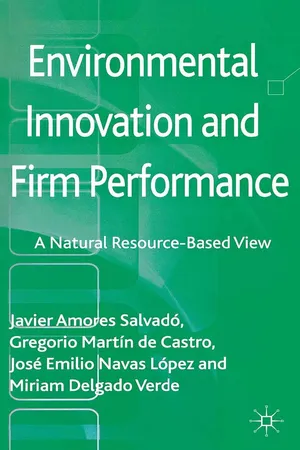
The links between a firm's competitiveness and the natural environment have been studied since the mid 90's. This volume explores, both theoretically and empirically, the relationships between environmental product innovation, green image and firm performance.
eBook - ePub
Environmental Innovation and Firm Performance
A Natural Resource-Based View
- English
- ePUB (mobile friendly)
- Available on iOS & Android
eBook - ePub
Environmental Innovation and Firm Performance
A Natural Resource-Based View
About this book
Information
1
Theoretical Framework
1.1 Introduction
Although there are many voices that highlight the importance of taking into consideration the restrictions imposed by the environment on the development of economic activity, at this moment, progress made in this regard is still scant. Nevertheless, sooner rather than later, companies will have to deal with a scenario of scarce natural resources where environmental orientation will be a first-order competitive element.
This book is the result of this concern. Its main aim is to show the theoretical foundations that sustain the economic logic behind the incorporation of environmental arguments to business activities. In order to shed some light on the potential benefits of environmental practices, we analyse the effect of two specific dimensions of product stewardship strategies (Hart, 1995) on business results. Specifically, we focus on the role of environmental product innovation and green image as two of the main driving forces of the relationship between the firm and the entire value chain made up of customers, suppliers and other stakeholders.
Thus, detailed analysis of firms’ innovative environmental practices and their commitment towards an image of environmental friendliness provide us with a fundamental knowledge base that, in future studies, should lead to the identification of those specific environmental capabilities that are needed to successfully tackle the sustainability social and economic challenge.
Therefore, in order to appropriately address the questions raised above, from a management approach, we focus on two main theoretical streams.
• The Natural Resource-Based View (Hart, 1995): The Natural Resource-Based View (NRBV) is the cornerstone of our argument. Taking the Resource Based View as a reference, it attempts to answer to the challenge of sustainable development. From this view, current economic patterns are not environmentally sustainable and firms, in order to be competitive in tomorrow’s economy, must develop the necessary resources and capabilities that enable them to adapt to the constraints imposed by the natural environment.
• Resource Based View of the firm (Wernerfelt, 1984; Barney, 1991, 2001; Peteraf, 1993). In line with what we have stated above, on the one hand, the incorporation of environmental arguments to processes, products and organizational modes to the firm, and on the other hand, competitive advantage achievement, require the development of a number of specific resources and capabilities.
Besides its importance as the ‘ecological evolution’ of the Resource Based View theory of the firm, the NRBV also plays a major role in the evolution of the link between the firm and the natural environment. Through the analysis of the different stages into the environmental management literature, we will appreciate the real value of this theory as it is the one that puts together the ecological concern and the competitive advantage achievement.
After reviewing and assessing the role of the NRBV in the environmental management literature, we will develop in detail its Resource Based View origins. Taking as the key reference the NRBV, in the following lines, we will proceed to analyse its fundamentals, general scope and the specific aspects of the product stewardship strategy to which we have devoted a significant part of our work.
1.2 Environmental concern and economic activity
We have to look back to the last century to differentiate between the three different stages or steps in the environmental concern/economic activity relationship. To do this analysis we will follow most of the assumptions proposed by Colby’s (Colby, 1991) and Del Brio’s (Del Brio and Junquera, 2001) classifications. According to their classifications, the first stage, where the environmental issues were almost completely absent from the economic debate, ranges from the beginning of industrialization to the early 1970s. In that period, firms were only worried about their competitive markets. The environmental issues were not considered at all in their strategic agenda, and the dominant theoretical approach was the Frontier Economics paradigm. The second stage in this theoretical evolution is characterized by the emergence of conflict between Deep Ecology and Environmental Protection principles. While the former approach is claiming humans’ subordination to nature, the last is trying to find the way to relieve the damage caused by firms’ industrial activities. The third stage is dominated by the Resource Management paradigm. Its advocates are aware of the fact that the solution to the environmental problem is not only in the implementation of Environmental Protection measures. At this time the main concern is how to set the ‘right’ prices for environmental goods. In the last stage the Eco-development paradigm emerges. This approach finds that Resource Management’s solutions do not face the real problem and instead more environmentally sound measures are needed. Scholars of this approach support prevention measures as well as changes in values and lifestyles.
As we will see, the Natural Resource-Based View plays a major role in this evolution. Its main assumptions serve to connect some elements of the neoclassical logic such as cost reductions and competitive advantage achievement to more ecologically and socially sound initiatives without renouncing to profit maximization. Next, we will detail the main features of every stage as well as the role of the NRBV in this evolution.
1.2.1 From ignorance to awareness
During the first decades of industrialization, in parallel with the scientific and technological knowledge advances that were emerging, a large amount of waste materials started to be thrown into the natural environment. At that time, it was generally accepted by economists that nature had the capacity to absorb and tolerate whatever harm or injury was caused by the economic activity. Furthermore, according to that conception, natural resources were unlimited and were not affected by human activity due to its regenerative power. While in the most advanced industrialized countries people’s standard of living was significantly improved, the natural environment was seriously altered.
This approach is in line with what Professor Colby calls the Frontier Economics paradigm. According to that view, nature was an infinite supply of physical resources and the economic thinking does not have to be worried about the role of nature. Furthermore, the main issues to be studied and debated deal more with the dichotomy resource allocation versus distribution than with the depletion of natural resources.
Although this approach could be understandable in the early days of industrialization, this conception of the relationship between the natural environment and the economic activity was challenged by the evidence. Thus, during the 1960s environmental pollution was intensified and industrial activity started to cause damage to the health and well-being of the people, causing climate changes, atmospheric alterations, air and water pollution and also hazardous chemical waste.
As a response, environmental awareness started to grow in the industrialized societies arguing that previous conceptions based on the indefinite economic growth were unrealistic and, what is more important, unsustainable. Proof of this socio-economic change was the United Nations’ General Assembly Resolution of December 3rd in 1968 convening a United Nations Conference on the Human Environment1 noting ‘the continuing and accelerating impairment of the quality of the human environment and its consequent effects on the condition of man, his physical, mental and social well being, his dignity and his enjoyment of basic human rights, in developing as well as developed countries’. This was the first international document and institutional effort recognizing that ‘the relationship between man and his environment is undergoing profound changes in the wake of modern scientific and technological developments’.
1.2.2 From awareness to conflict
In 1972 some important events occurred in the environmental field.
On the one hand, the first United Nations Conference on the Human Environment was held. One of the outcomes of this conference was the establishment of the United Nations Environment Programme (UNEP), the leading programme within the United Nations working on environmental issues.
On the other hand, the book The Limits to Growth (Meadows et al., 1972, in Colby, 1991) was released. Recognized as one of the main landmarks of the environmental concern, it had a great influence in that time, and its main contribution was to provide an early warning of the potential problems derived from the trade-off between environmental protection and uncontrolled economic growth.
These two events are interrelated as the final statement of the United Nations Conference on the Human Environment claims that the searching of economic growth as the primary goal does not necessarily lead to greater social and living standards as natural capital is becoming more and more scarce and is subject to physical limits.
Since that moment, firms’ and institutional pioneering initiatives in the field timidly started to emerge. Although the environmental issues were already in the debate, the mentioned initiatives did not go far beyond recognizing the problem and being aware of some of its consequences. At most, firms started to control (instead of prevent) their polluting emissions through the utilization of emission filters and end of pipe controls.
Behind this apparent inaction and the absence of more imaginative initiatives in regard to the environmental prevention was the conflict between two separate conceptions of the human–nature relationship: on the one hand the Deep Ecology approach, which is totally opposed to the Frontier Economics paradigm, and on the other hand the Environmental Protection view, which emphasizes the necessity to make compromises between two interconnected but sometimes opposing realities such as the economic activity and respect for the environment (Colby, 1991).
Deep Ecology advocates facing this conflict with a ‘take it or leave it’ approach, arguing that most technological advances usually lead to more environmental problems and cannot be categorized as progress. Consequently, it would be desirable to go back to preindustrial and rural lifestyles in order to live in harmony with the natural environment. Conversely, the Environmental Protection response to this problem was to apply a defensive strategy focused on repairing the damage caused.
Therefore, if the economic growth and the environmental improvement were understood as two conflicting realities, should we give up one for the other?
1.2.3 From conflict to solutions
The answer to that question came with The Report of the World Commission on Environment and Development (also known as the Brundtland Commission). The report, released in 1987 and entitled Our Common Future from One Earth to One World2, marked a point of inflexion in the way firms and institutions face the environmental degradation of the planet. By popularizing the concept of sustainable development, the commission tried to overcome the limitations of previous approaches, arguing that although there is no doubt about the successes of the industrialized societies in terms of human life expectancy, education, infant mortality or global food production, it is also true that this development have altered the planet, threatened the lives of many species and also the basis of human existence. In this sense, to mention only a few of these negative impacts, it is worth noting that the forest is still being destroyed in many countries; the burning of fossil fuels is generating carbon dioxide and causing global warming, and the desertification is, worryingly, spreading, affecting increasingly larger areas.
In other words, it must be possible to reconcile the economic growth with the preservation of the natural environment, and the natural resources must be consumed at a rate that allows the ecosystems to naturally regenerate themselves. In sum, ‘meet out current needs without compromising the ability of future generations to meet their needs’.
Focusing more in the sustainable development/firms’ relationship, the Brundtland Report highlighted four key points to be considered. First, although the manufactured goods are increasing, such increase is not enough to cover the necessities of the developing countries, which are constantly increasing their consumption levels. Second, new technologies offer great efficiencies and the anti-pollution measures have proved to be a good alternative to increase firms’ profitability and avoid environmental damage. Third, the transnational corporations have also their responsibility in the sustainable development challenge. They (together with the governments and institutions) must collaborate and assist developing countries so they can make better use of technology and try to prevent them from the same errors that industrialized countries committed in the past. Fourth, industries have a major role in providing goods and services that sometimes are essential to meet basic human needs. Therefore, they will live up to their responsibility.
As noted by Shrivastava (1995), the idea of sustainable development has also been criticized. Some argue that: although it seeks the management of global ecological resources and systems, even the researchers do not understand completely how they function; it superficially deals with indigenous people’s rights to decide about their own resources, limiting also their development options; and it is contradictory as it seeks to conserve the natural environment without seriously dealing with the current uncontrolled economic growth.
Nevertheless, although sustainable development has not solved the problems highlighted above, it has proved to be a good starting point, particularly for firms, which, drawing on sustainable development principles, have started to get more involved in the environmental field, putting into practice several initiatives like pollution prevention, waste minimization and clean technologies among others.
The Brundtland Report is very close to another environmental management paradigm, namely the Resource Management paradigm. It tries to apply the neoclassical vision but taking into consideration the fact that natural resources have also to be managed. Economic growth is still the major goal but it has to be achieved by following a ‘sustainable path’. Under this paradigm the consumption levels in the developed countries as well as the uncontrolled population increases in the developing world are unaffordable in the long term, and new solutions that go beyond the environmental control are proposed. This is a case of the establishment of the ‘polluter pays principle’ or the tradable emissions permit, which tries to ‘economize the ecology’ (Colby, 1991: 204). Under this paradigm, the environmental factor has two faces: on the one hand it is the crucial factor to achieve sustainable development and on the other hand is considered as a necessary evil to live with.
We can also include in this category those authors belonging to the open-minded neoclassical environmental economics’ group (Illge and Schawarze, 2009), whose members reject the introduction of fundamental changes to the economic system as well as the restrictions of material consumption. On the contrary, they also support the settlement of ‘right’ prices for environmental goods, which is, as we have seen, one of the main claims of the Resource Management advocates.
1.2.4 One step beyond
Although it is a step in the right direction, the above Resource Management measures are not a real challenge to firms. In fact, according to the Eco-development paradigm, what the ‘polluter pays’ principle is creating is a market for bads where the right to pollute ...
Table of contents
- Cover
- Title Page
- Copyright
- Contents
- List of Figures and Tables
- Foreword
- Acknowledgements
- 1. Theoretical Framework
- 2. The Nature of Environmental Product Innovation and Green Image
- 3. Research Model
- 4. Methodology
- 5. Research Results
- 6. Conclusions
- Notes
- References
- Index
Trusted by 375,005 students
Access to over 1.5 million titles for a fair monthly price.
Study more efficiently using our study tools.
Frequently asked questions
Yes, you can cancel anytime from the Subscription tab in your account settings on the Perlego website. Your subscription will stay active until the end of your current billing period. Learn how to cancel your subscription
No, books cannot be downloaded as external files, such as PDFs, for use outside of Perlego. However, you can download books within the Perlego app for offline reading on mobile or tablet. Learn how to download books offline
Perlego offers two plans: Essential and Complete
- Essential is ideal for learners and professionals who enjoy exploring a wide range of subjects. Access the Essential Library with 800,000+ trusted titles and best-sellers across business, personal growth, and the humanities. Includes unlimited reading time and Standard Read Aloud voice.
- Complete: Perfect for advanced learners and researchers needing full, unrestricted access. Unlock 1.5M+ books across hundreds of subjects, including academic and specialized titles. The Complete Plan also includes advanced features like Premium Read Aloud and Research Assistant.
We are an online textbook subscription service, where you can get access to an entire online library for less than the price of a single book per month. With over 1.5 million books across 990+ topics, we’ve got you covered! Learn about our mission
Look out for the read-aloud symbol on your next book to see if you can listen to it. The read-aloud tool reads text aloud for you, highlighting the text as it is being read. You can pause it, speed it up and slow it down. Learn more about Read Aloud
Yes! You can use the Perlego app on both iOS and Android devices to read anytime, anywhere — even offline. Perfect for commutes or when you’re on the go.
Please note we cannot support devices running on iOS 13 and Android 7 or earlier. Learn more about using the app
Please note we cannot support devices running on iOS 13 and Android 7 or earlier. Learn more about using the app
Yes, you can access Environmental Innovation and Firm Performance by Javier Amores Salvadó,Kenneth A. Loparo,Kenneth A. Loparo,Kenneth A. Loparo,Gregorio Martín de Castro,Miriam Delgado Verde,José Emilio Navas López in PDF and/or ePUB format, as well as other popular books in Business & Business Strategy. We have over 1.5 million books available in our catalogue for you to explore.