eBook - ePub
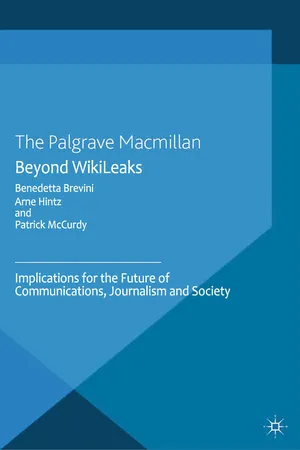
Beyond WikiLeaks
Implications for the Future of Communications, Journalism and Society
- English
- ePUB (mobile friendly)
- Available on iOS & Android
eBook - ePub
Beyond WikiLeaks
Implications for the Future of Communications, Journalism and Society
About this book
The 2010 release of US embassy diplomatic cables put WikiLeaks into the international spotlight. Revelations by the leaks sparked intense debate within international diplomacy, journalism and society. This book reflects on the implications of WikiLeaks across politics and media, and on the results of leak journalism and transparency activism.
Information
1
WikiLeaks and the Networked Fourth Estate
Yochai Benkler
This chapter explores how the WikiLeaks case intersects with larger trends in the news industry. It begins by describing the economic challenges faced by traditional media and the emerging pattern of what I call the “networked fourth estate.” This new media landscape will likely combine elements of the traditional news media with new forces in media production. “Professionalism” and “responsibility” can be found on both sides of the divide, as can unprofessionalism and irresponsibility. The traditional news industry’s treatment of WikiLeaks throughout this episode can best be seen as an effort by older media to preserve their own identity against the perceived threat posed by the new networked model. As a practical result, the traditional media in the United States effectively collaborated with parts of the Administration in painting WikiLeaks and Assange in terms that made them more susceptible to both extralegal and legal attack. More systematically, this chapter argues that the new, relatively more socially and politically vulnerable members of the networked fourth estate are needlessly being put at risk by the more established outlets’ efforts to denigrate the journalistic identity of the new kids on the block to preserve their own identity.
The crisis of the mass-mediated fourth estate
The American press – traditionally termed the “fourth estate” – is in the midst of a profound transformation whose roots are in the mid-1980s, but whose rate, intensity, and direction have changed in the past decade (Benkler, 2006, chapters 6–7). The first element of this transformation includes changes internal to the mass media – increasing competition for both newspapers and television channels and the resulting lower rents to spend on newsrooms, as well as fragmented markets that have led to new strategies for differentiation. The second element, nevertheless, was the adoption of the Internet since the mid-1990s. The critical change introduced by the networks was decentralized information production, including both news and opinion, and the new opportunities for models based on neither market funding nor state funding to play a new and significant role in the production of the public sphere (chapters 2–4 and 7).
Over the course of the twentieth century within the United States, local newspapers became local monopoly businesses. By 1984, the average market share of the top newspaper in small towns was close to 95 percent, and in medium-sized cities it was just over 93 percent. By 2006, the market share of the largest newspapers in such towns was over 97 percent. The absence of competition, in turn, sustained unusually high newspaper advertising rates, which then helped subsidize the cost of running newsrooms. However this practice began to change just before the emergence of the Internet with the rise of print and electronic advertising channels and the dispersal of advertising dollars (Benkler, 2006, chapters 2–4 and 7). This dispersion of attention and increase in competition meant that there were more outlets – not all of them having news – which consumers could go to. Changes within the industrial organization of American mass media led to disinvestment in newsrooms, audience fragmentation, and the emergence of right-wing media that used polarization as a differentiation strategy.
At the same time, the Internet rapidly shifted from being primarily a research and education platform to being a core element of our communications and information environment. The defining characteristic of the Net was the decentralization of physical and human capital (Benkler, 2006, chapters 2–4). In 1999, acute observers of the digital economy saw Encarta as the primary threat to Britannica in the encyclopaedia market (Shapiro and Varian, 1999, pp. 19–27). It was impossible to imagine that a radically decentralized, non-proprietary project in which no one was paid to write or edit, and that in principle anyone could edit, would compete with the major encyclopedias. And yet, 10 years later, Wikipedia was one of the top six or seven sites on the Net, while Encarta had closed its doors. Peer production and other forms of commons-based, non-market production became a stable and important component of the information production system. Just as open-source software became an important complement to and substitute for some proprietary software models, and just as things from photography (Flickr.com, 2011) to travel came to be based on peer production and on social production more generally, so too has news reporting changed. If the First Gulf War was the moment of the 24-hour news channel and CNN, the Iranian reform movement of 2009 was the moment of the amateur video reportage, as videos taken by non-professional journalists were uploaded to YouTube, and from there became the only significant source of video footage of the demonstrations available to the major international news outlets. Most recently, the Tunisian revolt was in part aided by amateur videos of demonstrations, uploaded to a Facebook page of an activist, Lotfi Hajji, and then retransmitted around the Arab world by Al Jazeera (Worth and Kirkpatrick, 2011, p. A1), and video taken by protesters was mixed with that taken by professional journalists to depict the revolt in Egypt. But the networked public sphere is constructed of much more, and more diverse, organizational forms than ad hoc bursts of fully decentralized activity.
The emerging networked fourth estate: Elements of the networked public sphere
As of the end of the first decade of the twenty-first century, it seems that the networked public sphere is constructed of several intersecting models of production, whose operations to some extent complement and to some extent compete with each other. Understanding the WikiLeaks events requires first understanding six broad trends in the construction of the networked fourth estate
1. Traditional mass media
One central component is composed of the core players of the mass media environment, who now have a global reach, and have also begun to incorporate decentralized elements within their own model. CNN, the New York Times, NBC News and MSNBC News, the Wall Street Journal, Fox News, the Washington Post and the Los Angeles Times, as well as the UK-based BBC and the Guardian, are among the top-ranked news sites on the Internet (Alexa, 2012). The Guardian’s editor-in-chief has claimed to have at least 36 million readers a month, by comparison to the paper’s daily circulation of about 283,000 (Reid and Teixeira, 2012). These major players are, in turn, complemented by the online presence of smaller traditional media platforms and sources from other countries, often accessed by readers through Yahoo and Google News, both among the top news sites in the world. The WikiLeaks case demonstrates how central these large, global online news organizational players are, but it also shows how hard it is for any one of them to control access to the news. One of Assange’s strategically significant moves was to harness these global mass media to his cause by providing them with enough exclusivity in their respective national markets and therefore economic benefits, and enough competition in the global network to make sure that none of them could, if they so chose, bury the story. The global nature of the platform and the market made this strategy by a small player with a significant scoop both powerful and hard to suppress.
2. Mass media aggregation sites
We are seeing the emergence of other models of organization, which were either absent or weaker in the traditional mass media environment. Remaining for a moment within the sites visible enough to make major Internet rankings lists, the Huffington Post,1 a commercial online collaborative blog, is more visible in the United States than any other news outlet except for the BBC, CNN, and the New York Times2 (Alexa, 2012). There are, of course, other smaller scale commercial sites that operate on advertising, like the Drudge Report, Pajamas Media (now PJ Media), or Talking Points Memo. These form a second element in the networked public sphere.
3. Professional-journalism-focused nonprofits
A third model that is emerging to take advantage of the relatively low cost of news production and distribution is the nonprofit sector. Here, I do not mean the volunteer, radically decentralized peer production model, but rather the ability of more traditionally organized nonprofits to leverage their capabilities in an environment where the costs of doing business are sufficiently lower than they were in the print and television era. These new players can sustain effective newsrooms staffed with people who, like academic faculties, are willing to sacrifice some of the bottom line in exchange for the freedom to pursue their professional values. One example is Pro Publica, a foundation-supported model for an otherwise classic-style professional newsroom. A similar approach underlies the journalistic award-winning local reporting work of the Center for Independent Media, founded in 2006 and renamed in 2010 the American Independent News Network. This organization funds a network of local independent nonprofit media in several US states. A related model is the construction of university-based centers that can specialize in traditional media roles. A perfect example of this is Factcheck.org, based in the Annenberg Public Policy Center at the University of Pennsylvania, which plays a crucial watchdog role in checking the veracity of claims made by political figures and organizations.
4. Nonprofit organization with peer production
Combining standard nonprofit models with peer production also allows other organizations to achieve significant results in the public sphere. An excellent example is offered by the Sunlight Foundation, which supports both new laws that require government data to be put online and the development of web-based platforms that allow people to look at these data and explore government actions that are relevant to them. As WikiLeaks did before the events of 2010/11, the Sunlight Foundation focuses on making the raw data available for the many networked eyes to read. Unlike WikiLeaks, its emphasis is on legal and formal release of government data, the construction of technical platforms to lower the cost of analysis, and enabling distributed individuals with diverse motivational profiles to apply collaborative practices to analyse the data. These new experiences of peer production complement other forms of participatory nonprofit media, such as the alternative press, community radio, and online alternative media such as Indymedia. In many parts of the world, collaborative media practices on older platforms, particularly community radio, are expanding and are challenging established commercial and public-service media (Downing, 2011).
5. Party press culture
Alongside the professionals based in large-scale global media, small-scale commercial media, high-end national and local nonprofit media outlets, and other non-media nonprofits, we also see the emergence of a new party press culture. Over 10,000 Daily Kos contributors have strong political beliefs, and they are looking to express them and to search for information that will help their cause. So do the contributors to Town Hall on the right, although the left wing of the blogosphere uses large collaborative sites at this point in history more than the right (Benkler and Shaw, 2010). Digging up the dirt on your opponent’s corruption, political ambition, and contestation is a powerful motivator, and the platforms are available to allow thousands of volunteers to work together, with the leadership and support of a tiny paid staff (paid, again, through advertising to this engaged community, or through mobilized donations, or both).
6. The individual
Finally, although less individually prominent and much more decentralized, individuals play an absolutely critical role in this new information ecosystem. First, there is the sheer presence of millions of individuals with the ability to witness and communicate what they witnessed over systems that are woven into the normal fabric of networked life. This is the story of the Iranian reform videos, the Tunisian and Egyptian revolutions and it is, of course, the story of much more mundane political reporting such as covering then Republican presidential contender John McCain’s singing “Bomb Iran” to the tune of the Beach Boys’ 1965 hit song “Barbra Ann” during a 2007 campaign stop in Murrell Infelt, South Carolina. Second, there is the distributed force of observation and critical commentary, as we saw in the exposure of error in a September 8, 2004, 60 Minutes story that was critical of President George W. Bush’s Texas Air National Guard service record. Claims quickly emerged challenging the authenticity of the memos that the story was based on. Twelve days after the original story aired, CBS issued a retraction and Dan Rather issued a public apology saying he was no longer “confident” in the documents (Murphy, 2009).
Third, there are the experts. For instance, academic economists like Brad DeLong, on the left, and Tyler Cowen, on the right, played a much greater role in debates over the stimulus and bailout than they could have a mere decade ago. Collaborative websites by academics, like Balkinization or Crooked Timber, provide academics with much larger distribution platforms on which to communicate, expanding the scope and depth of analysis available to policy makers and opinion makers.
WikiLeaks must be understood in the context of these trends that form the backbone of the networked fourth estate. Like the Sunlight Foundation and similar transparency-focused organizations, WikiLeaks is a nonprofit focused on bringing to light direct, documentary evidence about government behaviour so that many others, professional and otherwise, can analyze th...
Table of contents
- Cover
- Title
- Introduction
- 1 WikiLeaks and the Networked Fourth Estate
- 2 Following the Money: WikiLeaks and the Political Economy of Disclosure
- 3 The Leak Heard Round the World? Cablegate in the Evolving Global Mediascape
- 4 WikiLeaks and the Public Interest Dilemma: A View from Inside the Media
- 5 Something Old, Something New...: WikiLeaks and the Collaborating Newspapers Exploring the Limits of Conjoint Approaches to Political Exposure
- 6 WikiLeaks and Whistle-blowing: The Framing of Bradley Manning
- 7 From the Pentagon Papers to Cablegate: How the Network Society Has Changed Leaking
- 8 Dimensions of Modern Freedom of Expression: WikiLeaks, Policy Hacking, and Digital Freedoms
- 9 Weak Links and WikiLeaks: How Control of Critical Internet Resources and Social Media Companies Business Models Undermine the Networked Free Press
- 10 WikiLeaks, Secrecy, and Freedom of Information: The Case of the United Kingdom
- 11 WikiLeaks, Anonymous, and the Exercise of Individuality: Protesting in the Cloud
- 12 Anonymous and the Politics of Leaking
- 13 The Internet and Transparency Beyond WikiLeaks
- 14 WikiLeaks and the Arab Spring: The Twists and Turns of Media, Culture, and Power
- 15 Twelve Theses on WikiLeaks
- 16 Amy Goodman in conversation with Julian Assange and Slavoj iek
- Index
Trusted by 375,005 students
Access to over 1.5 million titles for a fair monthly price.
Study more efficiently using our study tools.
Frequently asked questions
Yes, you can cancel anytime from the Subscription tab in your account settings on the Perlego website. Your subscription will stay active until the end of your current billing period. Learn how to cancel your subscription
No, books cannot be downloaded as external files, such as PDFs, for use outside of Perlego. However, you can download books within the Perlego app for offline reading on mobile or tablet. Learn how to download books offline
Perlego offers two plans: Essential and Complete
- Essential is ideal for learners and professionals who enjoy exploring a wide range of subjects. Access the Essential Library with 800,000+ trusted titles and best-sellers across business, personal growth, and the humanities. Includes unlimited reading time and Standard Read Aloud voice.
- Complete: Perfect for advanced learners and researchers needing full, unrestricted access. Unlock 1.5M+ books across hundreds of subjects, including academic and specialized titles. The Complete Plan also includes advanced features like Premium Read Aloud and Research Assistant.
We are an online textbook subscription service, where you can get access to an entire online library for less than the price of a single book per month. With over 1.5 million books across 990+ topics, we’ve got you covered! Learn about our mission
Look out for the read-aloud symbol on your next book to see if you can listen to it. The read-aloud tool reads text aloud for you, highlighting the text as it is being read. You can pause it, speed it up and slow it down. Learn more about Read Aloud
Yes! You can use the Perlego app on both iOS and Android devices to read anytime, anywhere — even offline. Perfect for commutes or when you’re on the go.
Please note we cannot support devices running on iOS 13 and Android 7 or earlier. Learn more about using the app
Please note we cannot support devices running on iOS 13 and Android 7 or earlier. Learn more about using the app
Yes, you can access Beyond WikiLeaks by Benedetta Brevini, Arne Hintz, Patrick McCurdy, Benedetta Brevini,Arne Hintz,Patrick McCurdy in PDF and/or ePUB format, as well as other popular books in Social Sciences & Journalism. We have over 1.5 million books available in our catalogue for you to explore.