eBook - ePub
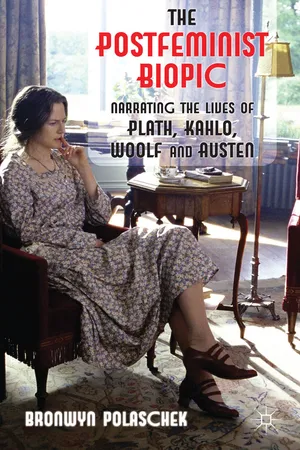
The Postfeminist Biopic
Narrating the Lives of Plath, Kahlo, Woolf and Austen
- English
- ePUB (mobile friendly)
- Available on iOS & Android
eBook - ePub
About this book
This book contributes to the growing literature on the biopic genre by outlining and exploring the conventions of the postfeminist biopic. It does so by analyzing recent films about the lives of famous women including Sylvia Plath, Frida Kahlo, Virginia Woolf and Jane Austen.
Information
1
Feminist Film Theory and Postfeminist Culture
In order to contextualise the subgenre of the postfeminist biopic, Chapter 1 lays out a series of debates within feminist film theory and postfeminism. It begins by exploring the dominant concerns of early feminist film scholarship, reviewing the methodologies of key scholars, and discussing why various forms of cultural analysis have supplanted earlier approaches such as gaze theory. In a second section the chapter considers the concept of postfeminism, a contested term that has been used by journalists and some scholars to describe contemporary culture since the early 1990s. Postfeminism has been variously interpreted as a backlash against feminism, a double entanglement of feminist and anti-feminist themes, a historical shift away from feminism, and an epistemological break with feminism. After considering each perspective, the chapter concludes that one of the less popular definitions within the debate, the argument that postfeminism represents an epistemological break from second-wave feminist ideas, is most constructive to identifying the shared characteristics of what I call the postfeminist biopic.
The absence of women from the screen and gaze theory
Early feminist film scholarship was concerned with the absence of women’s voices, and the female point of view, from popular, mainstream cinema. The focus of feminist criticism was the marginalisation and exclusion of women from film, in terms of both the lack of women working to create films and the stereotyped depictions of women on screen. The early methodologies to examine the absence of women in film can be separated into two schools of thought: the American sociological approach and the British tradition informed by semiotic and psychoanalytic theories.
In the first category, Marjorie Rosen’s Popcorn Venus (1973) and Molly Haskell’s From Reverence to Rape (1974) are the two earliest historical studies of the representation of women in mainstream American film. Inspired by the political context that produced Kate Millett’s Sexual Politics (1970), Shulamith Firestone’s The Dialectic of Sex (1979) and Germaine Greer’s The Female Eunuch (1970), both authors document Hollywood decade by decade, tracing a series of ideological images of femininity in film; both seek to reveal the false and oppressive quality of these conventional cinematic images by comparing them to the material circumstances of the lives of women at the time the films were released; and both identify Hollywood as increasingly misogynistic, a trend, they argue, that is a response to the increased economic and social power of women due to activism by second-wave feminists.
Rosen and Haskell’s work is significant in establishing a core feminist film agenda: the analysis of representations of women in popular, big-budget, generally male-authored films, and the location of these images within historical and social circumstances. This study – in its examination of the depiction of women protagonists in contemporary biopic films – can certainly be located within the tradition they initiated; however, a common criticism of this style of analysis is its one-dimensional reading of popular film. As early as 1973 Claire Johnston rejected the interpretation of Hollywood as a dream factory assembling oppressive cultural products on the grounds that this style of pseudo-Marxist analysis ‘short-circuits the possibility of a critique which could prove useful for developing a strategy for women’s cinema’ (1994: 32). In their overview of the development of feminist film theory Mary Ann Doane, Patricia Mellencamp and Linda Williams suggest that two factors converged to weaken this style of analysis: first, the limited number of images available of women in a relatively short film tradition, and second, an emphasis on images within the text rather than ‘the axis of vision itself’ (1984: 6).
Two of the most important scholars in the alternative British school of feminist film theory are Claire Johnston and Laura Mulvey. Each can be located within the broader tradition of cine-psychoanalytic film theorising, which combines semiotics with Louis Althusser’s theory of ideology and Sigmund Freud and Jacques Lacan’s work on the unconscious, to articulate a significant absence in Rosen and Haskell’s work: the question of how films create meaning.
Johnston cites Roland Barthes’s analysis of how myth operates: because they empty a sign of its original denotative meaning and infuse it with a new connotative meaning, myths are mistaken as natural, obvious and evident (1994: 32). She argues that the cinema is governed by the cultural myths of western society, including importantly the fundamental opposition of man as located inside history, and woman as ahistoric and eternal. The mythical quality of cinematic images guarantees that women will be reduced to objects of the male gaze: ‘Despite the enormous emphasis placed on woman as spectacle in the cinema, woman as woman is largely absent’ (1994: 33). For Johnston, feminist film theorists must examine how the sign ‘woman’ functions within specific film texts, and wider patriarchal culture.
Developing from Johnston’s work, Mulvey’s ‘Visual Pleasure and Narrative Cinema’ has been described as a ‘Zeitgeist text’ (Humm, 1997: 20). Mulvey creatively combines the ‘political weapon’ of psychoanalysis with feminist and Althusserian theory to demonstrate how ‘the unconscious of patriarchal society has structured film form’ (1999b: 58). Echoing Beauvoir’s analysis, she explores how in patriarchal culture woman stands
as a signifier for the male other, bound by a symbolic order in which man can live out his fantasies and obsessions through linguistic command by imposing them on the silent image of woman still tied to her place as bearer, not maker, of meaning.
(1999b: 59)
Mulvey argues that in Hollywood cinema women are positioned as erotic objects for the camera, the characters on screen and the spectators in the theatre; female characters connote ‘to-be-looked-at-ness’ and function as a spectacle to interrupt the narrative trajectory (1999b: 62–63). By contrast, the male characters bear the look and function to advance the story. The inherently masculine spectator narcissistically identifies with the powerful male hero, projecting his own look onto his screen surrogate to produce ‘a satisfying sense of omnipotence’ (1999b: 64).
Johnston’s early work, and then Mulvey’s canonical article, inaugurated the influential psychoanalytic strand of British feminist film theory which has been labelled ‘gaze theory’, and contributed to a shift from the early focus on images of women to categorising woman as a sign. Importantly, these theorists provided a means by which film scholars could interrogate the apparatus of cinema itself. Jackie Stacey emphasises that Mulvey’s significance in particular ‘cannot be overestimated; feminist film criticism has shown a continuing preoccupation with the questions of pleasure, spectatorship and gender identity foregrounded in her work’ (1997: 20).
While they take different theoretical routes, both the American sociological and British psychoanalytic schools of thought emphasise the absence of women from the screen, as well as the inherently bourgeois and patriarchal qualities of mainstream film. As Pam Cook argues, classical Hollywood in particular is treated as ‘inimical to feminist interests’ in these early accounts (1998: 231). Responding to this totalising style of scholarship various questions arise including: How can film scholarship account for the presence of women in the audience, and the pleasure they obtain from viewing mainstream films? What is the potential for a ‘progressive’ or ‘feminist’ mainstream cinema?
From female spectator to the woman in the audience: The rise of cultural analysis
Feminist scholars almost immediately challenged Mulvey’s fixed and monolithic description of spectatorship. Annette Kuhn’s comment about her work is exemplary:
If Mulvey’s argument is correct…dominant cinema is actually distinguished by an address which, at least through its evocation of certain kinds of looking, advances masculine subjectivity as the only subjectivity available. What exactly does this mean for women as spectators in cinema, given that women do go to the cinema, and indeed that for certain types of films they have constituted a large part of the audience?
(1993: 63)
Within the tradition of psychoanalytic film theory, various scholars have sought to complicate these early conceptions of spectatorship and the gaze as inherently masculine. In a later article, Mulvey herself proposes the notion of the transvestite female spectator (1999a: 125). Outlining Freud’s theory of femininity, she argues that Hollywood films allow a female spectator to rediscover the lost, phallic period of her sexual identity through masculine identification. Teresa de Lauretis suggests that narrative pleasure is available for women in the ‘double identification’ with the active masculine gaze and with the passive feminine image; female spectatorship evokes bisexual alliances (1999: 90). For Linda Williams the classical Hollywood film Stella Dallas represents how ‘the female spectator tends to identify with contradiction itself – with contradictions located at the heart of the socially constructed roles of daughter, wife, and mother’ (1990: 152).
Mary Ann Doane’s work represents a sustained examination of the consequences of the psychoanalytic approach for the theorisation of the female spectator. Doane accepts the operation of the cinematic apparatus as described by Mulvey in terms of the male spectator, but she seeks to expand the possibilities for the female spectator. Examining the women’s films of the 1940s, she argues that while a transvestite identification with the male hero is possible, the women’s film takes advantage of the female spectator’s proximity to the text and encourages overidentification with the female figure: ‘For the female spectator’, she says, ‘there is a certain overpresence of the image – she is the image’; therefore her relationship to the image is ‘a kind of narcissism’ enabling the female spectator to lose herself by taking the woman on screen as her own object of desire (1999: 135). Doane tries to avoid the totalising effect of Mulvey’s theory by identifying a point of resistance. Drawing on Joan Rivière’s theory of femininity as masquerade, a reaction formation against women’s transsexual identification (1986), she proposes that ‘womanliness’ for the spectator can be worn, or removed, as a ‘mask’ in a play of masquerading; it can therefore ‘generate a problematic within which the image is manipulable, producible, and readable by women’ (1999: 138–39, 143).
The interventions by Doane and others have enabled a more complex articulation of female spectatorship and of the effect of popular films on audiences. This study certainly assumes that women who watch postfeminist biopics are not necessarily interpellated as male spectators; their fantasies of identification, desire and pleasure are far more complex. A weakness of Doane’s approach, however, is that (as she acknowledges) the phrase ‘female spectator’ in her work is ‘not meant to refer directly to the woman who buys her ticket and enters the movie theatre as the member of an audience’ (1988: 8). For Gledhill and others this gap between the theoretical construct of the subject, and the response of actual women audience members sitting in the auditorium, is a weakness of gaze theories inspired by psychoanalysis and semiotics. The value of these theories, Gledhill argues, is that they provide an ‘escape [from] the simple enumeration of sexist stereotypes’ epistomised by the work of Rosen and Haskell; the danger is that ‘once the object of feminist criticism is defined solely in terms of the cinematic production of meaning, we lose the ability to deal with its relationship to women as defined in other social practices’ (1984: 19). This concern has encouraged many feminist film theorists to include insights from cultural studies in their work, inspired in particular by Stuart Hall’s call for a model of text–viewer relations that can account for the entire communicative process of text and context (1992).
Hall’s encoding/decoding model of cultural texts was influential for film theorists, including Gledhill who applies it to feminist film theory. In place of psychoanalytic theories which ‘offer largely negative accounts of female spectatorship, suggesting colonized, alienated or masochistic positions of identification’, she creates the theoretical framework of culture as negotiation:
Meaning is neither imposed, nor passively imbibed, but arises out of a struggle or negotiation between competing frames of reference, motivation and experience. This can be analysed at three different levels: institutions, texts and audiences – although distinctions between levels are ones of emphasis, rather than rigid separation.
(1988: 68)
Her theory is informed by Gramsci’s concept of hegemony in which ideological power is never secured, but must be continually reinforced through a constant give-and-take between contesting groups. As an example of how the product becomes a site of textual negotiation, Gledhill cites the American television series Cagney and Lacey (CBS, 1981–88). The show was made possible by the spread of ideas from the second-wave feminist movement, and was saleable because of its innovative framing of two female police officers within the male buddy movie format; but although the series was successful within the entertainment industry, garnering a number of awards, it was constantly under threat because of its subversive definitions of femininity and female sexuality. Gledhill’s insight is that the response of audiences to texts is affected by ‘a range of determinations, potentially resistant or contradictory, arising from the differential social and cultural constitution of readers or viewers’ (1988: 70).
Extending the cultural studies perspective, black feminist film theorists argue that earlier psychoanalytic analyses deny the specificity of the social and cultural positioning of black women spectators. bell hooks asserts that theories of the male gaze fail to incorporate how ‘the extent to which black women feel devalued, objectified, dehumanised in this society determines the scope and texture of their looking relations’ (1999: 316). In place of Mulvey and Doane’s notion of the passive/narcissistic female spectator, hooks theorises the black woman as experiencing ‘visual delight in the pleasure of interrogation’ of mainstream cinema (1999: 316).
The work of hooks signals one of the significant absences in the theories of Mulvey and Doane: a discussion of women’s active desire. Jackie Stacey argues that the specifically homosexual pleasures of female spectatorship are neglected in earlier psychoanalytic approaches (1990: 365). Analysing the classic film All About Eve (Joseph L. Mankiewicz, 1950) and the more recent Desperately Seeking Susan (Susan Seidelman, 1985), she advocates an alternative model of female spectatorship building on the insights of earlier theorists. For example, Stacey argues that in Desperately Seeking Susan
Roberta’s desire to become more like her ideal – a more pleasingly coordinated, complete, and attractive feminine image – is offered temporary narrative fulfilment. However the pleasure of this feminine desire cannot be collapsed into simple identification, since difference and otherness are continuously played upon, even when Roberta ‘becomes’ her idealized object.
(1990: 377–78)
Her argument is that the film tempts the female spectator with the fictional fulfilment of becoming the ideal feminine, while denying complete transformation.
Although still influential, there has been a general shift away from gaze theory in feminist film studies. This has been in part due to the methodology of psychoanalysis which scholars have argued produces a monolithic masculine or masquerading spectator (in the work of Mulvey and Doane), and is limited to exploring the relations within a film text rather than the meaning/s gained by the actual audience who watch the film. In the end gaze theory cannot adequately account for the enjoyment a woman might take from a film such as Alfred Hitchcock’s 1958 Vertigo (which Mulvey analyses in terms of her psychoanalytic model). Even more strikingly the concept of the gaze proffered by Mulvey is inadequate for theorising classical narrative texts which are oriented to or enjoyed by women (the pleasure highlighted by Stacey), and it neglects the complexity of factors that inform viewer responses such as class, race or sexual orientation (as hooks shows).
Another reason gaze theory is difficult to use in a contemporary context is the ubiquity and influence of the concept of the gaze. When it arose in the mid-1970s Mulvey’s notion of ‘to-be-looked-at-ness’ was an innovative, even devastating, methodology for analysing the apparent misogyny of film texts; however, in the intervening 45 years since she wrote her article, the idea of the gaze has been widely circulated to the point where it is now integrated into popular film and other cultural texts. Angela McRobbie analyses a Wonderbra advertisement from the mid-1990s featuring Eva Herzigova looking admiringly at her cleavage. For McRobbie the image echoes the stereotypical sexist advertisement. Its ironic humour presumes that spectators will be familiar with feminist critiques of advertising: ‘Indeed it almost offers (albeit crudely) the viewer or passing driver Laura Mulvey’s theory of women as objects of the gaze’ (2007: 33). While the advertisement signals the influence of gaze theory, it highlights equally how a straightforward application of this methodology to contemporary cultural texts is inadequate for delineating the complex treatment of the gaze in these texts, exemplified by Wonderbra’s ironic rejection of feminist concerns about media images of women.
For many contemporary scholars the methodology of the gaze neglects cultural factors including the rise of female-oriented film cycles since the 1980s, the increasing involvement of women in the film industry, the growing importance of women as a desirable demographic for advertisers, the influence of feminist concerns on film texts and culture, and the related revival of a contemporary version of the women’s film in the 1990s and 2000s. In order to take account of these shifts in the film industry, feminist film scholarship has mov...
Table of contents
- Cover
- Title Page
- Copyright
- Contents
- List of Figures
- Acknowledgements
- Introduction
- 1. Feminist Film Theory and Postfeminist Culture
- 2. The Biopic Genre
- 3. The Postfeminist Historical Woman in Sylvia
- 4. Frida and the Postfeminist Artist Biopic
- 5. The Hours, Feminisms and Women’s Art
- 6. Postfeminist Spectatorship in Becoming Jane
- Conclusion: The Postfeminist Biopic
- Notes
- Bibliography
- Filmography
- Index
Trusted by 375,005 students
Access to over 1.5 million titles for a fair monthly price.
Study more efficiently using our study tools.
Frequently asked questions
Yes, you can cancel anytime from the Subscription tab in your account settings on the Perlego website. Your subscription will stay active until the end of your current billing period. Learn how to cancel your subscription
No, books cannot be downloaded as external files, such as PDFs, for use outside of Perlego. However, you can download books within the Perlego app for offline reading on mobile or tablet. Learn how to download books offline
Perlego offers two plans: Essential and Complete
- Essential is ideal for learners and professionals who enjoy exploring a wide range of subjects. Access the Essential Library with 800,000+ trusted titles and best-sellers across business, personal growth, and the humanities. Includes unlimited reading time and Standard Read Aloud voice.
- Complete: Perfect for advanced learners and researchers needing full, unrestricted access. Unlock 1.5M+ books across hundreds of subjects, including academic and specialized titles. The Complete Plan also includes advanced features like Premium Read Aloud and Research Assistant.
We are an online textbook subscription service, where you can get access to an entire online library for less than the price of a single book per month. With over 1.5 million books across 990+ topics, we’ve got you covered! Learn about our mission
Look out for the read-aloud symbol on your next book to see if you can listen to it. The read-aloud tool reads text aloud for you, highlighting the text as it is being read. You can pause it, speed it up and slow it down. Learn more about Read Aloud
Yes! You can use the Perlego app on both iOS and Android devices to read anytime, anywhere — even offline. Perfect for commutes or when you’re on the go.
Please note we cannot support devices running on iOS 13 and Android 7 or earlier. Learn more about using the app
Please note we cannot support devices running on iOS 13 and Android 7 or earlier. Learn more about using the app
Yes, you can access The Postfeminist Biopic by B. Polaschek in PDF and/or ePUB format, as well as other popular books in Literature & Film & Video. We have over 1.5 million books available in our catalogue for you to explore.