- English
- ePUB (mobile friendly)
- Available on iOS & Android
eBook - ePub
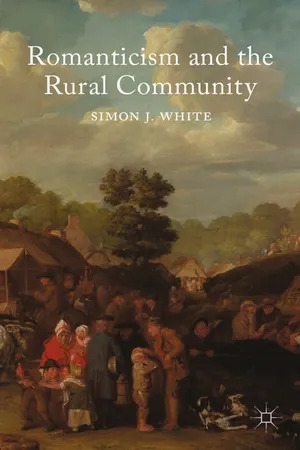
Romanticism and the Rural Community
About this book
The proper organisation of rural communities was central to political and social debates at the turn of the eighteenth century, and featured strongly in the 1790s political polemic that influenced so many Romantic poets and novelists. This book investigates the representation of the rural village and country town in a range of Romantic texts.
Information
1
The Cottager and 1790s Political Polemic
The interest in rural communities with which this book is concerned, began with the revolutionary controversy of the 1790s. Prominent contributors to the controversy from across the political spectrum agreed that rural communities were in crisis. This chapter will consider the ways in which four polemicists, writing from very different political positions, manifested their particular interest in rural community. John Thelwall in The Peripatetic (1793), Hannah More, Thomas Spence and Arthur Young were primarily interested in the living conditions of the semi-independent cottager, and in political, social and economic structures within small rural communities. This aspect of their work demands attention because of the acknowledged importance of 1790s polemic as background to the poetry and fiction of the Romantic period.1 The questions they pursued and the issues these raise provide a useful point of entry for understanding the central concerns of this book.
First, how and why did they think rural communities needed to be reformed? In different ways access to land was the core of the problem for all four writers. For example, Young remarks: ‘Go to an alehouse kitchen of an old enclosed country, and there you will see the origin of poverty and the poor rates. […] You offer no motives; you bring nothing but a parish officer and a workhouse! – Bring me another pot –.’2 Second, why did these writers see the solution to Britain’s political and social problems in a reformed countryside? The passage from Young is suggestive of his view – he believed that only a material interest in the land could attach people to their king and country (p. 32). Third, why did all of these writers view the position of the cottager as being so important? Thelwall describes cottagers as the ‘most important part of the [rural] community’.3 And finally, notwithstanding their different politics, are there similarities in the kind of rural communities that these writers envisaged for the future?
Thelwall undertook the walking tours on which The Peripatetic is based during the late 1780s. In this work he identified a set of new problems relating to the rural community that were to dictate the agenda for other writers during the 1790s. Thelwall was a founder member of the London Corresponding Society. In 1794 he was tried for high treason along with the other leading members of the society, Thomas Hardy and John Horne Took. All three were acquitted, but the government continued to view them as a threat. Eventually the continued harassment did get the better of him, and in 1798 he retreated from public life to live on Llyswen Farm, a smallholding near Brecon, in what is now Powys, itself an experiment connected with his notion of the cottager as representing some kind of ideal.4 But in The Peripatetic he is just as concerned with opening up debate about the future of Britain’s countryside. Thelwall was concerned about the quality of life of labouring people in both urban and rural areas, but believed that the countryside could help him to understand why it was not better. This chapter will show how the causes of the degraded quality of life of labouring people in the countryside are gradually revealed in The Peripatetic, before going on to look at the solutions offered by a conservative (More), an ultra-radical (Spence) and a pragmatist (Young).
John Thelwall and the disappearing cottager
The Peripatetic is structured around a series of excursions by the fictional narrator Sylvanus Theophrastus (who represents Thelwall) and his friends.5 As Judith Thompson explains in the introduction to her edition of The Peripatetic, it ‘interweaves the genres we think of as typically romantic – sentimental tales, gothic romances, pastoral lyrics, epic poetry – with marginal or non-literary genres like the tourist guide, medical literature, and the political lecture’ (p. 11). In so doing, according to Thompson, it ‘confounds literary definitions, challenges ideological assumptions, [and] confuses generic vocabularies’ (p. 11). But The Peripatetic is coherent in its persistent focus on the countryside. Theophrastus visits a number of larger towns – for example Rochester and St Albans – but most of the narrative is devoted to critiques of rural spaces and places, and encounters with rural types. As Thelwall later noted in a 1795 essay for The Tribune, he did not know much about the countryside before he made the walking tours that formed the basis for The Perapetitic:
Some years ago, before my mind had taken that strong bias in favour of political pursuits […] I took the opportunity of seeing, as far as I could, the condition of those orders of society, about whose happiness in the country I had heard so many romantic stories, while I was an inhabitant of the town, and took my ideas of rural felicity from novels and pastorals.6
Theophrastus and his friends turn from literary modes such as the sentimental tale or pastoral lyric to non-literary modes such as the tourist guide, political lecture or essay as they endeavour to make sense of the reality of rural life. The need to isolate both the material and the spiritual elements in the life of the countryside is the principal driver of Thelwall’s desire to counterpoint a range of figurative and descriptive kinds of expression in the text.
In his Tribune essay Thelwall suggests that the kind of extended tour of the countryside which is undertaken by Theophrastus and his friends engenders political awareness: ‘Enquiry will somehow or other be awakened; and, when it is awakened, the mists of delusion melt before the rising sun of truth, and the midnight hags of despotism bind us in their spells no more.’7 In other words, if observers can develop the ability to see through the idealised representation in novels and pastorals to the reality of rural life, then they will be able to penetrate other kinds of ideology. The problem with Thelwall’s attempt to impose such a reading on The Peripatetic is that Theophrastus and his friends do not experience a political awakening of this kind. In fact they repeatedly celebrate rural life, and often compare the condition of labouring people in the countryside favourably with that of their city- and town-based counterparts. The travellers do, however, experience a different sort of awakening, which Thelwall’s readers are encouraged to share, about the fragility of a particular way of life in the countryside.
One of the recurrent tropes in The Peripatetic is the pastoral idea of the country as an escape from the corruption of towns and cities. For example, in the section entitled ‘Excursion to Rochester’ the travellers stop at a rural hamlet where they are ‘saluted with the busy voices of playful infants […] in the full enjoyment of health, vivacity, and Liberty; free from all the dangers which, in towns and cities, render the unhappy being a slave, and a prisoner from his infancy, and a victim to cares, anxieties and sorrows’ (pp. 276–7). This is not as straightforward as it seems because it is not moral corruption that is traced to towns and cities, as is the case elsewhere in The Peripatetic, and as is usually the case in the pastoral mode. Rather it is the physical and practical difficulties associated with life in such places – the ‘cares, anxieties, and sorrows’ – that are identified as the problem. Joseph Massie’s statistics, collected in the middle of the eighteenth century, indicate that the incomes of labouring people were higher in towns and cities.8 But Theophrastus is right to point out that this does not necessarily mean their quality of life was better.9 They would have been less likely than their equivalents in the countryside to have other sources of income, and other means of sustaining their families. It is the greater independence, or potential for independence, of labouring people in the countryside that contributes most to the freedom that Theophrastus locates in the rural hamlet. By implication, this passage makes a connection between the quality of life of labouring people and that politically charged word ‘Liberty’. Of course the paternalist system, which still dominated rural life at the end of the eighteenth century, meant that labouring people were not quite as free as Theophrastus suggests.
For Thelwall this rural freedom and ‘Liberty’ was threatened because the contribution of the semi-independent cottager to rural communities, and to British society as a whole, had not been properly acknowledged. In a section of The Peripatetic entitled simply ‘The Cottages’ the narrator notices ‘three or four decent cottages which, though consisting of no more than two small cabins each, are nevertheless healthy, from their situation, and large enough for felicity, if Innocence and Good-humour dwell but under their roofs’ (p. 133).10 The reference to ‘Innocence’ and ‘Good-humour’ apparently aligns his remarks with the conservative evangelical campaign to morally reform rural communities epitomised by Hannah More in her Cheap Repository tracts (1795–98). The ‘Bermondsey pastoral’ embedded within the account of the cottagers also praises cottagers for their moral resilience. But it does so through a trope that, while it would never be used by More, was often employed by radical pamphleteers during the Romantic period:11
What needs the splendid couch of state?
Its silken hangings? beds of down?
Or piles of herald-sculptur’d plate
That oft the wasteful table crown?
On his hard palate stretch’d, at eve,
See labour’s opiate lull the swain!
Or see him pleas’d, at noon, receive
With grateful heart, his viands plain!
(ll. 5–12, p. 133)
The speaker suggests that the way of life of the people who inhabit such cottages is morally superior because it is less wasteful than that of the idle rich. When the prose narrative resumes, Theophrastus re-emphasises the point of view of the poem. He provides guidance for the reader whose jaded satirical eye, conditioned to equate ‘Grandeur’ and ‘Opulence’ with beauty and excellence, might be tempted to read these lines in bathetic terms: ‘he is neither fit for the sphere of Parnassus nor of the world, who cannot “parcel imperfections with his thoughts,” and give to every object something more of beauty or excellence than it intrinsically possesses in the eye of critical enquiry’ (p. 134–5).
The cottager’s way of life is not only morally superior, it also involves physical interaction with the land: ‘Here may the lark, and Philomela’s strain, / (Joy’s gayest note and sorrow’s sweetest flow!) / One rouse to labour still the lowly swain, / One soothe till slumber steeps his weary brow’ (ll. 45–8, p. 135). The London of the late eighteenth century contained more green space than it does today. But the city dweller did not interact with it in the same way as the countryman, particularly if the latter was able to keep a kitchen garden and grow some of his own food. The aristocracy and upper echelons of the gentry were also isolated from the working landscape by the size and grandeur of their dwellings, and the fact that these dwellings were often surrounded by untilled parkland. At the end of the eighteenth century parks were still popular, and were copied by the lesser gentry.12 The disconnection went further than just a lack of physical interaction with the land because the lives of the city dweller and of the rich in the countryside were not attuned to the rhythms of nature either. Thelwall’s cottagers were in harmony with nature. They begin and end their day’s labour in the company of the ‘lark’ and the nightingale.
Nature was a recurrent trope in 1790s political rhetoric, and both sides of the political spectrum were keen to naturalise the cottager within their political vision. Thelwall implies that the survival of the cottager might be of greater importance than reform itself. In the section entitled ‘Rewards of Useful Industry’, the narrator claims that ‘the system is alone to blame’, but his friend asks whether, should the franchise be extended, this ‘most important part of the [rural] community’ would be ‘neglected and despised?’ (p. 140). As John Barrell notes, Theophrastus responds with heavy irony, telling his companion to ‘suppress this freedom of speech, and remember THE ASSOCIATION [for the Preservation of Liberty and Property against Republicans and Levellers]!’ (p. 140).13 This is where the political vision of The Peripatetic begins to collapse.
In a sense the account of the protagonist’s excursions confirms Thelwall’s critique of the idealised representation of the countryside in his later Tribune essay. Thelwall wanted a political system that enabled labouring people to live decently. For Theophrastus and his friends, as for Thomas Paine in Agrarian Justice (1797), the life of the rural cottager constituted ‘decent’ living (p. 134), but they see the disappearance of cottagers and ‘decent’ cottager communities as unavoidable. They can only condemn ‘the fashion of late to cry out against these little habitations (especially when they presume to approach more stately buildings) as nuisances to the neighbourhoods in which they stand’ (p. 135), and warn the improving gentry to ‘learn humanity’ before they force labouring people to revolt (p. 136).14 As a result, the dominant tone of The Peripatetic, in its defence of the cottager, is anger, expressed in political lectures and essays, interspersed with pastoral lament in sentimental tales and poetry. Even when they do encounter a cottage, Theophrastus complains that ‘the poor inhabitant’ will soon be ‘driven from his cottage, from his little garden, and his bubbling spring, to seek perhaps, a miserable habitation within the smoky confines of some increasing town’ (p. 136). Ultimately there is a lack of political imagination in The Peripatetic. The protagonists cannot envisage a better life for labouring people in the countryside and this is the primary driver of the lamenting tone.
The cottager’s garden
Hannah More, a writer at the opposite end of the political spectrum to Thelwall, did believe that there was a future for the cottager and his garden. She also sensed the political potential of cottager communities to help preserve the political status quo. But whereas Thelwall implies that better living conditions for labouring people produced better morals, More claims that better morals produced better living conditions. Her writings suggest a possible pathway to the development of cottager communities through the moral reform of labouring people in the countryside. She set out to achieve this through the first large-scale pamphlet campaign to be undertaken in England, run from an organisation called the Cheap Repository.
The Cheap Repository tracts, distributed between 1795 and 1798 by the network of ‘sober, honest hawkers’ described in The Sunday School (1796), were at the centre of Hannah More’s evangelical campaign.15 Critics have argued that they constitute a response to Paine’s Rights of Man (1791) and Age of Reason (1795).16 More did write in her diary that she had been ‘conjured by the Bishop of London to answer Paine’s atheistical book [Age of Reason], with a solemnity which made me grieve to refuse’.17 But the way of life that many of the Cheap Repository tracts promote for labouring people has a lot in common with that advocated by Paine when he wrote about the countryside specifically in Agrarian Justice.18 This illustrates the way in which, by 1795, More’s aims had become more complex than simply countering the radical threat, which had been the driving purpose of Village Politics (1793). As several critics have observed, most recently Kevin Gilmartin, More’s campaigns to ‘reform residual elements of licentious popular culture, and to prevent the spread of emerging radical culture’ were interconnected.19 More’s vision was ambitious because she wanted to forge rural communities anew through a process of religious and secular evangelising. The ‘complicated – and sometimes contradictory’ politics that Christine Krueger finds in the tracts can be explained by the fact that, not only were radicals and conservatives fighting over the same territory, their ideas also often overlapped.20
The Cheap Repository tracts were distributed throughout both urban and r...
Table of contents
- Cover
- Title
- Copyright
- Contents
- List of Illustrations
- Acknowledgements
- Introduction
- 1 The Cottager and 1790s Political Polemic
- 2 Wordsworth and Community
- 3 The Gentry and Farming in Jane Austen’s Fiction
- 4 George Crabbe and the Architecture of the Parish
- 5 Agrarian Reform and Community in Burns, Bloomfield and Clare
- 6 Ebenezer Elliott, the Industrial Revolution and the Rural Village
- Epilogue
- Notes
- Select Bibliography
- Index
Trusted by 375,005 students
Access to over 1.5 million titles for a fair monthly price.
Study more efficiently using our study tools.
Frequently asked questions
Yes, you can cancel anytime from the Subscription tab in your account settings on the Perlego website. Your subscription will stay active until the end of your current billing period. Learn how to cancel your subscription
No, books cannot be downloaded as external files, such as PDFs, for use outside of Perlego. However, you can download books within the Perlego app for offline reading on mobile or tablet. Learn how to download books offline
Perlego offers two plans: Essential and Complete
- Essential is ideal for learners and professionals who enjoy exploring a wide range of subjects. Access the Essential Library with 800,000+ trusted titles and best-sellers across business, personal growth, and the humanities. Includes unlimited reading time and Standard Read Aloud voice.
- Complete: Perfect for advanced learners and researchers needing full, unrestricted access. Unlock 1.5M+ books across hundreds of subjects, including academic and specialized titles. The Complete Plan also includes advanced features like Premium Read Aloud and Research Assistant.
We are an online textbook subscription service, where you can get access to an entire online library for less than the price of a single book per month. With over 1.5 million books across 990+ topics, we’ve got you covered! Learn about our mission
Look out for the read-aloud symbol on your next book to see if you can listen to it. The read-aloud tool reads text aloud for you, highlighting the text as it is being read. You can pause it, speed it up and slow it down. Learn more about Read Aloud
Yes! You can use the Perlego app on both iOS and Android devices to read anytime, anywhere — even offline. Perfect for commutes or when you’re on the go.
Please note we cannot support devices running on iOS 13 and Android 7 or earlier. Learn more about using the app
Please note we cannot support devices running on iOS 13 and Android 7 or earlier. Learn more about using the app
Yes, you can access Romanticism and the Rural Community by S. White in PDF and/or ePUB format, as well as other popular books in Literature & Literature General. We have over 1.5 million books available in our catalogue for you to explore.